Ekaterina Coquillon Anganova
You grew up between Kazakhstan, Ivory Coast, France, Finland, Spain, China, and Colombia. How has moving between such different cultures shaped the way you understand identity and belonging?
For me, questions about identity and belonging have always been the most difficult to answer. Growing up between Kazakhstan, Ivory Coast, France, Finland, Spain, and China, exposed me to very different cultural environments, all of which have profoundly shaped who I am. I do not feel that I fully belong to a single place, and perhaps I never will. Instead, I see myself as a living mosaic, shaped by many cultures, experiences, and ways of seeing the world.
What allowed me to embrace this diversity without feeling disconnected was the strong sense of heritage I inherited from my family. I was fortunate to grow up within a cultural tradition that places great importance on ancestry, memory, and connection to one’s roots. I come from a Cossack lineage, and in our tradition it is important to know and honor our ancestors for at least seven generations. Growing up with this awareness gave me a deep sense of belonging and continuity. Knowing where I come from created an inner stability that allowed me to remain open to other cultures without losing myself.
Over time, I came to understand identity not as something fixed, but as something layered and evolving. My roots give me a foundation, while my experiences across different countries continue to expand my perspective. This understanding is also reflected in my artistic practice, where I often bring together visual languages, traditions, and symbols from different cultures to create dialogues rather than boundaries.
China became an especially important part of your artistic development. What initially attracted you to traditional Gongbi painting, and what continues to fascinate you about this technique?
I have always been a perfectionist by nature, and I tend to be drawn to details. In painting, I often feel that the more detail there is, the more rewarding the experience becomes. Gongbi immediately resonated with that aspect of my personality. It is a technique that demands extraordinary patience, precision, and discipline, qualities that I value deeply both as an artist and as a person.
What fascinates me even more than the technical aspect, however, is the cultural legacy that Gongbi embodies. Traditional Chinese painting is not simply a method of image-making; it represents thousands of years of accumulated artistic knowledge, philosophy, symbolism, and cultural development.
One of the most remarkable aspects of Chinese painting is the sense of responsibility that comes with it. There are established principles and conventions that have been carefully preserved over centuries. Learning them requires humility and respect. At the same time, those boundaries create an interesting challenge for contemporary artists. Innovation cannot come from rejecting tradition, but from understanding it deeply enough to contribute something meaningful to its ongoing evolution.
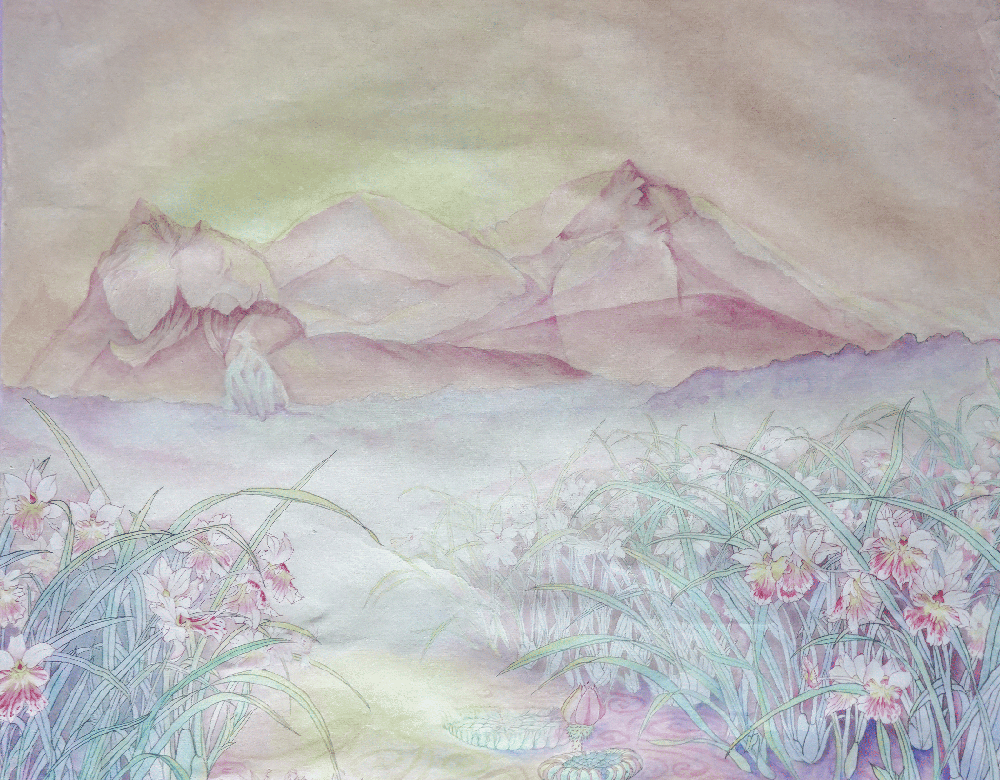
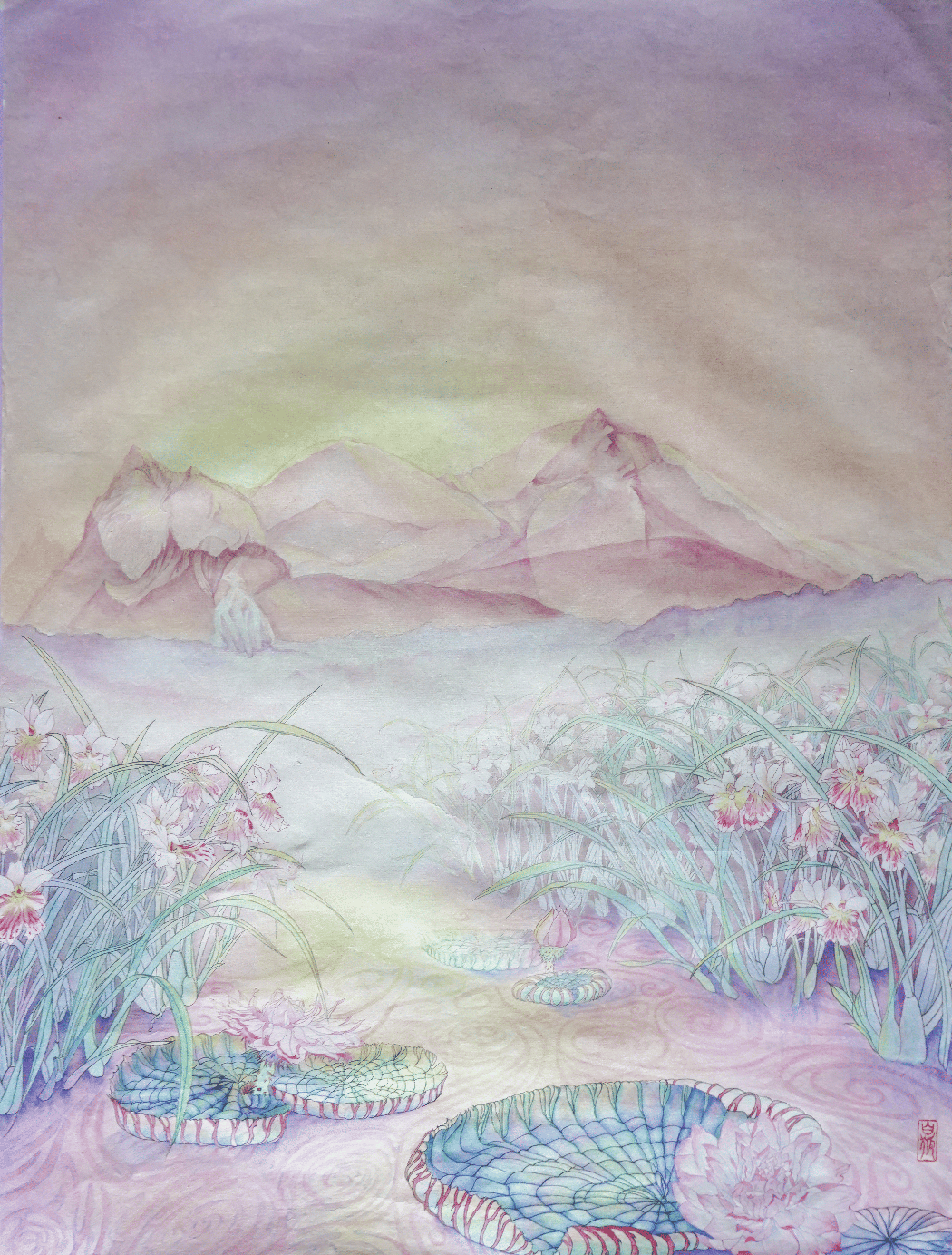 Ekaterina Coquillon Anganova | La Madremonte | 2025
Gongbi painting requires precision, patience, and a deep respect for tradition. How do you balance its established principles with your desire to develop a personal and contemporary artistic language?
To be honest, I am still learning how to balance it. Learning Gongbi required me to rethink my relationship with art from the ground up and let go of many assumptions shaped by my European upbringing. Immersing myself in traditional Chinese painting fundamentally changed the way I understand both art and the world.
The second challenge began when I left China. Suddenly, I had to find a way to remain faithful to a tradition I deeply respect while communicating with audiences who may not be familiar with its history, philosophy, or visual language.
For me, that balance comes from creating a respectful dialogue between the foundations of Gongbi and Chinese philosophy, European philosophy and artistic elements, and the many cultural influences I have encountered throughout my life. I approach Gongbi with great respect because it is part of a cultural legacy that has been preserved and refined over centuries. At the same time, I allow my personal language to emerge through the stories, symbols, and questions I choose to explore.
And from a personal standpoint, no matter how my practice evolves or what medium I choose to work with, I never lose the essence of who I am as an artist. My work remains deeply rooted in softness, femininity, imagination, and an attention to detail that has always been part of my personality.
Whether I am working through Gongbi or exploring other artistic approaches, those qualities continue to guide me. There is often a subtle sense of wonder or magical realism present in my work, alongside a fascination with intricate details, symbolism, and storytelling. The language may evolve, but the core remains the same.
Freedom Protects Them with Its Wings emerged after you returned to Kazakhstan as an adult. What did you discover about your homeland that you had not been able to understand as a child?
As a child, I often longed for a stronger connection to my roots. Growing up far from Kazakhstan, I sometimes struggled to understand why my mother had chosen to leave her homeland. I felt a deep curiosity about the place where I was born and a desire to belong to it more fully.
When I returned as an adult, I rediscovered not only the beauty of its culture and traditions, but also some of the realities that had shaped my mother’s life as a woman. As I began to understand her experiences more deeply, I also became more aware of the experiences of other women around me. Through conversations and observations, I encountered stories that were often kept private due to social expectations or fear of judgment. This helped me understand that every culture, no matter how beautiful and meaningful, also carries its own struggles and contradictions.
For the first time, I understood that leaving had not been a rejection of her roots, but an act of courage and protection.
That realization became the foundation of Freedom Protects Them with Its Wings. The work was born from the complexity of loving one’s homeland while recognizing its contradictions, and about the sacrifices women sometimes make to create greater freedom for the generations that follow. It is about love for one’s roots, but also about the freedom to grow beyond the limitations that any culture can sometimes impose.
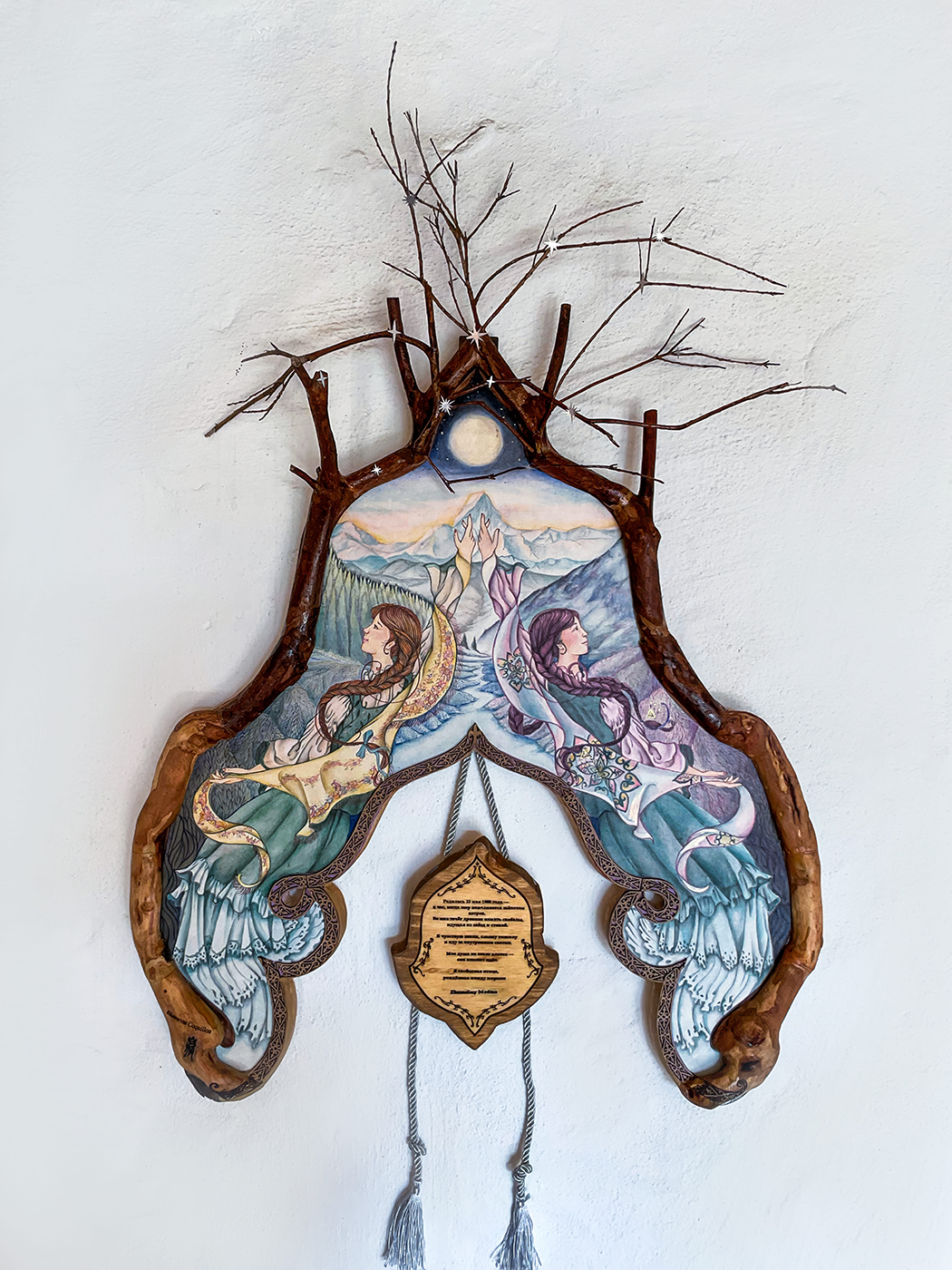 Ekaterina Coquillon Anganova | Freedom Protects Them With Its Wings | 2026
In this work, you combine Chinese painting techniques with Kazakh ornaments, poetry, wood, and an almost sculptural composition. How did you develop this unusual combination of materials and cultural traditions?
The combination of materials and cultural references developed quite organically from my experience of returning to Kazakhstan.
I was deeply moved by the vastness of the steppes and by the relationship between people and nature that has shaped life there for centuries. I wanted that sense of freedom, resilience, and connection to the land to be reflected not only in the imagery, but also in the physical structure of the piece, which led me to incorporate wood and a more sculptural composition,to create something that felt grounded, almost as if it had grown from the land itself.
A key inspiration was my friend, the Kazakh poet Medina Zhumabay. Through her poetry and our conversations, she shared stories about her ancestors, the culture of the steppes, and her experiences as a woman. We connected immediately on a human level, despite coming from different backgrounds.
She also introduced me to the symbolism embedded within Kazakh traditions. Symbols have always been important in my own cultural background as well, so I felt a deep respect and affinity for their role.I wanted to incorporate them thoughtfully so that they could extend those qualities not only to the women represented in the painting, but also to the women who encounter the work.
For instance, The Kus Kanat, or “bird’s wing” motif, became especially significant because it embodies freedom, movement, and protection, themes that are central to the painting. The Koshkar- Muiz, the ram’s horn motif, symbolizes strength, endurance, and connection to the land. Both symbols resonated deeply with Medina’s story and my own. In that sense, the work became a meeting place where different cultural traditions, personal histories, and shared values could coexist and support one another.
The two women in Freedom Protects Them with Its Wings represent different cultural backgrounds but are connected by the same land. What does their relationship express about female solidarity, shared memory, and cultural continuity?
Their relationship reflects a realization that emerged through my friendship with Medina and through reflecting on my own family history: across cultures, women are often the primary guardians and transmitters of memory.
In both our lives, it was our mothers and grandmothers who kept us connected to our roots. My great grandmother passed down stories, songs, and traditions that had survived generations of migration and historical upheaval. Medina shared similar memories of learning about her ancestors and cultural heritage through the women in her family. Although our backgrounds were different, we recognized the same thread connecting them.
This is what shared memory means to me. Culture is not preserved only through official history, but through everyday acts of care, storytelling, teaching, and remembering. Very often, it is women who carry that responsibility.
The work is also a reflection on female resilience, most of the time it begins with a lack of freedom. Throughout history, many women have lived under social pressures, restrictions, or difficult circumstances, yet they continued to nurture families, protect cultural knowledge, and create a sense of belonging for future generations. To me, there is immense strength in that quiet perseverance.
Ultimately, the relationship between the two figures expresses the idea that, beyond cultural differences, women often share similar hopes, struggles, and responsibilities. They carry memory, preserve culture, and help future generations remain connected to their roots. Above all, they embody a universal desire for freedom, dignity, and the ability to shape their own future while remaining connected to those who came before them.
The abundant orchids and Amazonian water lilies in La Madremonte create an imagined vision of nature flourishing without threat. How do beauty, ecological concern, and hope interact within this work?
In La Madremonte, beauty, ecological concern, and hope are inseparable. I wanted to raise awareness about the importance of protecting nature, but not through fear or shock. Instead, I chose to approach the subject through beauty.
Although the orchids and Amazonian water lilies may appear idealized, the plants themselves are real. The biodiversity they represent exists today, and that is precisely why it deserves our protection. For me, hope begins with recognizing that these ecosystems are still alive and that there is still something left to preserve.
Personally, I have always felt that images of destruction can be powerful, but their effect is often temporary. They shock us, move us, and make us aware of a problem, but over time people can become overwhelmed or emotionally exhausted. Beauty works differently. When we encounter something beautiful, we develop a desire to protect it. We want it to continue existing. We imagine a future in which it remains part of our lives.
That is why hope is so important in this work. I did not want to create an image of loss, but an image of possibility. Art can inspire preservation through wonder, and rather than focusing on what we have already lost, I wanted to remind viewers of what still exists and what we still have the power to protect.