
Sanah Ansari
Year of birth: 2001
Where do you live: Pakistan
Your education: Bachelor’s degree in Arts, Film and Television
Describe your art in three words: Intimate – Layered – Vulnerable
Your discipline: Contemporary Mixed-Media Practice (Marble, Acrylics, Handmade Paper, Fabric, Image Transfer)
Instagram
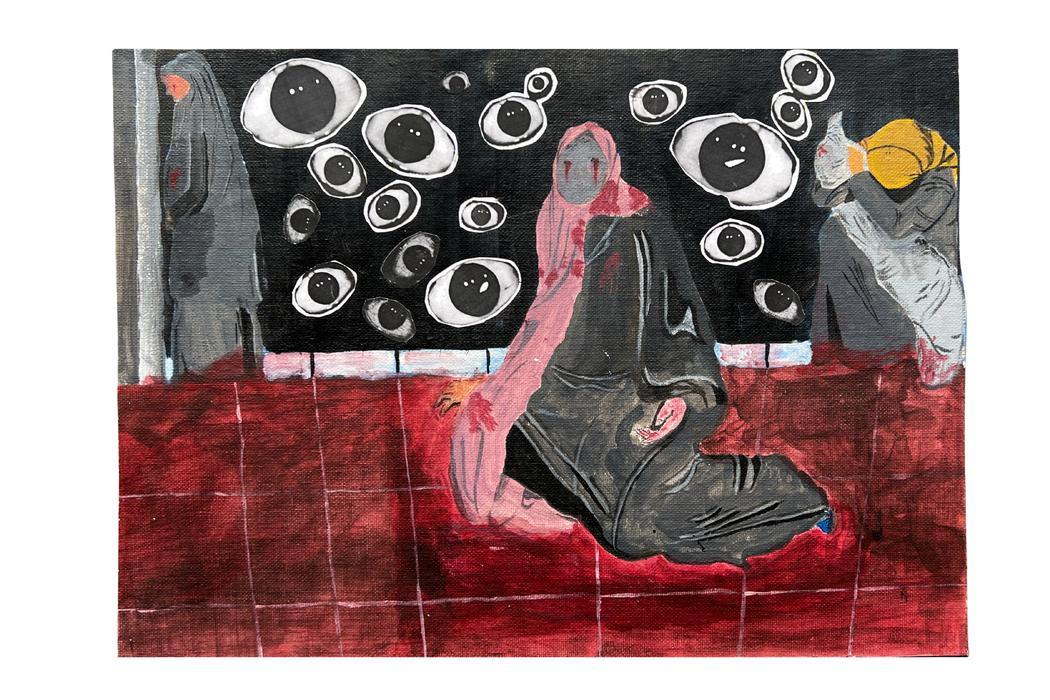 Sanah Ansari | Still watching | 2024
Your work is deeply rooted in personal memory and loss. How do you navigate the boundary between private grief and public expression in your art?
I don’t think I approach grief with a clear boundary in mind. When I’m working, I’m not trying to control how much I reveal, I’m trying to be honest. For me, the work only begins to feel real when I stop editing my emotions into something more acceptable and allow them to exist as they are: unresolved, uncomfortable, and sometimes contradictory.
At the same time, I’m careful about how that honesty is directed. I’m not interested in turning people in my life into villains. Even when I’m working through anger, like in the pieces that engage with my relationship with my mother, it’s less about accusation and more about what that experience has done to me.
In “What Remains, Still attached” it depicts how fragile I believe relationships become, if you face constant anger and disappointment, from a figure you expect more kindness. There’s a kind of inheritance in emotion. The anger I received, I carry. It shaped the way I understand love, to the point where I began to question whether love could ever exist without conditions. That realization took me a long time to confront, and even longer to translate into something visual.
Material becomes a way for me to hold that complexity without reducing it. Paper, for instance, carries fragility, it can tear, crease, collapse. Thread can suggest repair, but also how weak or temporary that repair might be. These choices aren’t decorative; they are emotional decisions. In this piece, I return to images of myself as a child, wearing red, full of hope, and later that red is only reduced to a thin thread, like a fragile hope, that contrast matters to me. It’s not nostalgia, it’s evidence of change. I have used onion and coriander skin within the paper to depict where I have seen my mother the most, always in the kitchen… away.. Surrounded by anything, but me.
With my aunt, the approach was entirely different. I lost her to cancer, but I refused to represent her through illness. I didn’t want her to be remembered in decline. I wanted to hold on to her as she was, vibrant, whole. Even there, the grief is present, but it lives in the material, in the physicality of the work, in the way something feels rather than what it explicitly shows.
Across my practice, I sometimes distort the female figure. That distortion isn’t about the body itself, but about what grief does internally, how it alters perception, identity, presence. It’s a way of making something invisible take form without needing to explain it.
So I wouldn’t say I hold myself back. I think I just choose to speak through form, material, and image rather than direct exposure. For me, that is the rawness. Because if I start filtering that too, if I start deciding what is “appropriate” to feel or show, then the work loses its purpose.
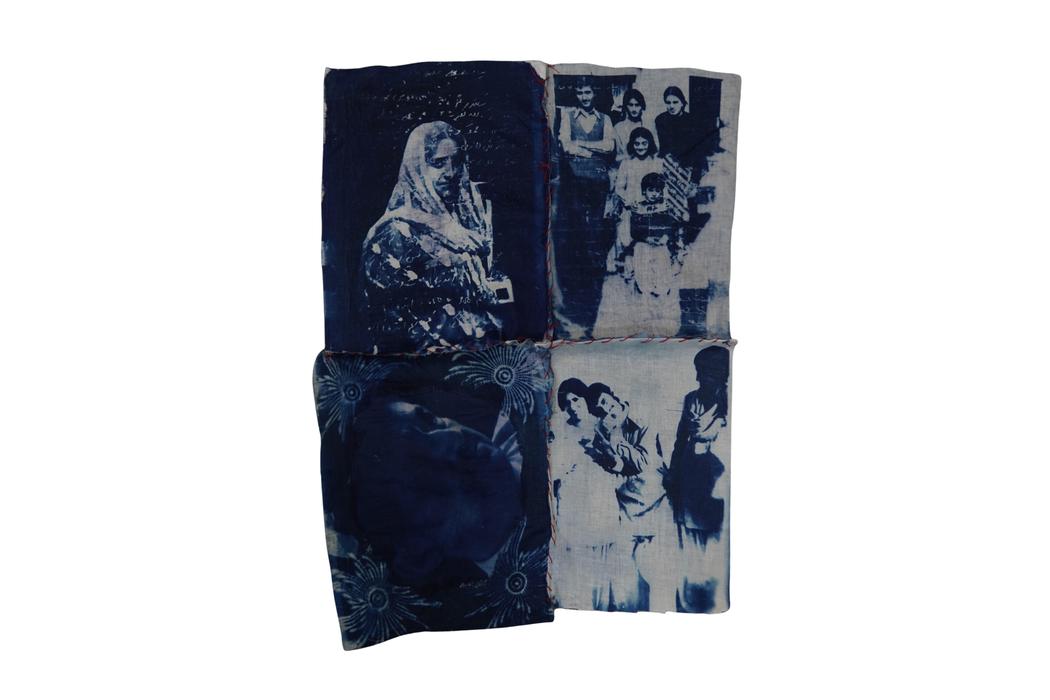 Sanah Ansari | What the Flood Did Not Take | 2025
In “She Remains in Stone”, you use marble as a central material. What drew you to its physical and symbolic qualities?
Marble came to me at a time when the feeling of her being “away” was almost too heavy to carry. I still don’t like to place her and the idea of death in the same sentence, it feels wrong. In my mind, she hasn’t disappeared, she has just stepped somewhere I can’t reach yet. I keep her close in small, quiet ways, a Polaroid of her tucked into my phone case, her voice notes that I return to, so choosing marble was my way of holding on to that closeness in a more permanent form.
There’s something about marble that feels both eternal and distant. It has this weight, this stillness, like it refuses to move or change, and that drew me in. I kept thinking about how, in Mughal traditions, stone was used to preserve memory, to carve names, moments, love into something that could out last time. I wanted that for her. I wanted her presence to feel engraved, not just remembered in passing but held, fixed, and honored.
But I didn’t want it to feel perfect or untouched. Memory isn’t like that. It fades at the edges, it distorts, it softens certain details while holding on tightly to others. So even within the marble, there’s a sense of roughness, of something slightly worn. It reflects how I remember her, not as a frozen image, but as something alive that shifts every time I revisit it.
The images I chose come from around her wedding days, when she was radiant, dressed in a beautiful saree, because that is how I want her to be seen. Not in illness, not in suffering, but in her fullness. My maternal side being from Bangladesh, those visual details carry so much cultural and emotional weight for me. They feel true
At the same time, I brought in softer materials, fabric, texture, because marble alone couldn’t hold everything I felt. I needed warmth in the work. The fabric reminds me of hiding under her dupatta, of that closeness, that comfort you don’t question as a child. It’s something you feel before you even understand it. I wanted people to feel that too, not just see it.
And then there are the color pencils, where I let my inner child take over. It feels less like drawing and more like trying to bring her back, gently, detail by detail. The way a child fills in color without hesitation, without overthinking, just wanting something to feel alive again. That part of me still misses her in the most instinctive ways, her touch, her scent, the quiet comfort of being near her. So I find myself returning to the small things she loved, like her jewellery, carefully bringing those details forward. It’s not about perfection, it’s about closeness, about holding on, even if only through color.
The piece is deeply personal, but I also think grief like this doesn’t belong to one person alone. Anyone who has watched someone they love fade, especially through something like cancer, understands that mix of tenderness and helplessness. So while the work begins with her, my beautiful Benu Khala, it opens itself to others who might recognize their own memories within it.
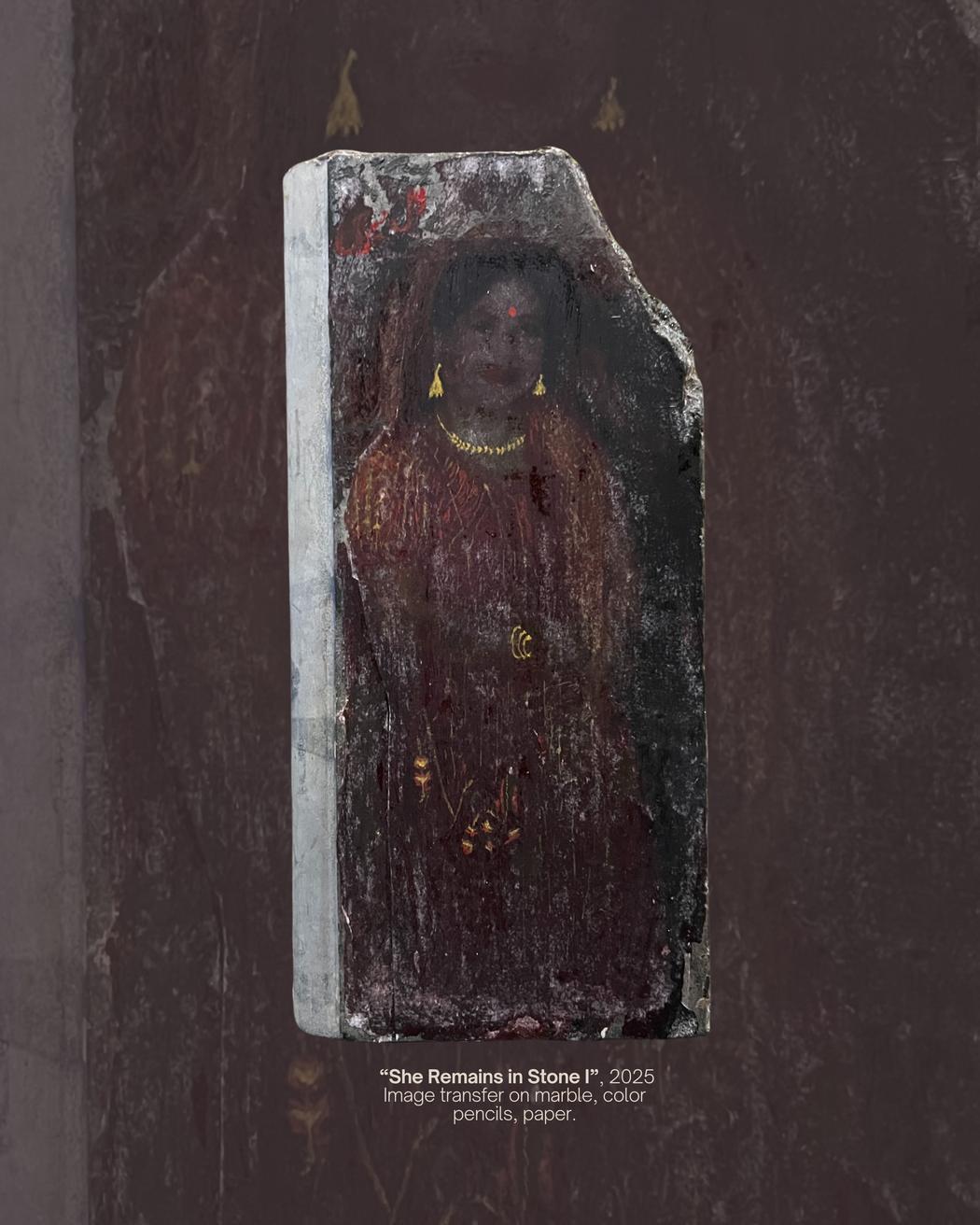 Sanah Ansari | SHE REMAINS IN STONE | 2025
The contrast between cold stone and warm memory is very present in this series. How do you approach this tension in your process?
For me, that tension isn’t something I try to resolve, it’s something I want to hold in place. The coldness of the stone and the warmth of memory exist together, just like grief does. You can feel completely numb and deeply emotional at the same time, and I think marble allowed me to sit inside that contradiction.
When I work with stone, it brings a kind of distance. It’s heavy, still, almost unresponsive. But the memories I’m working from are the opposite, they’re soft, intimate, sensory. So I intentionally bring in materials and gestures that interrupt that coldness. The fabric, the color, the hand-drawn elements, they all carry warmth, touch, and closeness. It becomes less about balancing the two and more about letting them coexist without one overpowering the other.
I think of it almost as a conversation between what is gone and what still lingers. The stone holds her in a permanent, unmoving way, but the warmer elements keep her alive, shifting, and felt. That tension is where the work breathes, it’s where memory resists becoming something fixed or distant.
In a way, I don’t approach it as a technical decision as much as an emotional necessity. Because if the work was only cold, it would feel too final. And if it was only warm, it wouldn’t hold the weight of absence. I need both to be present for it to feel true.
Your use of image transfer creates a sense of fragility and fading. How important is imperfection in conveying memory in your work?
Imperfection is essential to how I think about memory. I don’t see fading, distortion, or loss of detail as flaws, they’re actually closer to how memory behaves. When I use image transfer, I know from the start that I won’t get a perfect image, and that uncertainty is important. Parts might not come through, edges might break, surfaces might feel incomplete, and I let that happen.
In She Remains in Stone, that process became even more intense. Because I was working on a darker surface, I had to transfer the same image four to five times just to make it visible. Each layer took time to settle, to properly adhere, and there was always a risk that it still wouldn’t come through the way I expected. It was slow, repetitive, and at times frustrating, but also very honest. The image never arrived all at once; it had to be built gradually, almost like memory itself.
For me, a clean, sharp image would feel dishonest. Memory is never that precise. It shifts, it erodes, it holds on to certain details while letting others disappear. The fragility in the transfer process mirrors that.
I also think imperfection carries emotion in a way perfection doesn’t. When something is slightly faded or disrupted, you become more aware of what’s missing, and that absence becomes part of the experience. It asks you to feel rather than just look.
So I don’t try to control or correct those imperfections. Some of them are intentional, and some of them simply happen through the process, but together, they feel true to how memory exists for me: layered, fragile, and never fully complete.
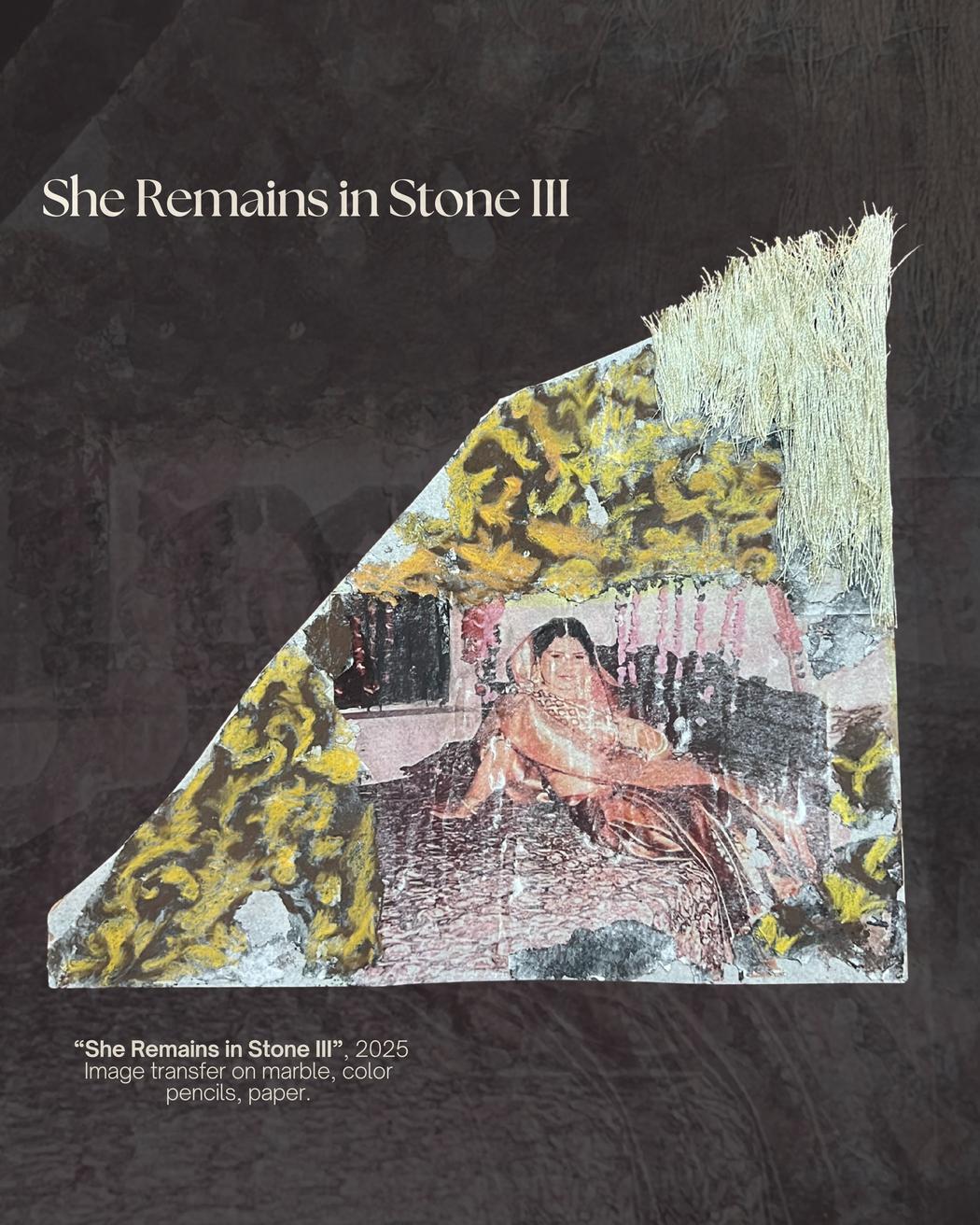 Sanah Ansari | SHE REMAINS IN STONE | 2025
You mention your khala as a central figure in this series. How did working on these pieces affect your relationship with her memory?
Working on these pieces came from a place where her absence felt almost too heavy to carry. Making them didn’t take that weight away, but it softened it. It gave me somewhere to place it.
In the process, I found myself spending time with her in a different way. I wasn’t just remembering her, I was studying her. The way she wore her sarees, her choice of fabric, the care she put into dressing up. Even her makeup, so subtle, but so precise. I kept returning to her lips, how softly beautiful they looked. She paid attention to these details, and through the work, I began to understand that more deeply.
I think that’s what changed. My memory of her became more attentive, more deliberate. It moved from something I held instinctively to something I could sit with, look at, and build from.
I don’t feel the need to let her go. I never will. And I don’t see that as something unhealthy. I accept that she is away, and I believe she is in a better place, but she is still very much with me. I carry her, and I always will.
More than anything, the work made me realize that remembering her is also a responsibility. I want to keep telling people about her, how she was, how she carried herself, how beautiful she was in the smallest, quietest ways. I want her to be remembered like that. Not through loss, but through everything that made her who she was.
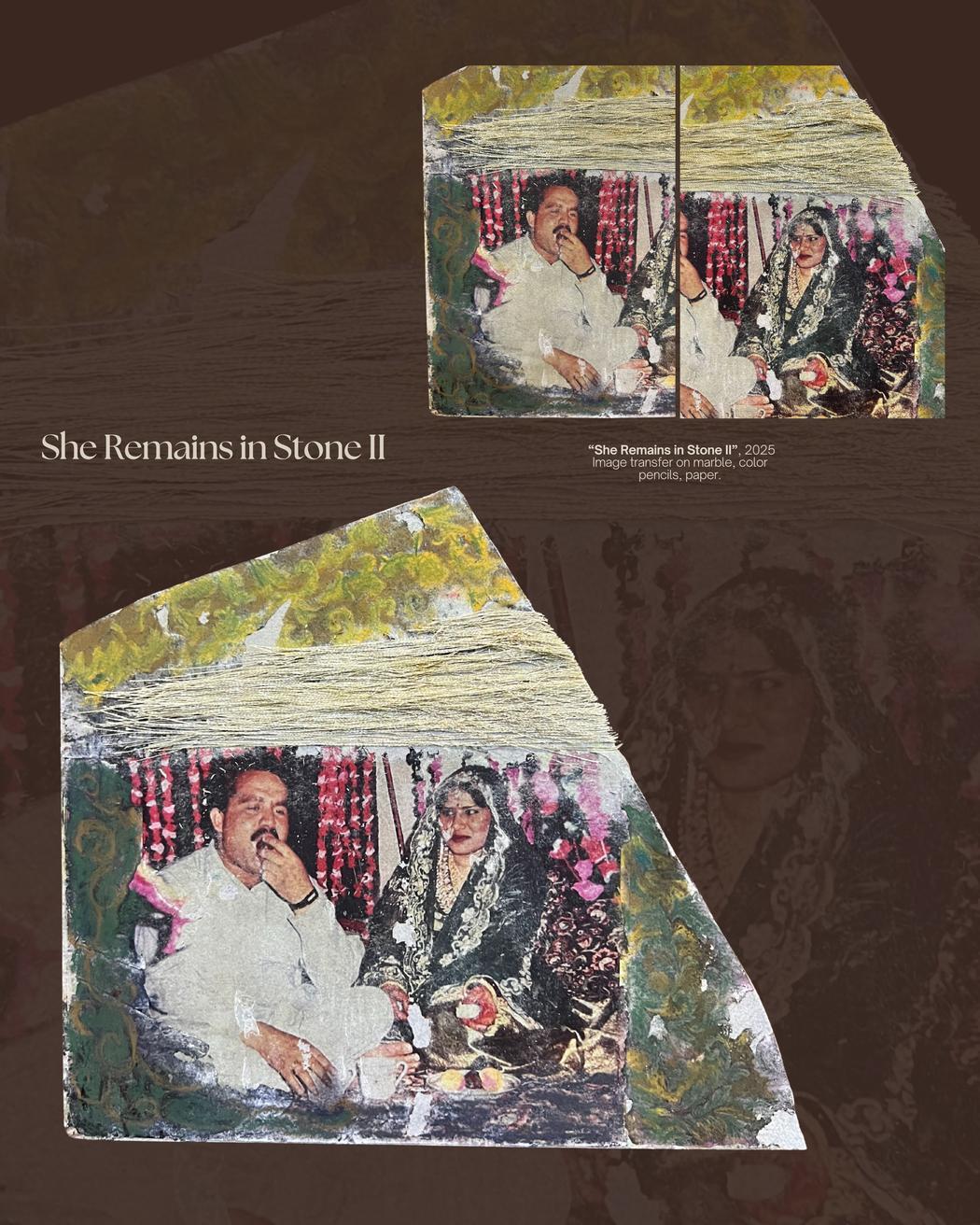 Sanah Ansari | SHE REMAINS IN STONE | 2025
How does working across different materials – stone, paper, fabric – help you express ideas that one medium alone cannot?
I don’t really begin with a fixed idea of which material I should use, it’s much more instinctive than that. I’m drawn to whatever feels like it can carry what I’m trying to say, not just visually but emotionally and physically.
Each material gives me something different. Marble, for me, holds a kind of distance, it’s cold, heavy, still. But the moment I place fabric against it, something soft, flowing, sometimes even luminous, it shifts completely. It brings warmth into the work, a sense of familiarity and presence. It reminds me of clothing, of touch, of care. It also feels deeply connected to where I come from, those textures carry a cultural memory for me that naturally sits alongside the personal one.
Then there are moments where I bring in something like color pencils. Against marble, they almost feel out of place, but in a necessary way. They add life to something that can otherwise feel very still and dark. It’s almost like insisting that something is still alive within it, that memory hasn’t completely settled into silence.
I think one material alone would flatten that experience. But when they come together, they allow me to hold different feelings at once, warmth and distance, comfort and absence, softness and permanence. That complexity feels honest to me.
And I think this is also why I’m drawn to contemporary art. It gives me the freedom to move beyond traditional ways of working. I’m very receptive to my memories and to my own vulnerabilities, and I need that openness to translate them into something real. Without working across different materials, I don’t think I would be able to express things as fully or as truthfully. It allows me to be intuitive, to be emotional, and to be as creative as I need to be.
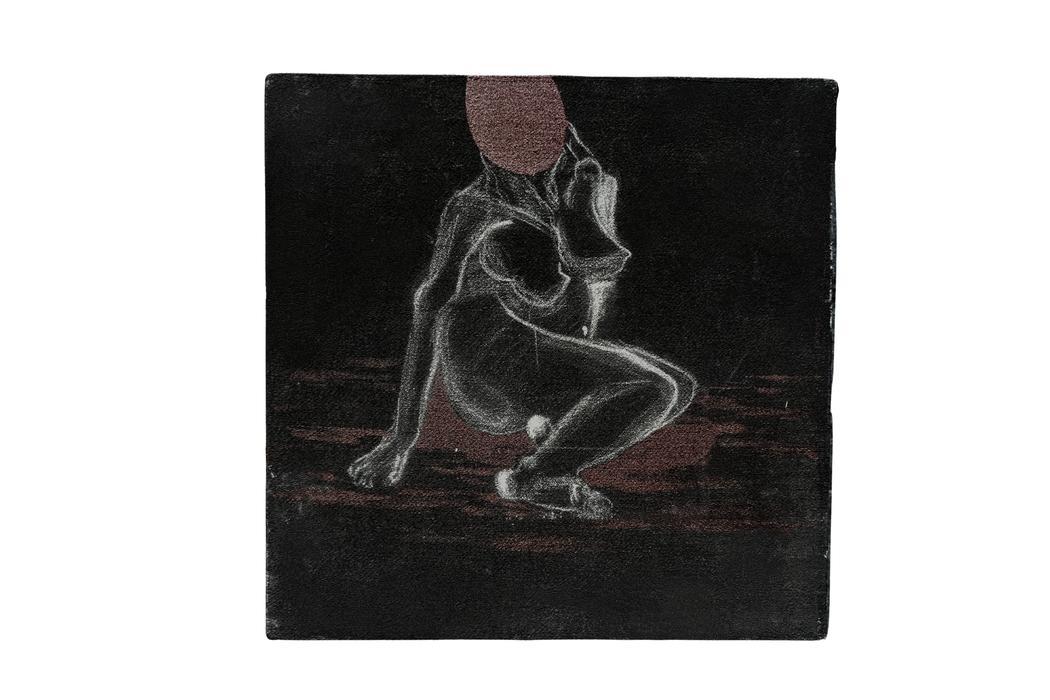 Sanah Ansari | Erased bt red | 2024
What do you hope viewers feel or confront when they encounter your work?
I don’t expect one fixed reaction from viewers, but I do hope they feel something before they try to understand it. Even if they can’t name it right away, that heaviness, that quiet discomfort, that sense of something sitting on the chest, I want the work to stay with them in that way.
A lot of what I make comes from experiences that are difficult to process even as I’m living through them. The feeling of losing someone, or the shock of realizing how quickly life can shift, how, in a single night, something as stable as home can become uncertain. That kind of helplessness, of being forced to leave behind what you thought was safe, stays in the body. And I don’t think we’re really taught how to deal with that. I’m still learning how to sit with it myself.
At the same time, I’m also responding to what I’ve grown up seeing around me, stories of violence against women, of lives reduced to headlines, and the way we’ve all become exposed to constant images of suffering. Seeing what is happening in Gaza, witnessing a genocide unfold in real time, and yet also seeing how quickly people become desensitized to it, it’s deeply unsettling. There’s this tension between feeling everything so intensely and also recognizing how easily these realities can be scrolled past, normalized, or forgotten.
But I don’t want to translate that pain into something graphic or overt. I’m more interested in what lingers beneath the surface, in how grief, fear, and memory reshape us quietly. That’s why the work holds back in certain ways. It asks you to come closer, to feel rather than just witness.
At the same time, I care deeply about how and where I come from is seen. There’s a tendency, especially in Western narratives, to reduce places like Pakistan to a single story, often one of extremity or violence. But that has never been the full truth. What I know, what I’ve experienced, is a culture that is deeply emotional, sensitive, layered, and full of care. And I think it’s important for me to hold that alongside the harder realities, to show that both exist, but neither defines us entirely.
So if there’s anything I hope viewers confront, it’s not just pain, but their relationship to it. How they see it, how they respond to it, and how quickly they might look away. And maybe, through that, also begin to see a place, people, and a set of experiences with a little more depth, and a little more empathy.
Leave a Reply
You must be logged in to post a comment.