
Alla V. Kolpakova
Your work combines crochet techniques with mathematical principles. How did this intersection between craft and mathematics develop in your practice?
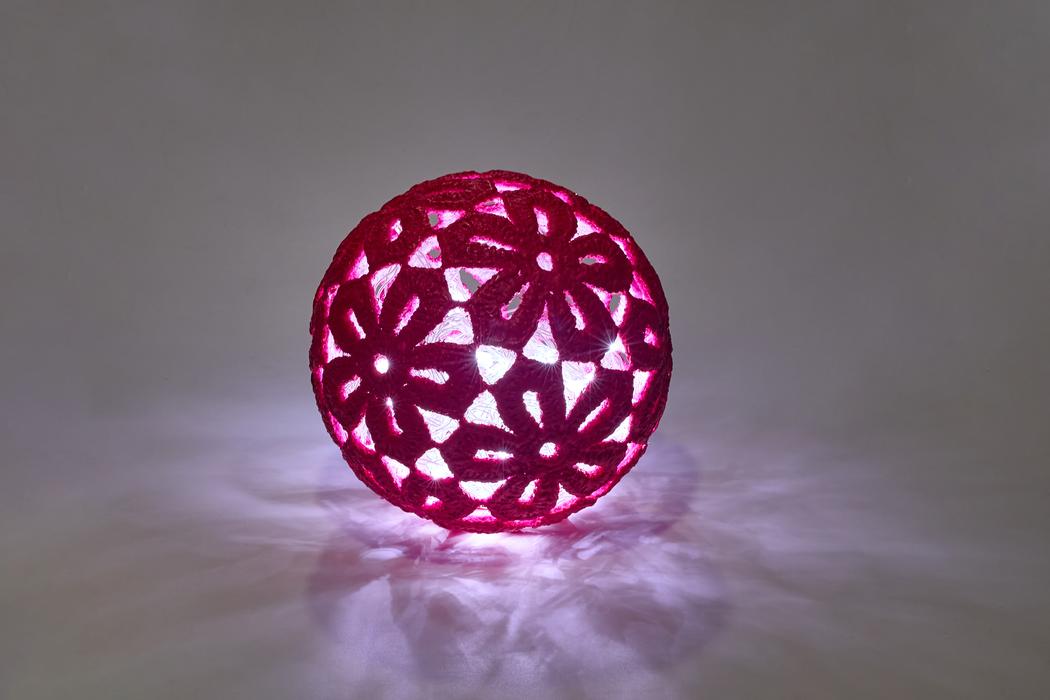
Crocheting has been my passion since childhood. What attracted me to this technique is that it allows you to create absolutely any idea that comes to mind, whether it’s a flat pattern for clothing or a three-dimensional flower for decoration. Crochet itself requires mathematical calculation. It’s comparable to a person’s handwriting—the result depends on how tightly or loosely you crochet, whether your stitches are higher or lower. Even a simple circular pattern needs to be adjusted and tailored to your own hand because for one person the result may form a cone, while for another the edge may ripple. And if the pattern is more complex, adding or subtracting a few stitches may not be enough.
You mention three approaches in your work – problem solving, shifting perspective, and combining ideas. How do these methods interact when you create a new piece?
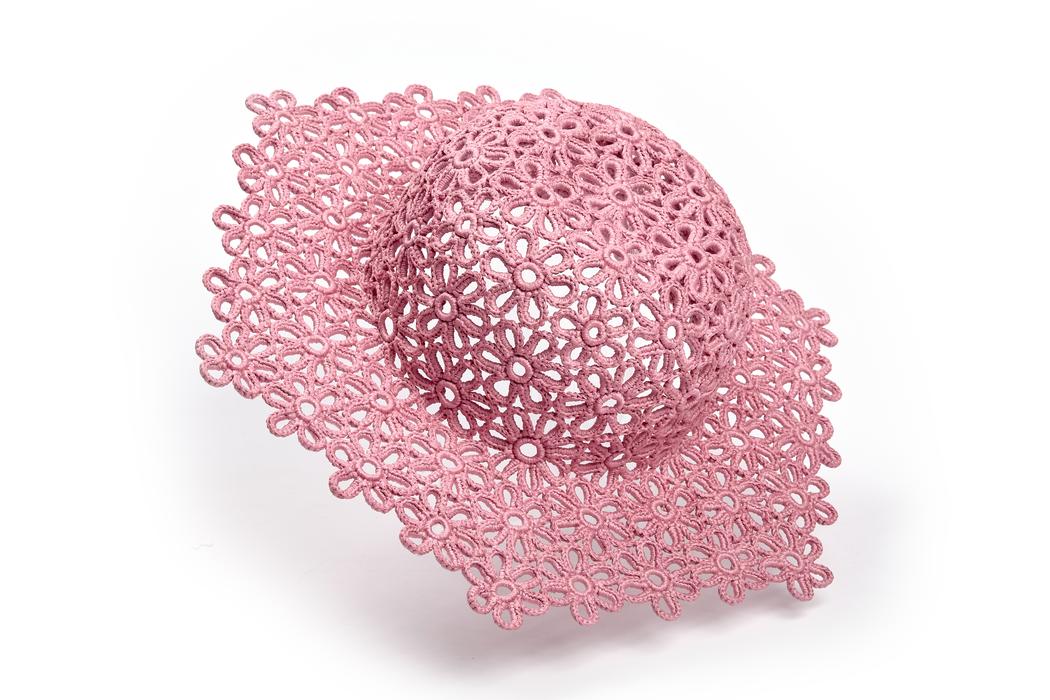
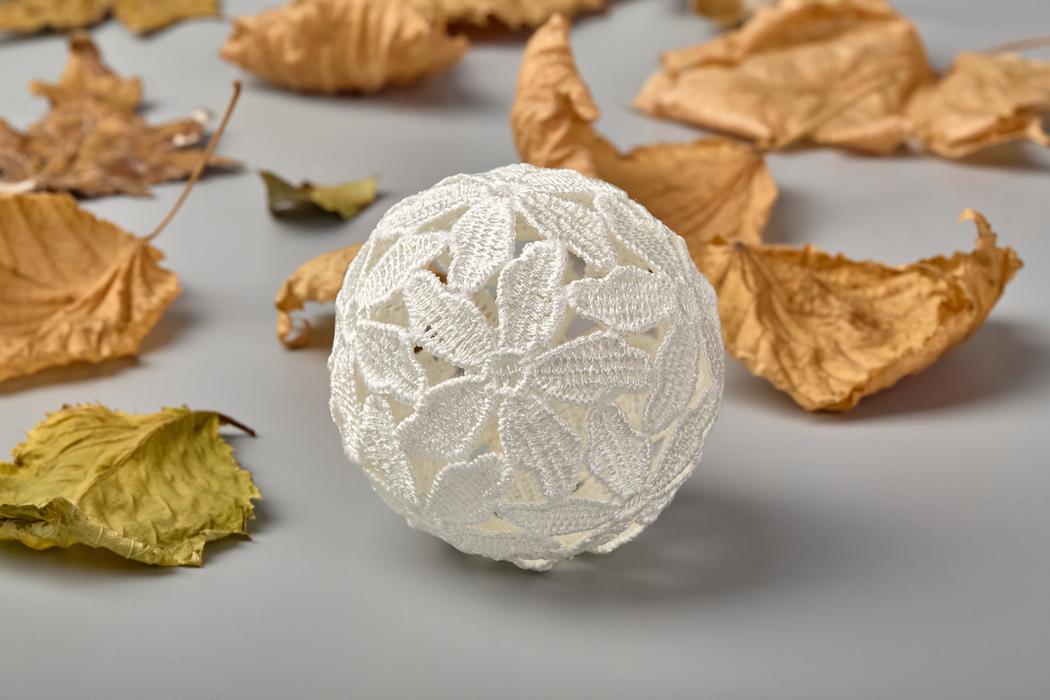
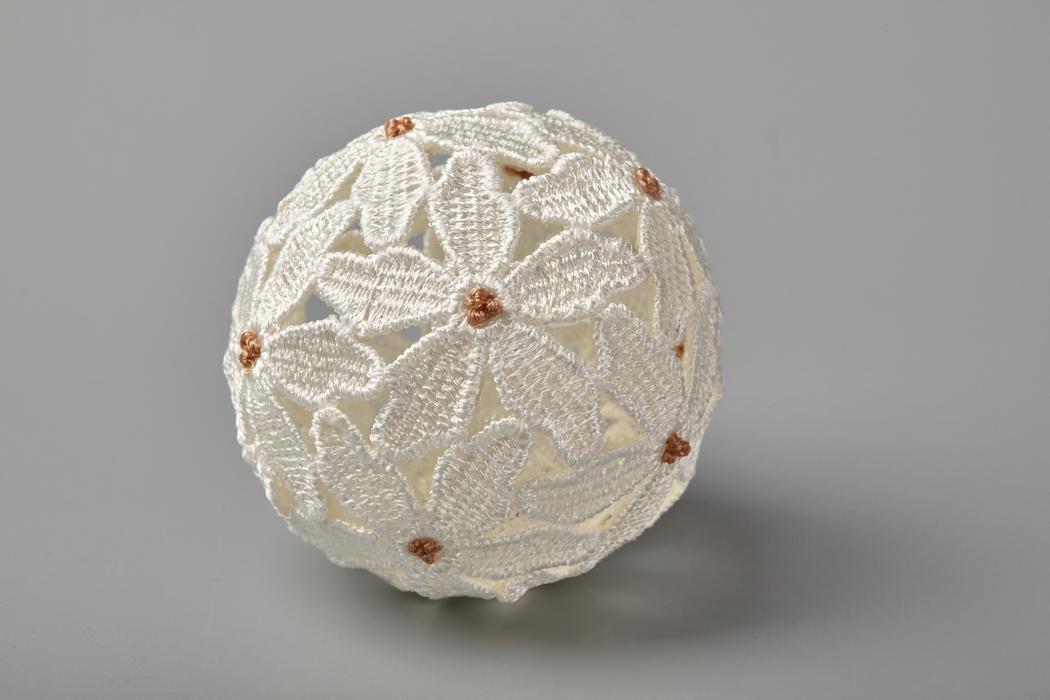
Using a combination of these methods in my creative process led me to the creation of mathematical art. Mathematical art is an interdisciplinary field that involves an approach combining ideas from different areas. I didn’t like the large gaps between flowers in the classic symmetrical way of joining motifs, so to solve this problem, I rotate one flower by 30 degrees and connect it asymmetrically, which is a form of shifting perspective. I also use combinations of 5-, 6-, and 7-petaled motifs to achieve a specific shape for the object. The exhibition “World in Lace” represents something intermediate between the Eastern Islimi ornament and the English Tudor architectural style.
Many of your works explore circular symmetry and 3D forms. What fascinates you about transforming flat patterns into spatial objects?
2D art is beautiful—you can look at it and immerse yourself in it endlessly. When I find a painting I like, I want to jump inside it and become part of it. Objects with complex shapes evoke a desire to have a different experience; you want to touch them, hold them, play with them. My first idea came while creating a garment. I didn’t like that there was no dart, so instead of a six-petaled flower, I inserted a five-petaled one, which created a slightly conical shape for a women’s dress in the bust area. The fitted garment looked much more interesting than a straight cut; it invited you to touch it and put it on.
Growing up in Kazakhstan, you were inspired by wildflowers and traditional ornamentation. How do these early visual memories influence your current work?
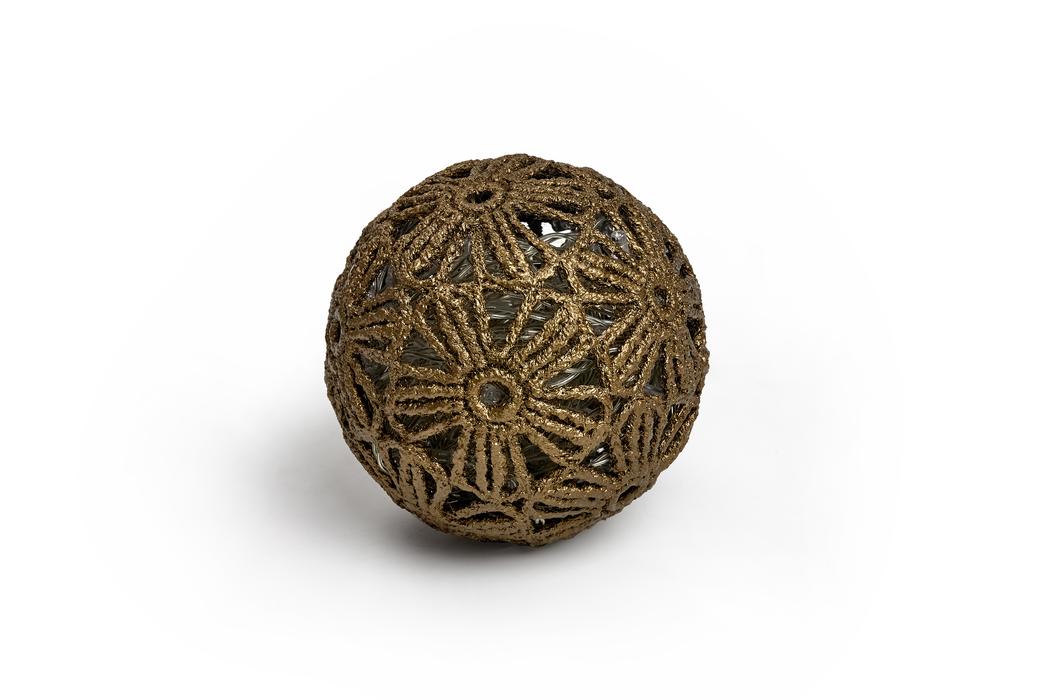
In childhood, we traveled a lot through Central Asia. Ornamentation is everywhere, but the architecture of Uzbekistan, especially the girih patterns, made a special impression on me. Later, in school, I realized that every angle of this design is constructed with geometric precision, and even where the pattern seems chaotic, there is a certain mathematical sequence that is not immediately visible. As I studied school subjects, it became clear that everything in living nature follows certain patterns and has a complex structure. Examples of structuring rules include fractals and Stephen Wolfram’s Rule 30. Steppe flowers and shrubs in Kazakhstan are somewhat more subtle and graceful compared to forest flowers and trees. They have thin leaves and stems, weightless flowers. Such flowers harmoniously fit into mathematical forms.
Your pieces often resemble delicate organic structures, almost like living forms. Do you see your work as closer to nature, mathematics, or something in between?
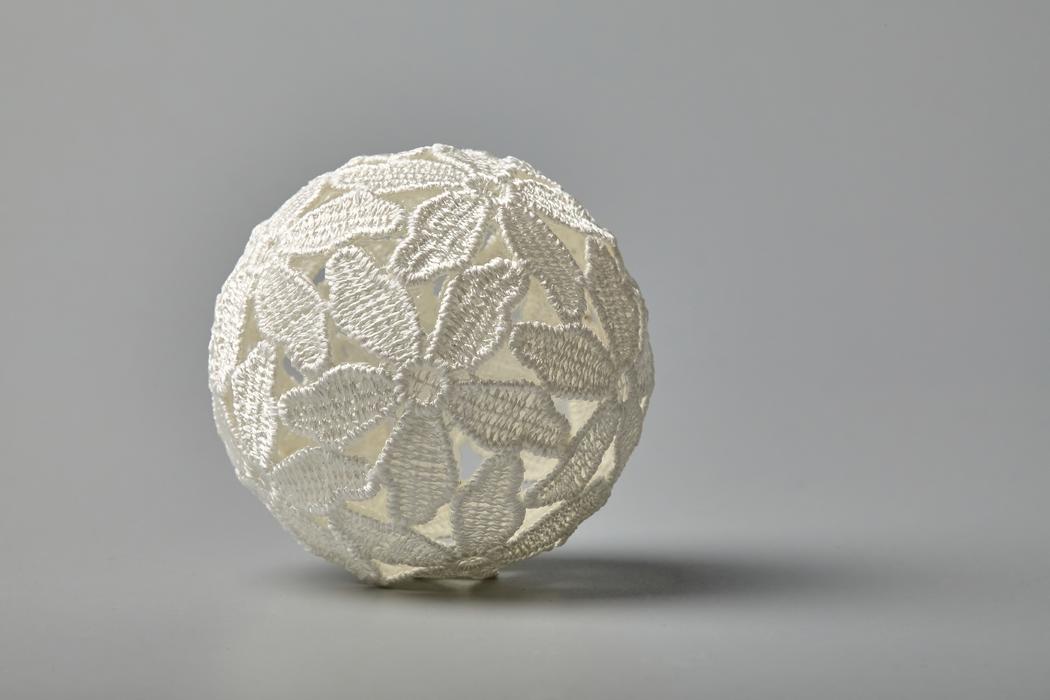
Eastern ornaments developed in several directions: one is the plant-based Islimi, known in European countries as arabesque; another is geometric girih; and the third is the written Kufic/calligraphic style. My art is an attempt to unite geometric and plant styles into a single whole. You can add asymmetry to motifs, making them not perfectly symmetrical or slightly irregular, following the principle of “Pythagoras’ wind-blown tree.” This makes the composition rhythmic and adds naturalness to the structure.
Can you describe your process when developing a new pattern? Do you begin with a mathematical idea, or does it emerge intuitively through making?
I see intuition more as the ability to quickly analyze information and relate it to existing experience, rather than as a gift of foresight or a sixth sense. In my case, it’s quite straightforward. I rely on knowledge and existing experience and, out of curiosity, try to create more complex objects or structures. I experiment while simultaneously studying and discovering new properties. If I like the result of the experiment, I then use it as existing knowledge to create a new, more complex work.
Do you see your work as functional objects, sculptural pieces, or conceptual explorations – or all at once?
Initially, it is a concept, and time will show what form it will take. I already have experience creating clothing; now I am creating art. But I also see the possibility of creating interior objects and architectural elements. Perhaps this will require knowledge of visualization software. At the moment, I design objects in my head, so to speak, using an analog method.
Leave a Reply
You must be logged in to post a comment.