Ruqing Yan
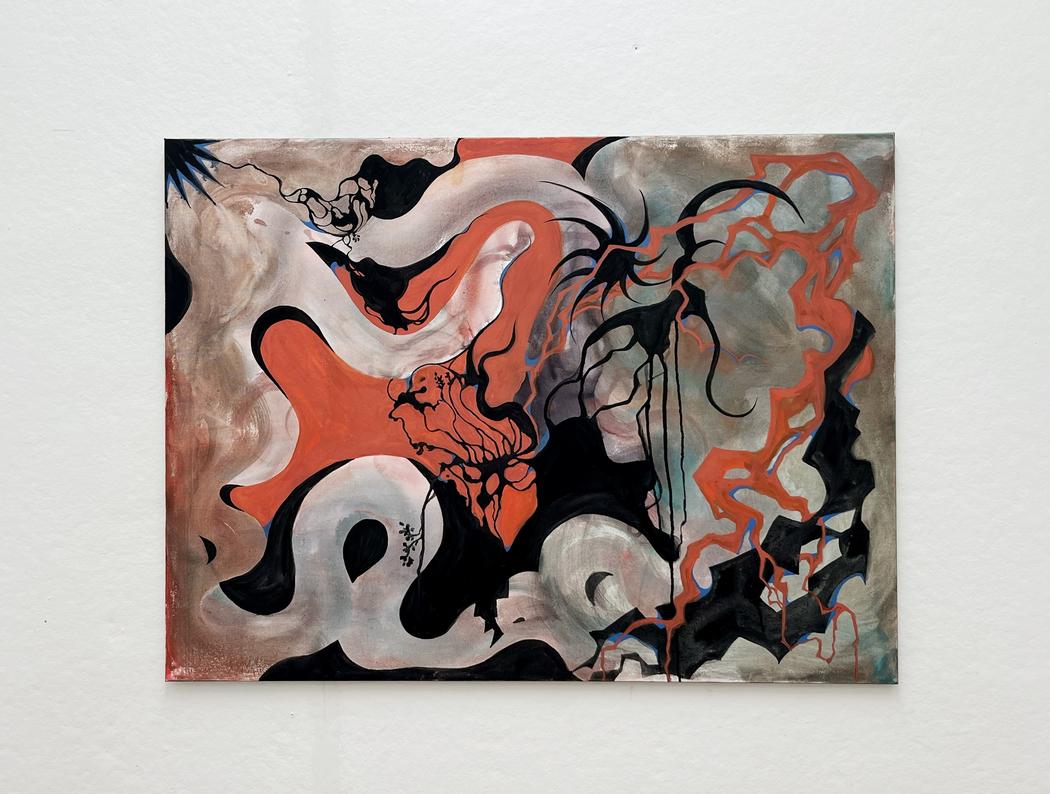 Ruqing Yan | Recording a birth of a sun | 2025
Your work often explores the tension between private expression and socially accepted forms of language. When did you first become aware of this fracture, and how has it shaped your artistic practice?
I first became aware of this fracture in elementary school, when we were asked to begin writing essays. I realized that my own thoughts and interests were not valued under a meritocratic lens, so I began experimenting with indirect forms of expression: acrostic poems and small, stream-of-consciousness stories.
They recorded only the most ordinary details of life, or fleeting thoughts, yet through careful linguistic packaging, people would accept and even praise them without knowing their actual meanings. Precisely because only I could decode them, I was able to preserve a private space for my inner world.
This early engagement with selecting and playing with language, imagery, and metaphor led my later visual practice toward a similar sense of indirection. From there, I developed an interest in folk art and symbolism. They established a consistent tone in my work: I select available symbols and elements, transform and reconfigure them, and begin to tell my own stories while leaving space for interpretation.
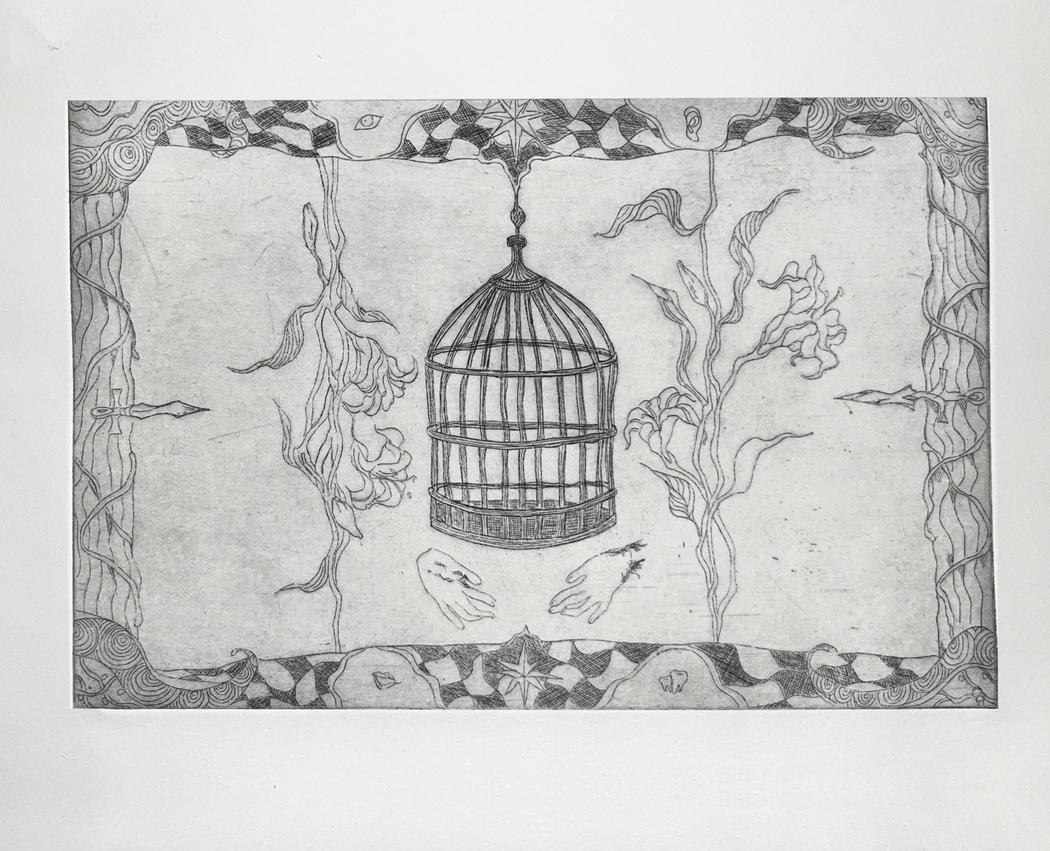 Ruqing Yan | Living Funeral | 2026
Many of your works feature recurring motifs such as birds, organic forms, or fragmented bodies. How do these symbols evolve over time within your personal lexicon?
While receiving a modern (or perhaps more precisely, Western and academic) art education, I have also continuously felt the force of so-called “primitive” and folk art, and have been deeply nourished by them.
These forms of expression often carry an animistic sensibility, emphasizing connections between humans and nature, and between the inner self and the external world. I often feel that the world itself resembles a river that contains everything: that at the end of life and the self, all things become interconnected.
Through references to folk and so-called primitive art, as well as the internalization of my personal philosophy, I frequently depict images of overlapping and transforming bodies and entities. Humans may become animals; animals may emerge from trees or stones.
Birds, with their lightness, function as symbols of liberation. They escape from bodies that are melting, dissolving, or fragmenting, leaving their containers behind and moving toward another side of the world, or another page of the story.
Your compositions often feel suspended—neither fully resolved nor entirely chaotic. How do you approach creating this balance between control and openness?
I tend to follow the flow of the image. Earlier in my practice, I preferred clear boundaries and defined forms, hoping to make narratives more visible. Now, I choose to retain a degree of ambiguity through intentional blank space, intuitive color balancing, and allowing chosen imagery to undergo further transformation and abstraction.
I have received feedback that viewers can see their own imagined figures and narratives within my work, so my work in this case is almost like a Rorschach test. This is indeed the result I hope for. I want viewers to have the freedom to interpret while engaging with my narratives.
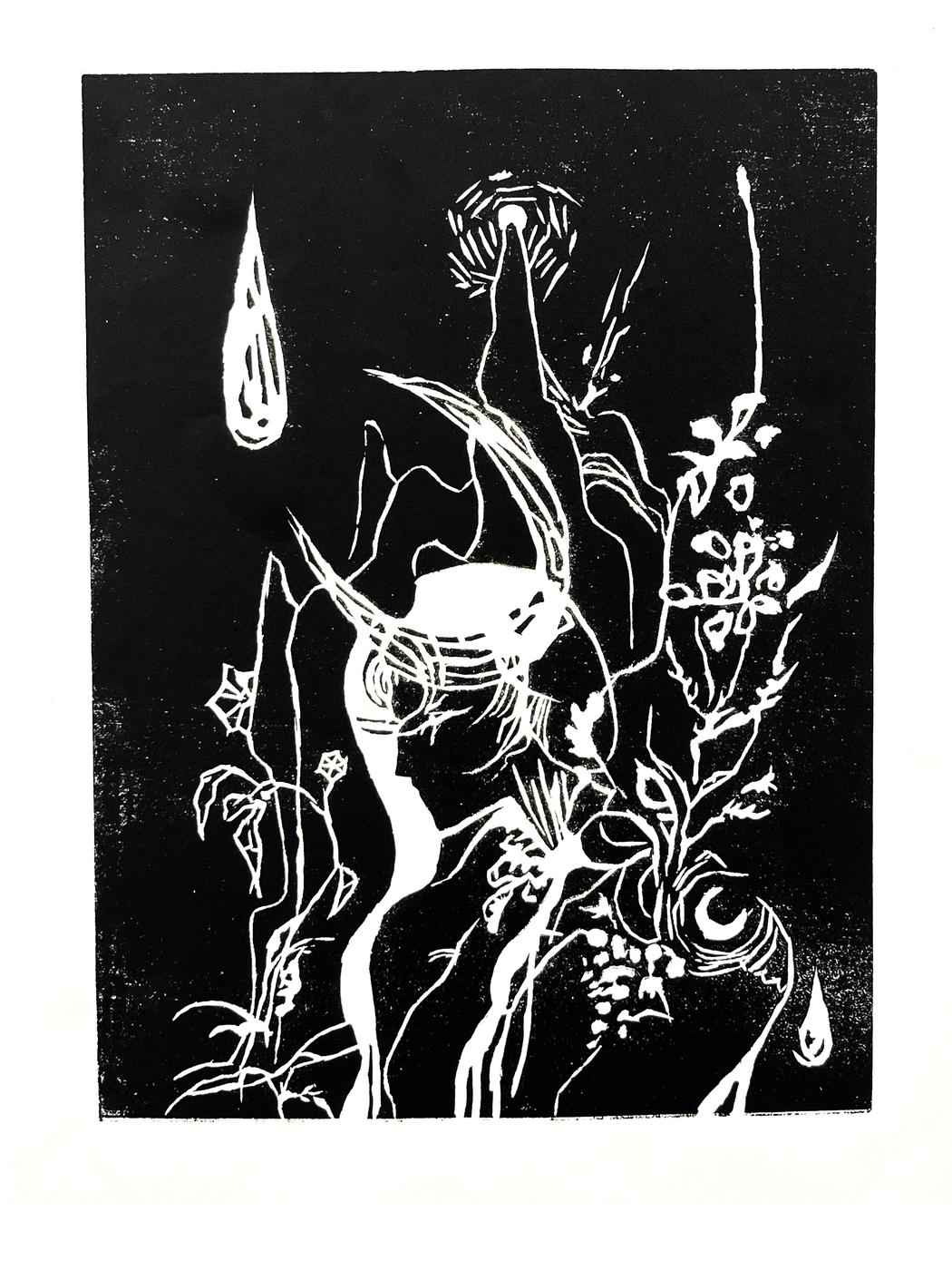 Ruqing Yan | Mute | 2025
How have your experiences moving between northern China and New York influenced your relationship with visual language and meaning?
When I was in China, I often felt that because we possess such an extensive history and an overwhelmingly rich cultural heritage, we can become overly proud of what already exists, while rarely approaching it with a renewed perspective. This makes it difficult to merge or generate new visual languages.
I deeply love the art and culture of my homeland, whose beauty lies in its depth. The beauty of New York, in contrast, lies in its breadth: chaotic, inclusive, and astonishing.
After coming to New York, I began thinking about how to “forget” certain ingrained knowledge and assumptions. I also started experimenting with nonlinear, collage-like narratives in my work.
Although I primarily work in 2D now, I have previously explored a wide range of materials and techniques, like woodworking, metal welding, ceramics, weaving. The possibilities of combination excite me. The richness of New York continues to create aftershocks in my practice. I am still learning to sense and respond to these ongoing waves.
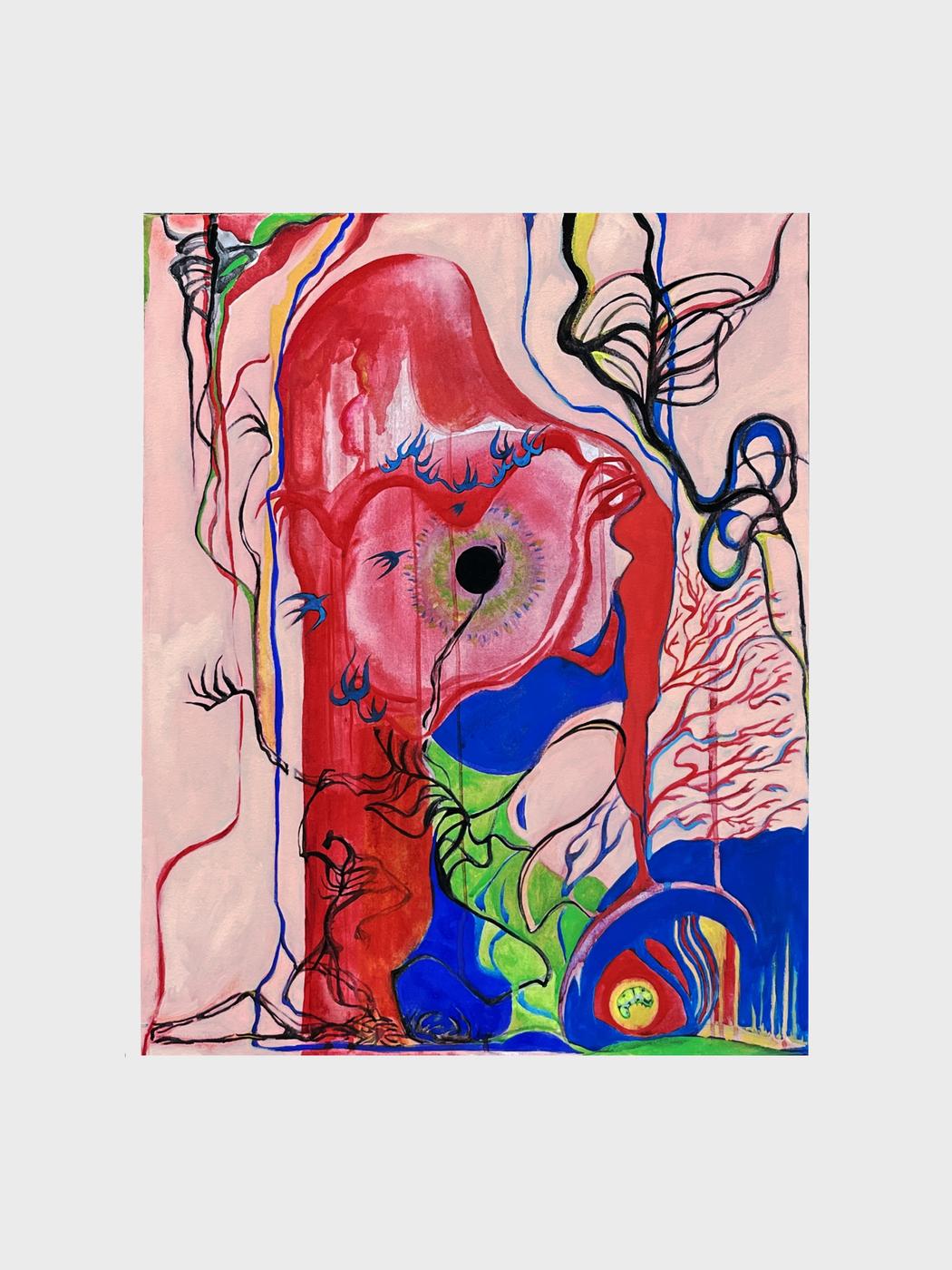 Ruqing Yan | Transmutation | 2024
Your work references religious and folk imagery. Are these references intuitive, or do you actively research and reinterpret specific traditions?
I tend to actively research and re-examine the religious knowledge I encounter. Religious stories and traditions often carry didactic purposes, but I am more fascinated by the tensions within the narratives themselves, as well as the space they allow for reinterpretation.
Hermann Hesse’s Siddhartha and Marguerite Yourcenar’s Kali Decapitated have been particularly inspiring to me.
In my recent work, I came across the idea in Buddhist culture that peacocks are considered sacred birds because they consume poisonous creatures, transforming toxicity into the richness of their plumage. I reinterpret this as a kind of predicament: the peacock becomes bound by its own beauty, compelled to continually ingest poison.
Beauty turns into an obligation, even a shackle. If it ceases this act and loses its beauty, it also loses its identity and becomes an ordinary bird. This reinterpretation reflects my ongoing interest in shifting identities and conceptual transformation.
In some of your pieces, the body appears fragmented, transformed, or merged with other elements. What role does the body play in your symbolic system?
The body, especially the human body, functions as a container in my symbolic language. It often represents manipulation, loss of autonomy, and constraint. As a result, it appears incomplete, sometimes requiring rupture in order to be reconstructed in other forms.
I see the human body as a limitation, something that restricts the freedom of thought and spirit. In my work, I often construct a contrast between the illusory body (the human form) and the “true” soul, which may take the shape of animals, flowing colors, or shifting elements.
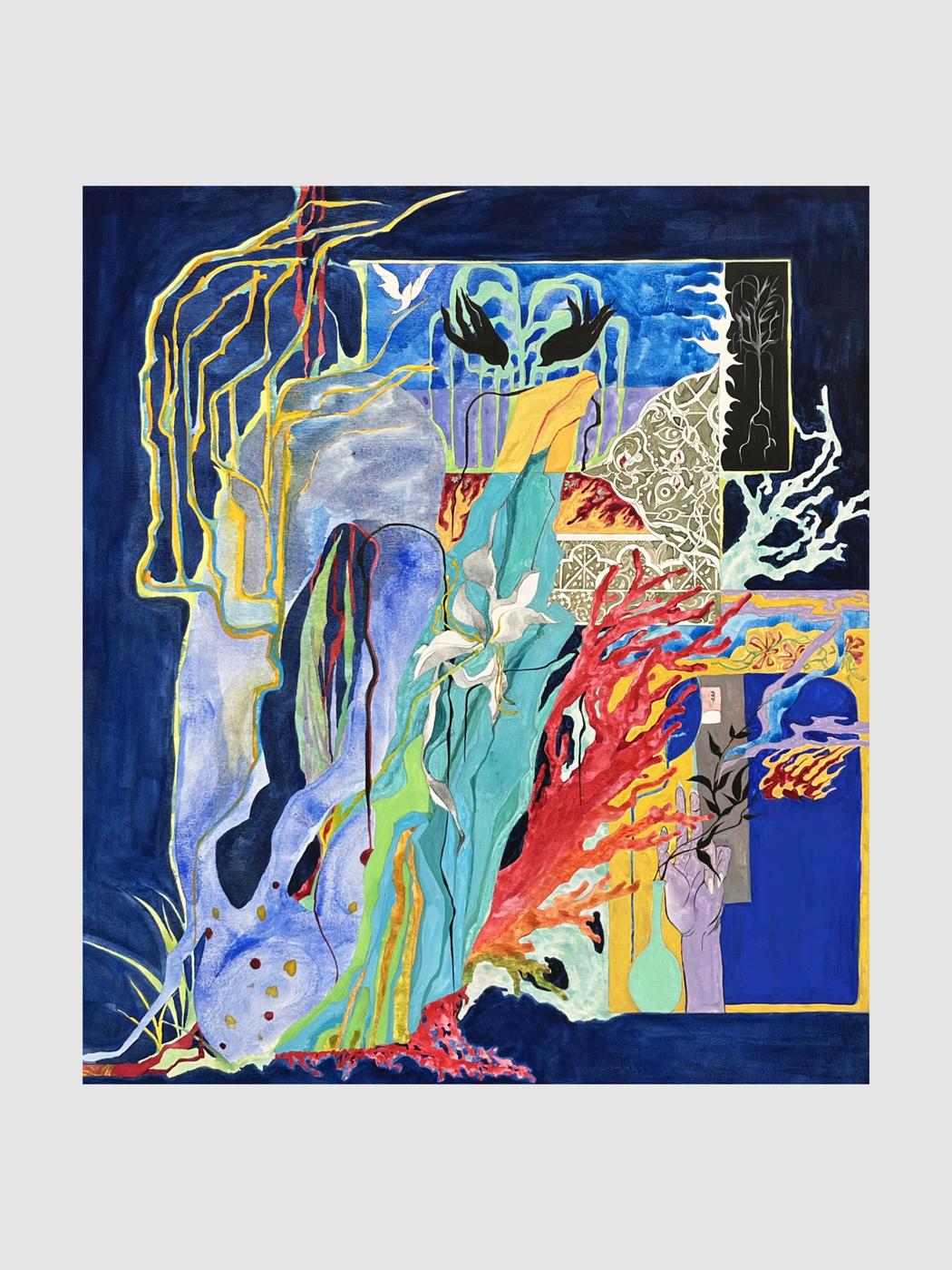 Ruqing Yan | Transmutation | 2025
How does your approach differ when working in drawing versus printmaking? Do these mediums allow different types of “language” to emerge?
Painting requires more patience from me, and also a greater degree of self-compassion. Working on canvas involves significant labor. I usually build my own canvases, so the preparation itself takes time. I also use water-based media, including gouache, to achieve subtle grain and gradients, which makes layering and correction more difficult compared to oil or acrylic painting.
Each painting feels like a ritual. I prepare offerings (canvas, pigments, digital drafts, my full attention) and hope for a desired outcome.
Printmaking, on the other hand, feels much more relaxed. It offers me the possibility of starting over, and within its reproducibility, I find a certain sense of release. I experiment with different papers, ink colors, and layered compositions. New possibilities constantly emerge, which excites me.
In terms of “language,” I feel that my paintings tend to present more complete and continuous narratives. Each work is like an open door into a story. In printmaking, however, I am still exploring its potential, and tend toward more fragmentary and symbolic expressions: a birdcage, a tiger, a collapsing castle. These feel like close-ups of specific elements within a larger story. I present them, but do not explain them.
Leave a Reply
You must be logged in to post a comment.