
Aleksey Artemyev
Your works often reveal the hidden mechanisms of society. What inner conflict or social tension most often becomes the starting point for a new painting?
Most often, it’s a conflict (or sometimes even an open confrontation) between what we truly want and what our loved ones, society, or even complete strangers expect from us. (Whispered aside: and it works the other way around too — we often expect things from others that they never intended to do, yet we’ve already assigned those things to them as obligations.)
I’ve always been irritated and deeply affected by this universal tension of “having to conform.” The painting “Awakening and Realizing the New” is precisely about that — the sharp, painful moment when your old points of reference (your parents, familiar environment, or even long-time friends and mentors) stop working, while the new ones are not yet clear. You begin to glow from within with new ideas, and the people around you often perceive that glow as a threat.
This is a fundamental — or I would even say almost standardized, according to some unwritten GOST or DIN of human experience (a metaphor for those common technical abbreviations in manufacturing standard parts) — situation that repeats itself in different forms throughout life: in youth (straight out of Dostoevsky’s Fathers and Sons), in our careers, in relationships, and even in our internal beliefs.
And that last part is the most frightening: when you yourself break your own long-held moral principles. I simply try to catch this feeling of inner fracture and look for a visual form or symbolic formula to express it.
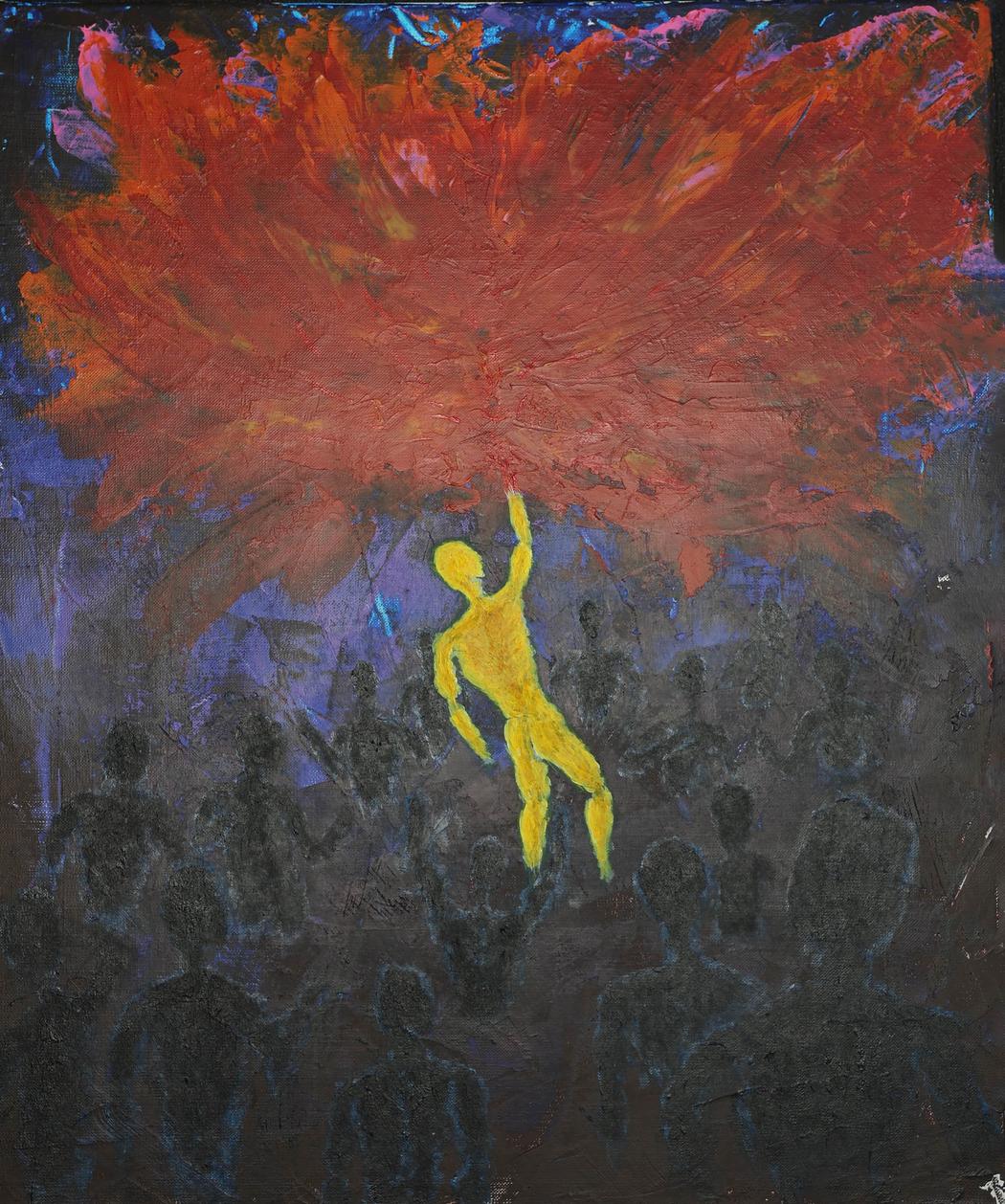 Aleksey Artemyev | Awakening and Realizing the New | 2024
You combine a rough, emotional palette-knife background with precise brushwork for symbolic details. How did this duality in technique become your artistic language?
Honestly? By trial and error. I started by trying to control everything — drawing every detail so precisely that there wouldn’t be a single extra stroke… The result was lifeless and frankly bad. Then I tried working only in a rough, emotional manner… but the idea got lost, and the small elements — the symbols — were drowned out by the burst of expressive brushwork.
And then my engineering habit of assembling two mechanisms kicked in. First, I create the background emotionally, sometimes even chaotically. It’s like modelling the weather or the environment. And then I “place” the object into this environment — the idea or the “question.” That part needs to be done calmly so that it becomes readable, like a technical drawing of a component.
This contrast is what creates the tension I want to convey on the canvas.
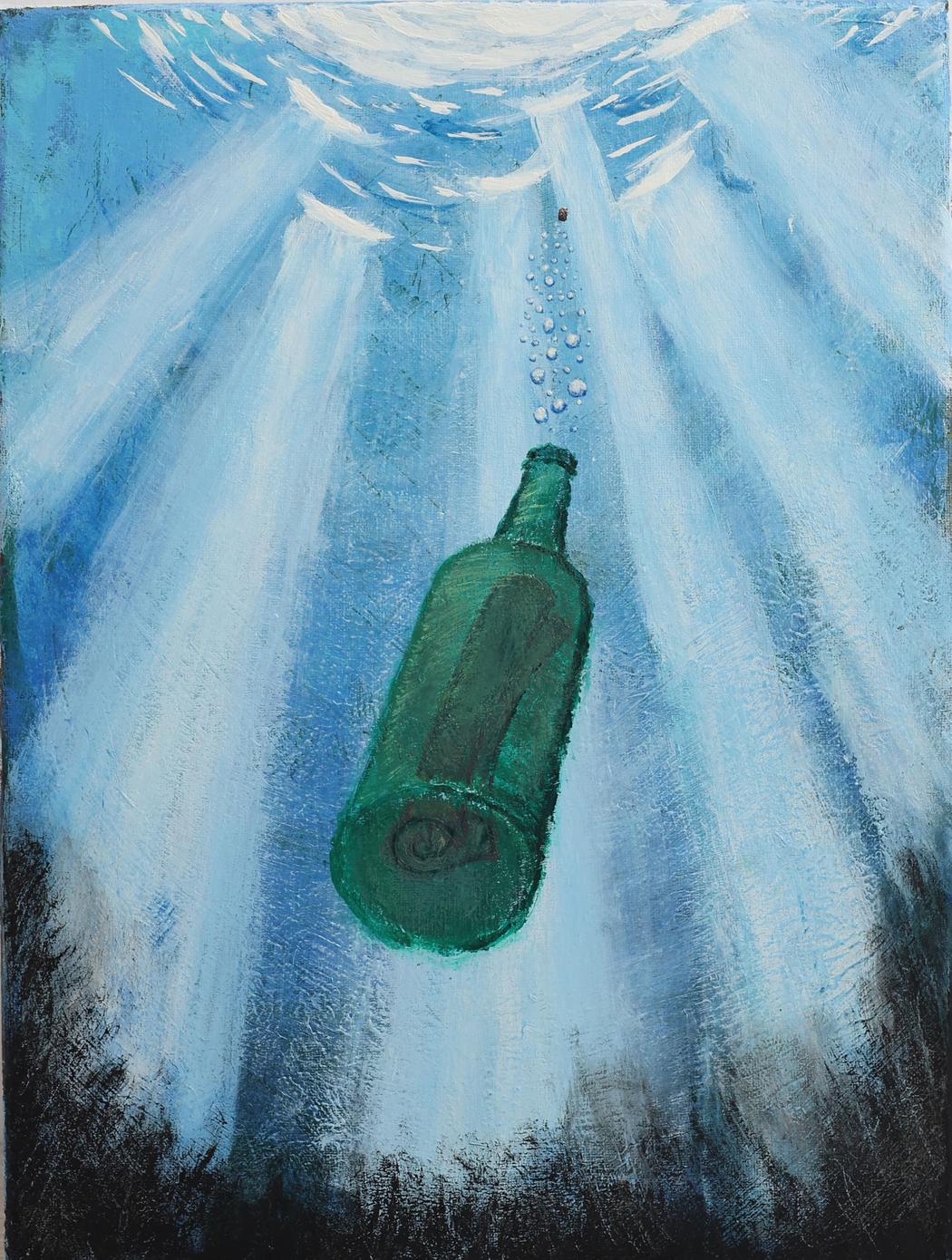 Aleksey Artemyev | Lost In The Depths | 2025
You describe your paintings as conversations rather than decorative objects. What is the most surprising reaction or interpretation you have ever received from a viewer?
The most surprising moment was when someone saw in the painting “You’re still here?! Finish up and close it.” not a comment on spending too much time at work, but a story about long, worn-out relationships. He said: “This is about that moment when both people know it’s over, yet they keep sitting in the same room and at the same table because they’re afraid to step out into that world of colors and lights.”
I hadn’t intended such a specific context, but the essence was understood correctly (just from a different angle) — the painting is indeed about that universal fear of new freedom and the old, exhausted expectations we often create for ourselves.
It’s actually the best kind of compliment — when a metaphor is interpreted in a personal way, and that interpretation enriches the overall meaning of the artwork.
Your background in industrial engineering and your work trips to the northern regions, close to the Far North, may seem distant from the world of art at first glance, yet they clearly influence your creative practice. How do these experiences — and the contrast between the harsh northern environment and life in a big city — continue to shape your themes and visual language?
Yes, that experience gives me a sense of scale and a feeling for material. In the northern regions of oil fields, all processes — and their impact on materials and people — reveal themselves in a very particular way: corrosion, heating pipes freezing during accidents, the erosion of nature in these areas on the one hand, and on the other — the very warm and supportive relationships between people in conditions of brutal cold and icy winds. In a big city, all these processes are hidden and “turned upside down” — both socially and psychologically. And this sometimes creates a strong sense of dissonance.
I simply transfer this cup of dissonances onto the canvas as engineering processes. “Lost in the Depths” is essentially an engineering metaphor: the message (signal) never reached its recipient, the communication system failed. And the failure itself is multifaceted. Experience in design teaches you to see not just an object, but its function, its future behaviour, and its “tension” within the overall structure.
The same goes for my paintings: each element is a component of a system called “conflict.”
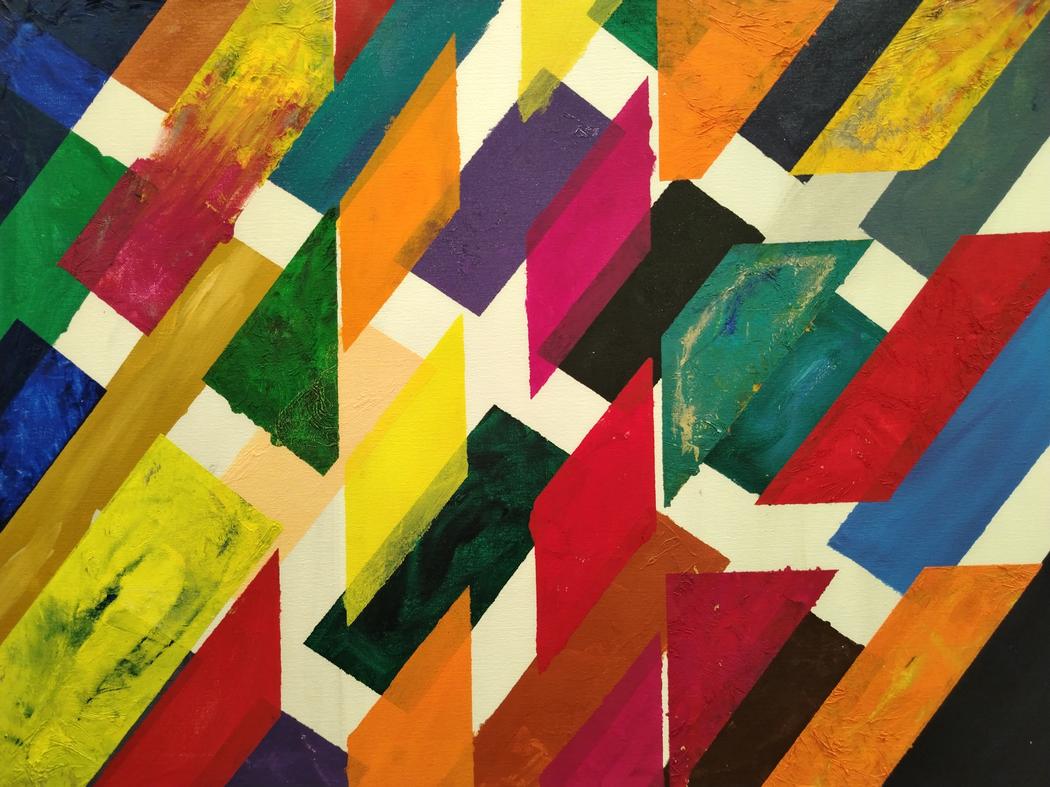 Aleksey Artemyev | Playing With Toy Cars, Through The Eyes Of A Child | 2025
Many of your works encode messages about loneliness, environmental damage, or social pressure. How do you decide which symbols to use to express these ideas?
I try to use simple or even everyday symbols — those a person encounters in daily life — and slightly transform them (and sometimes even break their usual perception). For example, the theme of loneliness is not just a solitary object (or the image of a person placed within it), but the very process of walking into loneliness. Let’s return to the painting “Lost in the Depths”: a bottle with a message that is slowly filling with water. Hope is physically sinking, and there will soon be no air left to carry even a cry to the world — ahead lie only dark depths.
Another example is the painting “Wash Your Hands Before Eating…”. The fear for one’s child is not only parental embrace, but also the attempt to shield them with a kind of warning tape that begins to melt from parental anxiety and control (as a parent of two children, I’m already noticing this tendency in myself).
One more example. Social pressure? Look at “Awakening and Realizing the New” — this pressure comes from all sides, even from those who, in theory, were supposed to offer support.
A symbol needs to be strong and preferably simple — like a steel nut with a chrome coating — able to withstand the weight of meaning while remaining instantly recognizable.
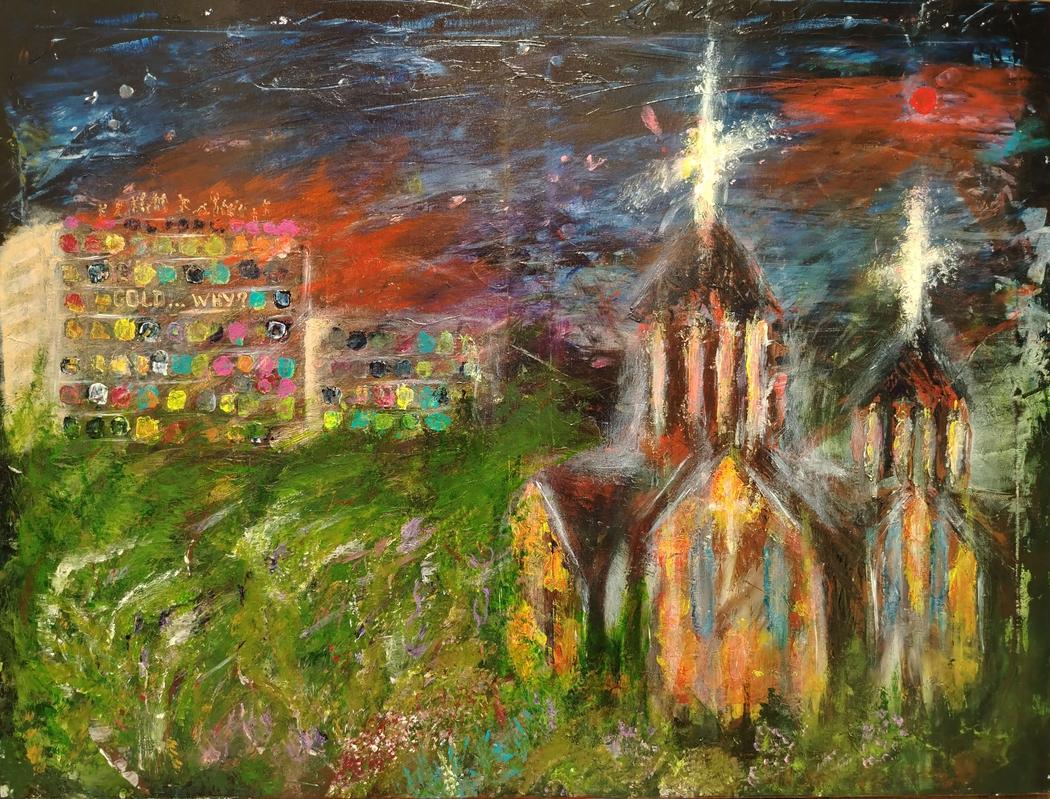 Aleksey Artemyev | Salvation Through Faith, Not Gold | 2025
How do you think viewers should approach your works – analytically, emotionally, or intuitively?
The main thing is—no “musts.” First, just look. If something catches you emotionally and you like it (or even if it annoys you—after all, a negative reaction is still a reaction), then “welcome aboard.” Read the “user manual”—that is, the painting’s description (eh… it seems my engineering background still hasn’t fully let me go, since I keep using technical terminology). And then “take off”: listen to your inner feelings.
For example, with the painting “Playing with Toy Cars Through a Child’s Eyes,” there’s no need for deep analysis. Just remember what it was like, or watch how your own children play. The stream of thoughts will naturally lead you to a simple realization: “When was the last time I looked at things with a clear, simple, childlike gaze?” And from there, you can even go deeper into self-reflection—if you wish, of course.
That’s how the mechanism works. But the very first moment is always that inner “click.”
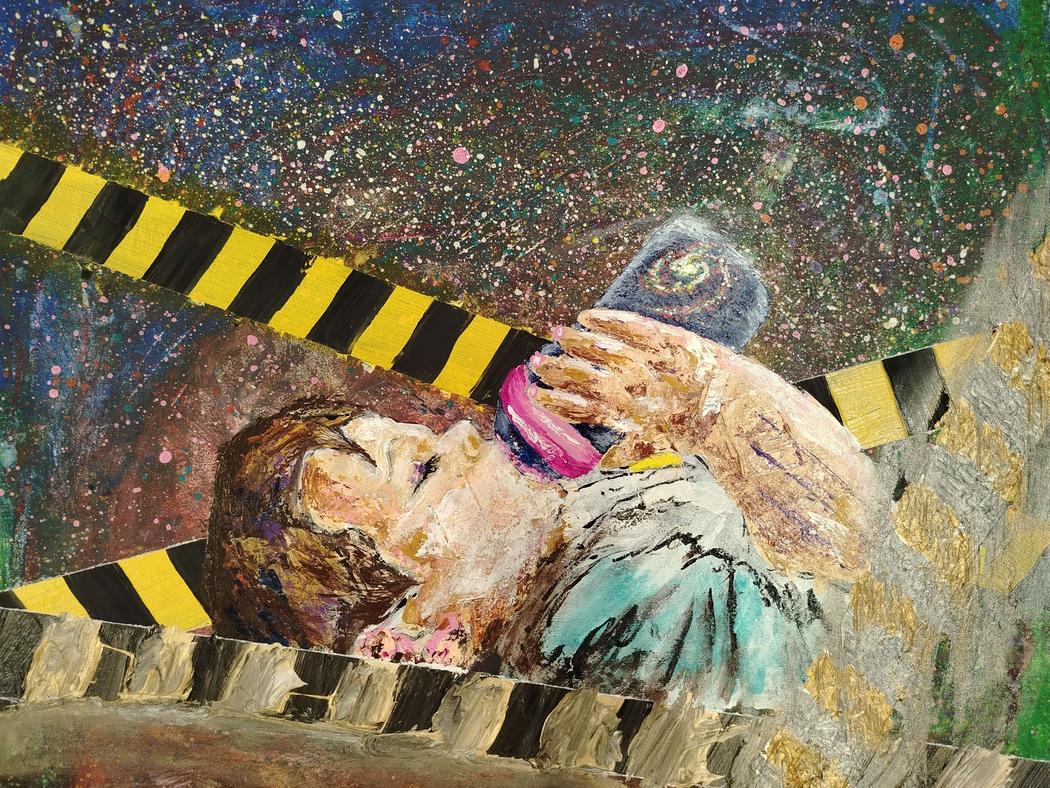 Aleksey Artemyev | Wash Your Hands Before Eating… Eating The Echo Of The Big Bang | 2025
If you could describe your artistic mission in one sentence, what would it be?
To paint complex and carefully overlooked feelings as something visible, so that they can be talked about and not feared to discuss.
Leave a Reply
You must be logged in to post a comment.