
S.W. Dinge
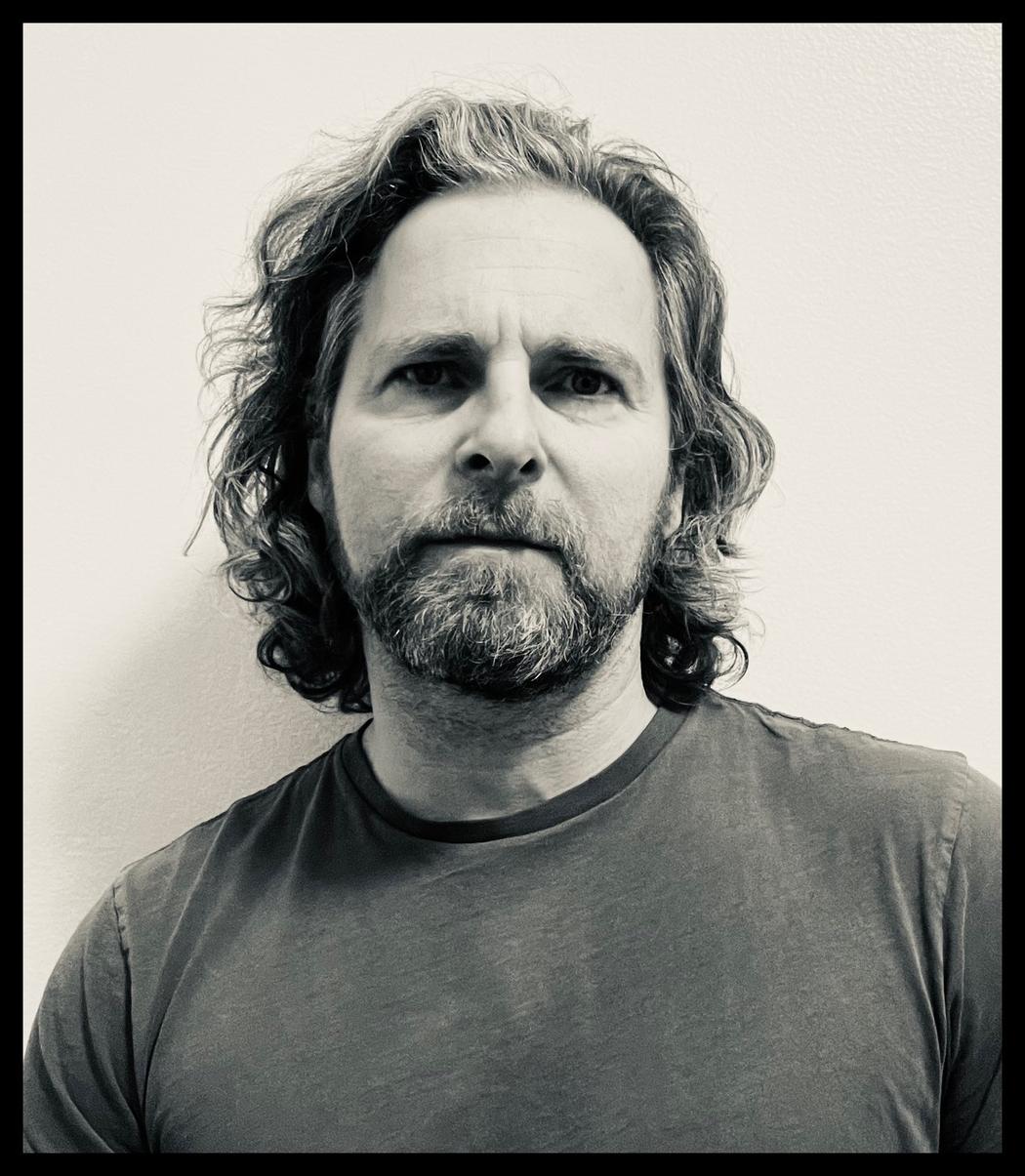
Your works balance simplicity with high energy. When you begin a new piece, what usually comes first for you – color, line, or composition?
I’m not one of those painters who fills a room with large blank canvases, and then paints in a fury for a few days, little by little on 10 or 12 paintings at once. Broadly speaking, I deal with each new canvas one at a time until it’s found some type of resolution, then I move on to the next one. Each one is a conversation, I suppose. And as with conversations, it works better when not everyone in the room is talking at the same time.
Each painting starts by creating ‘a problem’ visually. Then the next task is to fix the problem. This process of chasing the problem around the canvas happens as many times as it needs to until a sort of visual harmony is reached. I see my work similar, structurally, to how music comes together. A song is created by multiple instruments /sounds coming together in a unique way. Each player has to pull their own weight so the final result can be fully realized. I interpret each color, line, brushstroke, and shape to be a different instrument, each playing its own part, creating a visual ‘song’.
You often mention “impulsive lines” and “spills of color”. How do you cultivate spontaneity while still maintaining a strong sense of structure?
I hope to never see a familiar mark or shape that is so obviously ‘me’ when I’m painting. That’s almost impossible to achieve because everyone has their way of doing things that can’t be undone. I guess I’m aiming for a controlled spontaneity. Using something like a paintbrush extender, so I’m 3 or 4 feet from the canvas, can help to make it seem like someone else is doing the painting, I like that. Most often though, I paint with my non-dominant hand. Although I am getting better at that over the years so that might soon stop working the way that I need it to.
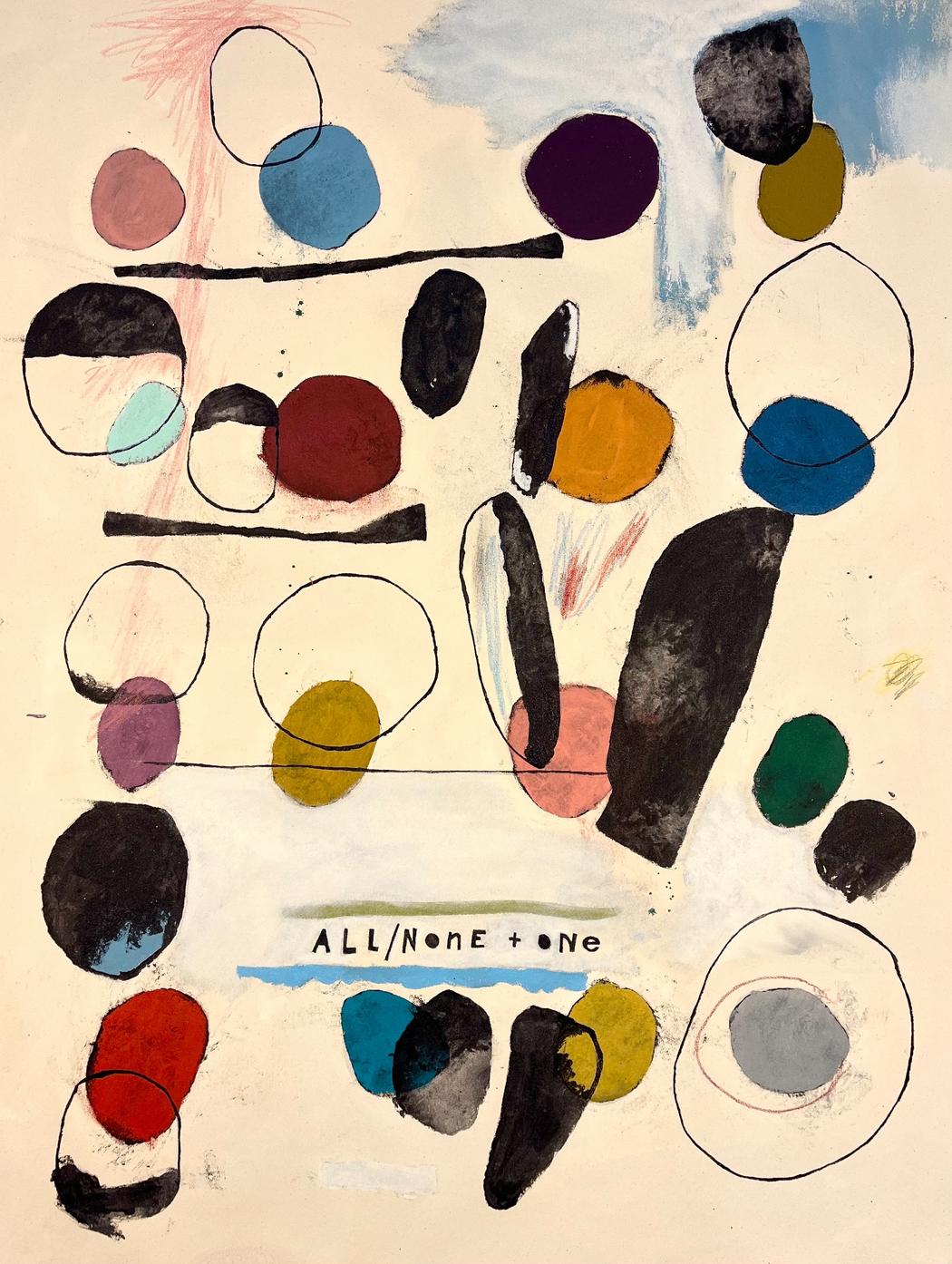 S.W. Dinge | All Or None +1 | 2023
Negative space plays a crucial role in your paintings. What does “quiet stillness” mean to you within such vibrant compositions?
I guess you could boil it down to saying that ‘there isn’t much going on in this part of the painting.’ Call it negative space, call it the gap between actions or call it simply unpainted, whatever you choose. These areas are just as important as the colors and the lines and the juxtapositions between them. They are room to breathe, room to reflect. Think about if someone is yelling or talking at you like mad without stopping. Soon you just stop listening. But if they take breaks to breathe and pause, you may be more apt to try and connect with what they’re saying.
I’m not particularly drawn to paintings that are super busy with layers upon layers upon layers of paint all over the canvas. I like trying to use the quiet and loud parts in concert with each other to find a balance that works. I’m not trying to coat a canvas in a blanket of paint, I’m trying to thread a needle.
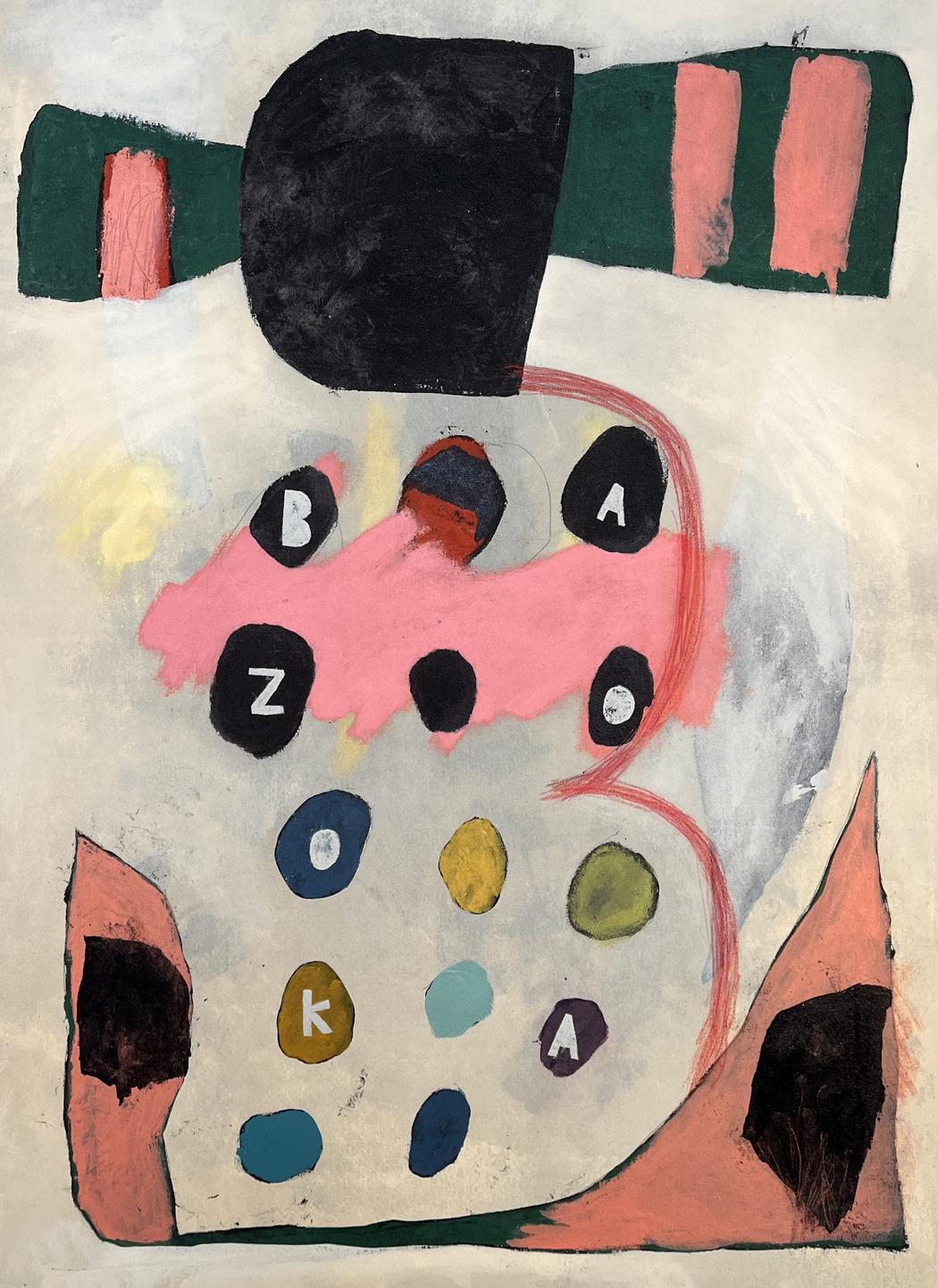 S.W. Dinge | Bazooka | 2023
Many viewers see hints of familiar objects in your shapes without them ever becoming literal. How intentional is this sense of near-recognition?
Yes, intentional for sure. I want these paintings to resonate with the viewer by tugging on their subconscious memory banks. Not every viewer is going to connect with every painting, but that’s OK. I often think of them as aesthetically pleasing Rorschach tests. There’s a possibility of seeing something in there but you can’t quite put your finger on it. The comment I enjoy the most about my work is when someone says ‘I love this painting. I don’t know why I do, but I do.’ When I hear that, I think ‘I got ‘em’, you know? I tapped into something.
Your work often feels simultaneously playful and confrontational. Do you aim for emotional ambiguity, or does it emerge naturally during the process?
Ambiguity, whether emotional or otherwise, is the whole game, in my mind. I want to dance around the obvious, not spoon feed it to the viewer. I’m not going to say that it’s a landscape or it’s a portrait or it’s a vase, because each painting possesses the potential to be all of those things. I try to keep things simple and vague enough so each painting is assessable on multiple levels at one time. I like the possibility that the viewer is experiencing something familiar to them, like when you bump into someone and you feel like you already know them, but you just can’t remember from where.
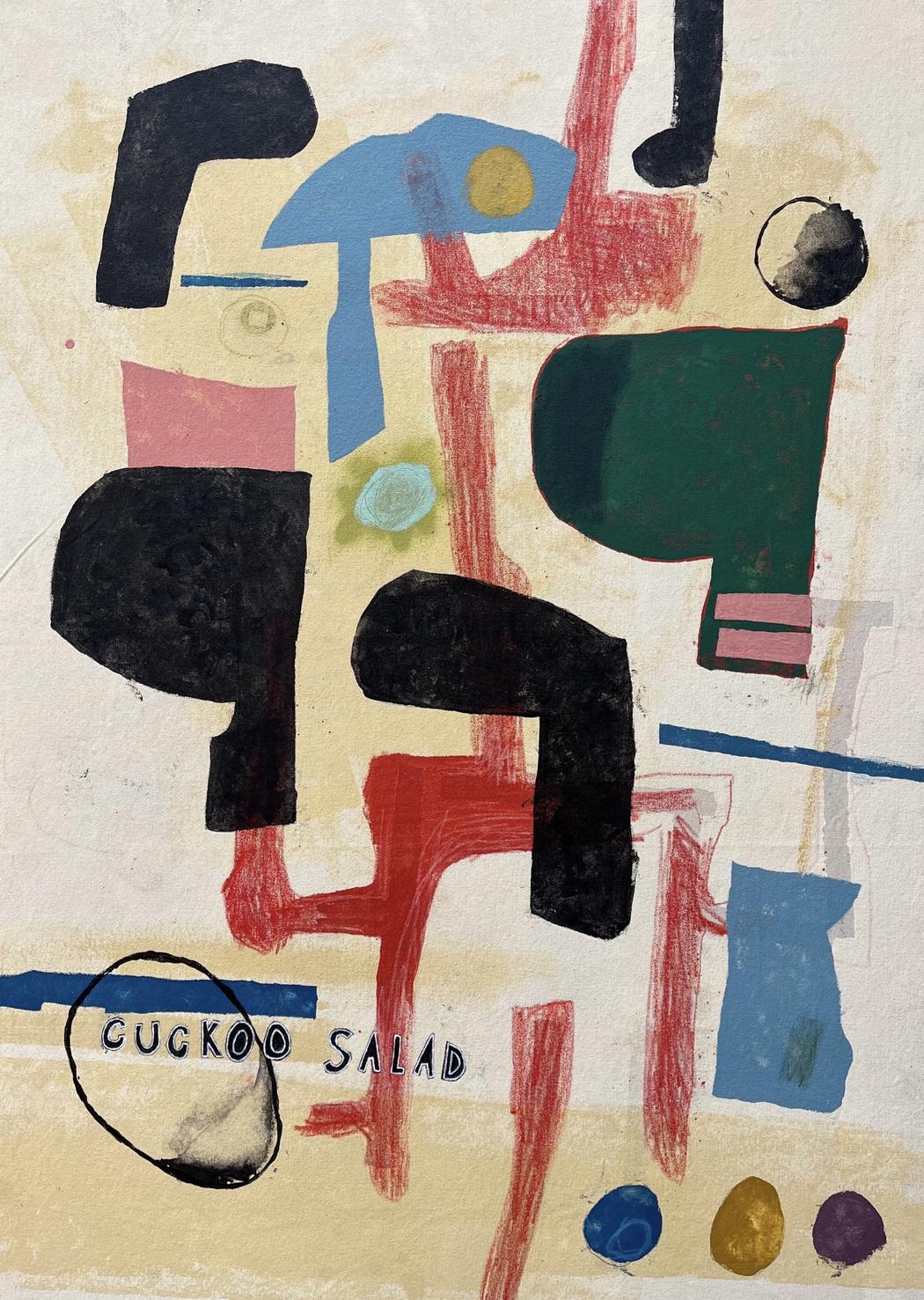 S.W. Dinge | Cuckoo Salad | 2023
How did growing up in New York State’s Adirondack region shape your sense of visual language or artistic sensibility?
I love upstate New York, don’t get me wrong, but all I’ll say is that there was a quote that always resonated with me. I believe it was movie critic, Roger Ebert, who said it but I could be wrong on that. It was ‘The only good thing about growing up in a small town, is that you know you want to get out.’
 S.W. Dinge | Echo | 2023
How do you know when a painting – especially one built on spontaneity – is truly finished?
Well, that’s the $1 million question, isn’t it? I know many painters will say that a painting is never finished and I suppose technically, I’d have to agree with them since I have gone back in to add to paintings a decade or more later. That doesn’t happen very often, though. I’m very cautious not to overwork a painting. Restraint is critical. Sometimes I push it too far and it loses something. It’s not as impactful for some reason and then I get into correction mode, trying to recapture what it once had. Kind of like when you’re driving on the highway and you miss your exit. Everything you do from that point on is just trying to get back to where you were before.
It’s difficult to articulate really because I don’t fully understand it myself. At some point during the process, something signals to me that there is nothing more I can do to increase the impact this painting can have. I don’t question it, I don’t force things upon it, I just except it and move on.
Leave a Reply
You must be logged in to post a comment.