Alexandru Valentin Duta
How did diving become a means of artistic expression for you, and what led you to develop the underwater chapter of SOLACE?
My relationship with the sea started long before I became a diver. As a child, I spent most of my time swimming, holding my breath and exploring, always looking for strange marine life to observe in quiet places.
I will always remember my first night dive. The feeling of floating in the darkness, surrounded by the open sea, was unlike anything I had experienced before. There was a particular tranquillity to it, completely different from anything above the surface.
Years later, night diving brought back that same childhood feeling, but on another level. Being alone in the dark ocean feels like entering another world, where time stops and it’s just me, the sea and the excitement of encountering something unexpected.
I think this feeling is at the heart of the underwater chapter of SOLACE. We all have places where we find tranquillity, places we escape to when everyday life becomes too noisy. Through my photography, I want to share that place with others, perhaps inspiring them to experience night diving themselves and discover what it can offer them.
Your background in cinema influences your photographic approach. What do you borrow from filmmaking to suggest a story within a single underwater frame?
One of the most important influences from cinema is the ability to convey emotion rather than simply show something beautiful. In filmmaking, we often talk about the “money shot” , that one defining shot that captures everything. I approach photography in a similar way because I only have one frame to tell my story.
I want my photographs to make viewers stop and look beyond what is in front of them, allowing their imagination to wander into unknown places. My jellyfish photographs, for example, often take on a cosmic, almost otherworldly appearance. I enjoy creating art that evokes mystery, leaving space for each viewer to find their own story.
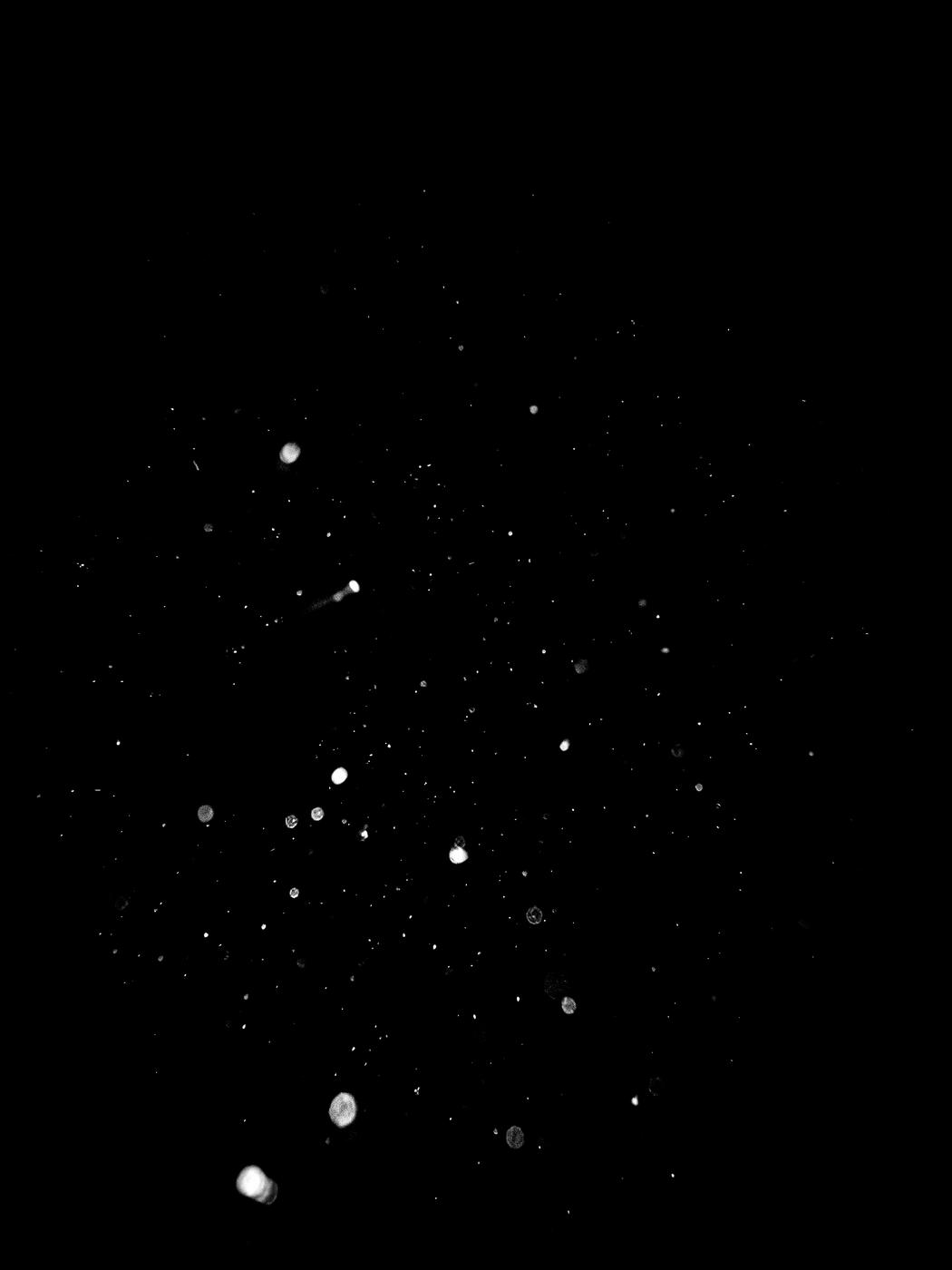 Alexandru Valentin Duta | Plankton Floating Around Me
How has working in black and white changed what you notice underwater, even before you raise the camera?
After spending so much time underwater, especially at night, you start seeing things differently. Colours fade into darkness, and you become more aware of shapes, textures and subtle contrasts.
Sometimes, when I’m observing marine life, I turn off my torch and let my eyes adjust. There is never complete darkness, there is always a little ambient light. It’s similar to waking up in a dark bedroom as a child. At first, you can barely see anything, but after a few minutes, shapes slowly begin to appear. I think most of us remember that feeling.
The octopus photograph is a recreation of this experience. Look close at the octopus and the sandy seabed around it. The silvery tones and low contrast give an idea of how I see the underwater world under moonlight.
Of course, I cannot capture that exact moment directly. When I photograph a subject, I introduce artificial light to recreate what I experienced in the darkness.
I pay attention to form, texture, contrast and composition. I ask myself whether the subject creates curiosity or mystery. There is so much detail hidden in what might initially look like a simple black and white photograph.
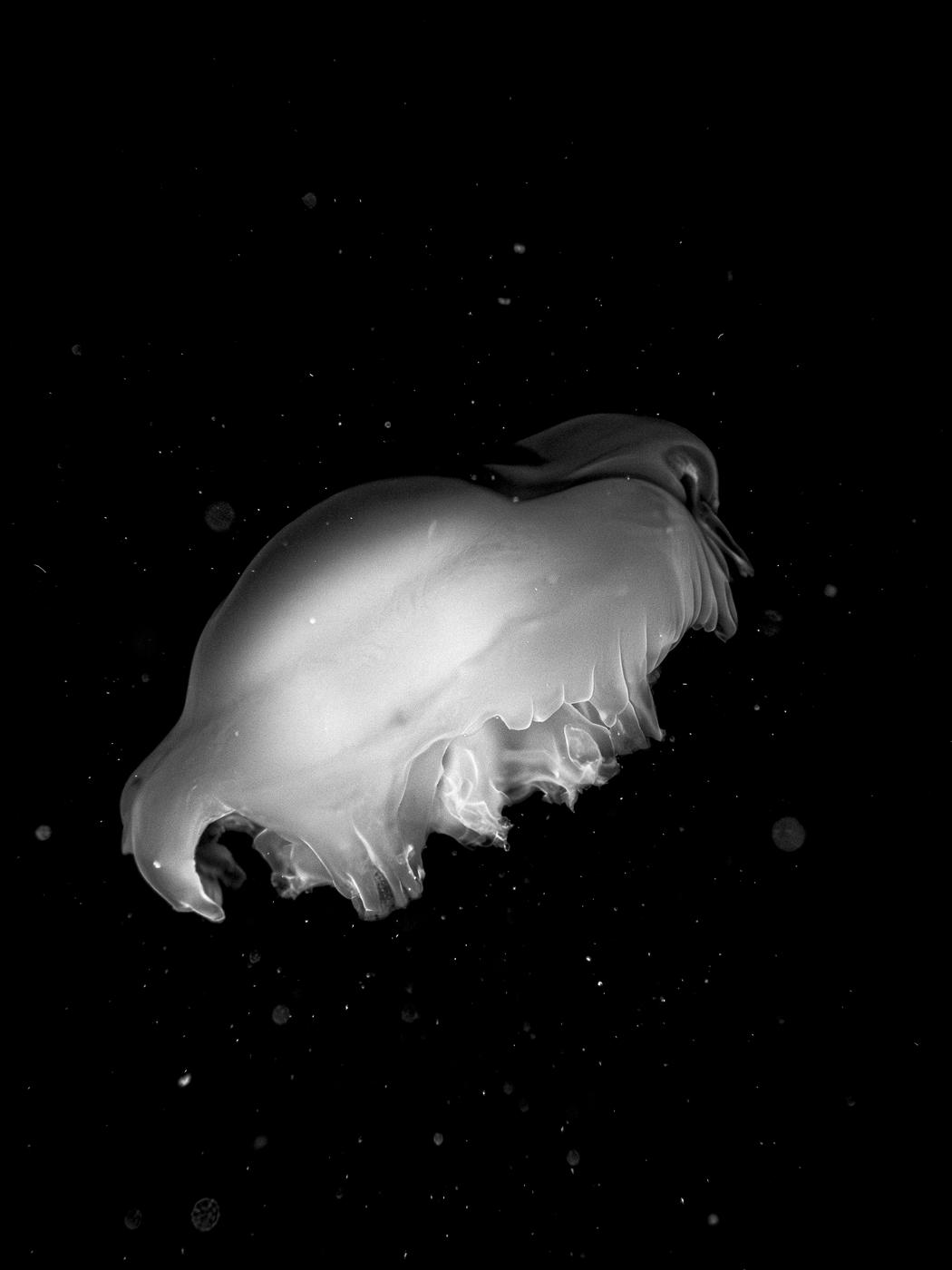 Alexandru Valentin Duta | Ghost Bloom III – Last Light
What does the title Ancient Dancer reveal about the way you experience time while watching a jellyfish move?
Jellyfish have always fascinated me. They are among the oldest creatures on Earth, having survived for over 500 million years. There is something incredible about that. They simply drift through the water, almost as if they have no concern for time.
During night dives, surrounded by darkness, watching them move can feel almost like being in space. Of course, I’ve never been to space, but we’ve all seen those cinematic images of astronauts floating in zero gravity. Underwater, we experience something similar. On land, gravity keeps our feet on the ground and limits how we move. Underwater, we become almost weightless, able to float freely in every direction. There is no floor beneath us to follow. We can simply drift through the water.
Combined with the darkness and the slow, graceful movement of a jellyfish, it creates an almost surreal feeling.
All these things together make me lose my sense of time. I can spend 70 minutes underwater and come back feeling as though only 20 minutes have passed. For me, Ancient Dancer captures that feeling of timelessness.
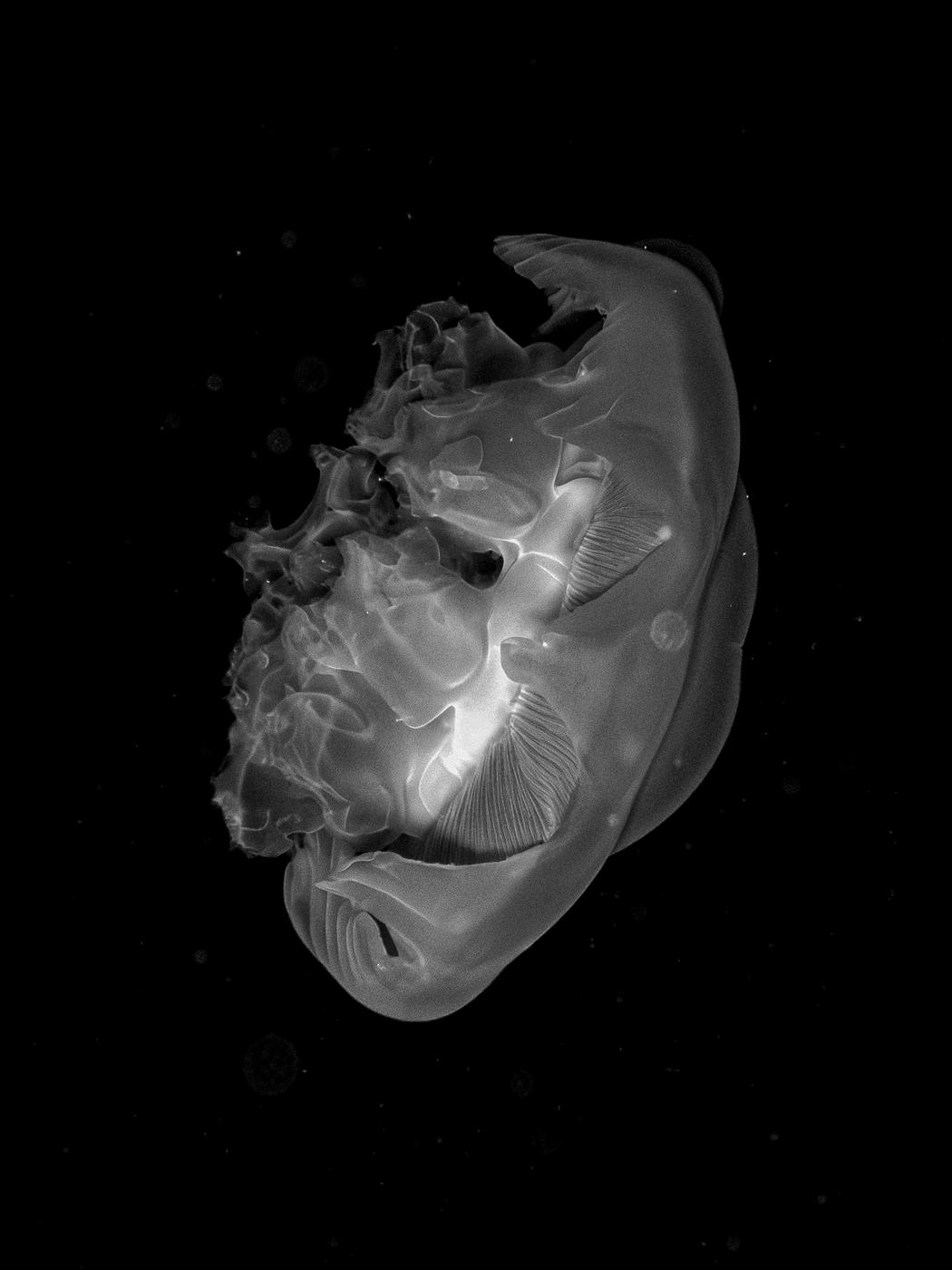 Alexandru Valentin Duta | Ghost Bloom I – Midnight Bloom
You describe night diving as both a source of tranquillity and an encounter with the unknown. Can you share a moment when those feelings came together and shaped a photograph?
One of my strangest encounters was with a flying gurnard during a night dive. We all have a general idea of what a jellyfish looks like underwater, but seeing a fish spread its wing -like fins and glide through the darkness is something quite extraordinary.
I started gliding alongside it. Sometimes I followed it, while other times it circled around me, almost as if it was curious about my presence. It didn’t seem frightened at all.
I ended up spending the entire dive with it, completely forgetting to look for any other marine life. I was so absorbed in that encounter that nothing else mattered. There was a strange tranquillity in simply following each other’s movements, while discovering something so unexpected. I think that’s where tranquillity and the unknown meet.
Your photographs can make familiar marine creatures appear almost extraterrestrial. What do you hope this sense of unfamiliarity opens up in the viewer’s relationship with ocean life?
We all know how beautiful the ocean can be with its vibrant colours and beautiful light, and I completely agree. But there is another side to it that I want to invite people to explore.
I want viewers to look differently, to question, wonder and become curious. By taking away colour, familiar marine creatures can take on an almost ethereal, extraterrestrial appearance.
I particularly like how, against a dark background, suspended particles in the water become visible, almost like stars surrounding a creature floating in space. I deliberately leave them in my photographs because I enjoy giving viewers the freedom to interpret what they see. Some of my friends have told me that certain jellyfish look as if they are floating between stars in space. That’s exactly what I love. allowing people to discover their own worlds within my photographs.
I hope this encourages people to look at familiar marine creatures differently and discover a little more mystery and fascination in the underwater world.
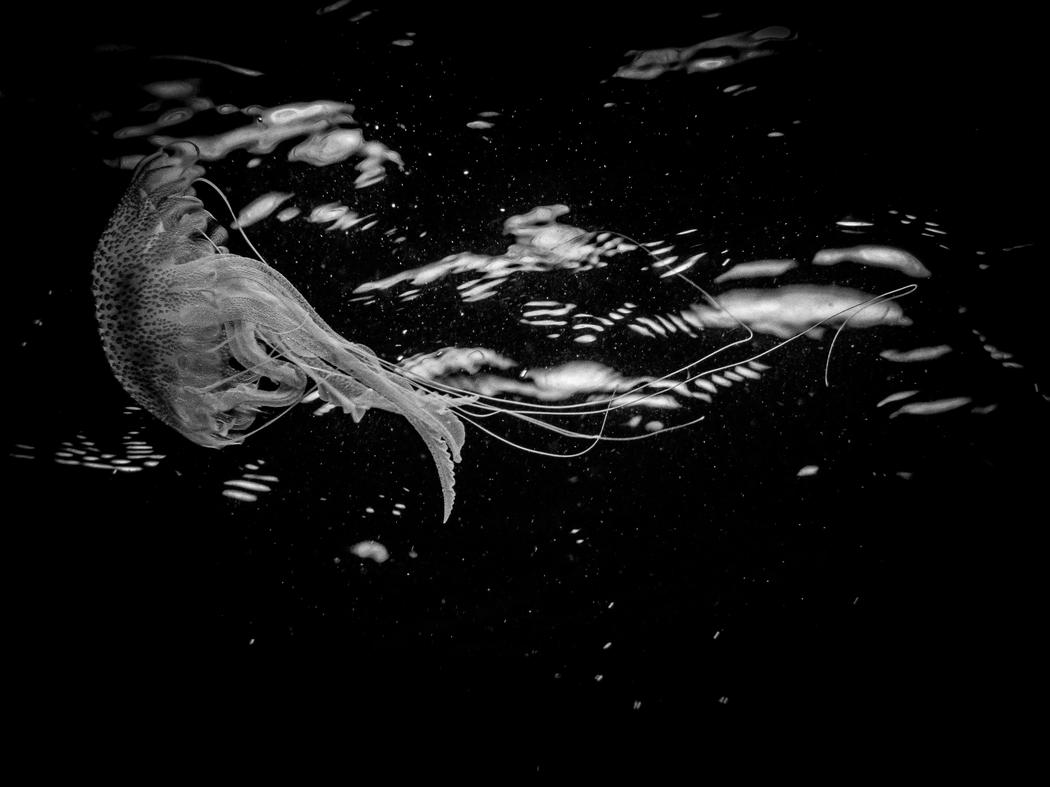 Alexandru Valentin Duta | Ancient Dancer II – Cadence
As you continue the underwater chapter of SOLACE, what would you like to explore that these photographs have not yet allowed you to express?
One of the experiences I’d most like to share through SOLACE is what it feels like to glide through the ocean in darkness, with my torch switched off and tiny particles of plankton floating all around me. Sometimes it feels as though I’m drifting through space, surrounded by stars.
Photograph 4 is an attempt to recreate that feeling. I used suspended sand particles and artificial light to represent the plankton floating around me. The difficulty is that the plankton is only visible in complete darkness. The moment I introduce artificial light to photograph it, I change the very conditions that make the experience possible. A camera cannot capture that exact feeling.
I’d love to find a way to communicate that experience more faithfully through photography. I
sometimes think that to truly understand what I mean, someone needs to experience a night dive themselves, switch off their torch, and simply float for a while. Then they might understand exactly what I’m trying to describe.
Perhaps in the distant future, camera technology will allow us to capture these moments more naturally, in almost complete darkness, with nothing but moonlight. That’s something I’d love to explore further with SOLACE.