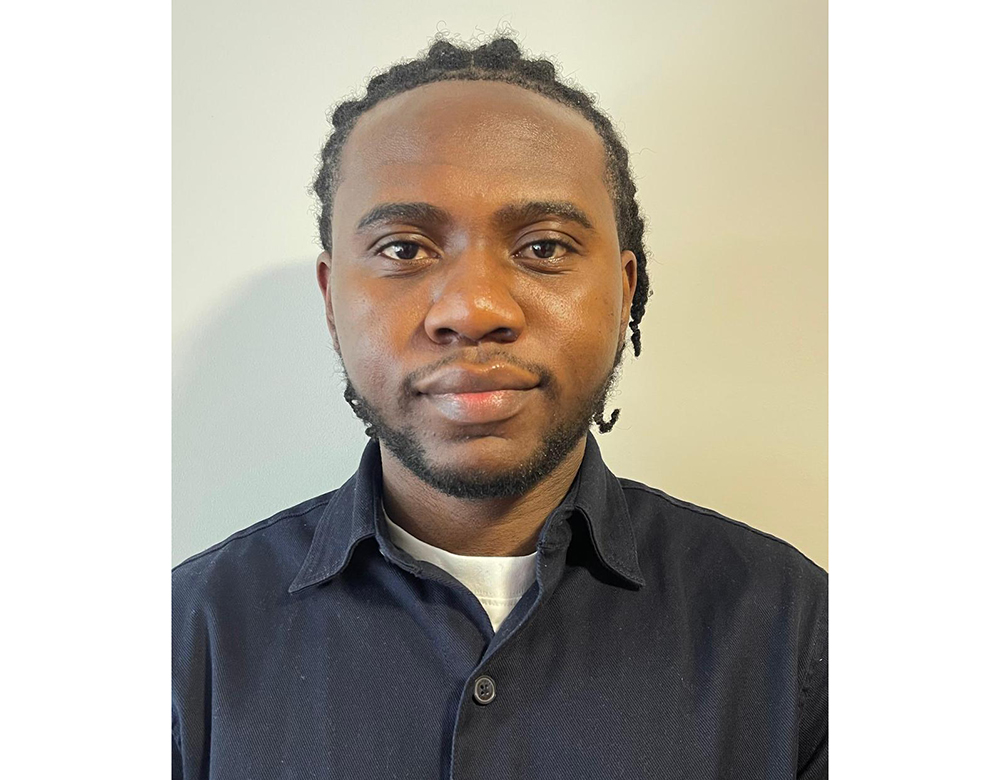
Tobiloba Majekodunmi
What personal experiences led you to centre Black women in your photography, and how has your understanding of this subject evolved?
I grew up in Nigeria surrounded by women who held everything together: mothers, aunties, teachers, women running businesses from a market stall. They carried a kind of authority that everyone around them understood. But when I started looking seriously at photographs, I noticed how rarely that authority made it into the picture. Dark-skinned women were often underlit, washed out, or framed through hardship and need. The camera seemed to see them less clearly than I did.
That gap is where the work began. In the early years I think I saw my role as correcting something, as if I had to prove a beauty that the world kept overlooking. Six years on, and after showing the work in both Nigeria and the UK, I understand it differently. The beauty and the strength were never in question. What I am really doing is paying attention, and creating conditions in which a woman can be seen the way she already sees herself.
I am also more honest now about my own position. I am a man photographing women, so I am not speaking for them. The portraits are something we make together, and the work only holds if that is true.
How do you build trust with the women you photograph, andhow much do their own ideas shape the portraits you create together?
Trust starts long before the camera comes out. I usually meet the women I photograph first just to talk: about the work, about what they want to be seen as, and just as importantly, about what they do not want. I share references and earlier images so they know the language I work in, and I ask about theirs.
During the shoot I show them the images as we go. If something does not feel like them, we change it. Nobody should leave a session feeling that something was taken from them.
Their ideas shape the portraits far more than people might assume. I bring the light, the structure and the ground the image sits on, but they bring presence, gesture and much of the styling. A painted band on the arm, the choice of nails, the way a hand rests near the face: these often begin with the sitter. Some of the closed-eye portraits came from a woman simply closing her eyes between frames, and that moment of rest turned out to be truer than anything I had planned. My job is often to recognise those moments and build the image around them.
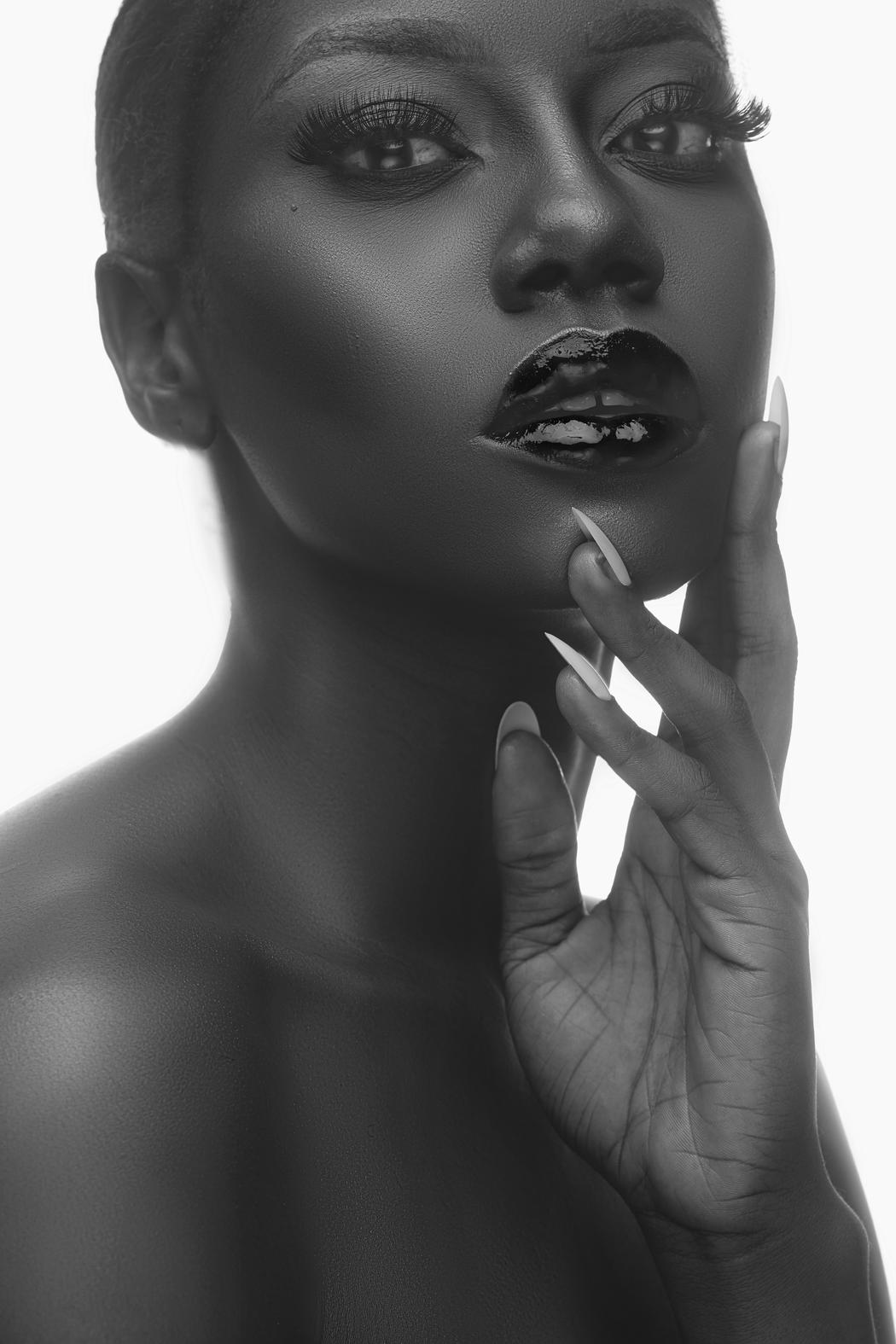 Tobiloba Majekodunmi | Shalom
Strength and resilience are central to your work. What place dosoftness, vulnerability and uncertainty have within your understanding of these qualities?
I think they are inseparable. There is a version of “strength” that gets attached to Black women which is really a burden: the expectation to endure everything, to never need rest, to always be hard. I am not interested in reproducing that. That image can become a cage.
For me, real strength includes the freedom to be soft. When a woman closes her eyes in front of the camera, she is allowing herself to be seen without guarding against the viewer. That is vulnerable, but it is also an act of self-possession. She does not need to perform for you.
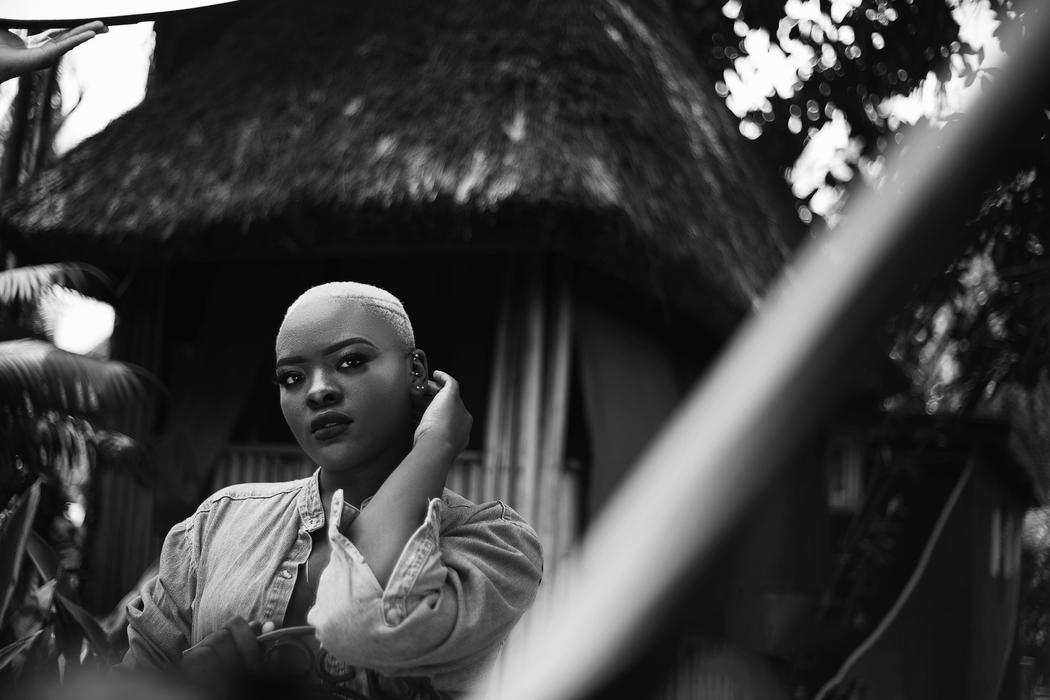
In Rock and River I think about this through the landscape itself. Stone feels like the obvious symbol of resilience, but water shapes stone over time. Softness has its own kind of power, slower and more patient.
Uncertainty matters too. Not every sitter arrives knowing exactly how she wants to be seen, and I don’t always know either. When I edit, I often keep the frames where something is slightly unresolved: a hesitant hand, a gaze that has not quite settled. Those images feel more human to me than ones where everything is certain.
You describe sculpting dark skin with directional light. What do you look for in the relationship between highlights and shadows when creating a portrait?
Dark skin holds light beautifully, but differently. It reflects, it carries undertones of red, gold and sometimes blue, and it rewards light that has a direction. Flat, frontal light tends to erase form, so I work with light that lets the face and body turn: you can see where a cheekbone rises, where the collarbone catches.
What I look for is a highlight that describes an edge, rather than one that simply makes the skin brighter, and a shadow that stays open and full of detail rather than collapsing into black. The shadow is not absence; it is part of the face. If the transition between the two is right, the skin reads almost like sculpture, with weight and volume.
I am very conscious that photography’s technical history was calibrated around lighter skin, and that dark skin has often been exposed as a problem to be solved. I approach it the other way round. Dark skin is the starting point the whole lighting is built around. The ground matters as well: a deep crimson background warms and deepens the skin, while a luminous white ground makes the figure stand out with real clarity. Each changes how the highlights and shadows speak.
How do you decide whether a photograph needs rich colour or black and white? What changes emotionally when colour is removed?
I choose colour when the relationship between skin, ground and adornment is part of the meaning: gilded lips against a crimson field, for example, where the conversation between warm tones is the whole point. In those images colour carries pleasure, presence and celebration.
I move to black and white when the picture is more about form, gesture and time. Rock and River is in black and white because removing colour puts the woman and the landscape on the same tonal register. Skin, stone, water and sky become part of one surface, and that is exactly the sense of belonging I want.
Emotionally, black and white slows the viewer down. It removes some of the immediate information so you start to read tone, texture and expression more carefully. It feels more interior, and it also loosens the image from a specific moment in time.
I am aware that the historic archive of Black women in black and white is often ethnographic, made by people looking at them rather than with them. So I take printing seriously: rich, deep blacks, a full tonal range, real detail in the darkest skin. The monochrome has to feel like dignity, not distance.
Skin texture remains visible in your carefully styled studio images. What principles guide your approach to retouching and the way you represent skin?
My main principle is simple: remove what is temporary, keep what is permanent. Dust, a stray hair, a mark that wasn’t there yesterday, those I may take out, especially if the sitter asks. But pores, texture, scars, stretch marks and the natural variation of the skin stay unless she asks me otherwise. That texture is the evidence of a living person.
I never lighten skin or shift its tone. For a long time the beauty industry has smoothed dark skin into something plastic and uniform, and I don’t want to participate in that. Most of my post-production work is about shaping light rather than altering skin: dodging and burning to strengthen the form that was already there in the studio.
The styling in my studio images is deliberate and polished, so the visible texture creates a balance. The makeup and adornment are a performance of self-possession, and the skin underneath reminds you that this is a real woman, not a surface. The women I photograph also see the final edits. It is their face, and they should recognise it.
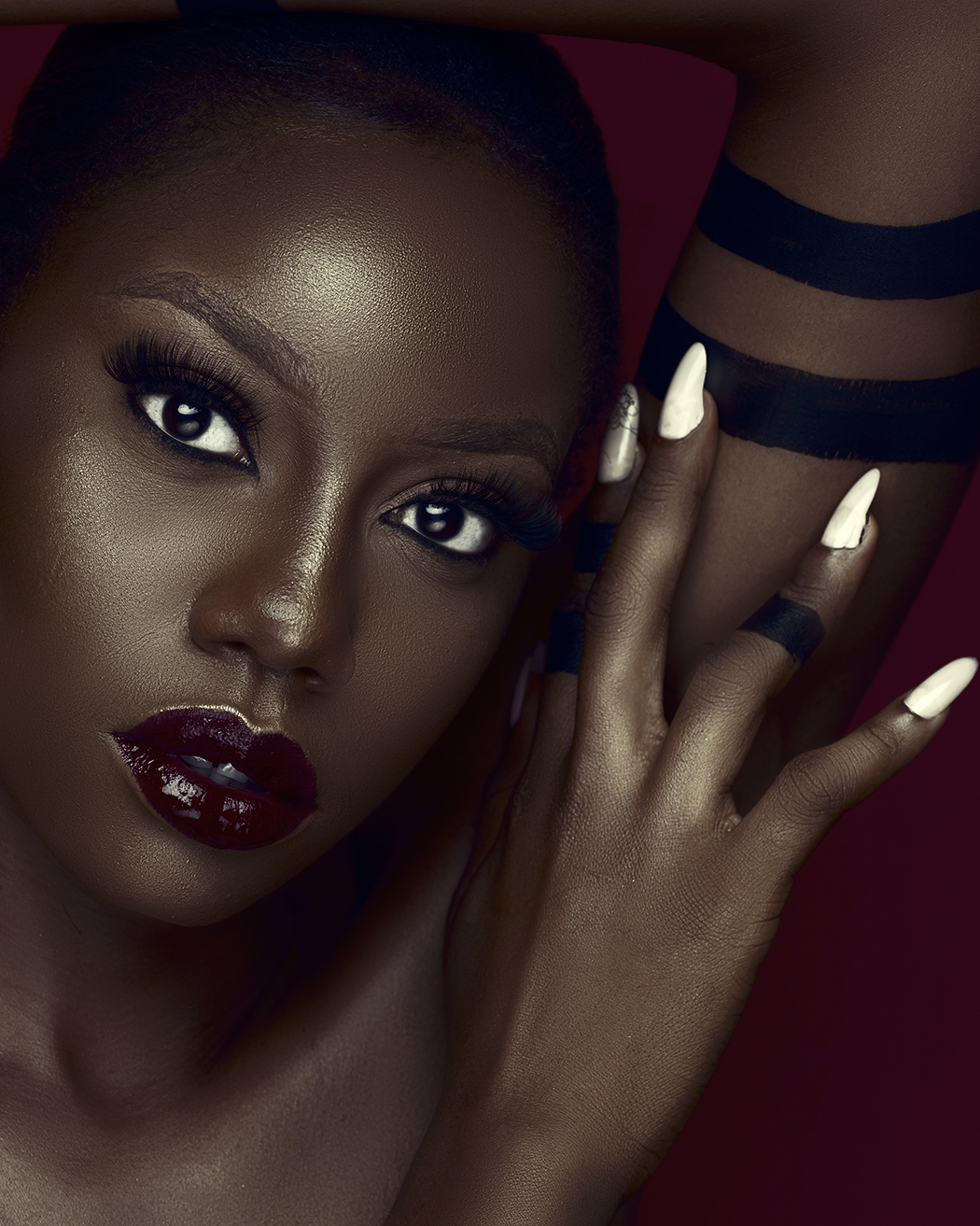
You want your photographs to make viewers slow down and look again. When selecting your final images, what makes you feel that a portrait can sustain that attention?
I edit slowly. I often print a selection and live with it for a few weeks, and the images that keep holding my attention are the ones that survive. If I understand everything in a photograph at first glance, it usually doesn’t make the final edit.
What I look for is a portrait that keeps something back. There is often a tension between stillness and something unresolved: the position of a hand, the weight of a gaze, the way a shadow falls across part of the face. That small tension invites you to return.
The gaze itself is central. Either the woman closes her eyes and you feel you are witnessing something private, or she looks directly at you and you have to hold that look.
Both ask the viewer to take responsibility for how they are looking.
Finally, I think about whether the image belongs to her as much as to me. When the sitter sees the picture and recognises herself in it, not an idealised version but herself, that is usually the portrait that can sustain attention, because there is real presence in it.