Ivelina Stoyanova – Still Her
Ivelina Stoyanova – Still Her
by Anna Gvozdeva
Captaloona Art Gallery, Madrid · 28–29 September 2026
One Image, Many States
Ivelina Stoyanova contributed a single framed print to the exhibition at Captaloona Art Gallery in Madrid, and it held its wall with unusual authority. A Bulgarian photographer and researcher working between documentary and fine art practice, Stoyanova treats the photograph less as a record than as material to be worked on. Still Her (2026) takes one portrait of a woman and subjects it to fragmentation, layering, concealment and alteration. The project’s wager is that the sitter stays recognisable while never quite remaining the same.
The Tear as Method
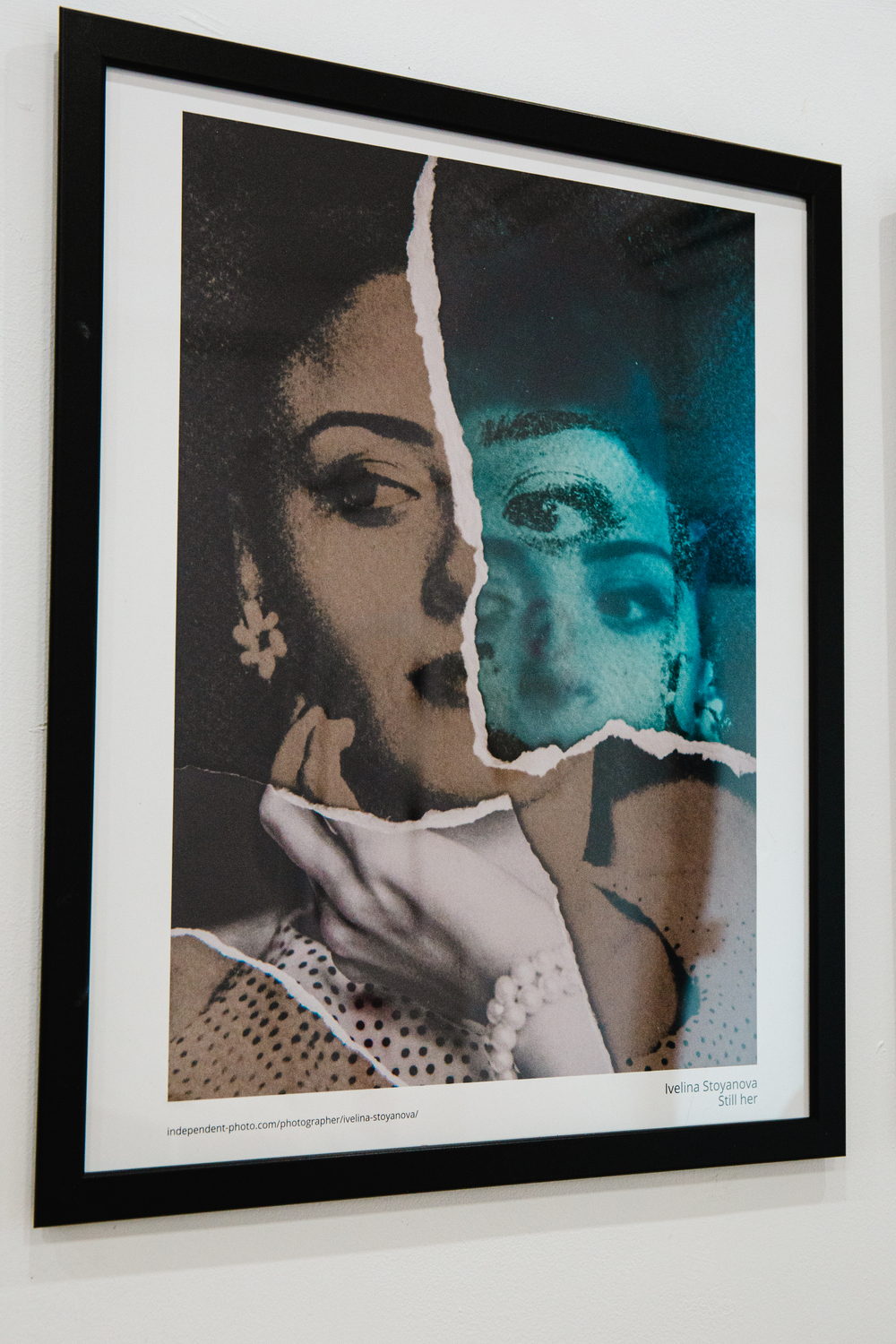
The exhibited image compresses that process into one surface. A warm, sepia-toned portrait fills the left side: a woman with a flower-shaped earring rests her fingers against her jaw, eyes turned aside, in a pose borrowed from mid-century studio glamour. A ragged vertical tear opens onto a second layer of the same face, printed in cold cyan and set slightly off register. Its features refuse to align with the first; an eye appears where a brow should be, so the face seems to look twice – once away from us, once straight at us.
A second, horizontal tear exposes the lowest fragment: an untreated section of the original black-and-white photograph, showing the hand at the chin, a bracelet that appears to be pearl, and polka-dot fabric. It reads as the series’ point of origin, a glimpse of the image from which every transformation began. The white, fibrous edges of the tears act as seams between states, and they carry the work’s argument. Identity here is neither lost nor restored; it is stacked, and each revision leaves the earlier one partly visible.
The title earns its ambiguity. “Still” reads as persistence – she remains herself despite the damage – and as the photographic still, the arrested frame. Stoyanova holds both meanings without forcing a choice.
On the Wall
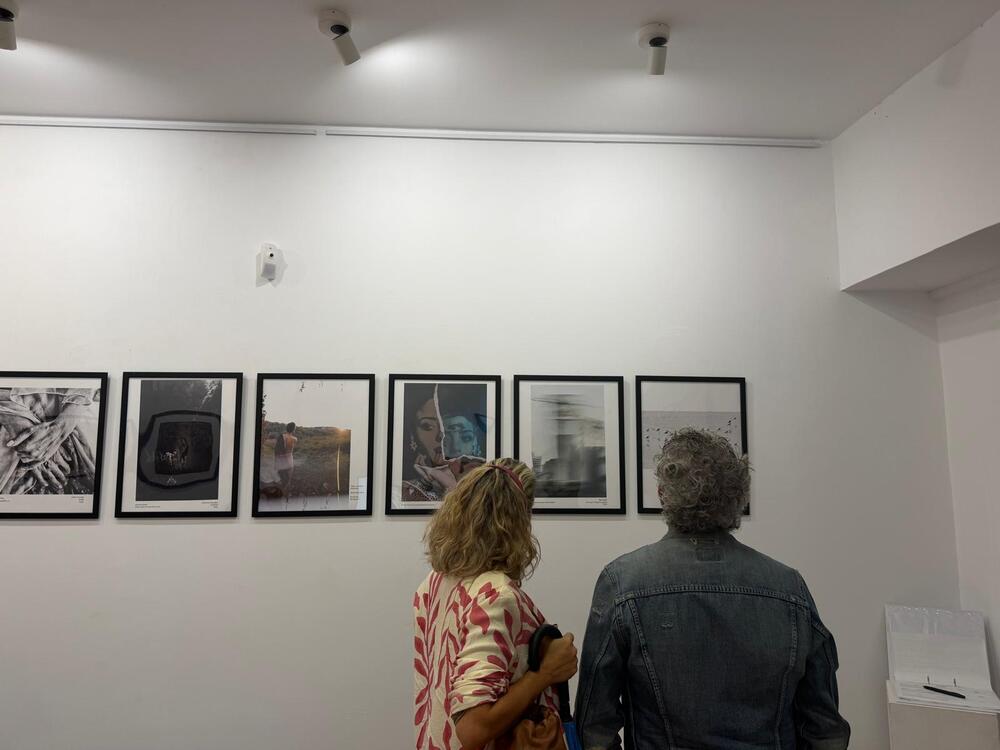
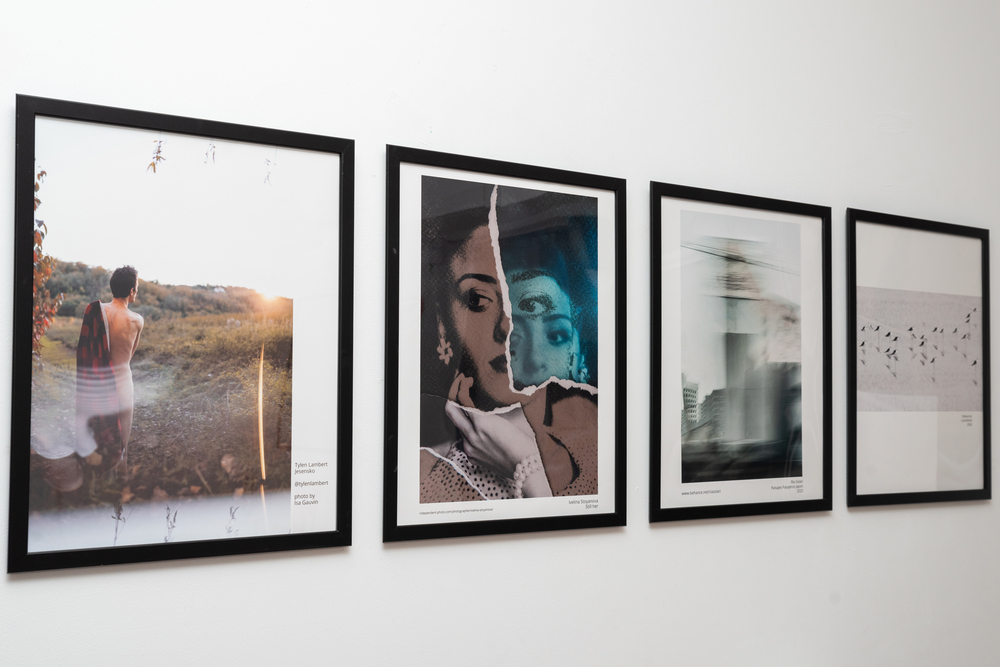
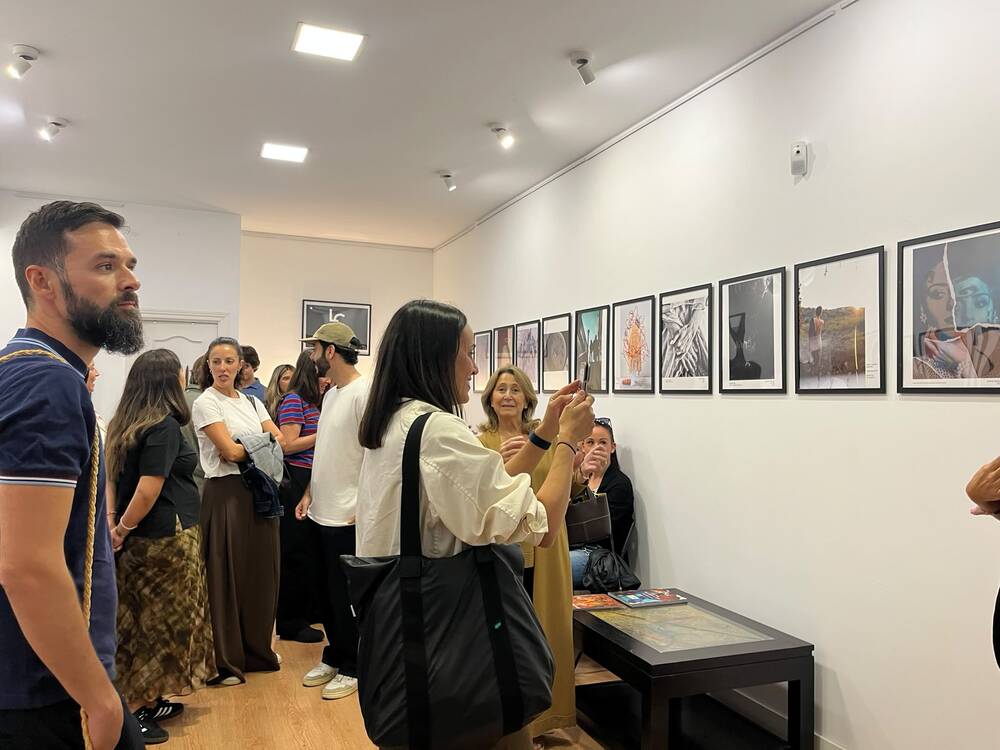
The work hung in a single eye-level row of uniformly black-framed prints with generous white margins. Its neighbours leaned toward muted tones, soft-focus landscape and blurred urban motion; against them, Still Her was the most saturated and graphically dense image in the sequence. Placed at the end of one wall, it worked as a visual full stop – the image the eye lands on first in the installation views. Its closest dialogue was with an adjacent blurred cityscape. Both treat the photograph as an unstable surface, but Stoyanova locates that instability in a human face, which raises the emotional stakes considerably.
Assessment
The strengths are clear: a precise central idea, a confident colour contrast, and a structure in which form and content coincide. The tear is not decoration; it is the method made visible.
Torn-paper imagery has become a widespread graphic idiom, and the work’s force depends on the precision of its specific choices. Stoyanova meets that test: the displaced eye and the cold cyan layer turn a familiar effect into a statement about looking and recognition. In places the tears follow the contours of the face almost too neatly, guiding the eye rather than unsettling it; later states of the series could afford to take more risk. Equally notable is how much of the project a single state of Still Her contains. Through its layers the whole arc of change can be sensed, from the original photograph to its new versions, and the viewer completes the series on their own.
The retro styling – pearls, polka dots, the studio pose – also needs careful handling, since nostalgia can easily overpower inquiry. Here it mostly serves as a reminder that the feminine image has always been constructed. Still Her is an intelligent, visually arresting work by a photographer whose most interesting material is the photograph itself. The series is well worth following as it develops.