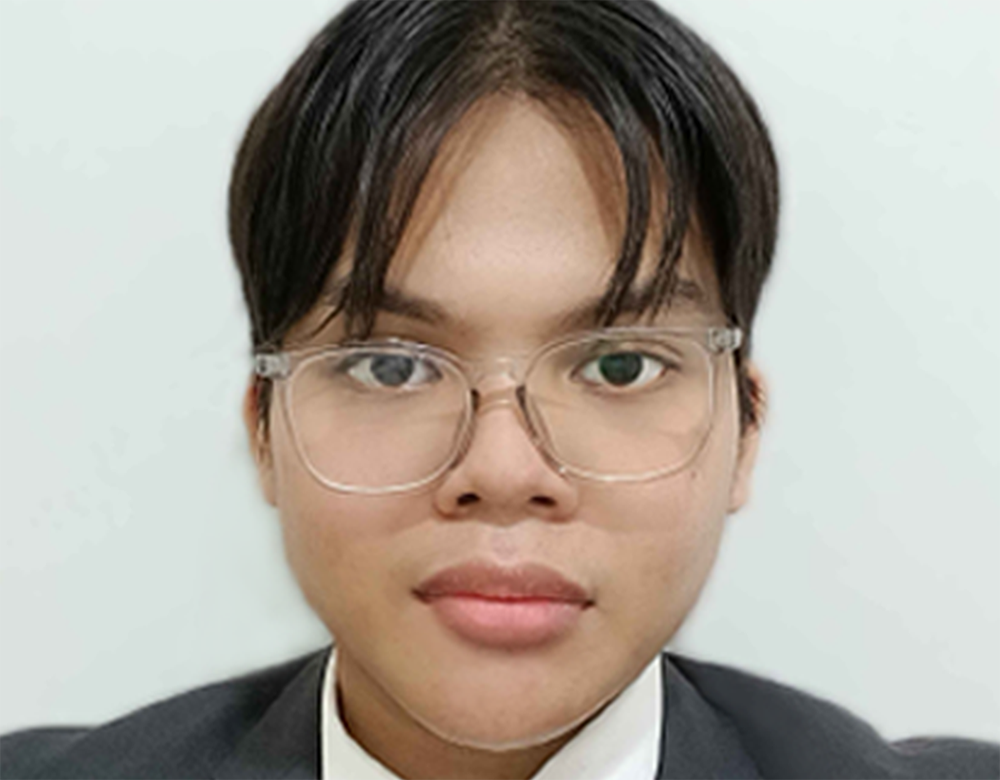
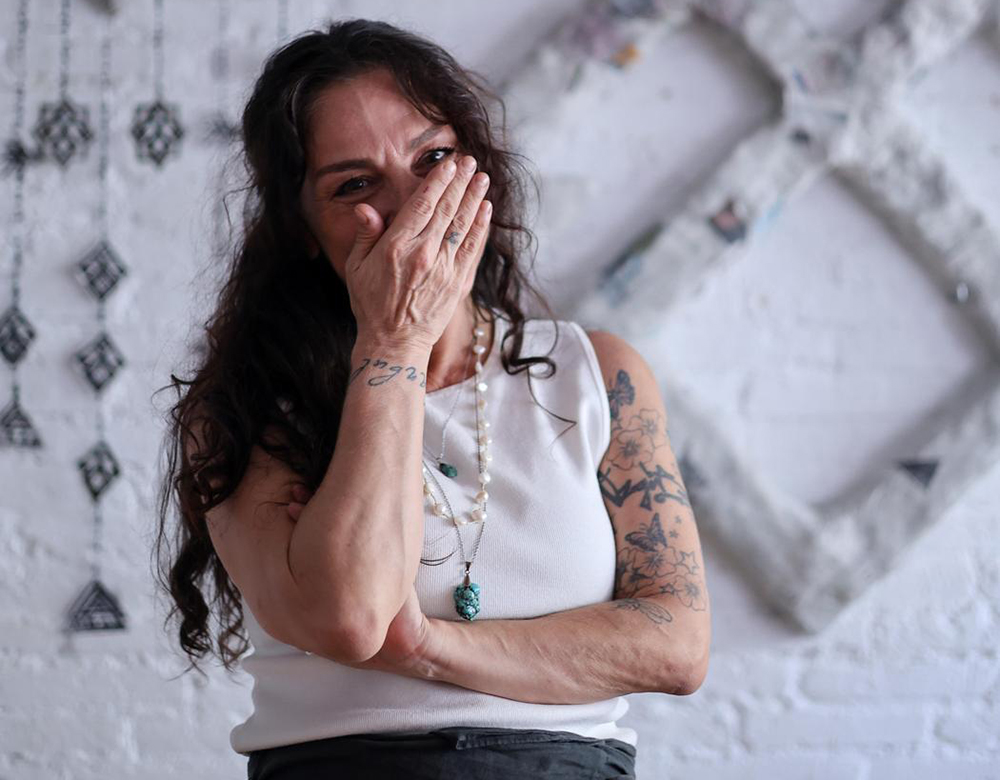
Derya Alibaş
Your younger sister’s gift of colors and a canvas marked the beginning of your painting journey. How has the role of art in your life changed since that first encounter?
I discovered my love for colors and textures in 2003, when my younger sister gave me an easel and oil paints as an outlet for my emotions. As a single mother, I had to be strong. This ever-growing passion led me to work as a makeup artist after I finished evening school in 2007. Later, I founded my brand, Jingle Jangle, and my mixed-media collages evolved into scarves, kaftans, and kimonos.
Art had always been a part of my life, even if I didn’t fully realize it at the time. The more experience I gained, the more inspired I became.
You describe your grandmother through vivid memories of henna-coloured hands, Turkish carpets, calligraphy, and mosaic lights. How do these memories find their way into your work today?
These memories are constantly unfolding for me. My grandmother is a heroine of her own life—just like my mother, and myself— and I believe all women who have hit rock bottom time and again and have risen back up despite it all, are defying everything and everyone!
I recall entering a room and seeing my grandmother praying, surrounded by calligraphic prayers on the walls and carpets featuring motifs that told a different story from that of the woman who cleaned for the postal service by day and worked—among other places—at IBM in the evenings. This is the same woman who had to leave her little village behind, travel to the big city of Istanbul with her five children and work as a cleaner in other people’s houses. So my grandpa left for Germany and soon after his family followed.
Her example to be creative in different ways still inspires me to this day. It’s unimaginable, even thinking now , that they moved to a country without speaking the language and especially without being able to read or write. Back then, girls didn’t go to school in most of the villages in Anatolia. Yet, despite such hardships and barriers, my grandmother still managed to raise her children as well as her grandchildren, helped people in need, bought herself land and apartments to save enough money, and left the heritage behind to her five children.
That is why I feel a constant, conscious and unconscious urge to revive my culture within myself. In my opinion, our history classes were not very well taught in Germany back in the 70s and 80s.
It was shameful to be türkisch (the garliceaters) back then or to have specific religious beliefs so it was sentences like ‘oh you’re so pretty you don’t look Turkish!’ that made you feel a sense of belonging. And in the teenage years you think it is better to be German. Because you’re born there.
But if you’re curious enough and with time and wisdom, you discover another version of history and not the one taught in European schools. My passion for history definitely led me to investigate more about my heritage and I felt deeply amazed learning about the depth, vastness and richness of Turkish history & culture.
So connecting with my grandmother before she passed away is still one of the greatest gifts I hold onto. I remember asking her about her happiest moments , her biggest regrets and her life in general and her answers unchained something in me.
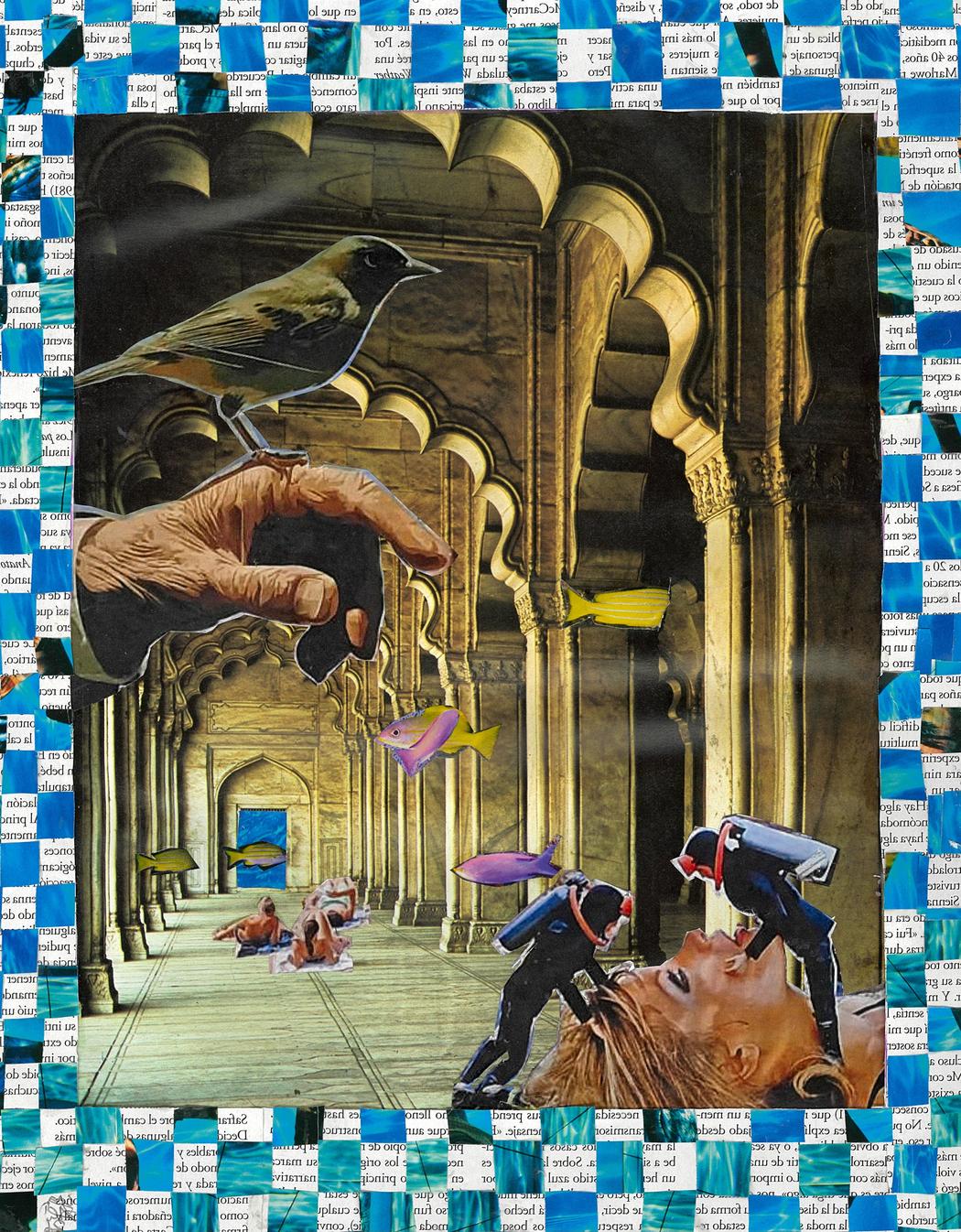 Derya Alibaş | Insidethanout | 2026
You describe your mother as having a musical soul. Does music influence the rhythm, atmosphere, or composition of your art?
Yes, I’d say so. My mother was always singing and certain songs trigger an automatic explosion of ideas in me. Most of the happy memories I have of her are from the times she was happiest: singing either alone or in front of an audience. so she showed me it is never to late to fulfill dreams as she started singing with a Turkish choir in Frankfurt.
Having lived in Germany, the Caribbean, Türkiye, and Spain, how has your understanding of home evolved, and how does this appear in your visual language?
Growing up in Germany, I always knew I didn’t want to live there. My first attempt at living in Istanbul didn’t go so well—I was too soft for the city. My entire life changed when I had the chance to step aboard the yacht Stormvogel 1961 with my then-boyfriend (now my husband). I found my home at sea; it was on that yacht in the West Indies that I created the collages I use for fabric printing. The water is my home. My name, Derya—an Old Persian word for “sea”—is constantly reflected in my art.
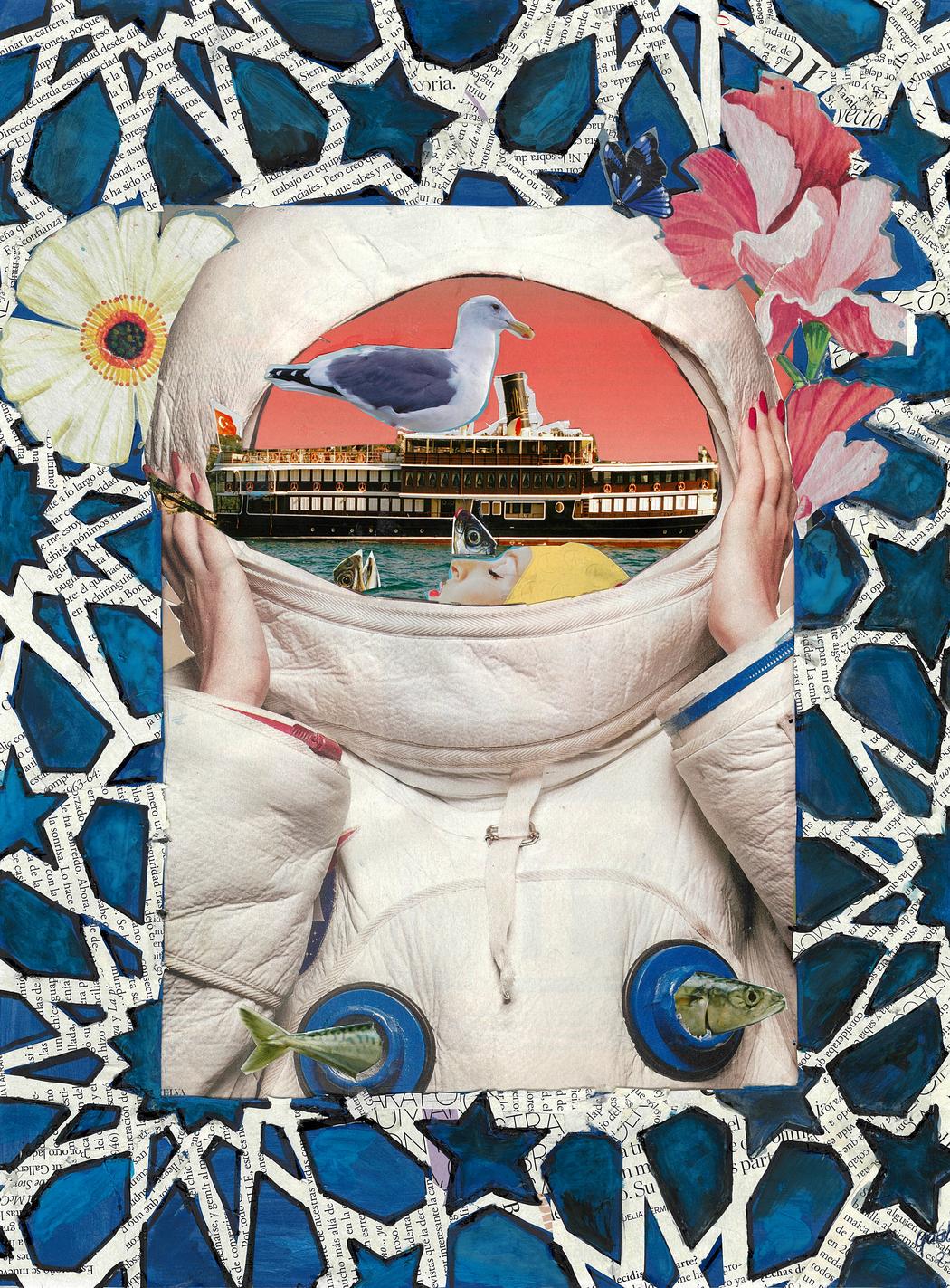 Derya Alibaş | Astrobul | 2025
The strength and unity of women are central to your practice. How do you translate the idea of women holding and supporting one another into artistic choices?
This applies more to my upcoming exhibition. Although I channel this energy through my collages and am inspired anew every day by the strong women in my life, it relates more to the female legacy art project I have been working on for about two years—and which will be the subject of my first solo exhibition at the Abyss Artspace in Valencia in February 2027.
You describe birds and hands as expressions of a divine presence. How do you approach depicting something invisible through familiar, everyday images?
I think that because I have long engaged with Turkish art, literature, and carpet motifs, it has an unconscious effect on my art—meaning I don’t start by making a plan or a sketch. I work towards the piece, and it develops on its own; I let my subconscious do the work for me.
What would you like to preserve from your female ancestors, and what would you like to transform or pass on in a new form through your own work?
I want to preserve their creativity, their strength, and their connection to nature, their nurturing souls as well as the knowledge they carried in their hands and hearts. My grandmother passed on her knowledge through handwork; my mother, through her voice and her connection to music and nature. Their forms of expression differed, yet both were creative ways of connecting with life.
For me, it is not merely about preserving these things as memories; I want to transform them and pass them on in a new form. That is precisely what “The Female Legacy” is about: asking what we inherit, what we carry within us, and what we pass on to the women who come after us. I believe that something greater can shift when women begin to honor the wisdom of their mothers, grandmothers or just woman they met along their path. And when we support one another. Perhaps the world can change through this reconnection.