
Ayla Canay
Your artistic practice brings women’s unseen stories into public view. What personal or social experiences first led you to focus on women’s lives, roles, and struggles?
As a woman from my region, I have often felt expected to be strong and resilient. The changing political orientations and the policies and discourses directed at women have, over time, become part of my own personal experience. I began to express the emotional and intellectual impact of these changes through the artistic language I know best. My ceramics have become a visual record of the traces this political atmosphere has left on me. Therefore, my work is not only a reflection on the social position of women, but also an exploration of how the political and social transformations of the place I live in resonate within my personal world.
In the Dependency series, the wedding ring becomes the central visual form. Why did you choose this symbol, and how does its meaning change when translated into ceramic sculpture?
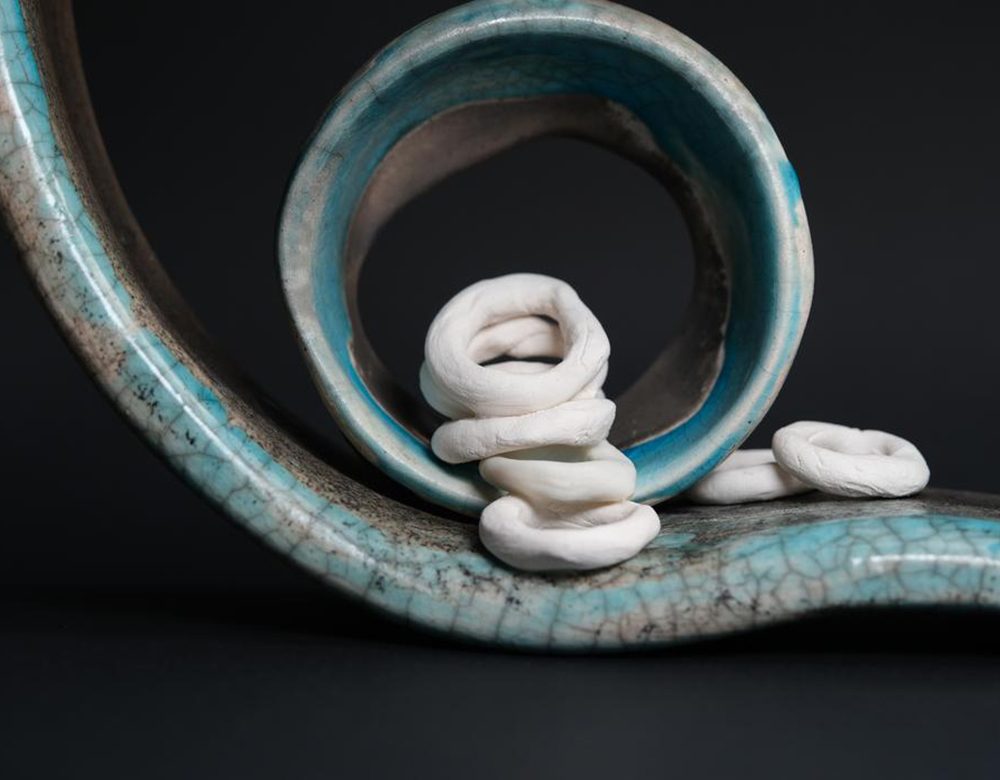
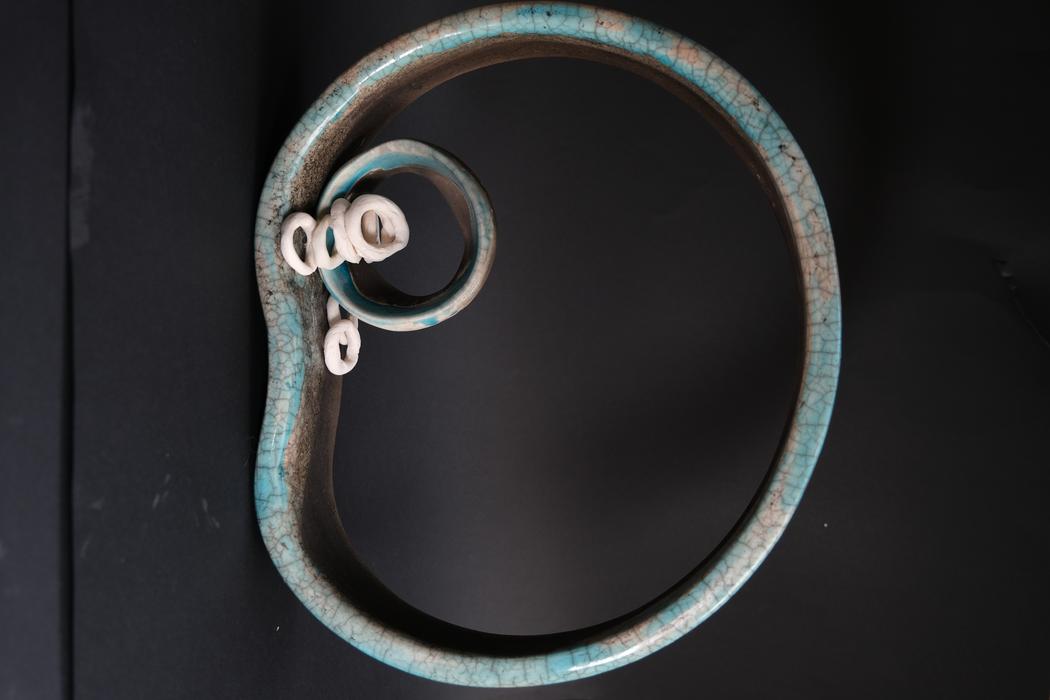
The main reason I chose this symbol is because it represents the concept of commitment. Traditionally, the wedding ring is a symbol of commitment, continuity, and togetherness between two people. However, I question the way relationships function today, where partners can change very quickly and relationships may begin and end with equal speed. By reinterpreting the wedding ring in my work, I explore what commitment means in contemporary relationships.
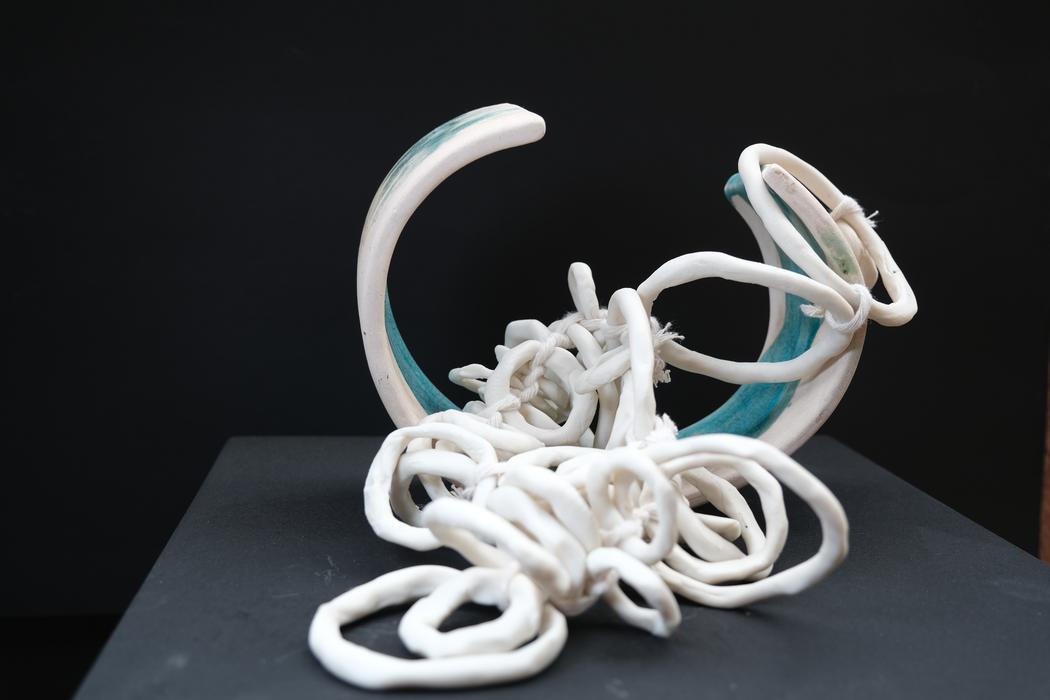
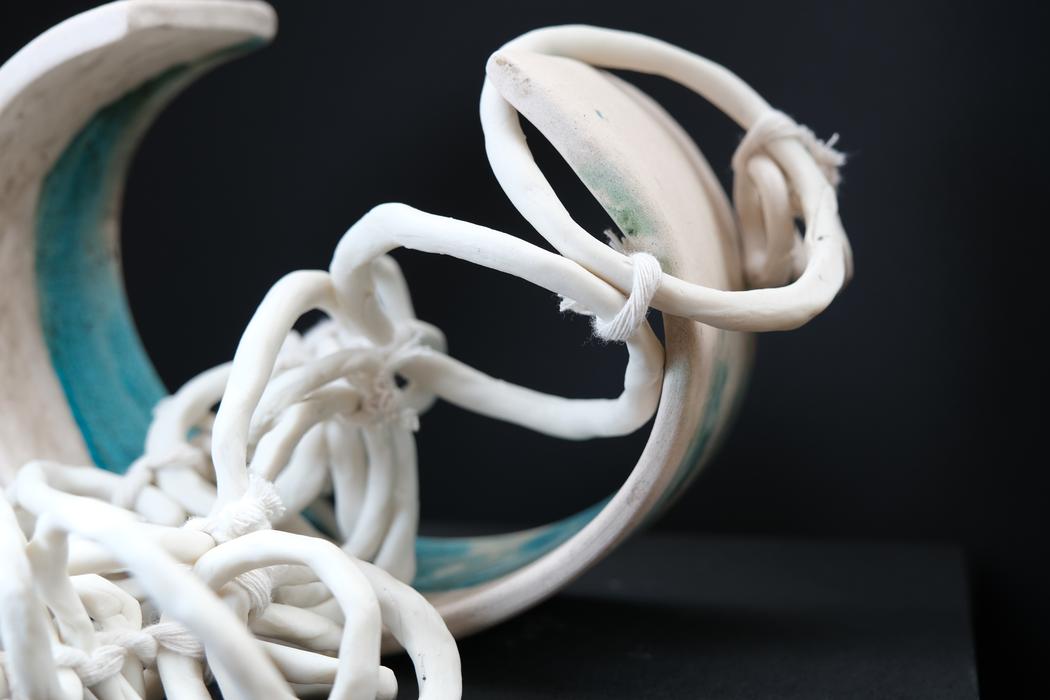
In my ceramic sculptures, the ring-like forms are connected, creating a larger structure. When these individual forms come together, they depend on one another and create a stronger whole. This structure makes visible the strength of connection and makes me think about how a meaningful bond is not simply about being together, but about creating a relationship in which two people can support and strengthen one another.
 Ayla Canay | Dependency | 2026
Some of the ring-like forms appear complete, while others are open, distorted, intertwined, or broken. What emotional states or stages of a relationship do these different forms represent?
I believe that everything in the universe is constantly changing, transforming, and remaining in motion. The same is true of relationships. I think that searching for perfection in a relationship inevitably leads to disappointment. That is why I am drawn to forms that are imperfect and constantly changing. For me, these imperfections reflect the natural process of transformation and the ever-changing nature of relationships.
The works explore the tension between forming meaningful bonds and preserving personal freedom. Do you see commitment and independence as opposing forces, or can they coexist?
I don’t believe that commitment and independence are contradictory; I believe they can coexist. Of course, this depends on how we define freedom. For me, being committed to someone does not mean possessing or restricting them. It means witnessing the journey of someone you love, giving them the space to follow their own path freely, and being able to grow together along the way. I believe that true commitment is not about limiting one another, but about being able to walk side by side while respecting and protecting each other’s freedom.
 Ayla Canay | Dependency | 2026
Your statement suggests that multiple partnerships and emotional impermanence may arise from an inner sense of emptiness. How do the sculptures give physical form to this emotional void?
For me, emotional emptiness is not necessarily a sense of deficiency, but rather a space that we constantly try to fill through our relationships and the connections we form with others. When we move too quickly from one relationship to another, we may sometimes be trying to escape that inner space rather than truly experiencing it. My sculptures explore the tension between our desire to connect and the feeling that something within us is still missing. The spaces within and between the forms become a physical representation of this emotional void. However, this emptiness is not entirely negative for me; it can also become a space for self-discovery and for reconnecting with oneself.
Your wider practice addresses gender, family structures, and political events. How is Dependency connected to the social expectations placed on women within marriage and contemporary relationships?
Although the roles within marriage vary from one society to another, in many cultures women are expected to establish, maintain, and hold the family and home together. In Turkey, there is a saying, “The female bird builds the nest.” This expression clearly reflects how responsibilities and emotional burdens within the family are often placed on women. In my Dependency series, the shine of the gold and yellow tones I use on the wedding rings also refers to these expectations. While the wedding ring symbolizes love, commitment, and togetherness, it also makes visible the expectations placed on women to be the ideal wife, the ideal woman, and the person responsible for holding the home together.
 Ayla Canay | Dependency | 2026
You teach Basic Design and Drawing Techniques in the Department of Textile and Fashion Design. How has teaching influenced your own approach to materials, form, and artistic experimentation?
Working in the Department of Textile and Fashion Design has had a significant influence on my approach to materials and form. I sometimes incorporate textile materials into my ceramic and artistic practice, and one of my textile works was awarded second prize at an International Textile Biennial. This experience has allowed me to move freely between different disciplines and materials. For me, what matters most is finding the material that best serves the idea I want to express. I believe that when an artist has something they truly want to communicate, any material can become a means of giving that idea a physical form.