Erika Somerfeld
Your work often moves between floral imagery and abstraction. What draws you repeatedly to flowers, leaves, and other organic forms?
Flowers and organic forms are the ultimate expression of life. They reach a breathtaking peak in their youth and then gradually begin to decay, revealing distinct stages of beauty throughout their cycle. Beyond that obvious transformation, I am endlessly drawn to the hidden colors, lines, and shapes buried within them.
For me as a Taurus—an earth sign—including floral or organic elements brings a sense of hope, which I deeply need to keep creating.
Many of your compositions are densely populated with marks, fragments, and overlapping shapes. How do you know when a painting has reached the right balance between abundance and visual clarity?
I’d be a true genius if I always knew when to stop! In all honesty, I often prefer the second draft of a painting over the third because it carries more raw spontaneity. As both a woman and a painter, I have a lot to say. It’s always easy to take away when a piece feels overcrowded, but it requires real intent and vision to add to a painting once it has found its form.
I was once commissioned to create a six-foot abstract piece using a palette of marigold and burgundy. Near the end, I knew it still needed something extra. I took a leap of faith, using a rainbow of fine-point acrylic pens to weave delicate, multicolored lines throughout the entire composition. Taking that risk made the piece pop.
Texture plays a central role in your practice. What materials and techniques do you use to build the physical surface of a painting, and how much of this process is planned in advance?
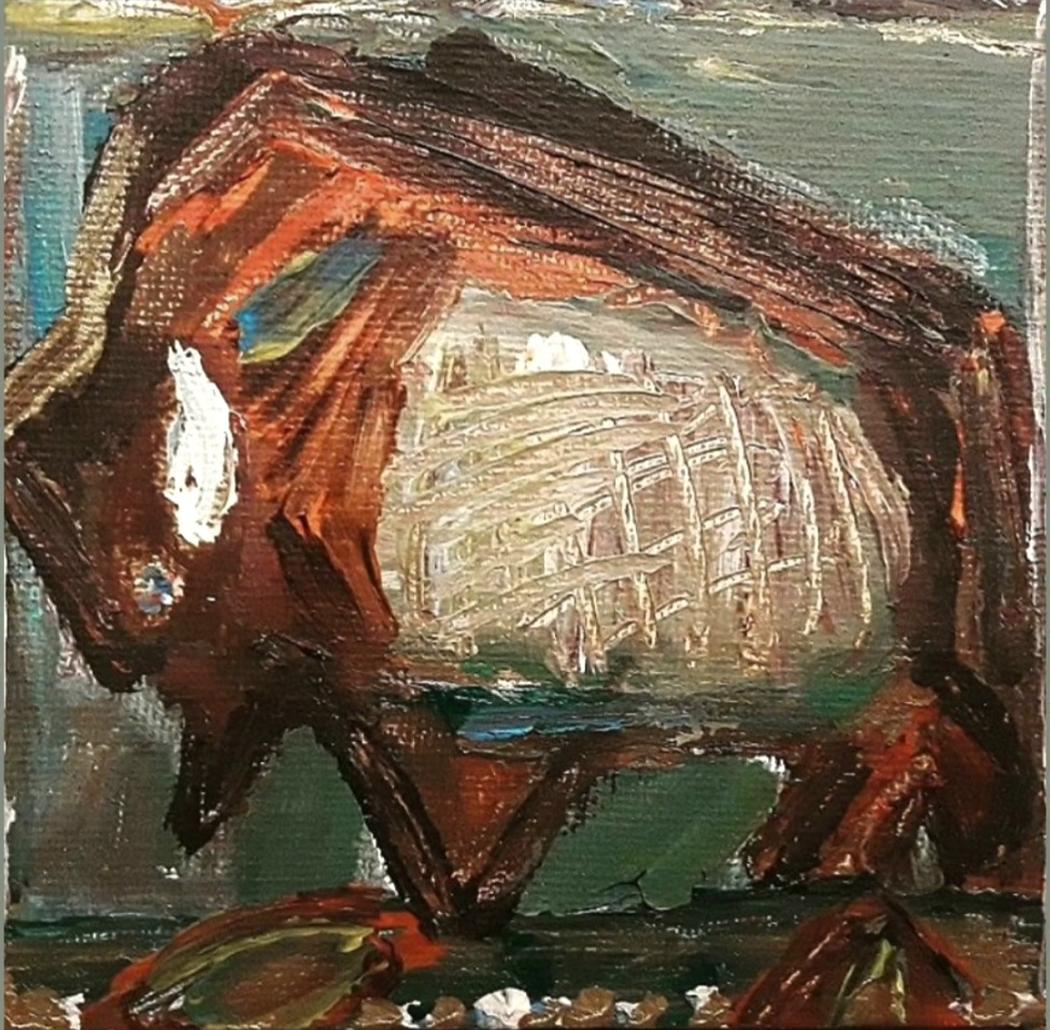
Texture is essential to my work; I wouldn’t be interested in the medium without it. That said, I rarely venture into three-dimensional assemblage—I’m not interested in attaching stones or heavy objects to the canvas.
At most, I’ll paint over collage paper, though there’s truly no limit to how many layers of paint I’ll build up. As a mosaic tile designer as well, I’ve learned to glue and layer American pennies to elevate images.
A friend once remarked that I practically “murder the canvas” before bringing it back to life! I have to get physical in art. I’ll take a blade to the full sides of the work to lift the paint away from the canvas. I almost always expose the raw linen and frayed edges in a spot or two to honor the physical, tangible aspect. In my painting of a red cowboy boot, I frayed the linen on the right side of the canvas to mirror the fringe trim of the boot itself.
Once a painting is completely dry, I’ll often place it under hot water and scrub it to pull up the underlying layers. It’s a nerve-wracking technique, but the payoff is worth it. Whether through abrupt brushstrokes, scrubbing away color, or chipping paint with a palette knife, I paint purely from emotion.
Your fractured layers allow earlier colors and gestures to remain partially visible. Do you think of these concealed elements as a kind of memory or history embedded within the work?
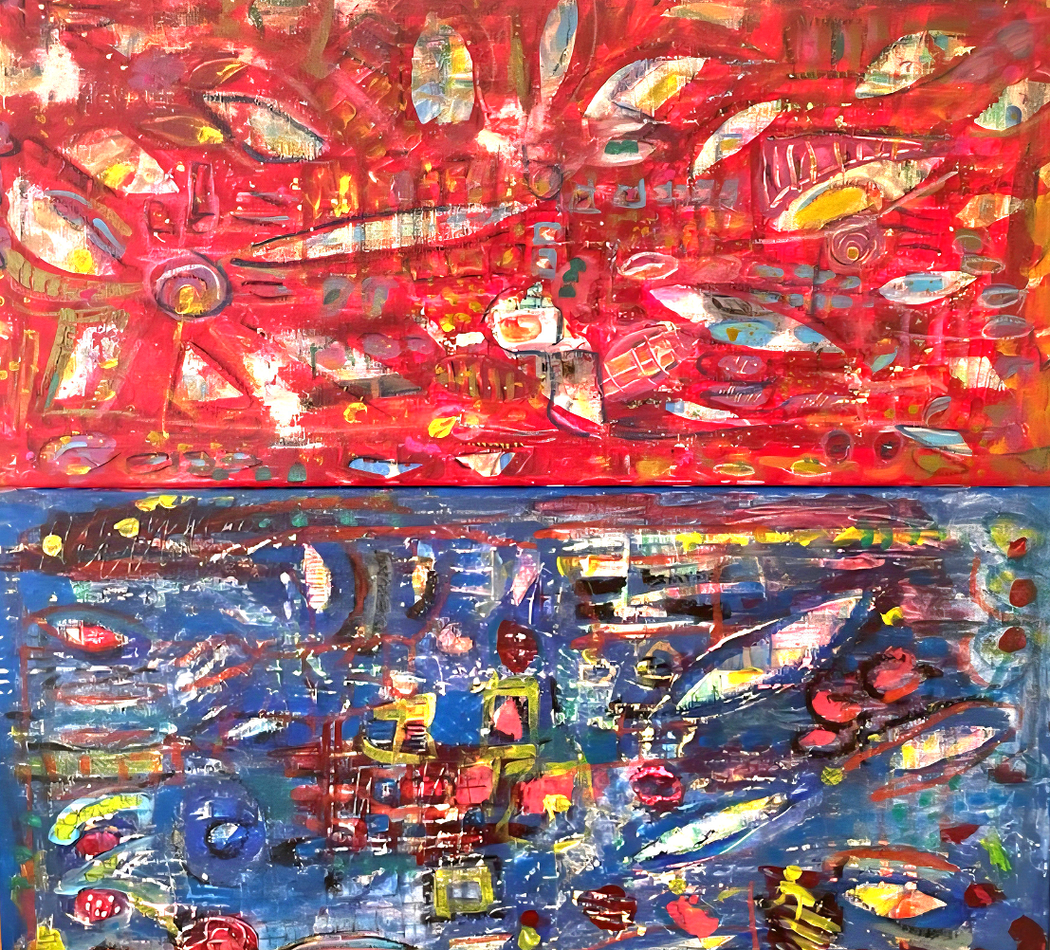
Starting with multiple layers frees me from worrying about art theory, perfect shapes or complementary colors early on. I can play, never knowing what will survive the final draft. I often use the bottom layer as a personal journal, handwriting and chronicling dramatic thoughts and feelings. Knowing those written marks exist underneath makes the painting very personal. If I care to, I can later wet and scrub the piece down to reveal glimpses of those hidden truths.
A few years ago, I had found- and lost again- my first love, who I met while attending art school in London. Angry and heartbroken, two sister paintings I was working on reeked and read like sheer blasphemy! Months later, I realized I didn’t own that energy, so I painted the dark words over with bright florals.
Some of your paintings begin with images created by your eight-year-old neighbors. How did this collaboration first develop, and what do children’s spontaneous gestures introduce into your practice?
I often invite my young neighbors to paint the foundational layer of my canvases, knowing that even if only 5% shows through in the final piece, it sets a joyful tone.
It grew very naturally out of their curiosity about my garage studio space. I soon realized that their canvases—enchanted by pure innocence—made the perfect starting point. Children combine shapes, colors, and imagery from uncluttered, joyful minds. Their spontaneous marks, sometimes on the sides of the canvas, sometimes upside down, inspire me to keep pushing forward. Their process sparks ideas that may never have been born otherwise.
(Claire, one of the girls, wanted to chime in on this interview: “Erika teaches us to texturize the colors, sometimes using a fork or the end of the paintbrush, so that none of our pictures are flat and boring!”)
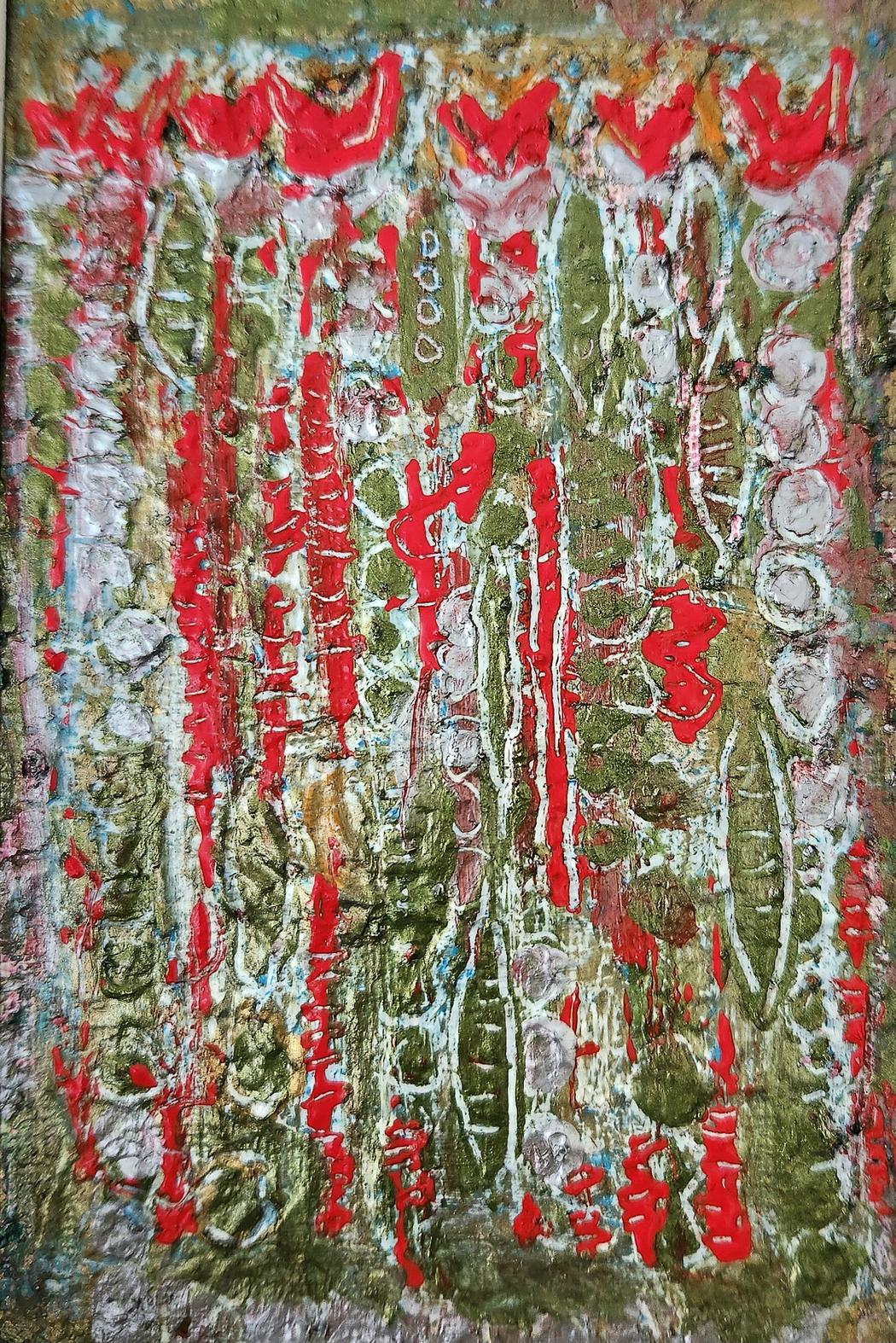
In some works, botanical forms seem to merge with symbols, handwritten text, or architectural structures. Are these elements connected to specific narratives, or do they emerge intuitively?
The fusion of a hard architectural structure with a softer floral image emerges intuitively. Fusing those elements compels chaos not only through varying hues and scales, but through the tension between feminine and masculine representations.
Unless the project calls for a specific narrative—like incorporating song lyrics or lines of poetry—I treat the bottom layer of the canvas as an intuitive journal for my feelings.
I also love how stencils establish a linear, structured grid, only to layer colorful, whimsical flowers over or under it to introduce a whole new personality to the piece. To me, that interplay is what truly defines mixed media.
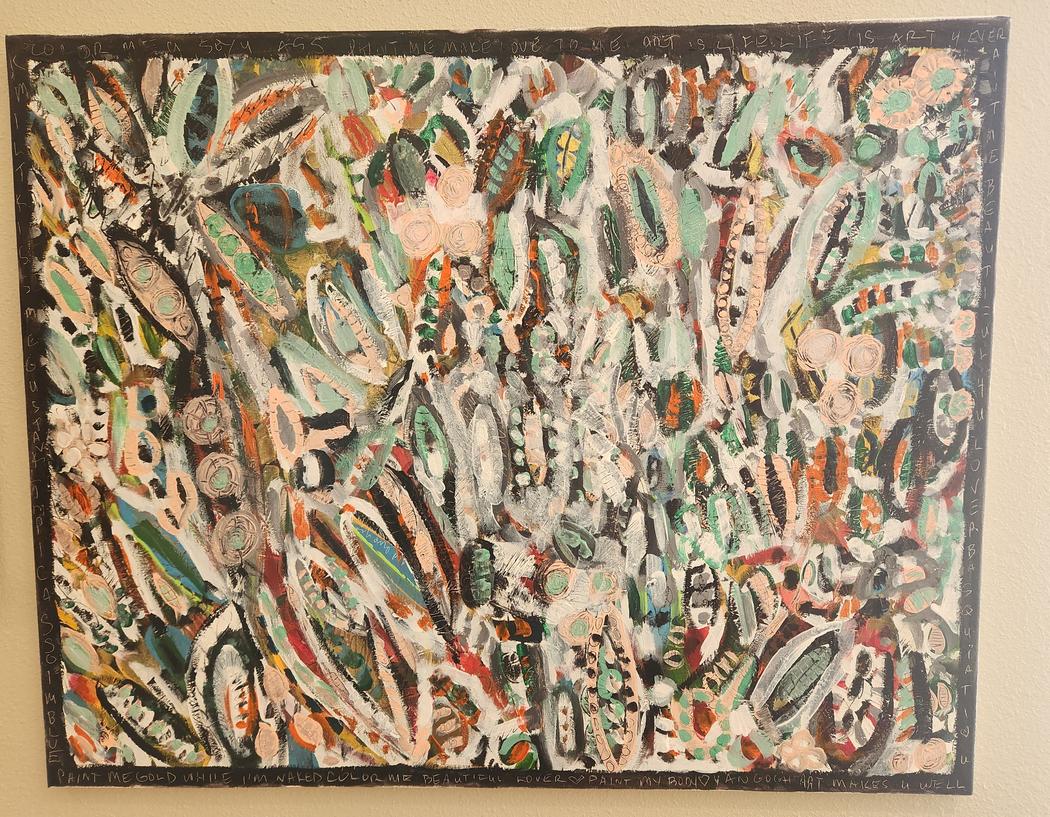
How have your studies in computer graphics in London and plein air painting in Rome influenced the relationship between structure, spontaneity, and observation in your work?
Formal training taught me the mechanics of painting—dimension, negative space, and color theory. But intuitive creativity is something I’ve carried with me since childhood. My mother used to remind me that I would throw food coloring across the New York snow as a kid!
When I studied plein air in Rome five years ago, I was too shy to display my final pieces alongside the other students during our final presentations. However, a working artist who was studying alongside us confided that my work was her favorite. That moment gave me immense confidence.
Classes provide a linear, structural foundation, but the heart and spontaneity of the work are elements I strive to bring to the canvas naturally.