
Rodrigo de Toledo
Your work develops a complex fictional mythology. How did this universe first begin, and what continues to drive its evolution?
It began quietly and almost accidentally, in 2005, when I started making symbols and connecting them — spontaneously, as a form of integrating various creative insights and sketches. I wasn’t aware at the time that it was the beginning of a potentially very long-term art project, one that I would eventually come to engage in as a spiritual process. The mythology took its first formal shape in 2010, with a series of five paintings called Inner Mythological Realms, which were later published as part of my illustrated fiction Chronicles of Entanglement. From there it expanded significantly into The Myth of the Incomplete Self – a Psycho-archaeological Codex, developed between 2016 and 2018, and has continued to evolve through subsequent bodies of work, including Kin, from 2022 to 2024.
The mythology in The Myth of the Incomplete Self grew from a question: why do we feel incomplete? What are we missing? That question became a creation story — a cosmology that draws on Gnostic, Hindu, Buddhist, and alchemical sources, filtered through my own imagination and visual language. The Gnostic myth of the Demiurge, the Hindu myth of Brahma, the Buddhist understanding of the ego as an imaginary construct, the Freudian notion of an essential lack at the root of desire — all of these became threads I intertwined into a pantheon of my own deities, creatures, and archetypes, each with a specific symbolic role in narrating how the illusion of a separate self comes into being.
A critical turning point was two residencies in Italy — in La Macina di San Cresci near Florence, and in Assisi — where I was immersed in medieval and ancient Roman energies. Inspired by what I described as the “whispers” from old temple stone walls, church bells, ruins, illuminated manuscripts, and medieval painting, I consolidated the mythology’s symbols and created most of the leather parchment codex pieces. That encounter with very old, very material sacred art crystallized something in the work. What continues to drive the evolution is, ultimately, the same thing that started it: the ongoing search for self-knowledge — inner archaeology — and the interest in mythology creation as an art form. As I move forward, this mythological world keeps expanding through new series — some rendering my existing iconography in new ways, and some adding entirely new elements to it.
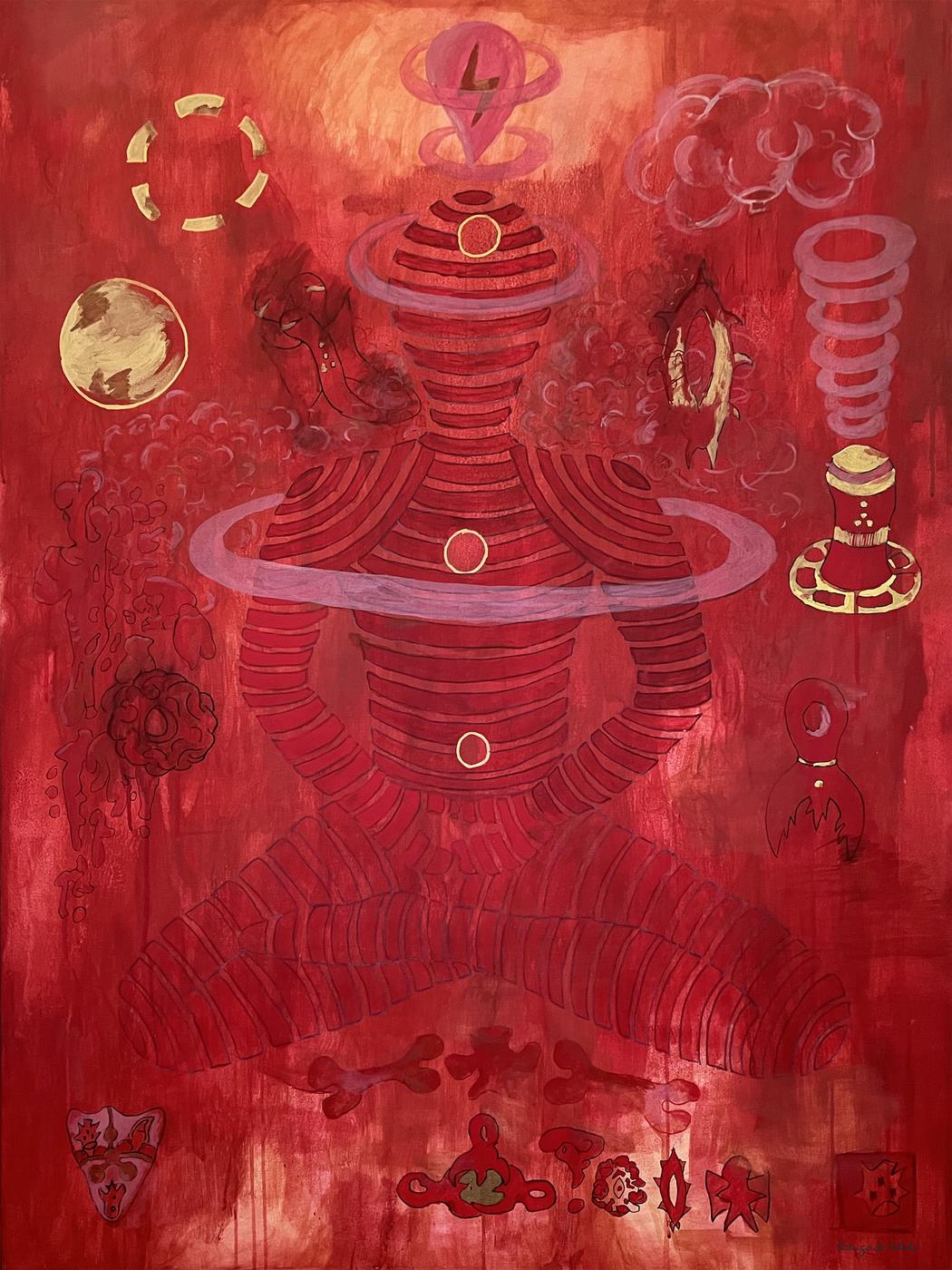 Rodrigo de Toledo | Meditator | 2022
You describe your process as “psycho-archaeological inquiry.” Could you elaborate on how you discover, collect, and transform symbols in your practice?
The term captures both dimensions of what I do: the psychological self-observation and the archaeological accumulation. I research ancient mythologies and their icons, loosely navigating what Jung called the collective unconscious, allowing myself to be drawn instinctively toward imagery that resonates — not through systematic study but through something closer to attraction. It takes time to generate and collect a set of symbols, characters, and environments. I draw them with a surrealist stream-of-consciousness spontaneity first, then refine their appearance, and finally make them fit visually, coherently, and conceptually into the existing mythology and iconography.
The resulting vocabulary is both invented and inspired by the reading of existing archetypes — a personal iconography where symbols from very different traditions are uniquely interpreted, arranged, combined, and transformed. In The Myth of the Incomplete Self, for instance, the iconography includes figures such as the Knot — a red circular form representing the ego or self — the Autogen, which is the teethed creature governed by the auto-craving principle, the Golden Egg, the Lightning Bolt Drop, the Supreme Vessica, and an entire pantheon of deities: the Primordial, the Muse, Vita, the Thousand-Heads. Each symbol has a precise role in the cosmological system, yet each also reads as a pure image with its own visual life.
The compositions follow what I call an invented visual grammar — a combination of hieroglyphic language and mysterious alchemical schemas. I even developed actual hieroglyph sets for the mythology: flesh logograms grammatically arranged in rows like ancient script. The catalog for The Myth of the Incomplete Self includes a full visual glossary of this iconography, because the system is dense enough to warrant one. That systematic dimension is the designer in me expressing itself within the artist’s imaginative freedom — and I think that tension is generative.
The catalog is available on Amazon.
Your imagery often blends sacred, mythological, and pop-cultural elements. How do you balance these different visual languages without hierarchy?
I don’t experience them as being in competition, which may be why hierarchy doesn’t feel like the right frame. From a Jungian perspective, all archetypal imagery — whether it appears in a Tibetan thangka, a Gnostic manuscript, or a Japanese manga — emerges from the same collective unconscious. The specific cultural container changes, but the psychological source is the same. When I see it that way, the supposed gap between sacred and popular disappears.
My visual grammar performs that synthesis formally. The primitive pop-surreal style I employ shares structural qualities across all these traditions: hieroglyphic flatness, bold outlines, saturated fields of color, a preference for symbol over illusionistic space. Whether I’m drawing on alchemical diagrams, medieval illuminated manuscripts — which were a major influence during the Italian residency — or the graphic language of comics and cartoons, the underlying visual logic is compatible. They’re all systems of symbolic communication that prioritize legibility and iconic power over naturalism or realism.
The need to create mythological imagery, pantheons, cosmologies, and origin stories is as alive in contemporary animation studios and comic book houses as it ever was in ancient temples. My work is partly about making that continuity visible and integrated. Personally, I am equally drawn to the sacred and to the pop — from Hieronymus Bosch to Takashi Murakami.
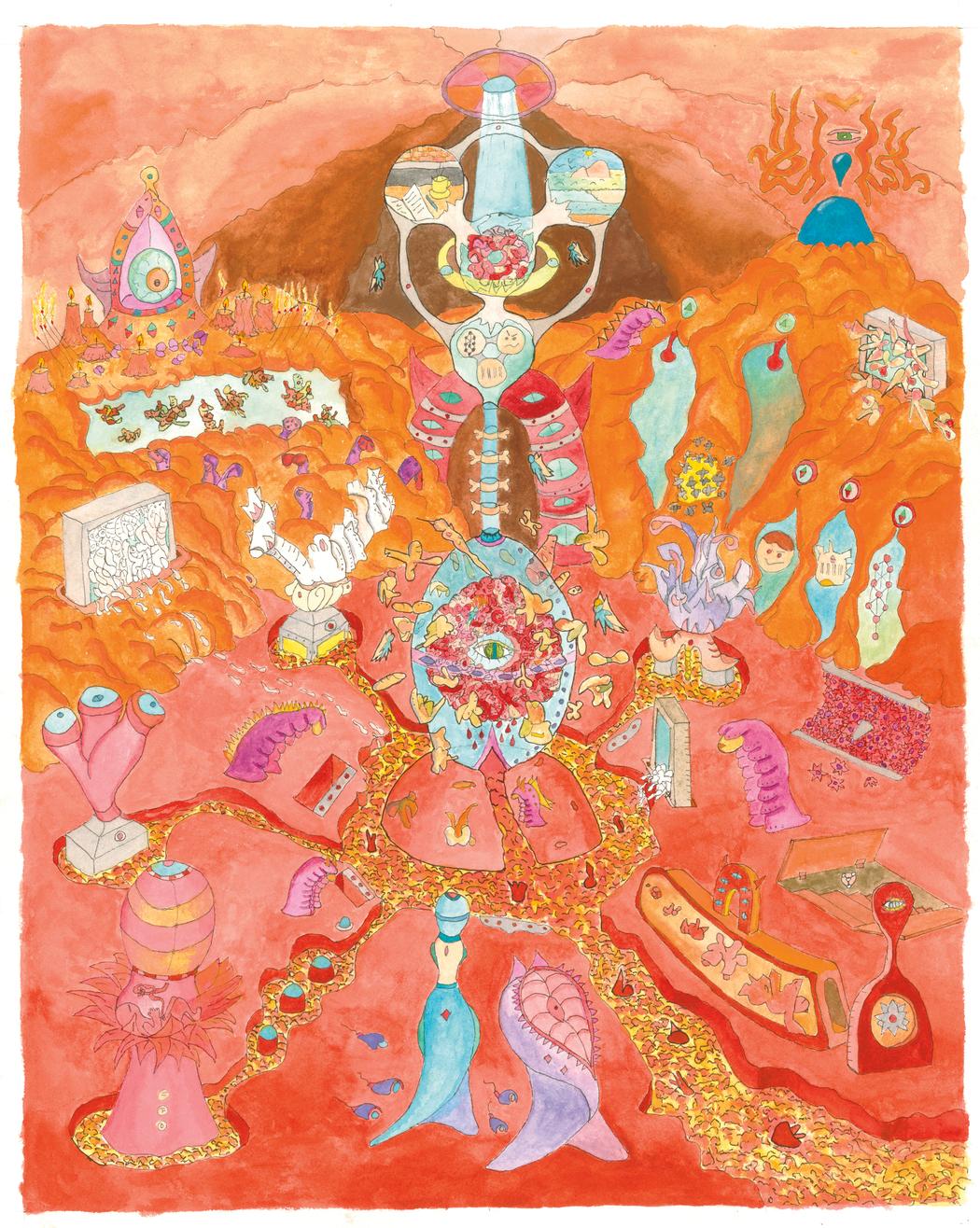 Rodrigo de Toledo | Minds Cave | 2010
Many of your compositions resemble diagrams, maps, or cosmologies. Do you see your works as systems to be “read,” and if so, how should a viewer approach them?
Yes, absolutely — the diagrammatic quality is central and deliberate. The catalog for The Myth of the Incomplete Self includes specifically titled sections: Cosmo-Mythological Diagrams, Archetypal Iconography Schemas, and the three phases of the Self’s Sublimation Journey. These works were conceived as pages from an imagined ancient codex — painted on leather parchment and rice paper, framed in shadow boxes, floating over red velvet backgrounds as though they had been excavated from some lost hermetic tradition. The imagery suggests hieroglyphic or linguistic arrangements, a visual syntax using the codex’s symbols and archetypes. So yes, there is a system, and it can be read — in the sense that each symbol has a specific role and meaning within the mythology’s internal logic.
But I want to clarify what “reading” means here. The catalog exists partly because the iconography is dense enough that some explanation enriches the viewer’s encounter with the work. At the same time, I don’t intend for that knowledge to be a prerequisite for the work to resonate. The symbolic grammar is open-ended and was designed to interact with the viewer’s own imagination and psychological experience. What I hope is that people enter the compositions with intuitive attention first — let the imagery land, notice what attracts or puzzles or moves them — and follow that thread. The diagrammatic quality creates an invitation to read, but the interpretive destination is the viewer’s own. My mythology is designed to be a structure through which people can project their own narratives and, ideally, support their own journey of self-knowledge.
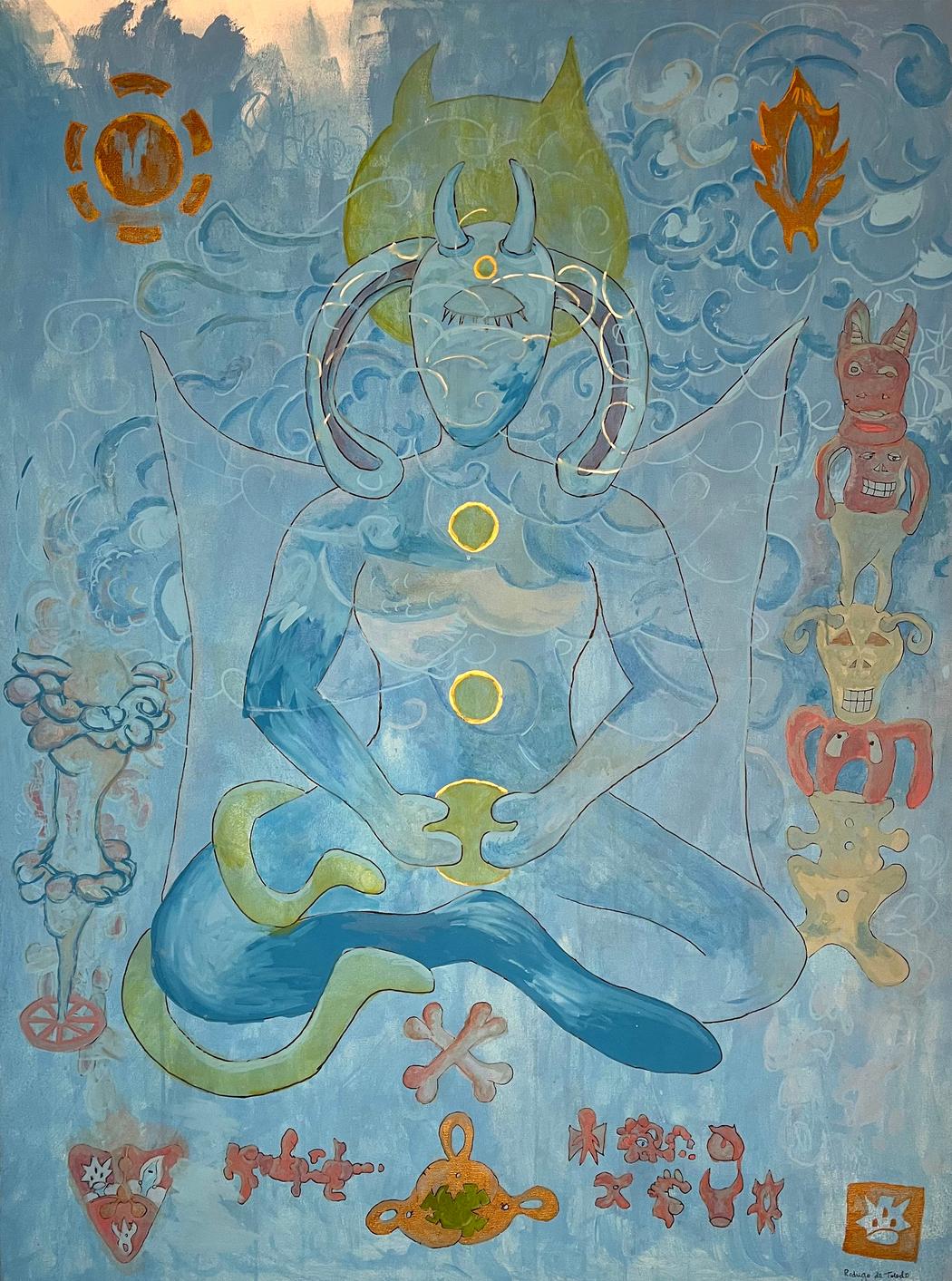 Rodrigo de Toledo | Zi-Bunny | 2022
Having worked across painting, animation, VR, and interactive media, how does each medium reshape or expand your fictional universe?
Each medium is a different portal into the same universe, but a portal with its own physics — its own set of possibilities that inevitably shapes what can pass through it. I think of my practice as a transmedia cosmology: the mythology doesn’t live in any single medium; it exists across all of them simultaneously, and each one reveals a different dimension of it.
Painting — particularly gouache and ink on rice paper, or acrylic on canvas — is where the mythology feels most tactile and intimate. The material quality of those surfaces matters deeply: the leather parchment pieces in The Myth of the Incomplete Self were explicitly conceived as pages from a lost ancient codex, and the choice of material — goatskin, rice paper, watercolor paper — was inseparable from the meaning. Holding or standing before one of those shadow-boxed parchment pieces activates a very different relationship to the imagery than seeing it on a screen.
Animation adds time and sequence — it allows the mythology to move, breathe, and unfold in duration. My early animated work — going back to the short Logod, first screened in 1990, and Uneaten Future, screened at SIGGRAPH and ISEA in 1995 — already carried the seeds of this universe. Archetypes and deities become characters, performers, when animated; they acquire behavior, which deepens their psychological dimension considerably.
Interactive and virtual environments shift the viewer’s relationship to the work entirely — from contemplation to inhabitation. Installations like Tetrad Dimensions of the Cosmos combined animation, performance-recorded video, and painted plastic toys, staging the mythology as an environment you enter rather than an image you observe. That spatial, participatory dimension opens something that painting and animation alone usually cannot.
What excites me is the cross-contamination between media — the world-building activity itself. Digital painting informs how I approach acrylic on canvas. The ceramics — the Hieroglyphic Tablets and Divination Cubes — bring a ritual, object-based weight to symbols that also live in paintings. The universe grows richer precisely because it cannot be contained in any one form.
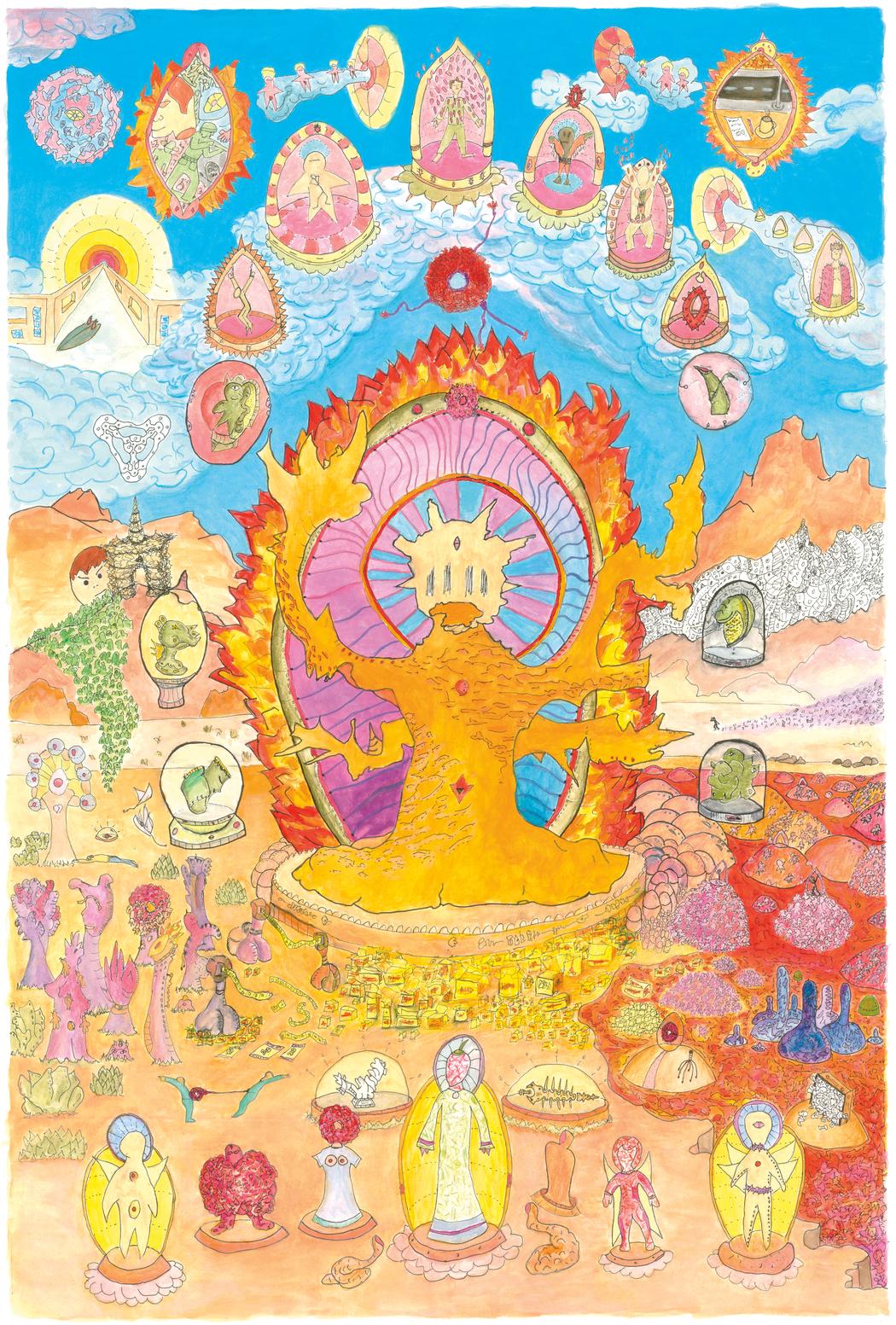 Rodrigo de Toledo | The Valley Of The Muse | 2010
Your background includes both fine arts and technology, including work at NASA. How has this intersection influenced your artistic thinking and aesthetics?
The technology and the art were never separate for me — they developed together from the beginning. I founded one of the first digital animation studios in Brazil in 1987, at a moment when this was genuinely pioneering territory, especially in South America. That early experience gave me a foundational insight: that technology wasn’t a limitation on artistic expression but an extension of its vocabulary, and that being at the frontier of a new medium was itself a creative condition worth pursuing.
The NASA years added another dimension. Working as a creative director at NASA Ames Research Center on educational multimedia projects required me to think with rigor about how complex systems and ideas — space science, planetary exploration, cosmological phenomena — could be made visually accessible and experientially compelling. The challenge of translating scientific complexity into engaging visual and interactive form sharpened my instincts about visual communication as a meaning-making practice. There’s a direct line, I think, between that experience and the way I approach the cosmological diagrams and iconographic schemas in The Myth of the Incomplete Self — those works are also attempts to make a complex system navigable and vivid.
My experience as a visual communication professor, along with my background in technology and graphic design, gave me, ultimately, a systems-thinking sensibility. I approach my mythology the way a designer approaches a complex design problem: as a coherent system with internal rules, a vocabulary, a grammar. The catalog’s visual glossary — with its thirty-plus named symbols, each with a precise role in the cosmological structure — reflects that design methodology applied to mythological world-building. The fiction and the design thinking are inseparable. The spiritual content is entirely personal and sincere, but the structural discipline that holds it together comes directly from having spent decades thinking about how visual languages function as systems. All that said, spontaneity and unconscious material play a significant role in the work as well.
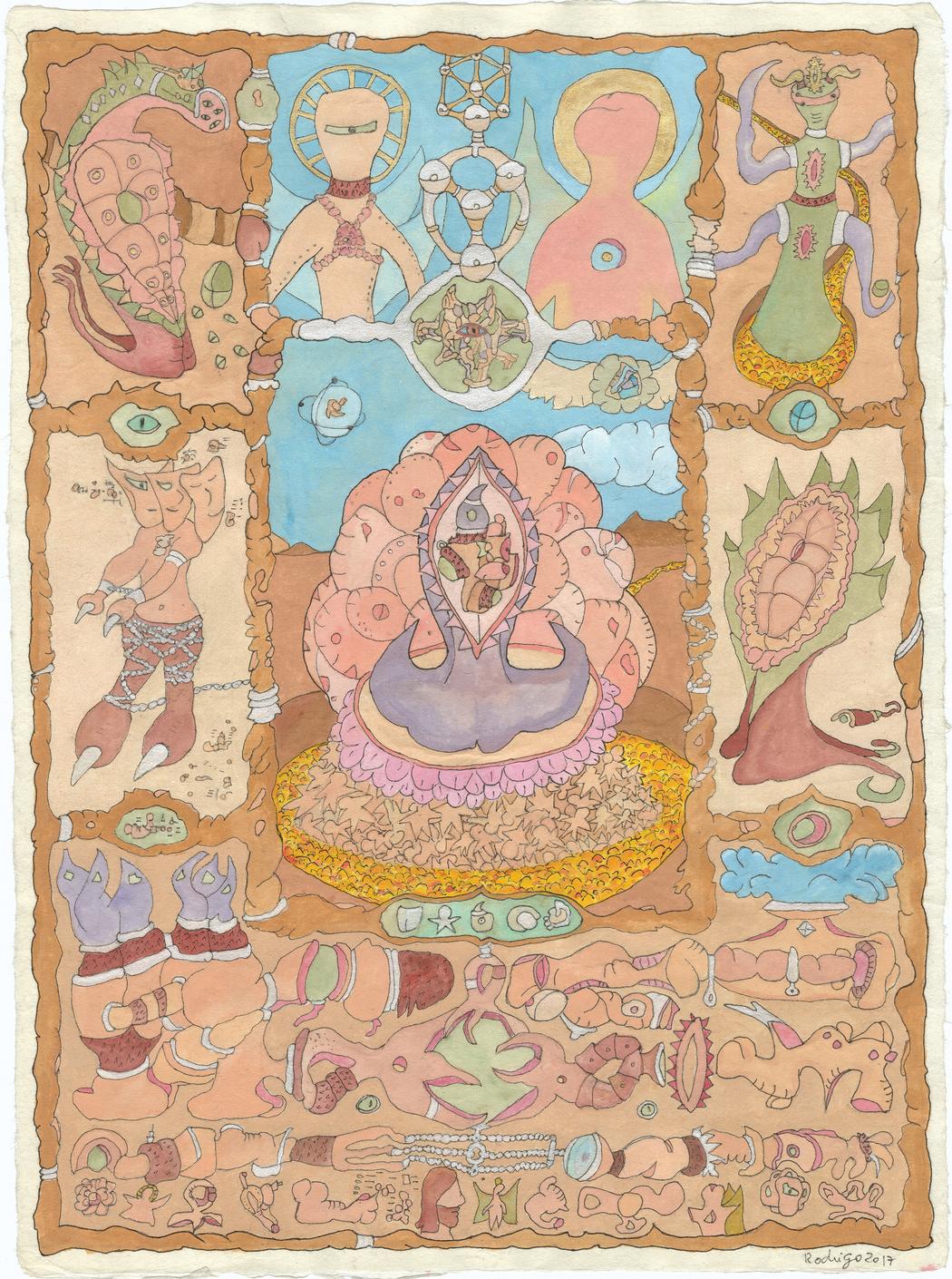 Rodrigo de Toledo | Pergamene | 2017
You mention engaging the viewer as a participant in meaning-making. What kind of response or interaction do you hope your audience experiences?
What I most hope for is a moment of genuine recognition — not intellectual decoding, but something more visceral: the sense that a symbol or image in the work is somehow already familiar, already resonant, as though it belongs to an inner vocabulary the viewer didn’t know they had. That is the nature of archetypal imagery: it speaks to something pre-personal, something that belongs to the collective rather than to any individual.
The psychoanalysts who wrote the preface to the Myth of the Incomplete Self catalog — Tatiana and Carlos Porto Campos — articulated something important when they wrote that the mythology directly addresses the core of the human structure: our incompleteness. That is the deeper aim. The mythology isn’t about my incompleteness specifically; it’s about a condition we all share. The Knot, the auto-craving principle, the cycle of desire and aversion, the search for sublimation — these are not private symbols, even though they emerged from a very private process of self-inquiry. They point to universal psychological structures.
My ultimate aspiration is to support what I think of as the viewer’s own “know thyself” journey — the same process that guides my life and my studio practice. I hope the work creates conditions for genuine self-reflection: encounters with archetypal imagery that might illuminate something about a viewer’s own psychology, spirituality, or sense of identity. At the same time, I want the work to be pleasurable and alive at the surface. The pop-surreal dimension — the playfulness, the humor, the visual delight — keeps the work open and inviting rather than hermetic, and in places, so does the roughness of the primitive aesthetics. The deepest symbolic content is there for those who want to engage with it, but the surface should captivate anyone. That tension between playfulness and depth, between the sacred and the cartoonish, is the signature energy I’m always navigating, and it’s the experience I hope viewers feel.