Stavros X. Petrou
Your practice moves between visual art, performance, literature, and traditional craft. How do these different forms come together in your work?
Visual art, performance, literature, and every other form of artistic expression represent, in my case, different manifestations of the same quest.
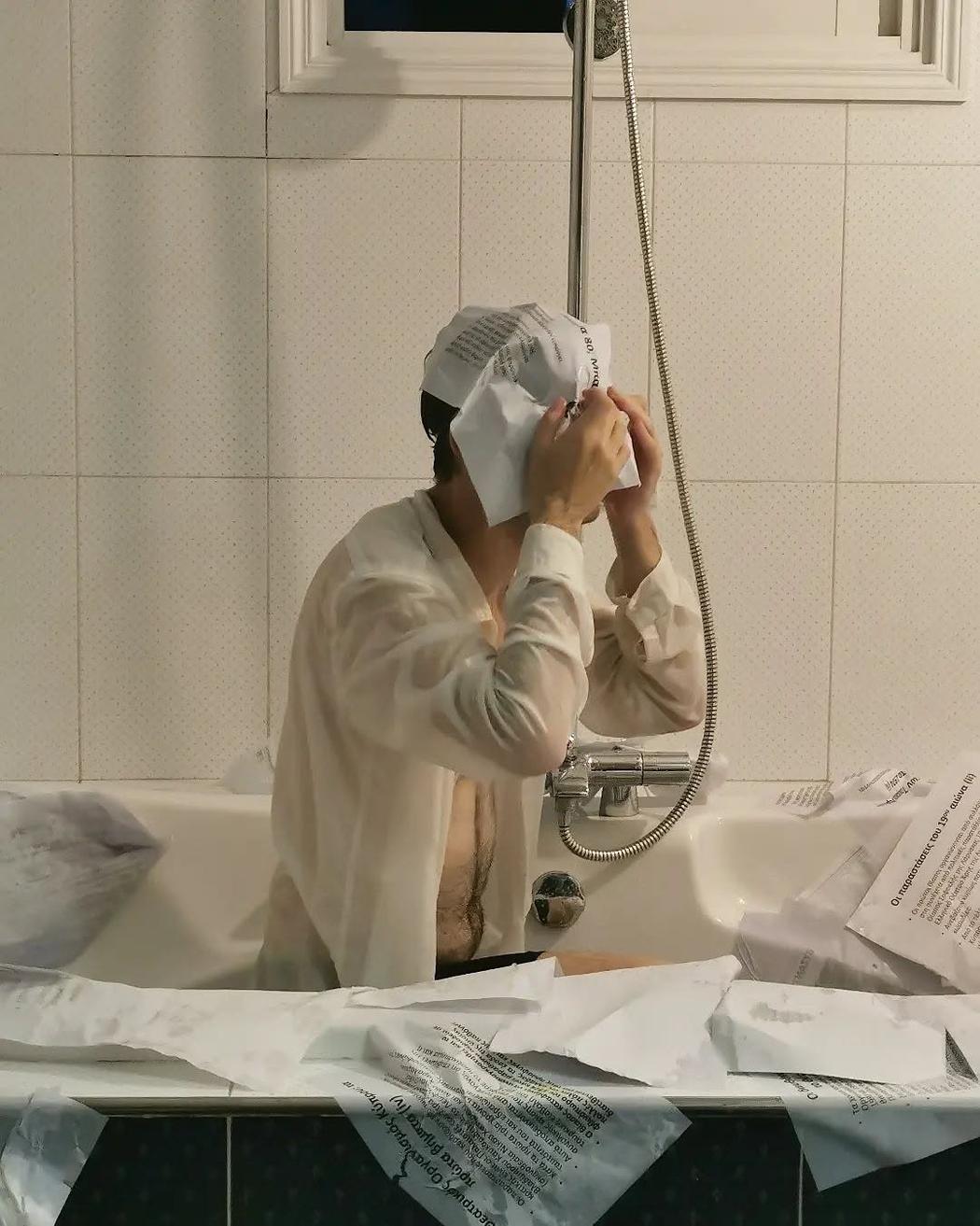
I rarely know from the outset what form a work will eventually take. I usually begin with a sensation, a question, or an image that persists and demands attention. At other times, I begin with a material that I feel compelled to explore. And when I speak of materials, I do not necessarily refer to conventional “art materials”, but rather to any medium that can carry meaning – even something as unexpected as tissue paper.
As the process unfolds, it is the material itself that begins to reveal the path forward. It is at that moment that I understand whether an idea is asking to become a performance, an installation, a poem, or perhaps all of them simultaneously.
I am fascinated by the moment when the boundaries between artistic disciplines dissolve. A poem can acquire a physical presence through an installation, while a performance can transform into a living image. I do not choose the medium; rather, each idea seeks the form and the body through which it can exist.
You describe art as a way of transforming chaos and trauma into creation. How does this idea shape your artistic process?
Art appears to defy the very notion of futility. Through art, we transform chaos and trauma into creation. Art has taught me the beauty of truth. A broken object, an unfinished poem, a hesitant stroke of colour on a canvas can move us precisely because they are authentic.
I believe that my artistic process begins exactly where experience becomes difficult to articulate through everyday language. Trauma, for me, is not a subject to be illustrated, but an existential condition that seeks a new form of expression.
There are moments when I enter the studio believing that I know what I want to create, only to leave having produced something I could never have consciously conceived. This unpredictable encounter with matter is among the most essential moments of the creative process.
I do not know whether art has the power to heal pain. What it can do, however, is transform experience into meaning.
Basket weaving appears as both a material and a conceptual language in your practice. What first drew you to this traditional technique?
Basket weaving, for me, is an art form hidden within the fabric of everyday life. I am fascinated by it because it teaches us that creation emerges through the collaboration between the artist and the material, through patience, care, and the passage of time. Each individual fibre acquires meaning through its connection with the others, just as people, memories, and cultures are shaped through relationships and interaction.
I first encountered this art form during my childhood through my grandmother, who was herself a craftswoman. The tradition of basket weaving, as it developed within the community where I grew up and was preserved from one generation to the next, is a traditional craft based on the interlacing of flexible plant materials collected from wetlands in order to create functional objects. It forms part of the Intangible Cultural Heritage of Cyprus, the island of my origin, and was inscribed on the National Inventory of Intangible Cultural Heritage of UNESCO in 2017. Its development is deeply connected to the natural environment of the region: the salt lake beside my childhood home has been, for centuries, the place where the materials used in this craft are gathered.
For me, basket weaving is not merely a traditional technique. It is a conceptual language, an embodied form of cultural knowledge, and a way of speaking about everything that constitutes identity and the very essence of being.
How do you approach the transformation of inherited craft techniques into contemporary installation or performance?
I do not approach traditional techniques as precious remnants of a past that must be preserved untouched. I perceive them as living forms of knowledge that continue to evolve as long as there are people willing to reinterpret them through the lens of their own experiences.
We do not simply inherit tradition; we enter into a dialogue with it. My creative process does not begin with the desire to reproduce a technique, but rather to understand what it can still communicate to us today. When these practices are transferred into the realm of contemporary installation or performance, they reveal new possibilities of interpretation and new meanings that engage with contemporary social and existential questions.
One of my most significant visual artworks is Kaina Daimonia, a work inspired by basket weaving and, above all, by my lived relationship with my grandmother. The work seeks to redefine folk art through the language of contemporary visual practice, and it is therefore a great honour that it is preserved as part of the permanent collection of the Cyprus Folk Art Museum.
The title Kaina Daimonia refers to the Socratic expression “kaina daimonia”, meaning new ways of thinking or new ideas. Within the context of the work, the title can be understood as an invitation to perceive tradition not as something static or confined to a museum space, but as a living creative force capable of acquiring new meanings in the present.
I am not interested in tradition as nostalgia. I am interested in it as truth. Perhaps, ultimately, the art that preceded us is not behind us, but ahead of us, because each generation is called upon to decide anew what deserves to continue.
Your work often involves the body, tension, restraint, and physical presence. What role does the performing body play in your artistic language?
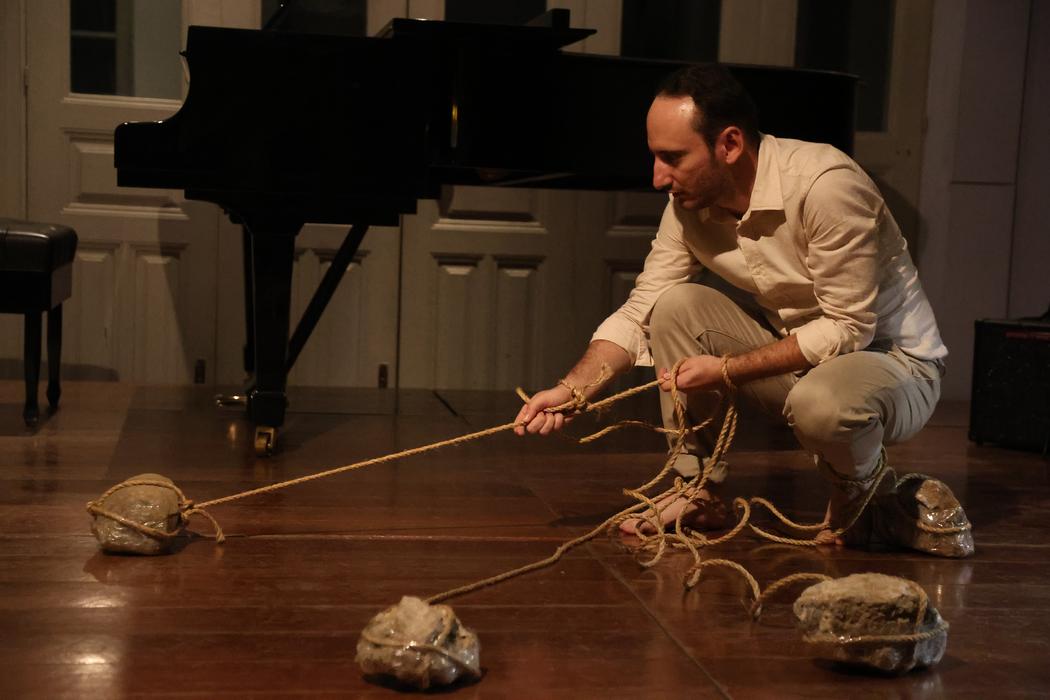
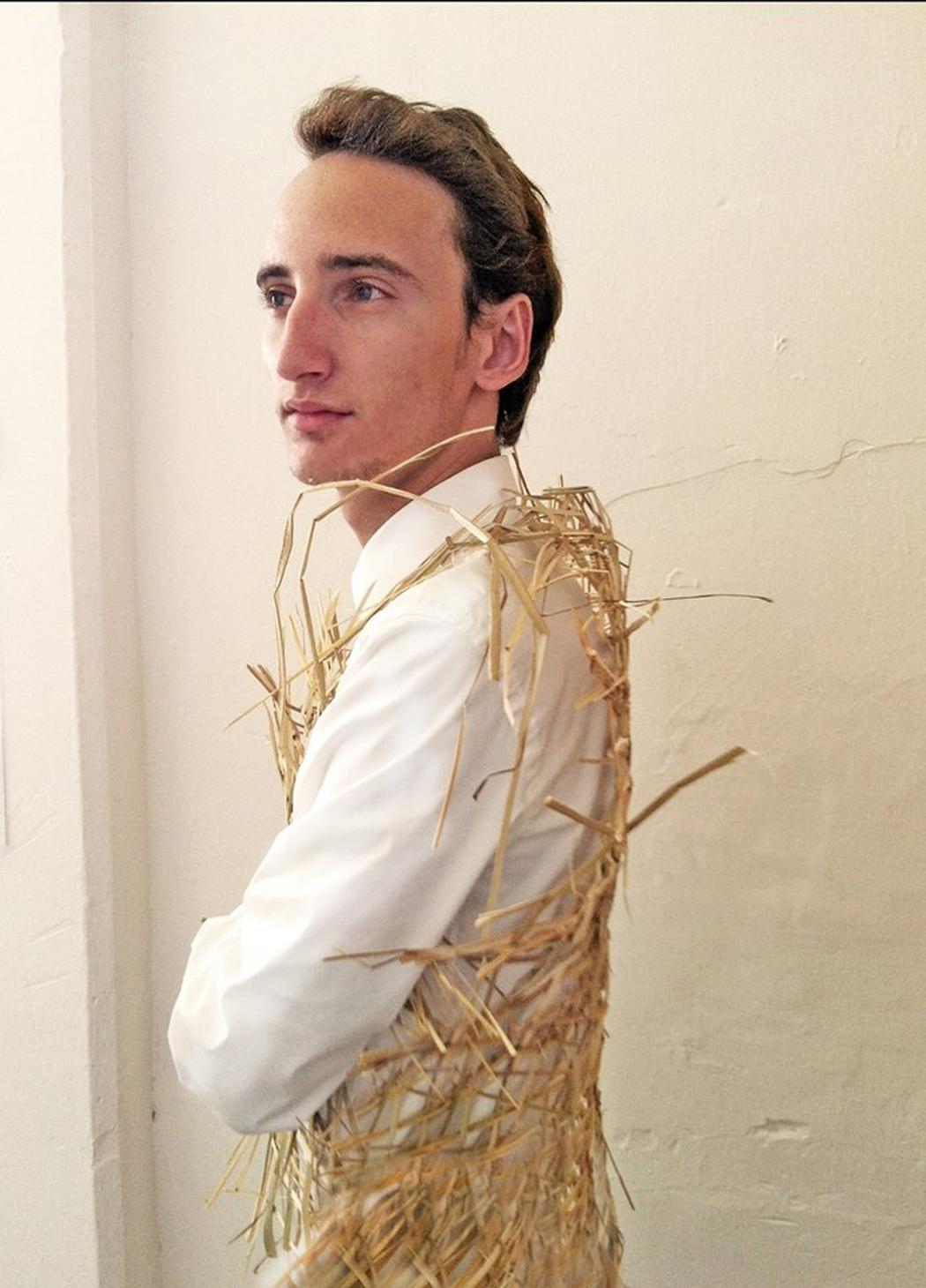
In my works, and particularly in my performances, the body is not an instrument that serves an idea; it is the very idea taking on physical form. I perceive the body, in a sense, as our ontological imprint within the world of material reality. Movement, stillness, and breath carry a meaning that precedes language. The body is the first place where memory, desire, violence, loss, and transformation are inscribed.
In a similar way, I approach the notion of intensity – a quality that deeply fascinates me – not as an element of provocation or spectacle, but as a condition of revelation. When the artist encounters their own limits, social conventions begin to collapse, and a deeper, almost primordial truth emerges. It is there that performance is born, not as a representation, but as an actual event. This is why every performance remains impossible to reproduce in exactly the same way: it is a singular occurrence.
A fundamental prerequisite for creating art within this framework is the physical presence of both the creator and the recipient. In an era where images are endlessly reproduced and experience is increasingly mediated through screens, live presence acquires an almost ritual dimension.
My artistic language is shaped through this encounter between the body, time, and space. In my performances, I do not seek to embody a role, but rather to create an experience that allows the viewer to become an active participant within it. It is at the moment when the body ceases to be merely a biological existence and becomes a vessel of memory, ritual, and poetic truth that I feel art truly begins.
How does your Cypriot cultural background inform your use of material, memory, and traditional forms?
Cyprus is the way through which I learned to perceive time, memory, and matter. I grew up witnessing traces of different historical periods coexisting within the same landscape. Perhaps this is why I came to understand time as a series of layers of experience that exist simultaneously, and materials as carriers of stories. The ancient philosopher Zeno of Citium, who was born in Cyprus, suggested that the world possesses consciousness and reason, and that it is, in a sense, a living entity.
The place where one grows up and lives inevitably shapes both one’s human and artistic identity. Although I was born many years after the Turkish invasion of 1974, the trauma of a “divided homeland” and displacement continues to remain alive through the experiences and memories of people to this day. Elements of this collective memory are unconsciously reflected in the way my artistic practice is formed.
I do not seek, consciously or programmatically, to represent Cypriot identity or to illustrate its history. What interests me is to reveal experiences that, while emerging from a specific geography, speak to broader dimensions of the human condition.
What questions or emotions would you like viewers to carry with them after encountering your work?
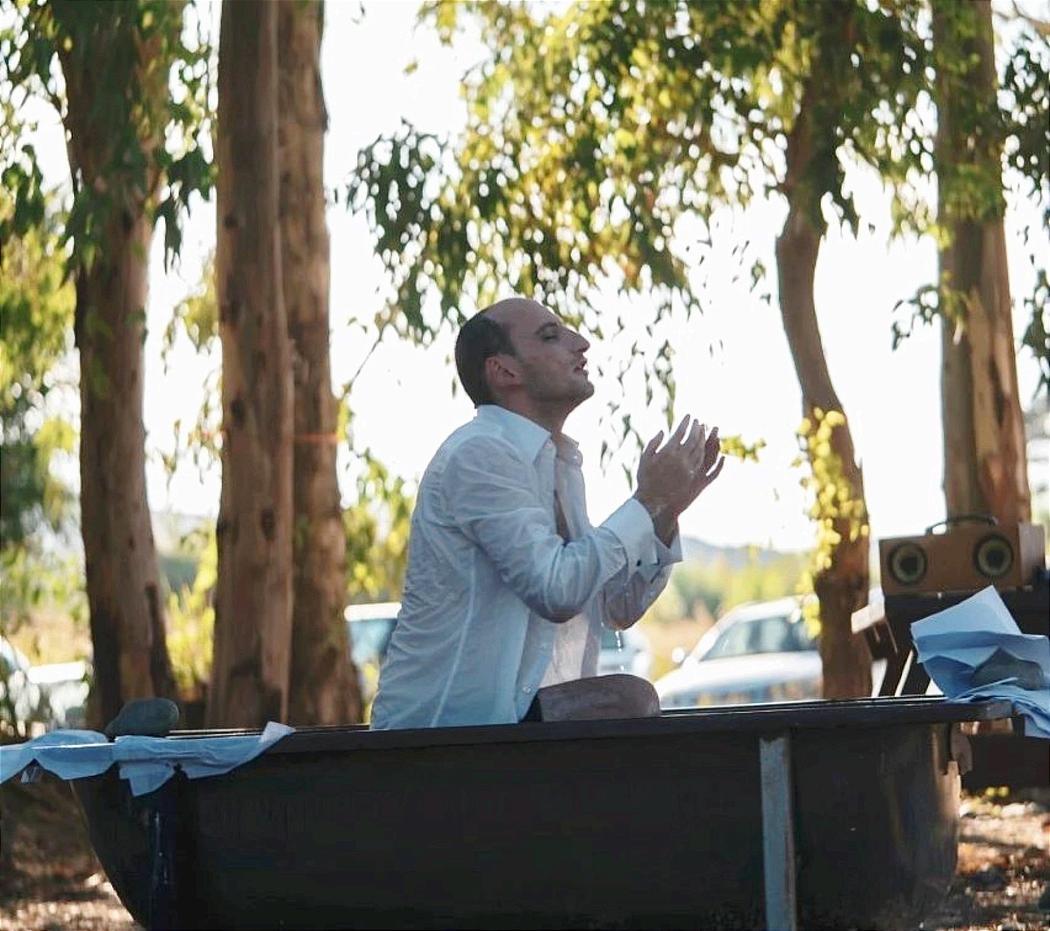
I am interested in creating conditions for encounters; inviting the viewer to slow down, to observe, and to feel that what is unfolding before them concerns them personally. I do not seek to transmit a message; rather, I aim to open a space where new questions can emerge. From their very conception, my works are created to be approached first through emotion and only afterwards through thought. I choose emotional resonance over didacticism. I would never want to dictate to the viewer what they should feel.
I believe that art becomes truly alive only when it leaves room for personal experience and interpretation. If a work leads everyone towards the same answer, then it has perhaps already limited its own possibilities. If someone leaves an exhibition having changed, even imperceptibly, the way they look at an everyday object, a gesture, or even at themselves, then I feel that this constitutes a form of success for the work.
The greatest gift for an artist is to realise that a work no longer belongs to them. From the moment it encounters the viewer, it begins a life of its own — one that the creator can no longer control. This, I believe, is where the true freedom of art resides: in its capacity to exist as a universal human language, one that speaks directly to the deepest and darkest root of our primal cry.