
Between Devastation and Regeneration: Jingchao Yang’s When the Ecology Collapses
By Tabitha Ysart Green
 When the Ecology Collapses, 2026. Installation view at Apsara Studio. Courtesy of the artist.
From May 5th-10th artist Jingchao Yang presented his solo exhibition Planetary Conditions at LumiNoir Art, London. This exhibition focused on the artist’s series “When Ecology Collapses”, re-examining the relationship between humans and nature from a cross scale perspective, as we continue to approach the critical point of no return.
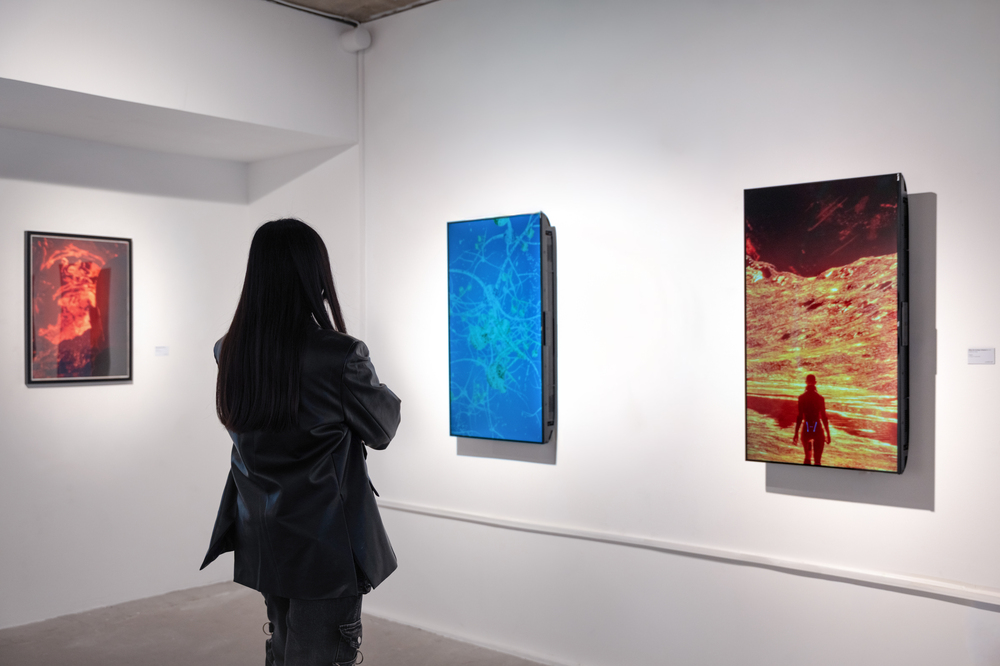 When the Ecology Collapses, 2026. Installation view at Apsara Studio. Courtesy of the artist.
“When the Ecology Collapses” unfolds through a series of four single-channel video artworks, which combine real-time generation with environmental recordings, each exploring the effects of natural disasters. Yang constructs a multidimensional, immersive narrative space within which the viewer is brought into close contact with the realities of natural disasters and the effect of humanity on the planet. The four videos each appear to focus on one type of extreme ecological event; volcanic eruptions, solar flares, extreme flooding and deep freezes and display the devastating effects of these events on the natural environment, cities, and animals.
 When the Ecology Collapses, 2026. Installation view at Apsara Studio. Courtesy of the artist.
Yang juxtaposes scenes of devastation with images of lush green forests and flowering meadows, emphasizing the power of natural disasters and the change that can be wrought on both cities and the wilderness by these events.
Each of the videos centers a humanoid (though not actually human) protagonist who appears, in the first instance, as an impartial bystander within the chaos, a non-human entity acting as a placeholder for the viewer. However, this changes when presented with the scenes of lush nature. Their attitude and actions morph from viewer to participant, active within the scenes. They seem to interact longingly or reverently with the natural landscapes – stroking, caressing and laying down within the scenery, completely at ease and serene.
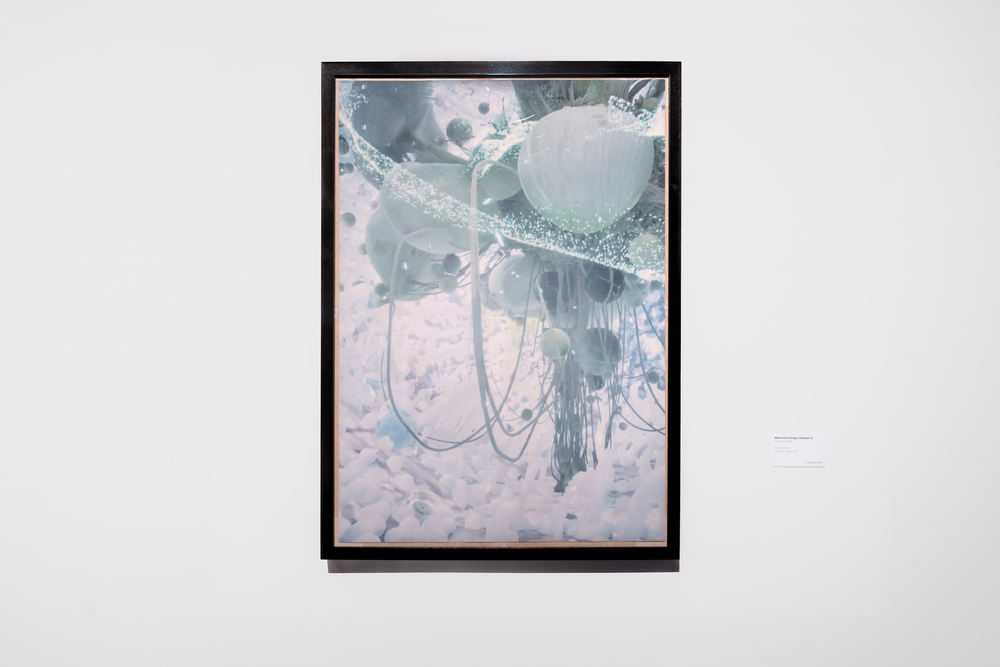 When the Ecology Collapses, 2026. Installation view at Apsara Studio. Courtesy of the artist.
The scenes of devastation and untouched natural beauty are separated by sequences of abstract ever-changing forms akin to neurons and neural pathways, as if the viewers have entered the mind of the protagonist, physically witnessing them processing the lengths of the devastation, or their awe at the natural world.
Yang further highlights the contrast within the visual language through the curated soundscape. He utilises classical instruments with jarring staccato rhythms, mechanical sounds, deep reverberating tones, dramatic vocalisations and sliding note transitions reminiscent of soundtracks from horror or high tension action films, further accentuating the effect of the disastrous visuals. This is then juxtaposed with a more serene and controlled soundscape, with the classical instruments employed as expected in long dramatic flourishes and vocalising which bring to mind awe inspiring vistas from nature documentaries.
The implementation of contrasting visuals and soundscapes generate a shared tension that highlights the complex relationships between human behaviour and natural systems, reflecting the broader ecological focus of Yang’s artistic practice. Though these works focus on ostensibly natural disasters, rather than directly man-made devastation, the visuals continue to question the effect which humanity, or the protagonist, has had on their environment. This prompts the viewer to question whether the protagonist themselves were the cause, and whether their display of reverence is in fact grief or guilt.
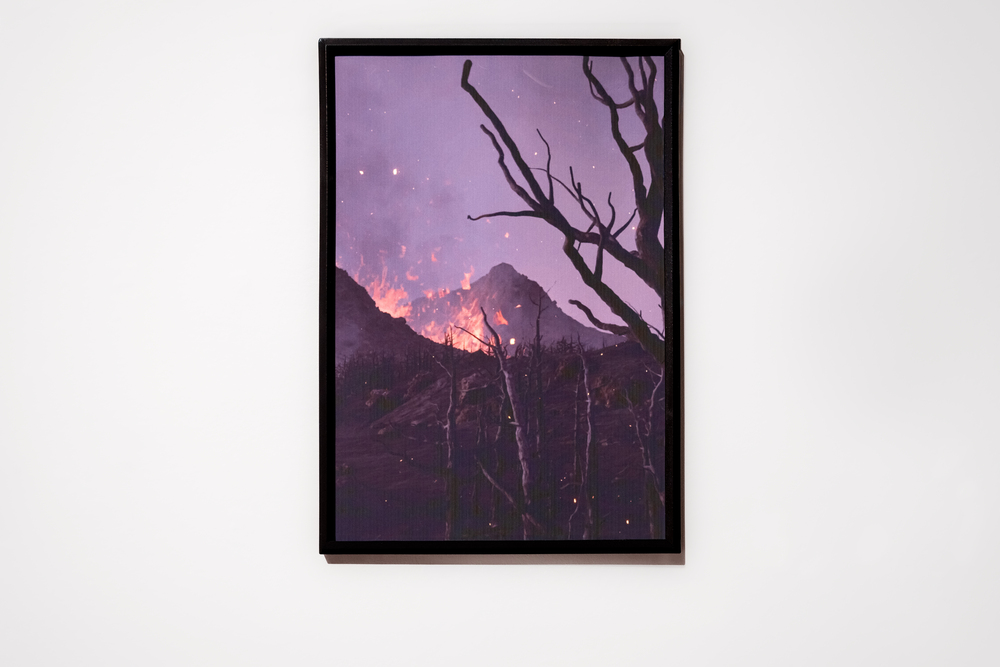 When the Ecology Collapses, 2026. Installation view at Apsara Studio. Courtesy of the artist.
In this exhibition, Yang adopts a decentralised perspective, viewing landscapes as self-operating systems and removing the anthropocentric viewpoint common amongst ecologically focussed artistic expression. The humanoid protagonist, though symbolically poignant, and critical as an eyepiece through which the viewer experiences the piece, is not an active participant in the desolation of the landscapes. Instead, disaster is presented as a natural part of ecosystems, and in some ways, a driving force for positive change or growth.
Through the implementation of a non linear framework, flashing between the scenes of destruction, natural splendour, and abstract forms, the untouched natural landscape acts as both a before and after to the devastation: what is destroyed and what can regrow. This morphs the piece from a simple narrative description of the effects of natural disasters, into a compelling demonstration of the resilience, transformative capacity, and regenerative potential of natural ecosystems, capable of bouncing back after destruction. Again contrasting with Yang’s previous work these pieces seem to offer hope in the face of despair for the future of natural ecosystems and the relationship between humanity and the environment, demonstrating the possibility of rejuvenation and reconnection.
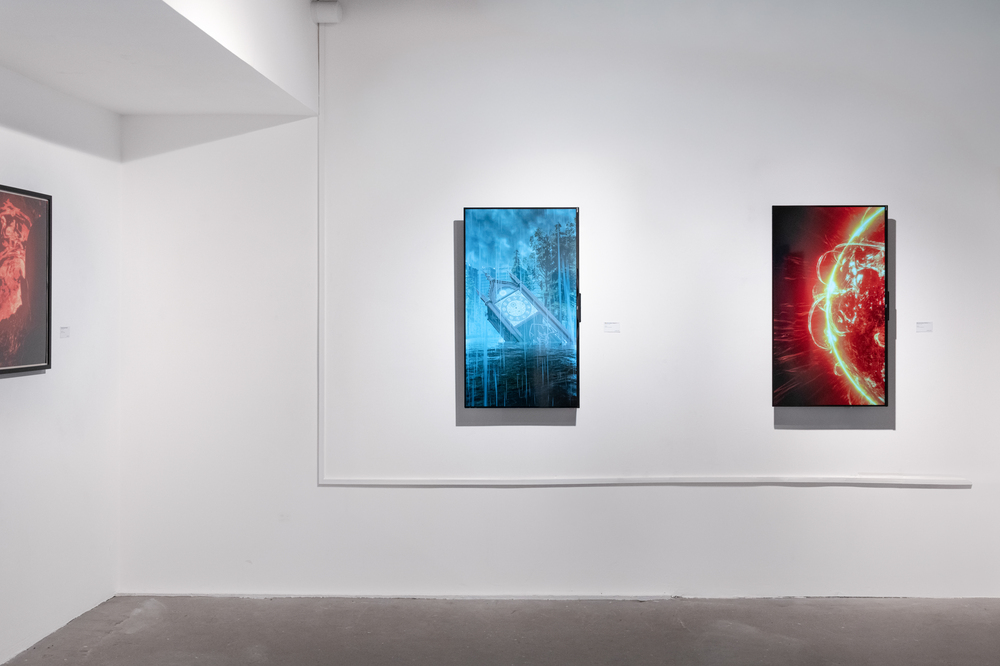 When the Ecology Collapses, 2026. Installation view at Apsara Studio. Courtesy of the artist.
This is an especially poignant exhibition, particularly in the UK where very few natural disasters occur, bringing the viewer into stark contact with the realities of the power of nature and how mankind is affecting our planet. In the context of a recent shift towards human accountability, most notably demonstrated by the new permanent exhibition at the Natural History Museum, London “Fixing Our Broken Planet”, opened in 2025, and similar exhibitions such as “Our Future Planet”, at the Science Museum, London, 2021 – 2022, and “Changing Landscapes” at the Museum of Science, Boston, in 2024, Yang’s exhibition continues to demonstrate how art can be used as an important tool to communicate and raise awareness about our planet. Though the events depicted in “When the Ecology Collapses” are classed as natural disasters, their frequency and the extent of their devastating effects can be directly linked to the activities of humanity, particularly global warming and the effects of greenhouse gases. Through their work, Yang plays an important role, ensuring that our relationship with our planet is not forgotten.

Leave a Reply
You must be logged in to post a comment.