
Takuya Inoue Higa
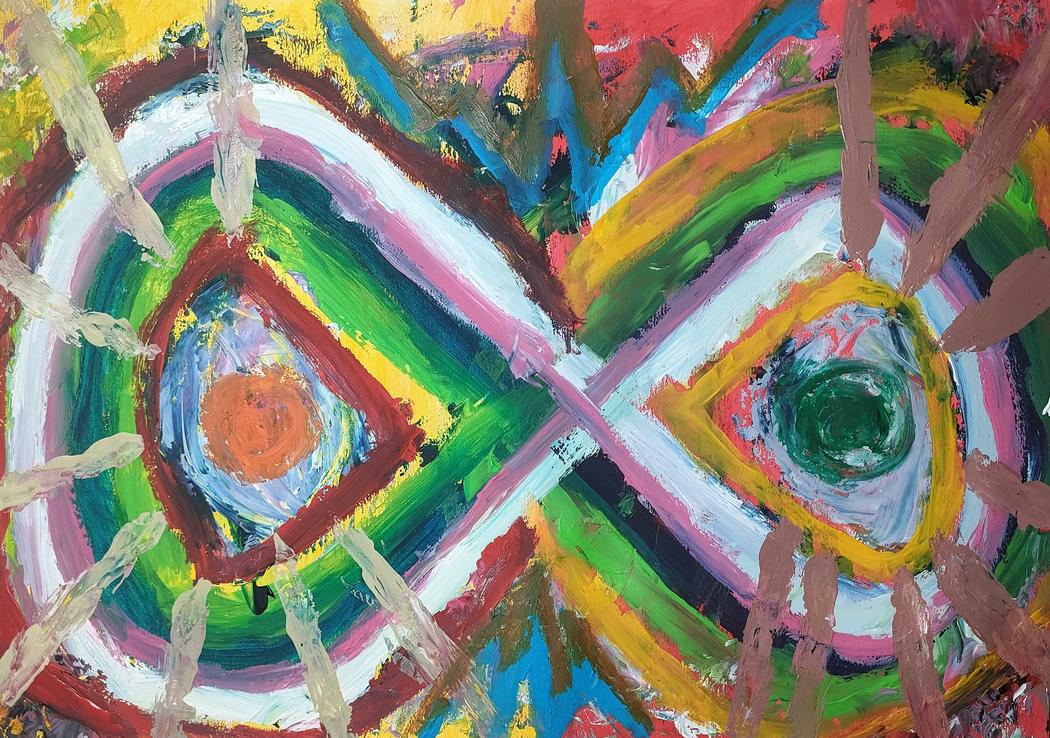 Takuya Inoue Higa | Don’T Stop The Passion! | 2025
You describe your practice as beginning from sound and emotion rather than a fixed idea. Can you walk us through what usually happens from the moment you hear music to the first brushstroke on paper?
Yes, I can describe the process that leads me from the initial urge to paint to the moment I begin working.
I often associate music with color in my mind. Some people might describe this as a form of synesthesia, although I am not certain whether I truly possess it. Still, there have been times when live performances or songs heard in bars have evoked the foundations of color and form within me.
I subscribe to a music streaming service, where I have created a folder titled “Sources of Inspiration.” It currently contains around 340 tracks—songs I personally love as well as pieces with distinctive performances—and I expect this collection to continue growing.
I usually work late at night. In a completely dark studio, I prepare a small, reading-lamp-like light and sit in a comfortable chair. Wearing sealed headphones at maximum volume, I select a piece of music that either closely matches my current emotional state or feels emotionally comfortable to me. I then put a single track on repeat and sit quietly, breathing deeply in a way that resembles meditation, while staring at a completely blank canvas (watercolor paper) placed on the easel. My gaze is fixed on the canvas, but my concentration is entirely devoted to the music.
At some point, a rough foundation of colors and forms begins to emerge in my mind. I usually begin painting at the moment this internal image appears. If I attempt to fully define the image beforehand, I lose flexibility during the act of painting itself.
In most cases, the time between starting the music and applying the first color to the canvas is within three to five minutes. Sometimes, the image appears almost instantly, the moment the music begins to play. On other occasions—especially when working on very large formats, such as F50, where pressure and hesitation are greater—I may proceed more cautiously, taking up to an hour before making the first mark.
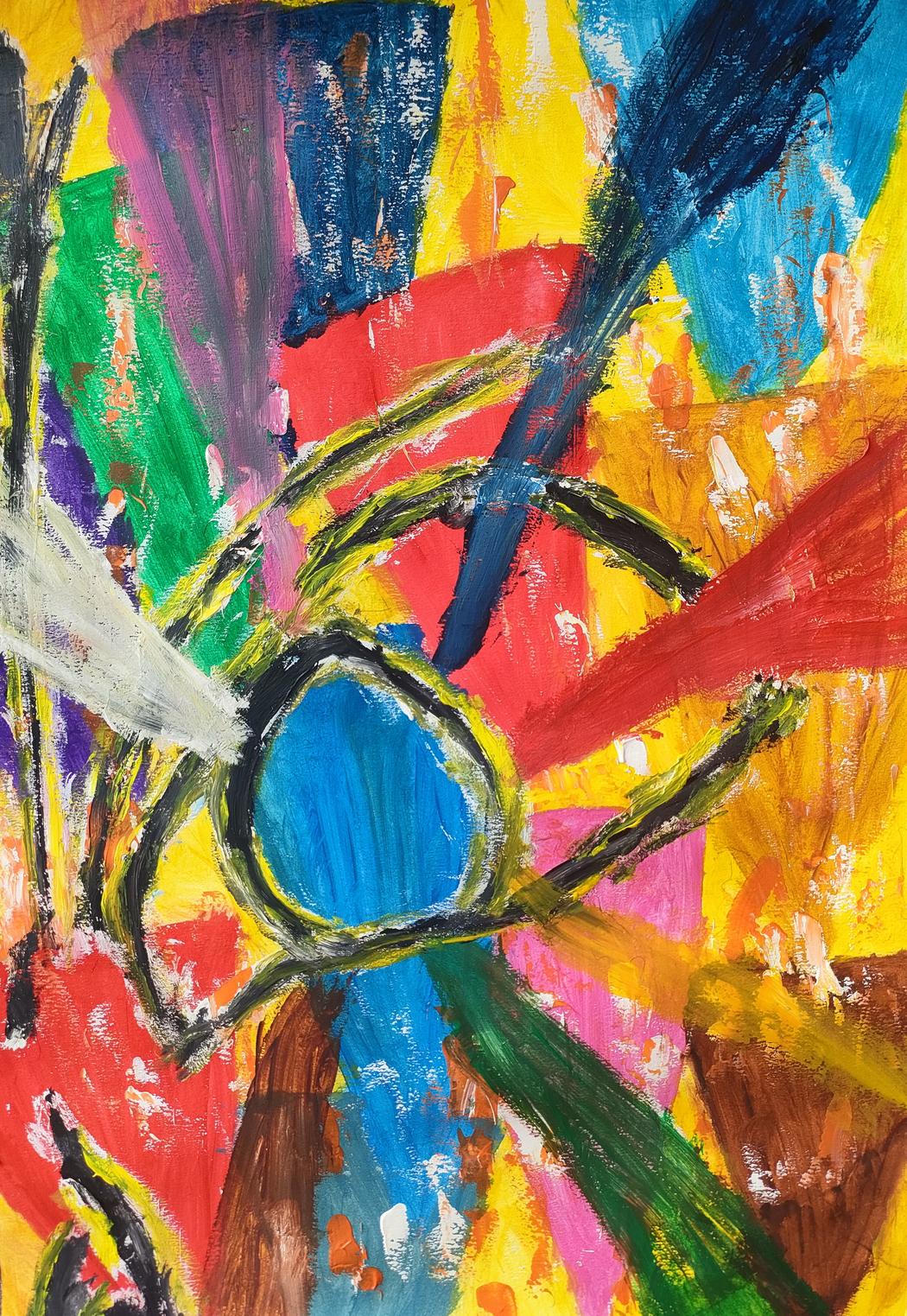 Takuya Inoue Higa | Fighting Spirit | 2025
How does being neurodivergent shape the way you perceive color, rhythm, and composition in your paintings?
I have been diagnosed as neurodivergent, specifically with ADHD and ASD, and I have also experienced schizophrenia and bipolar disorder. Throughout my life, I have gone through many difficult periods as a result of these conditions.
This is my personal perspective, but in Japanese society, communication often relies less on direct language and more on atmosphere, social niceties, and the ability to read unspoken intentions or subtle dishonesty within conversations. For people who, because of their traits, find it difficult to navigate these implicit expectations, adapting to society can be extremely challenging. Building close relationships, finding a partner, or maintaining stable employment can become particularly hard. I also acknowledge that my own personal shortcomings played a role, and there were periods in which I became deeply isolated.
Ironically, however, the very experiences of isolation, sadness, and inner struggle that arose from my neurodivergence have become deeply embedded in my artistic expression. The emotions I lived through did not disappear; instead, they accumulated and found a place within my work.
At the same time, being neurodivergent has also had positive aspects. I experience strong impulsivity toward painting, periods of intense hyperfocus, and what I might call a form of artistic dependence—if I do not paint, my emotional state becomes unstable. While the loneliness that accompanied this had clear disadvantages, it also provided long stretches of time for introspection. This, in turn, allowed me to deepen my personal philosophy.
To prevent my mental state from collapsing, I actively sought ways to strengthen my inner balance: reading to sharpen my rational thinking, training my body, practicing meditation, and engaging in philosophical dialogue with ChatGPT to broaden my perspective. Through these efforts, I accumulated knowledge, values, passion, and a sense of challenge and adventure. I believe these elements directly influence how I perceive color, rhythm, and composition.
There is one more aspect that is difficult for me to express, but important. While I am not good at telling lies and they are often easy to see through, more importantly, my experiences of being hurt by dishonesty have made it impossible for me to deceive others without causing harm. I do not know whether this trait is directly related to neurodivergence, but I believe it contributes to my need to translate the fusion of music and message honestly into color and structure, without distortion.
 Takuya Inoue Higa | Madness And Explosion | 2025
Many of your works feel like emotional outbursts – almost visual screams or songs. Do you see your paintings as a form of communication where words have failed?
As a neurodivergent artist, I often experience significant difficulty in verbal communication due to my traits.
For example, despite living with disability, I still wish to experience romantic love and to love someone deeply. However, because of my neurodivergence, understanding and acceptance are often difficult to achieve. I am also unable to hide my disability through lies, and as a result, many people instinctively keep a certain distance from me from the very first introduction.
As I mentioned earlier, because I cannot rely on atmosphere or unspoken cues to communicate, I must express myself clearly in words. At the same time, because my life lacks stability, I have come to believe that I am fundamentally unlovable. But is it truly right to give up on the desire to love someone, even after understanding these conditions? People may laugh and call such a desire ugly—but is it really ugly? And who has the authority to declare that it is?
While painting, these questions begin to surface. They turn into cries, emotional eruptions, and acts of resistance against the merciless norms of society. The works that emerge from this process are what I later share on Instagram.
In other situations, when interpersonal difficulties lead me into depression, I sometimes become unable to create anything at all. However, when even a small margin of emotional energy returns, I channel those feelings into painting. As I work, my brush moves as if encouraging me, transforming cries, wishes, and prayers for recovery into visual form. The messages that appear at those moments are recorded instinctively rather than rationally, often as brief written notes. When I later revisit the work during another low point, I feel as though I am being encouraged by my own paintings.
If viewers, from their own perspective, experience similar feelings of encouragement or deep resonance through my work, I believe that would be the greatest fulfillment I could experience as an artist.
As another example, in my work Super Vocal, I had once aspired to become a vocalist myself and came to understand the intensity of devotion to singing and the greatness of pouring one’s entire body, soul, and spirit into a voice. I believe that this experience was reawakened through the music that served as inspiration and emerged together with the underlying colors and message of the painting.
In Fighting Spirit, after three years of continuing to paint without selling a single work and being rejected from every open call, I found myself emotionally withdrawn. At that time, a particular song gave me a powerful sense of encouragement. Passion surged through my body, and a message took form: “This is no time to cry or sink into despair. Even if no one recognizes me, I will never break my brush. Even if I never enter the mainstream, I will continue to fight. Fighting spirit. Passion does not die. I will fight alone if I must. Look—this style is my art. This is me. I will rise again and again. I will fight again and again.” That message became a forceful cry—something that, I believe, could convey more than words alone ever could.
You mention that messages emerge naturally during the process. Do you recognize these messages only after the work is finished, or are you aware of them while painting?
In response to your question, I am often already aware of the message while I am painting.
For example, works such as Super Vocal, Fighting Spirit, Scream, and My Sister clearly fall into this category. On the other hand, in a piece like Madness and Explosion, I first painted intuitively as an abstract work, following pure inspiration. Only afterward did I reflect on my past experiences and ask myself what this painting wanted to tell me, and what I wanted it to express. Even in that case, however, I believe there was a faint sense of direction embedded in the work from the beginning. Overall, I feel that the former approach—being aware of the message during the process—occurs more frequently for me.
The thoughts that emerge while I paint are deeply connected to my everyday life and past experiences, as well as to reflection, introspection, and dialogue. As I move from colors evoked by the music that inspires me to the shapes that continue to form while painting, I often pause and look closely at the work, asking myself, “What is this painting trying to tell me?” During these brief pauses, ideas shaped by my own philosophy and experiences begin to surface, encouraged and pushed forward by the colors on the canvas.
By the time these short breaks end, an internal dialogue has taken place—almost like a backpacker freely choosing a path without a fixed destination—and I arrive at an expression that feels closest to the message I truly want to convey. In this sense, my process often begins with instinct, driven by musical inspiration, and then gradually shifts toward the middle and final stages, where reason and presentation come into play as I make conscious choices to shape the work.
Additionally, when I post my paintings on Instagram, I include a written message alongside the image. Whenever a thought or message arises during the painting process, I make sure to record it immediately in a memo on my computer.
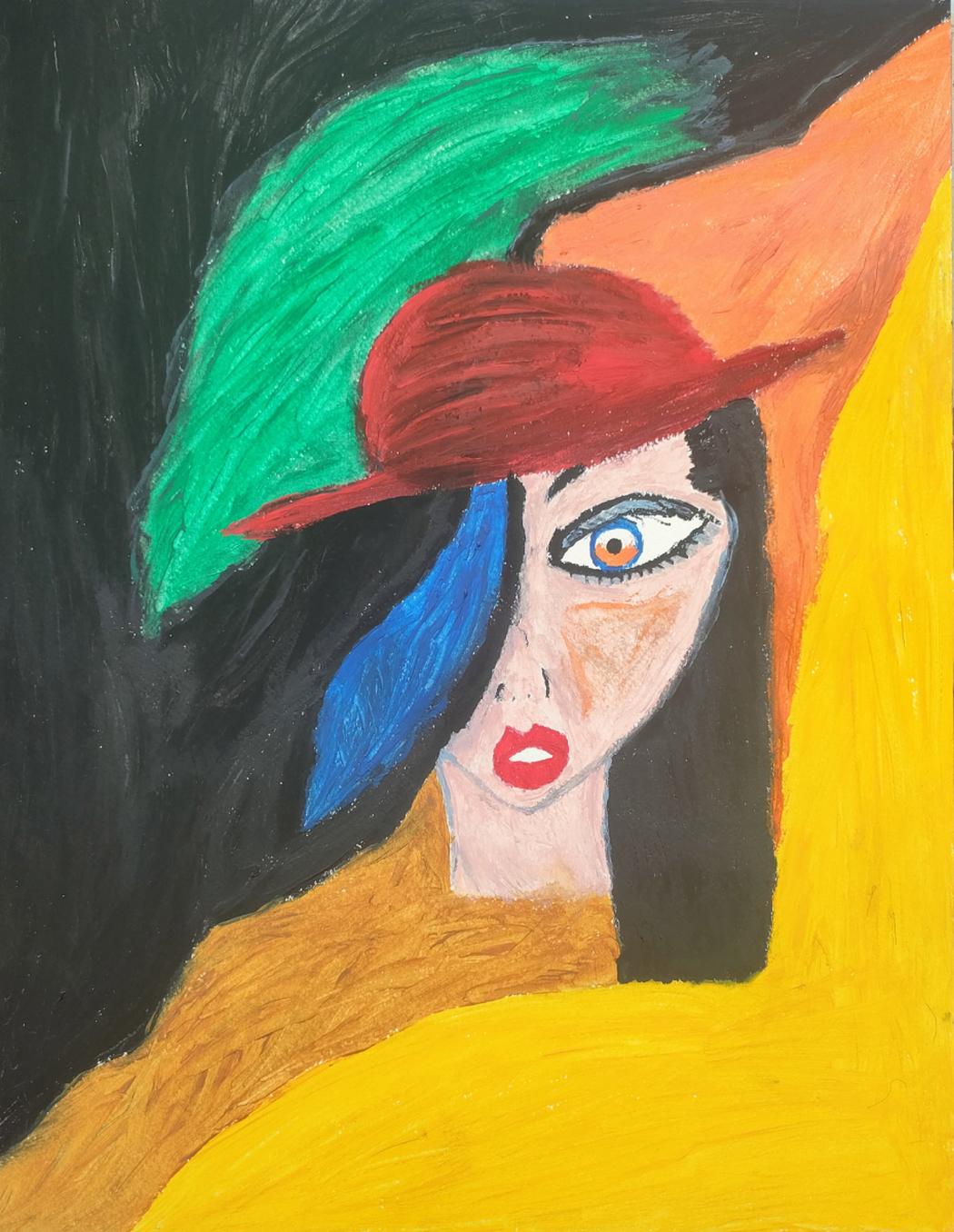 Takuya Inoue Higa | My Sister | 2025
Music plays a central role in your practice. Are there particular genres, artists, or sounds that repeatedly influence your work?
Music plays a central role in my creative practice, and I listen to a wide range of songs based on personal preference. One important aspect of my process is that the same piece of music can generate completely different inspirations at different times. For this reason, I do not impose a strict rule such as “one song for one artwork, never to be used again.” By allowing time to pass before returning to the same track, I can create new works that carry different messages. That said, while painting, I always repeat a single piece of music on loop.
I am able to draw inspiration both from music with lyrics and from instrumental sound. However, I believe it took time for me to become comfortable generating inspiration from songs with lyrics in my native language. In contrast, foreign languages often feel closer to instrumental sound to me. I have worked while listening to songs sung in Japanese, French, English, German, and Spanish, and regardless of whether lyrics are present, I now find it easy to enter an inspired state.
When it comes to genre, I do not have strong preferences or limitations. I listen to a wide range of music, from Japanese enka to video game soundtracks, as well as Western music. This includes hard rock, oldies, and even music inspired by Asia, such as pieces featuring the Chinese erhu. I have experimented with many styles. If I were to highlight some particularly memorable influences, I would mention the Japanese rock band The Back Horn, background music from the Touhou Project game series, The Phantom of the Opera: Overture, as well as passionate styles such as flamenco and tango.
Another characteristic of my process is that the emotional direction of the music—whether it is bright, melancholic, or intense—often determines the nature of the resulting work. The messages I convey emerge from the paintings themselves, which are born from musical inspiration, and in this sense, music and the messages I wish to communicate are indirectly but deeply connected.
As one example, in my work Scream, the source of inspiration was the song Gekkou by Onitsuka Chihiro, a Japanese female artist. The song conveys a tragic atmosphere and expresses the fragility of continuing to live within a cruel world. While the lyrics themselves were important, I was especially influenced by the emotional inflections of her voice and the accompanying performance. From this, I was able to attach the message, “To all my fellow companions who suffer from disability,” and convey both shared pain and a sense of solidarity through the painting.
The place where I currently live, Okinawa, has a long history of exchange with many countries, both Eastern and Western. Over time, people from diverse backgrounds have visited and interacted here, making it what could be called a “mosaic of cultures” within Japan. For me, having roots in such a place—and also having had the opportunity to study abroad in the past—may have formed the foundation that allows me to resonate with music from around the world. Moving forward, I want to continue searching for new sounds, repeating cycles of experimentation and adventure, and continuing to paint in dialogue with music.
 Takuya Inoue Higa | Scream | 2025
Your paintings often balance intensity and vulnerability. How do you navigate these two forces during creation?
To be honest, until I received this question, I did not have a clear awareness of this balance within myself.
I had felt that there were differences in intensity and vulnerability—such as expressions of passion or sadness—from one work to another. However, realizing that both intensity and vulnerability coexist within a single piece was a new discovery for me. Thank you for bringing this to my attention. In response to your question, I would like to reflect on this aspect of my process more carefully.
From my perspective, my paintings often begin with instinctive inspiration, which brings an initial sense of intensity. As the process continues, I then make conscious choices guided by reason, selecting direction and structure. I believe that this combination results in works where these two forces—instinct and reason—are clearly interwoven.
As mentioned partially in my answer to question four, this may be a phenomenon that arises from the way instinct and rational thought are alternately used during the act of creation. Beyond this structural process, I also feel that the messages embedded in my paintings are not composed solely of strength. Vulnerability is allowed to coexist alongside it. In other words, while there is something I strongly wish to assert or convey, there is also a part of myself that has not reached a complete or absolute certainty, and that presence remains within the work.
 Takuya Inoue Higa | Super Vocal | 2025
How do you feel when viewers interpret your work in ways that differ from your original emotions or intentions?
To be honest, when viewers interpret my work in ways that differ from my own emotions or intentions, I do feel a slight sense of disappointment at first. However, I make a conscious effort to quickly respect and empathize with their interpretations and emotional responses. Rather than opposing the feelings or meanings they derive from the painting, I try to communicate my own intentions through dialogue. If my perspective is not accepted, I choose to respect their sensibility and way of seeing.
Of course, I do want to make an effort to express my own intentions as clearly as possible. Because, as a neurodivergent person, I am often the one who struggles to be understood in everyday life, I feel it is important to extend the same understanding and consideration to those who view my work.
At its core, I believe that art is a vast form of entertainment. If someone receives an impression from my work and, from that impression, expands their own imaginative world and enjoys it, that alone is something to be genuinely happy about. And when the message I wish to convey is understood, I believe it can lead to an even deeper level of resonance—where joy or sorrow is shared, where philosophical insight is awakened, or where the work becomes a source of warmth that gently accompanies someone at the depths of their sadness. That level of resonance is my greatest ideal.
Leave a Reply
You must be logged in to post a comment.