

Esther Kwon
After nearly two decades in brand experience design, what drew you toward painting? How has that background shaped your approach to composition?
For nearly two decades, I worked as a designer, creating images with clear purposes and messages. Design constantly required me to think about what to communicate and how to communicate it, which naturally made me sensitive to color, form, negative space, and the way the eye moves across an image.
At some point, however, I began to feel a desire to create images that were not made to communicate something for someone else, but rather to explore the emotions and memories that remained within me. That became one of the most important reasons I turned to painting.
Design and painting are certainly different disciplines, but my years of experience in design naturally remain present in my work. When I balance colors, guide the viewer’s gaze across the canvas, or decide what to reveal and what to leave out, I can still feel the influence of the visual instincts I developed as a designer.
You describe memory as retaining certain colors, light, and emotions rather than an exact account of events. How do you decide which details to keep when a memory becomes a painting?
The scenes I remember are never as precise as photographs. As time passes, the details of a place or what happened there may begin to fade, yet certain colors, qualities of light, the feeling of the air, and the emotions of that moment can remain surprisingly vivid.
When I paint, I do not try to recreate a scene exactly as it was. Instead, I ask myself what has remained after everything else has begun to disappear.
Sometimes it is an intense green, warm sunlight, or light shimmering across water. I follow these fragments of sensation and use them to reconstruct the memory. Ultimately, what I want to paint is not an exact image of the past, but the emotional impression that continues to live within me.
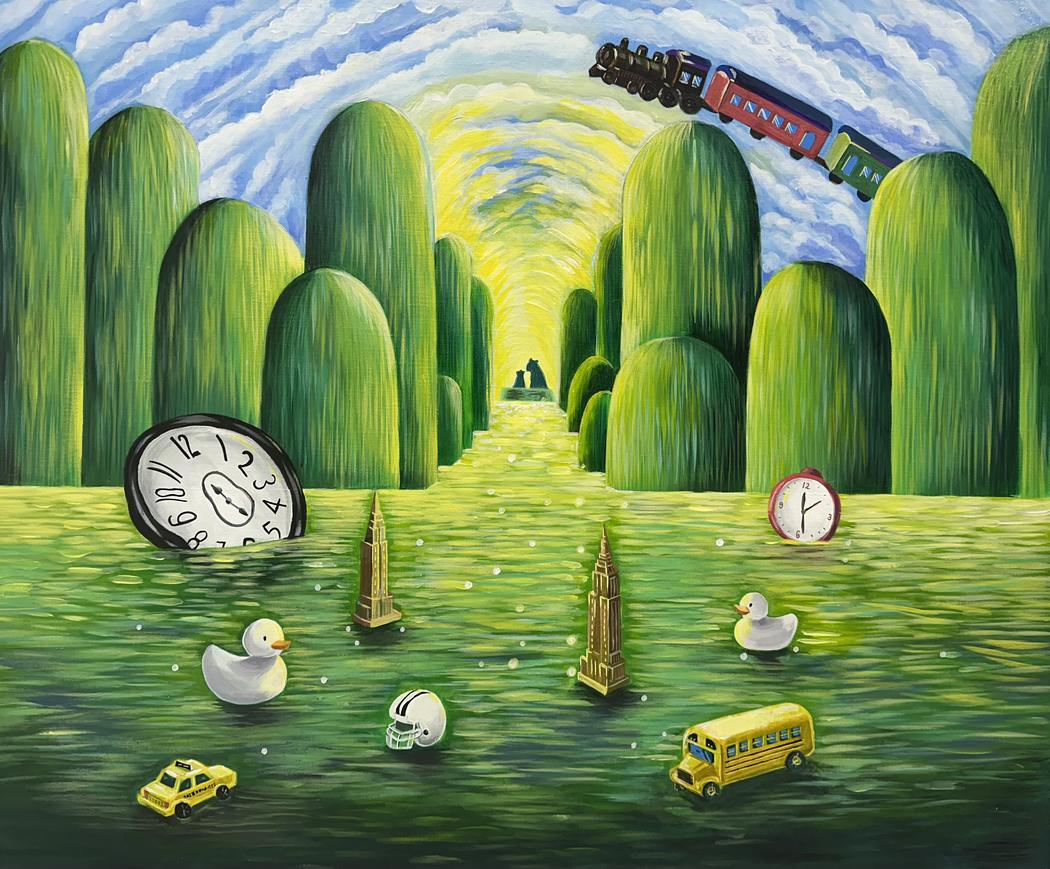 Esther Kwon | The Fleeting Moments Of Life | 2026
In two of your paintings, you return to a similar green landscape, but change the figures and the movement of the water. What led you to explore this scene more than once?
Even the same memory can feel different each time I return to it. On one day, I may remember the landscape most vividly; on another, it may be a person, the light, or the movement of the water that comes forward.
For me, returning to the same place in a painting is therefore not about repeating a scene. It is about looking at the same memory again through a different emotional lens.
As time passes, memories subtly change, and I also change as the person remembering them. The shifting figures and movement of the water within similar landscapes reflect this changing nature of memory and emotion.
Small figures often appear far away in your paintings, surrounded by luminous forms. What does that distance allow you to express?
I prefer the figures in my paintings to exist as small parts of the landscape rather than dominate the image.
When we remember a moment from long ago, we do not always remember a person’s face or expression clearly. Sometimes we remember them together with the light, atmosphere, and sense of distance that surrounded them. In that sense, the figures in my paintings are less like specific individuals and more like presences that remain within a memory.
By placing them at a distance, I hope viewers can move beyond the story of a particular person and enter the emotional atmosphere of the landscape itself. Their small scale also suggests how fragile and precious human presence can feel within a vast landscape.
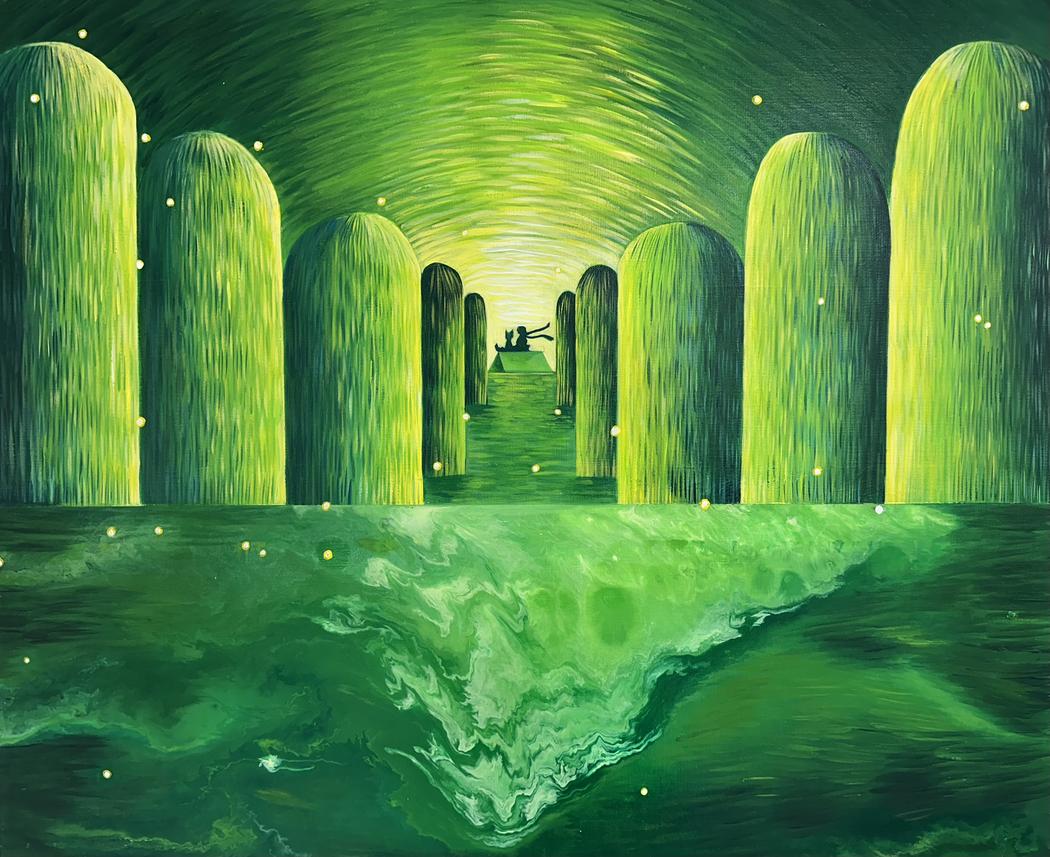 Esther Kwon | Everyday Warmth | 2026
The green light in these landscapes feels inviting, while the paths seem to lead somewhere unknown. How do you think about the relationship between familiarity and mystery in your work?
The landscapes I paint often begin with places that actually existed, but I do not want them to remain entirely realistic.
A place within memory can become both familiar and strange. We may recognize it, yet as time passes, the boundary between what we actually saw and what our minds have reconstructed begins to blur.
This is why the paths and light in my paintings often seem to lead somewhere without revealing exactly where. I am drawn to that ambiguity. When a familiar landscape contains a sense of mystery or unfamiliarity, I feel it can move beyond a personal memory and become a psychological landscape.
What has painting helped you notice about ordinary experiences that you might have overlooked while living through them?
Painting has taught me to look more closely at very ordinary moments.
Sunlight filtering through leaves, a landscape encountered unexpectedly while traveling, or a path I once walked with my family—these were not necessarily moments I considered special at the time. Yet I have discovered that they often remain with me long after they have passed.
I do not think our lives are shaped only by extraordinary events. Sometimes the moments we barely noticed become our warmest memories with the passage of time.
For me, painting has become a way of rediscovering these moments and recognizing the extraordinary within the ordinary.
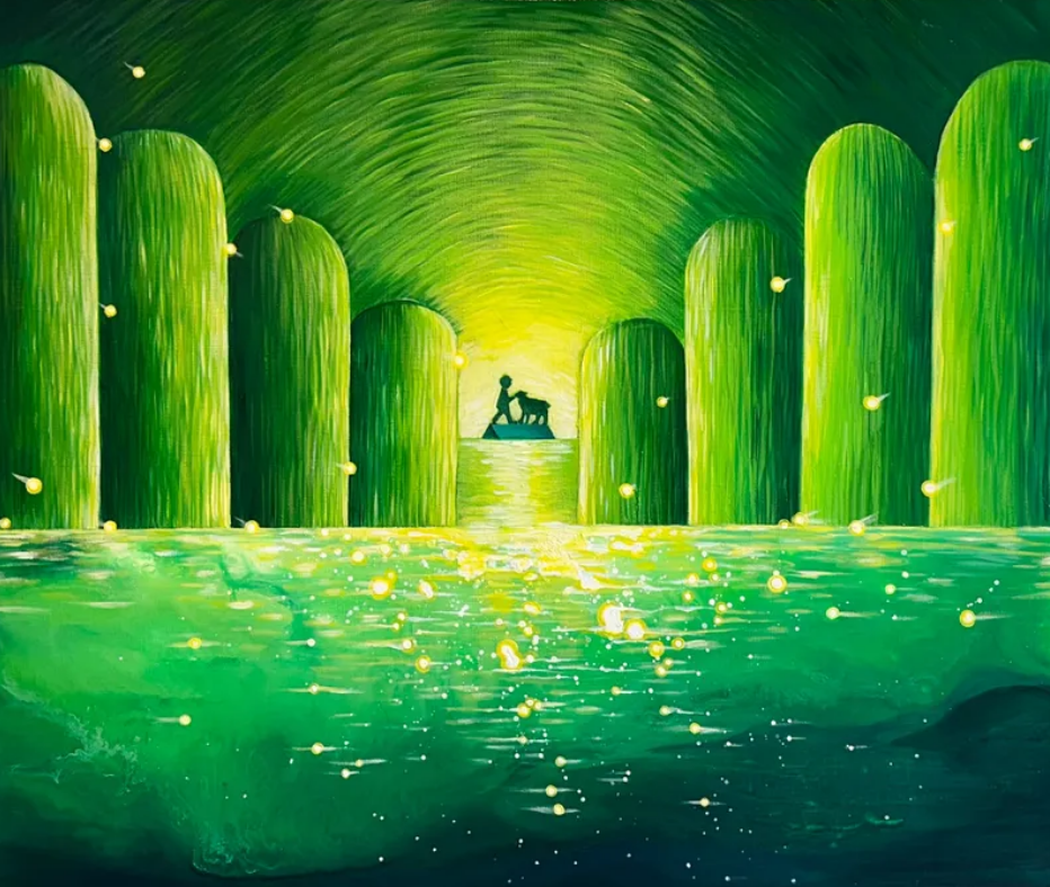 Esther Kwon | Everyday Warmth | 2026
When viewers encounter your paintings without knowing the memories behind them, what room would you like to leave for their own interpretations?
My paintings begin with personal memories, but I do not want them to remain only my stories.
For this reason, I try not to explain the situations or figures in my paintings too specifically. I want to leave enough space for viewers to bring their own memories and experiences into the work.
For one person, a landscape in my painting might recall a place from childhood. For another, it might evoke a day spent with family or a journey taken long ago.
I am interested in the moment when a painting that began with one of my memories encounters the memory of someone else and becomes a different story. In a way, I feel that this is when the work is completed again through the viewer.