DADO
You describe yourself as a Croatian-Greek illustrator currently studying in the UK. How have these different cultural environments shaped your visual language and approach to storytelling?
Having been born in Switzerland, moved to multiple different countries in my life and with my family scattered across the world, my work brings a variety of different cultural perspectives, ways of life and thinking. A part of me is everywhere I have lived, and I have a great appreciation for all these different experiences. My work is greatly influenced by where I am in the moment, as each place contains different memories and emotions and the people within it. Since I am inspired to a big extent by observations from my daily life and the people around me, creating in Greece, for example, will bring out a more bright, energetic and homely feel in my work. On the other hand, when I am in the UK, I am very much more on my own, in a country which I feel to be more closed off and cold, which will slowly build up the environment which I develop in my art.
Character design is central to your practice. When creating a new character, do you begin with their appearance, personality, backstory, or the world they inhabit?
It depends. I think most of my ideas start off with a feeling or a state of mind. I very often see my life from a third perspective, in a cinematic kind of way, and from then on, I start to envision. The movement, colours and feeling of that scene, all onto paper. I have always loved designing characters with dynamic clothes and weird silhouettes, just building up on who they are with accessories and little details. That way, even if I might have a starting idea for who I want to design, there is always more depth that will come off that character once I start drawing them.
I also think a lot of my characters are an extension of myself. Art starts off as a personal process, and I put a lot of myself in (real or imaginary).
After the scenario is set in my head, I start to imagine the movement in their appearance and how their environment breaths and becomes one with them.
Lastly, another way I begin my process is just by observing people on the street. I love seeing weird outfits, unique body types and situations that interest me, and to develop them with my imagination.
Your illustrations often feel like fragments of larger stories. How much of the narrative do you develop before you begin drawing, and how much do you intentionally leave open to the viewer’s imagination?
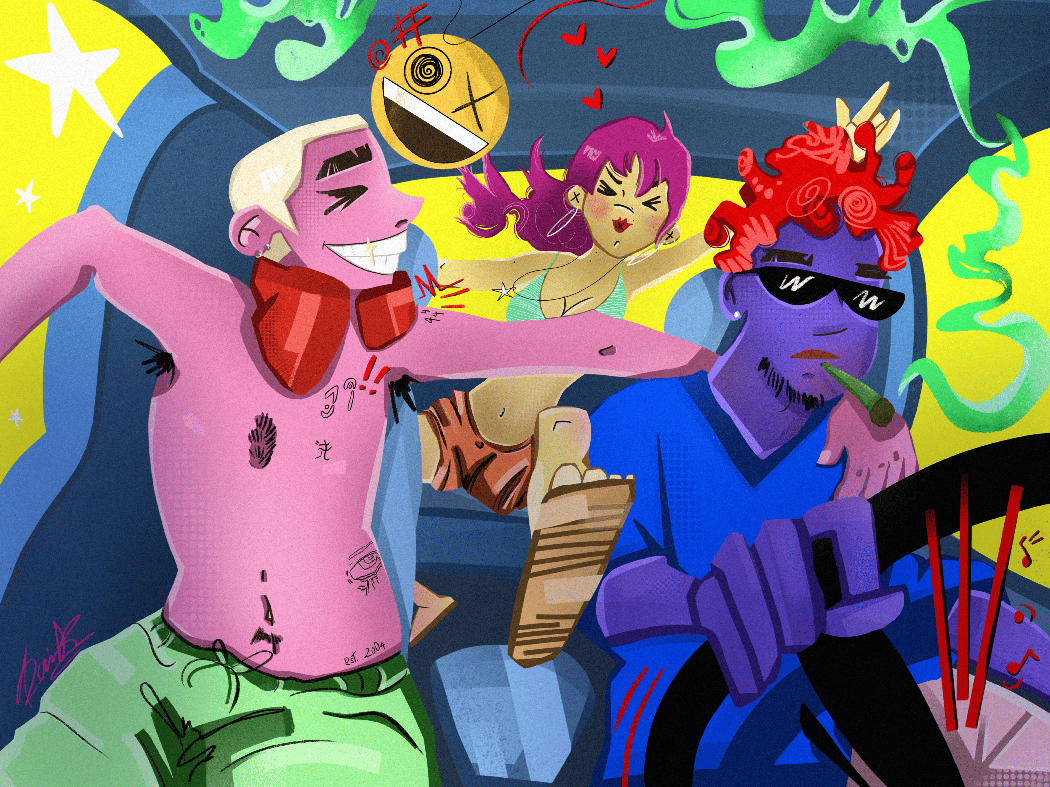
A lot of my work is memories with an exaggerated feeling and atmosphere. I will be in my friend’s speeding car with music blasting, and I already have the scenario starting to develop in my head, with bright colours and everything kind of “jumping at you”.
I think we also want to relate to someone and be understood, so I like not telling the whole story, and leaving room for interpretation, because this is something I also find very appealing when looking at other people’s work. Every emotion is universal, so the idea that someone can see themselves in what I draw is amazing. A lot of times my illustrations will kind of “develop themselves” in a way. Without a set goal or intention, I’ll start developing an idea that speaks for itself, or conversely, leave a few holes in the story.
Often, I’ll begin with a small cool detail I want to draw, like a hairstyle, or a pose, and as I start developing that personality the story builds itself, I just make room for it.
The works presented here move between very different settings – from a mysterious underwater encounter to an urban nighttime scene and a brightly coloured social moment. What draws you to such varied worlds and atmospheres?
I get inspired from so many different things every day. It could be a movie I watched, an artist, a building, or an experience, and very often I want to try new things and experiment, to see what speaks to me. Sometimes the ideas in my head stay more grounded and realistic and other times depending on my influences will need way more fantastical elements in them.
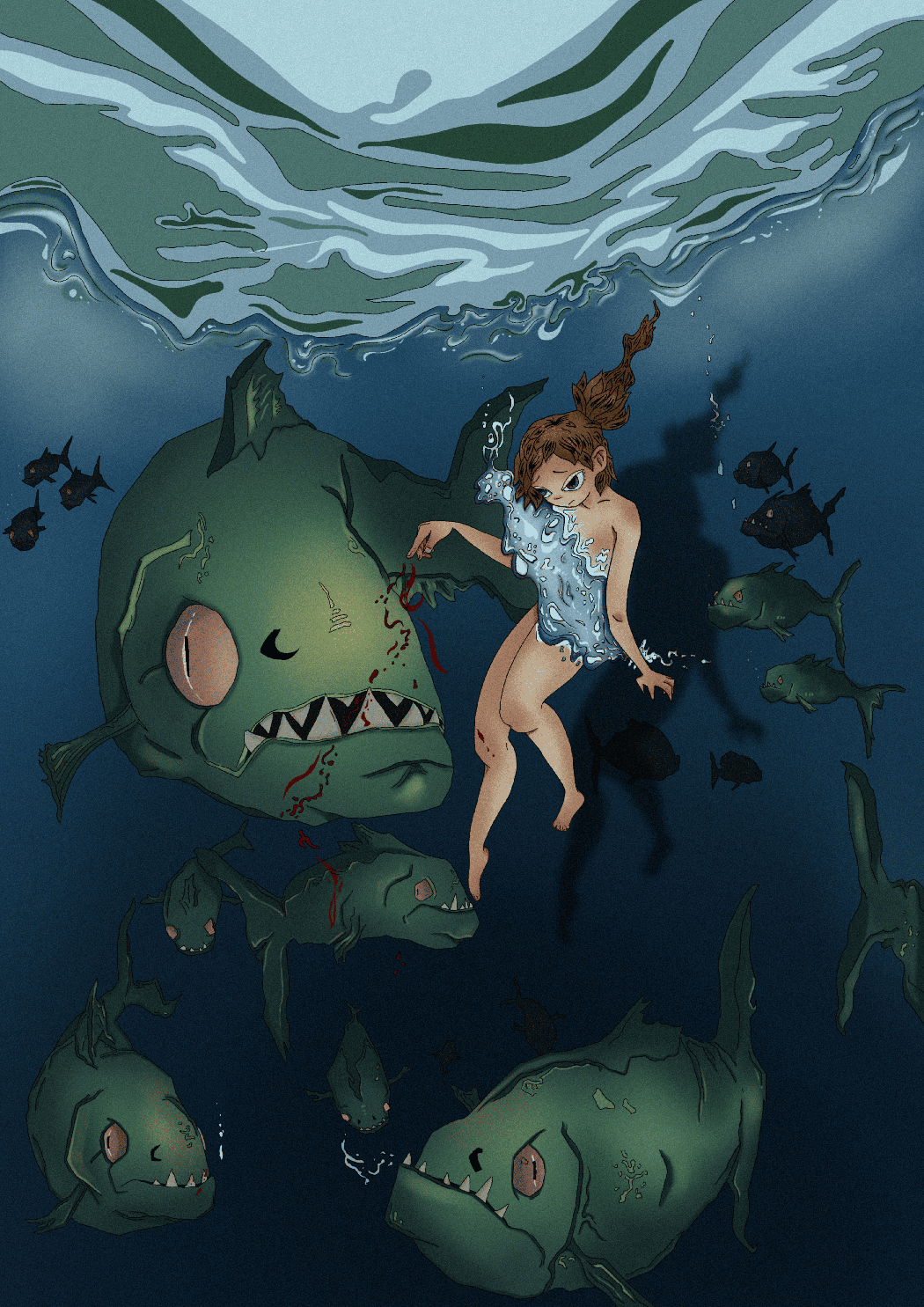
I have always loved drawing characters, and more recently with colour, because it can communicate so much and it’s just beautiful to me. The underwater scene, for example, was for a university magazine with the theme “Lust” and I drew my own interpretation of it, without wanting to head to the more general idea tied with the theme which is usually sexual.
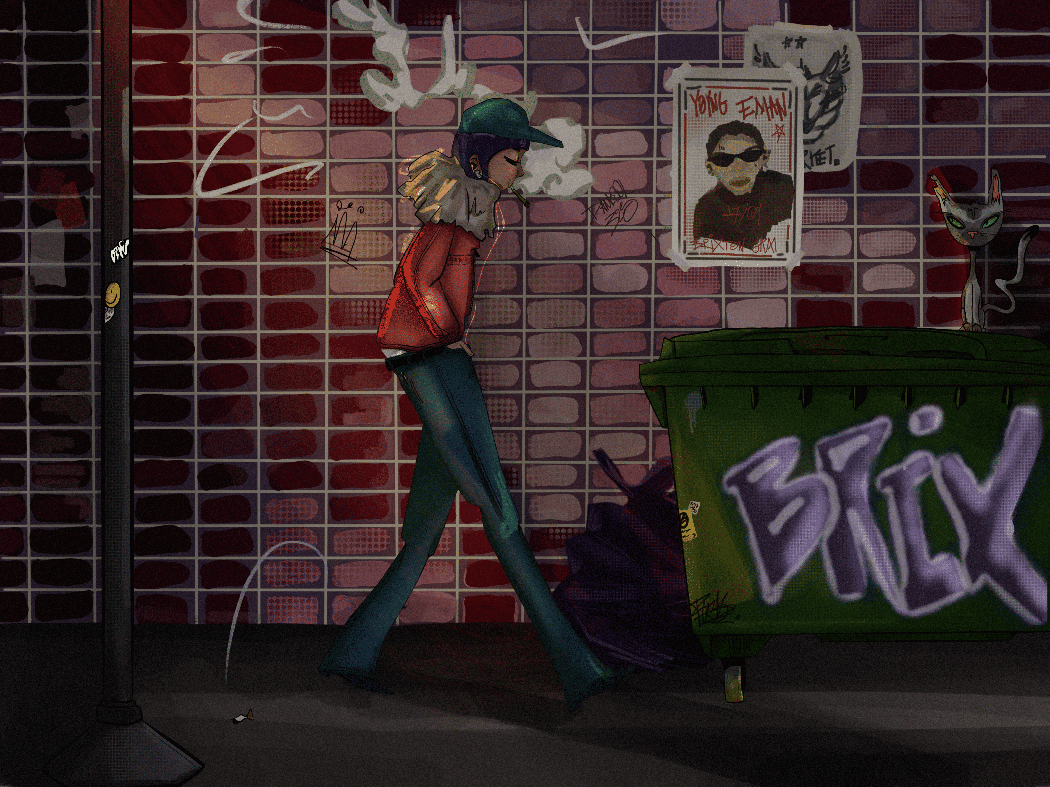
The urban nighttime scene was drawn when I was living in Brixton. I used to return very late at night from work, walking fast and keeping to myself. This systematic walk is one I walked daily, in a run-down but cultured environment.
I have also never played video games in my life, and recently tried Zelda, Breath of the Wild. The art in that is just beautiful. It’s a fantasy story, with amazing environments and really cool weapons, characters and villages. This has inspired me to design more fantastical characters, not fully humans, and explore more environmental design.
Humor and unease often coexist in your imagery. How do you balance playful, exaggerated character design with darker or more ambiguous elements?
In a way, I think that this partially separates the characters mental state from its environment. In the Brixton scene, this was a daily ritual of walking home, so the character is almost unaffected by their darker seeming environment, whilst still being a part of it.
At the same time, a moment is never completely fuelled by one emotion. There are so many elements in my head that fight for hierarchy and feel like they need to be present.
There are two sides to it. Firstly, coming from another country and moving to Brixton comes with adaptation mixed with a level of fear, especially as a woman. The area completely shifted at night…but then I had my music playing on my headphones and became almost detached. Playful smoke and hand drawn lines come in contrast with the environment, but it also signals the enjoyable parts of living there independently as a student.
Then again, with the underwater scene, my character is placed in dark water surrounded by piranhas. The theme given was “Lust”, and the water ripples at the top are lighter and more playful than the rest of the imagery. A situation for me is never simply black or white, there is so much in between that I feel needs to be present and spoken.
Your characters communicate strongly through posture, facial expression, clothing, and gesture. How do you use body language to suggest relationships and emotions without relying on written dialogue?
I used to draw only detailed and traditional pencil portraits that were a copy-paste from an image. I think starting within that style not only helped build a good foundation in understanding anatomy, facial expressions and lighting, but also just pushed me to pursue and find what my imagination had to say. That annoyance of not having produced anything that was really “mine”, pushed me to experiment a lot with colour, break anatomical rules and see how figures coexist with each other, and just come up with my own ideas.
I also have a background in theatre and film. Years of theatre exercises and improvisation are all very much about how you communicate something, what your goals and needs are for a scene, how you present yourself, especially what happens when other characters come into play.
I think in combination with the above, this unconsciously helped me to interpret someone’s emotional state and relationship to another without dialogue on paper. I love dramatizing all this too, like a huge smile or aggressive clothing, but sometimes some drawings come out more silent and subtle that express something too. Take the Brixton scene for example. It is more reserved and relaxed, so I tried to convey that atmosphere through the environment and the characters stance.
Lastly, I find self-expression through mediums such as clothing, tattoos, piercings and hairstyles a way to know a person’s story. All these choices reflect who we are and what we want the world to see us as I believe. Considering all these small but important choices when building a character is a really fun process for me.
Symbols, graphic marks, and handwritten elements appear throughout your illustrations. Are these primarily decorative, or do they carry specific meanings within the worlds you create?
Even though my work lately has been mostly digital, I still find my sketchbook processes to be really important. That blend between digital and sketch is something I have always been attracted too, resembling a comic book feel. Sometimes I will use words to express what I want, but mostly it will all be found within my illustration.
Most marks like this feel “needed”, that’s where my hand goes, and it’s completely produced by the atmosphere and vibe of what I’m creating. Often, I use them to convey a motion that is happening or has happened, like a cigarette bud falling, loud music from headphones or the motion from a stirring wheel.
On the other hand, a lot of small symbolic marks will carry a meaning. In a lot of my other illustrations, I repetitively draw some marks, like a cross for example. Because my work is vastly derived from my personal life and people I know, I have tied some marks to different people. It could be necklace they always wear, a specific gesture, which I have directly associated with that person, and serves as a sign that it is them.