
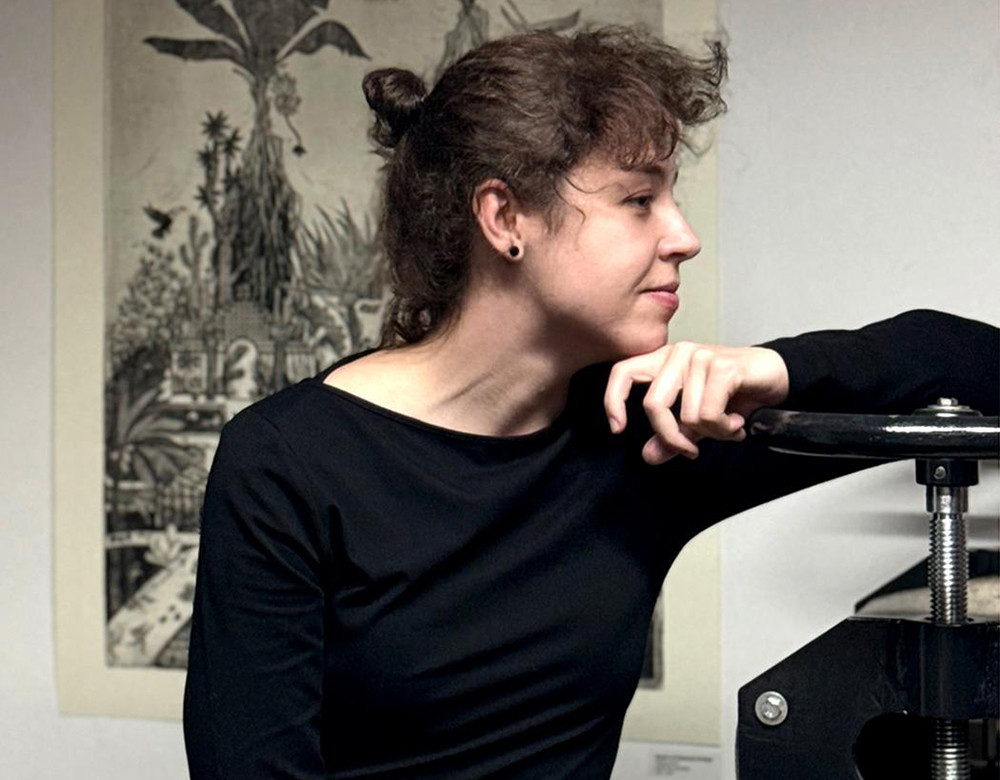
Modesta Gorol
Your works often feel like complete imaginary worlds with their own landscapes, creatures, and hidden narratives. How do these worlds usually begin in your mind?
I love the beginnings. Finding the idea is probably the most important moment in the process, as it sparks the enthusiasm and desire to bring the work to life. There is no single approach.
All my works belong to an artistic cycle called Delta World, which I am constantly expanding. It is a multiverse of connected worlds, where one can travel between them through tiny, often hidden doors within each composition. Its many branches and sub-cycles emerge in different ways.
Sometimes an idea begins with research. The Gardens prints are inspired by real places and the stories shared with me by gardeners. Conversations, scents, and memories fill my mind and become a starting point.
When I collaborate with musicians, my art becomes part of their visual identity and appears on posters and covers. My artistic freedom is guided by the essence of each piece. Musicians often share their feelings, impressions, and verbal descriptions of particular sounds, which I use to imagine and create a dedicated world.
Other works are deeply personal and independent of external stimuli, at least consciously. Their landscapes and creatures become a manifestation of artistic freedom and an ongoing discovery of what my mind is capable of. In these cases, the process is very intuitive, rooted in emotions.
What all my works have in common is the large number of sketches I make while searching for the right way to express an idea. I pin them to the walls of my studio and live with them, looking at them from a distance until one catches my attention and I feel the urge to develop it further.
Sometimes an idea simply appears at random moments—in an elevator, on a tram, or even during conversations. Someone’s seemingly random words can trigger images that develop into wider concepts. This happened with my oil painting To the East (2024): while listening to friends talk about Japan, a cat in a tree, and the passing of time, this cacophony of images and thoughts unexpectedly formed the idea in my mind.
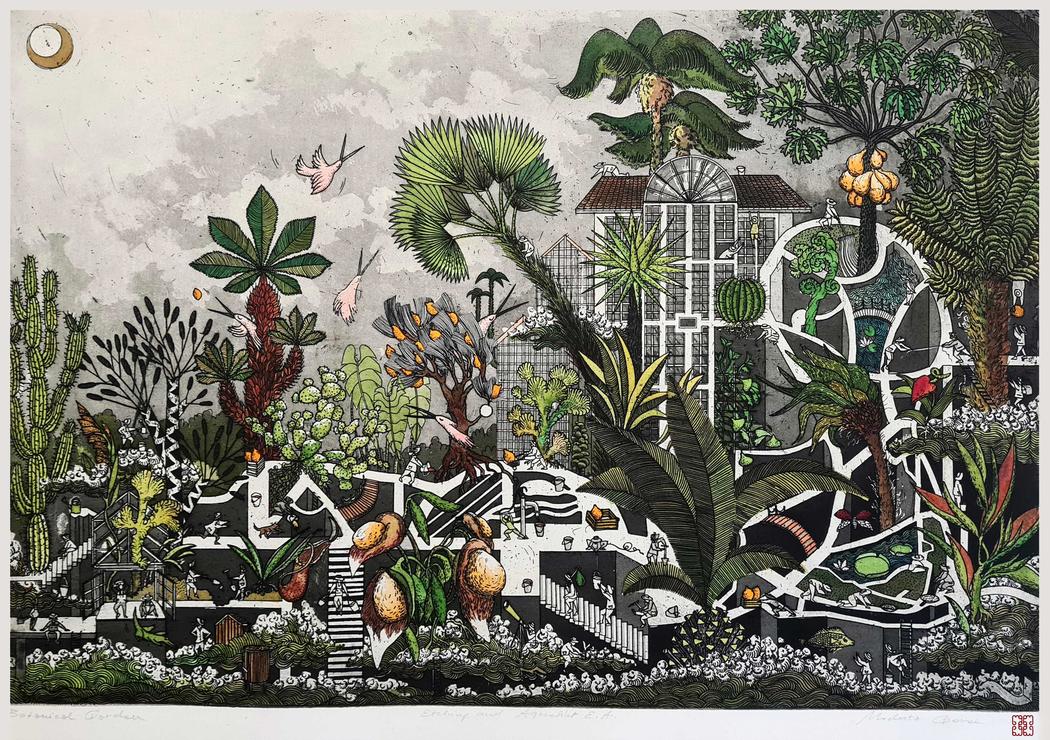 Modesta Gorol | Dresden Botanical Garden
Nature is central to your practice, but you rarely represent it literally. How do you decide which elements to keep recognizable and which to transform through imagination?
When I create works about gardens, certain elements require a degree of literalness. Showing a specific plant species that is particularly important, the distinctive architecture of a greenhouse, or the garden’s map woven into the visual composition needs to remain recognizable. These selected parts of the image are recognizable because I want to clearly convey the qualities of the garden and the stories the gardeners have shared with me. After all, the narrations depicted in these prints are true!
There are also areas where I can allow myself greater freedom and metaphor. The fact that a garden is proud of their remarkable collection of carnivorous plants, for example, can be expressed by enclosing the entire composition in a cage (Savage Garden of Lausanne, 2025). In another work, palm roots transform fantastically into pathways along which tiny gardeners both walk and sail in boats. This suggests the interweaving of flora and fauna, and the multidimensional coexistence of people and plants within the garden (Geneva Garden, 2026).
So, when I create, I let reality and imagination permeate one another.
Your compositions are filled with animals, birds, plants, and unusual interactions between them. What role do these creatures play in the stories you create?
These characters are my imaginary friends 😉 They play leading roles, sometimes supporting ones, but they are always part of the story. Moreover, they all travel between the Delta Worlds and meet in different scenarios, creating meaningful scenes.
For example, in the To the East painting, a young fawn lies alone peacefully on a yellow geometric form, gazing at a blue sun on the horison. We later discover that this sun travels along a horizontal axis, circling the world where night never falls. The fawn is still very young, with only a small set of antlers. But the shadow cast by the sun reveals a slightly different reality: it is a shadow from the future, showing the same animal fully grown, with enormous, majestic antlers. The cats that have grown from a trees also seem to live according to their own whimsical logic. Sometimes they manage to escape their shadows and, as cats tend to do, they are not particularly willing to submit to the demands of reality. Could the fact that the shadow is late be a quiet painterly sigh, a desire to slow down the passage of time? I leave that subjective decision to the viewer.
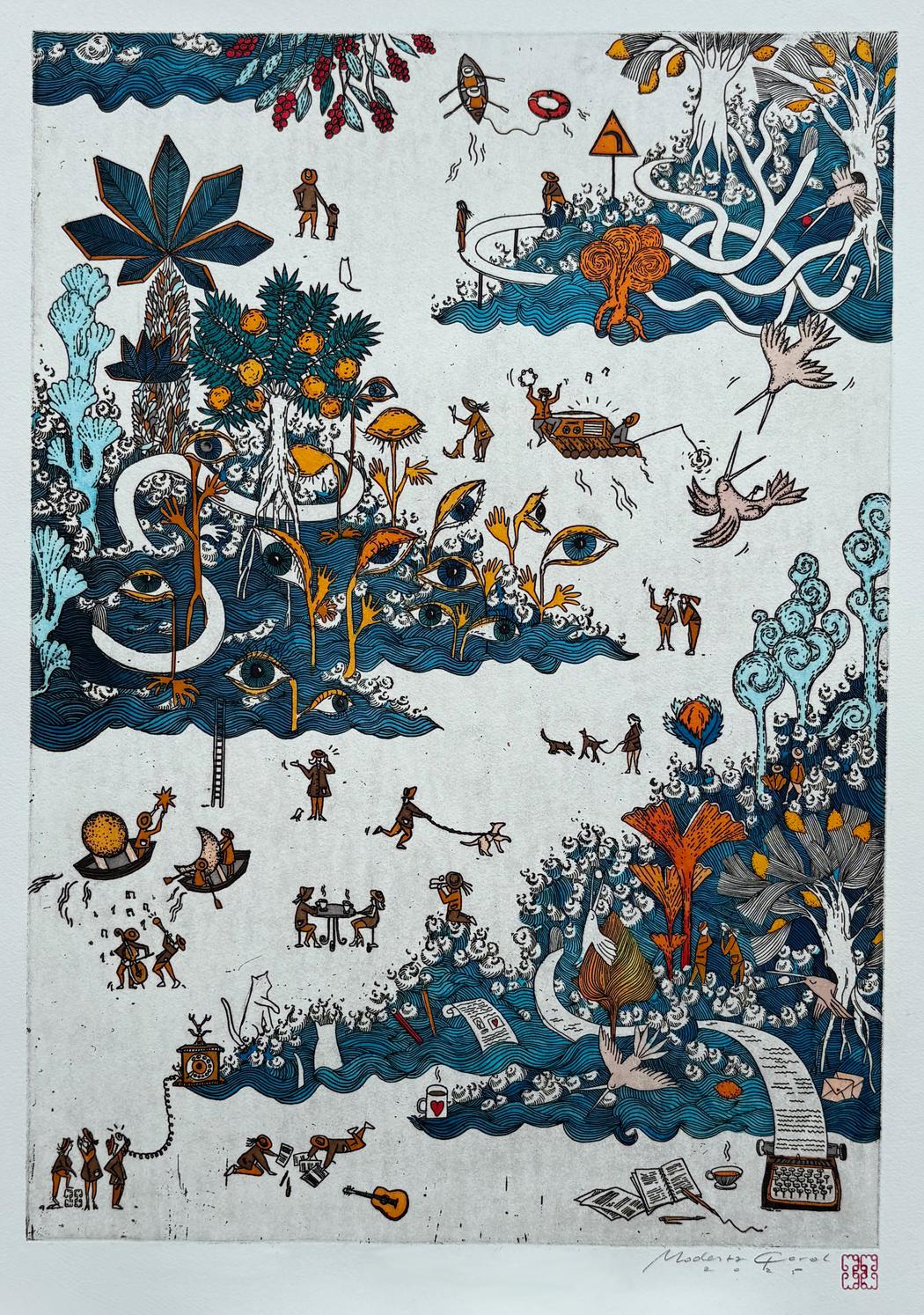 Modesta Gorol | Garden Of Stories
You describe hidden doors as a way of connecting different works and allowing viewers to move between imaginary worlds. How did this idea develop, and what do these passages represent for you?
My doors’ conception symbolizes constant change. This is where the name Delta World comes from. The word “delta” has many meanings: in physics and mathematics, it represents change or difference; it is also a letter of the Greek alphabet and the branching point of a river. All of these meanings are reflected in my imagined world.
The idea of the doors also comes from a desire not to close the composition—to leave a way out, to keep the story from ending, and to escape into another space whenever I feel like it. Sometimes, even to escape from myself. The doors allow me to build a graphic narrative with its own chapters and storylines. They make it possible to surf through time, visiting events from the past as well as the future.
I still have drawings I made as a child, many of them contained doors. Back then, it seemed completely obvious to me, in that very childlike way, that every drawing had a continuation that simply could not be drawn because I had run out of paper space. So I drew doors instead—so that anyone who wanted to could simply walk through and keep going.
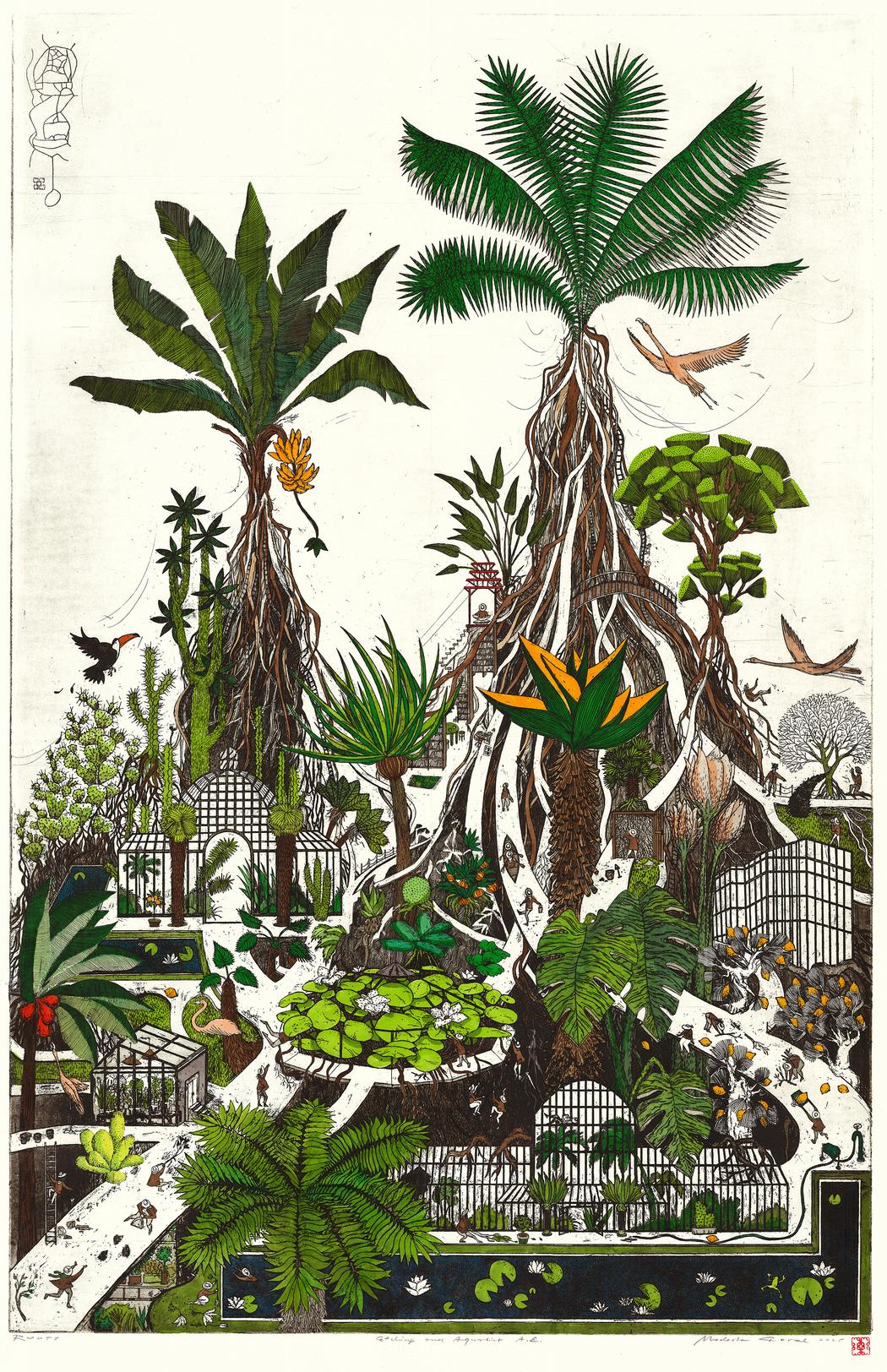 Modesta Gorol | Geneva Garden Roots
Your Gardens series begins with visits to botanical gardens and conversations with gardeners and curators. What kinds of stories or details from these encounters tend to stay with you and eventually enter the artwork?
There are so many stories that I always have to make a selection. After the research my head is overflowing with information and my notebook is packed with sketches.
I always try to present each garden from its most interesting side. I choose the stories that make each garden unique. They are not always just facts about rare plants or impressive collections. Sometimes what makes a garden unique is a skeleton accidentally discovered during the renovation of a greenhouse. Sometimes the fact that visitors once found… a crocodile in the bushes, apparently left there by someone. One garden has a remarkable library, another exceptionally rich, multi-level herbarium. In the Geneva garden, you can find flowerpots with doors—which naturally made me very happy 😉 —and one of the ponds is visited every morning by a wild heron that comes to find a fish and greet the gardeners as they begin their work.
When selecting stories, I am aware that there are already countless botanical publications and natural history books that document gardens and plants, providing excellent information about collections, species, numbers, and achievements. My aim, therefore, is not to document or educate, those functions are already very well served. Art, and the ability of artistic interpretation, allow me to show the garden from a different perspective—one that is more creative, social, and cultural. I can bring attention to events that would never appear in a newspaper or scientific publication because they seem too trivial. But they beautifully reveal the character and everyday life of a garden. That is what interests me the most.
When creating a work inspired by a real botanical garden, how much of the actual place remains in the final image, and how much becomes an entirely new landscape?
The proportions vary from one artwork to another. Sometimes a garden is evoked through small details set within an entirely imagined landscape; at other times, the whole composition is based on the actual map of the garden and closely reflects its real layout.
There are also occasions when a garden shares its plans and dreams for future development with me. In those cases, I allow myself to predict the future and place a dream greenhouse—one that does not yet exist—into the print. I am always curious to see whether it will actually be built a few years from now!
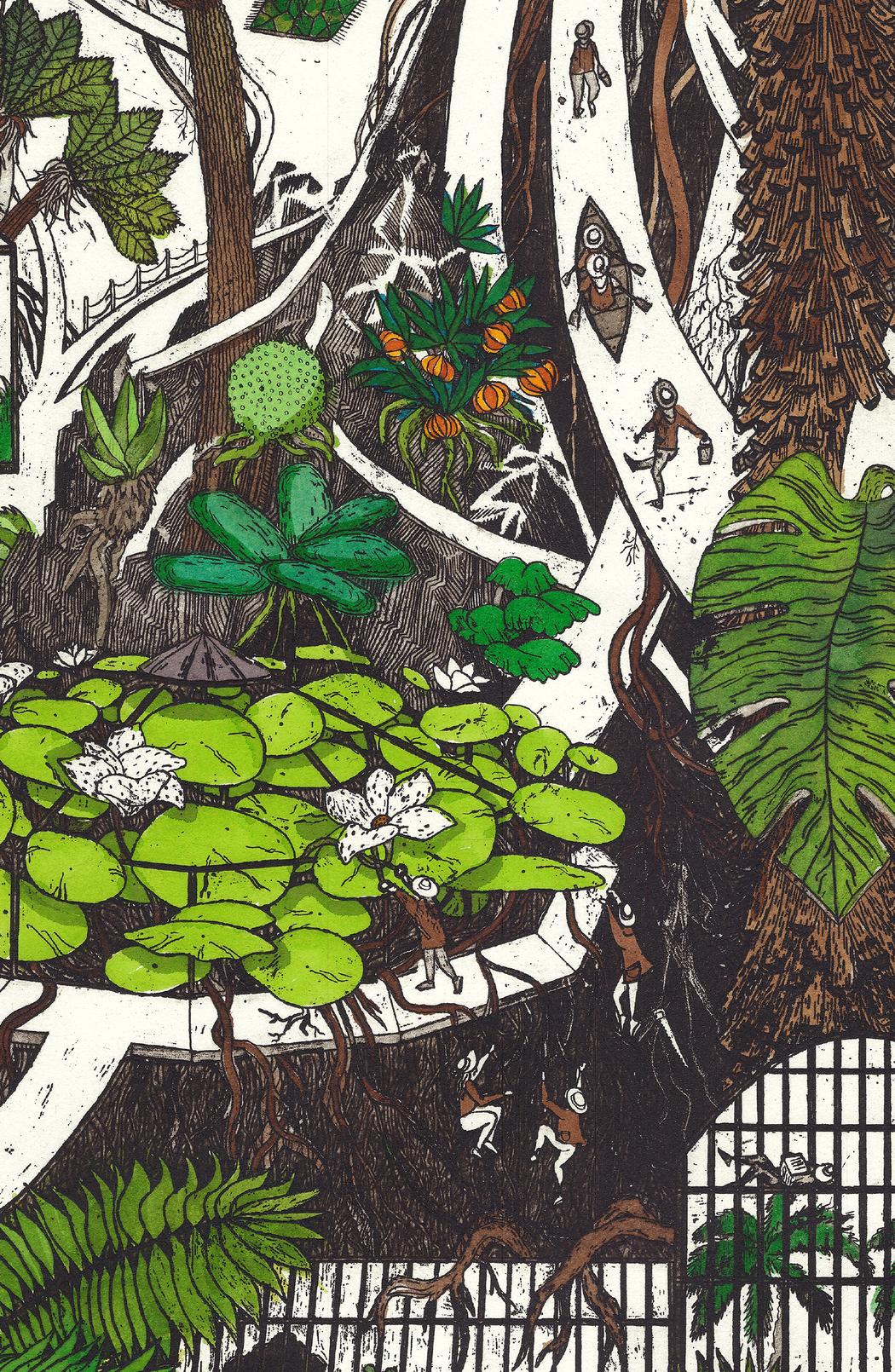 Modesta Gorol | Geneva Garden
Your compositions often contain many small details that viewers may discover only after spending time with the work. How important is this sense of discovery to the way you want your art to be experienced?
The discovery is crucial. Each work tells its own story, and I like to compare it to music: to fall in love with a song, you have to give it time and attention. You have to listen from beginning to end, catch the details, understand the words, feel when the song reaches its climax and when it begins to settle. You listen for the nuances and colours of the sounds, feel the rhythm, and notice the structure—the verses, the chorus, and the ending. Finally, the meaning of a song can change when you learn more about the artist’s life or the context in which it was written.
I think my art works in much the same way. The viewer needs to spend some time with it to get a full experience. The idea is that, when viewing a piece from a distance, the viewer is intrigued by the overall composition. As they move closer, they begin to discover secondary stories and hidden narratives, and can read and interpret the work in their own personal way. And when they look at the artwork again, they notice something new each time. I find that very rewarding.