
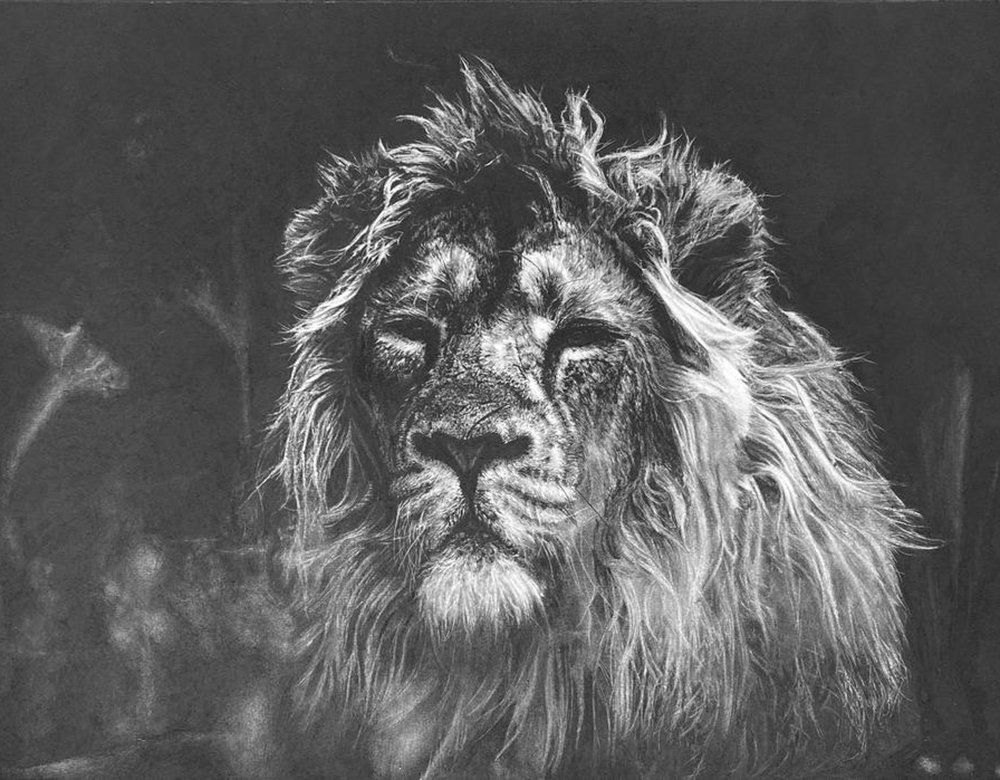
Zoe Baer
Charcoal is central to your practice. What qualities of this medium allow you to express memory, vulnerability, and emotional intensity more effectively than colour might?
I originally worked much more with colour, so my attachment to charcoal came later. What I love about it is the contrast, but also the imperfection of the material itself. Charcoal is powder. It is never completely smooth, flat or controlled, and those tiny irregularities create texture in skin, hair and fabric that can make a drawing feel very human.
That imperfection is important to me because so much of my work is about vulnerability and authenticity. I am interested in what happens when we stop trying to appear perfectly composed and allow ourselves simply to be human. Black and white also strips away some of the distraction of colour. It gives me a very direct relationship with light, darkness and contrast, which can create an emotional intensity that I sometimes find harder to reach in colour.
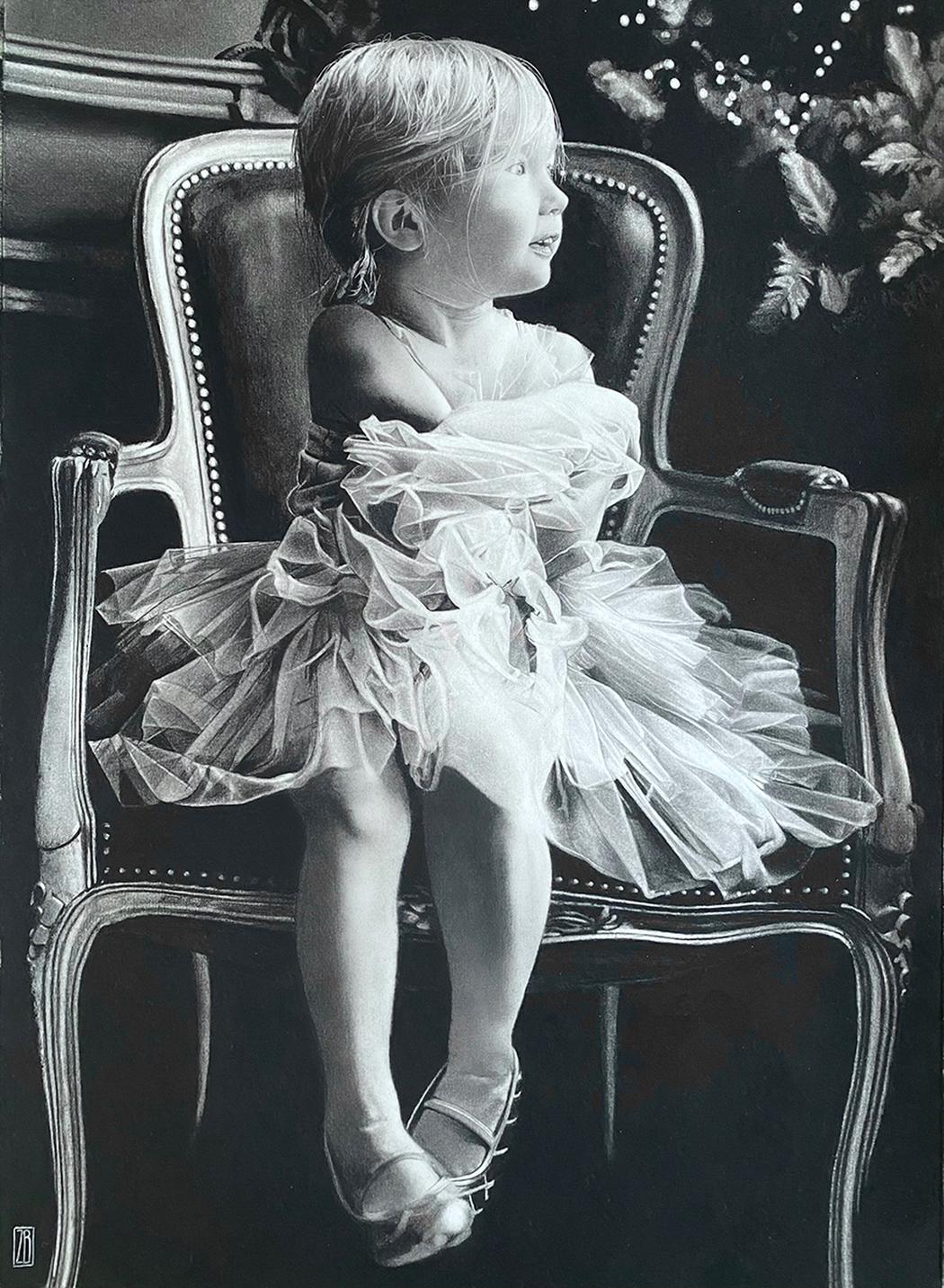 Zoe Baer | Glimmers Of Christmas Joy
Your drawings demonstrate extraordinary attention to texture — from skin, hair, and fabric to feathers and animal fur. How do you build this level of detail while preserving a sense of spontaneity and life?
I try not to think of detail as an end in itself. I am not interested in reproducing every hair or every pore simply because it is there. The detail has to serve the presence of the subject.
A lot of it comes from observing light rather than objects. Instead of thinking, “this is hair” or “this is skin”, I look at changes in value, texture, softness and contrast. Charcoal also helps because I can move between extremely precise marks and areas that are rubbed, erased, blurred or left unfinished.
I think life often comes from resisting the temptation to control everything. If every centimetre is equally perfect, the drawing can become strangely lifeless. I like allowing some areas to disappear, remain rough or carry traces of the process.
The gaze plays a powerful role in your portraits. What interests you about the emotional connection created through the eyes of your subjects?
The gaze is probably one of the most important elements in my work because it is where an image can suddenly stop being only an image.
I am very interested in the difference between looking and actually seeing. We spend so much of our lives looking outward — at other people, at appearances, at what we think we should be — while avoiding what is happening internally. In some drawings the subject looks directly at us, while in others the gaze turns inward. Both can create a kind of confrontation.
Psychologically, I am interested in what exists underneath the persona we present to the world. A face may appear beautiful, confident or completely composed while the eyes reveal vulnerability, uncertainty, strength, sadness or thought. That tension between the outer image and the inner person is something I return to constantly.
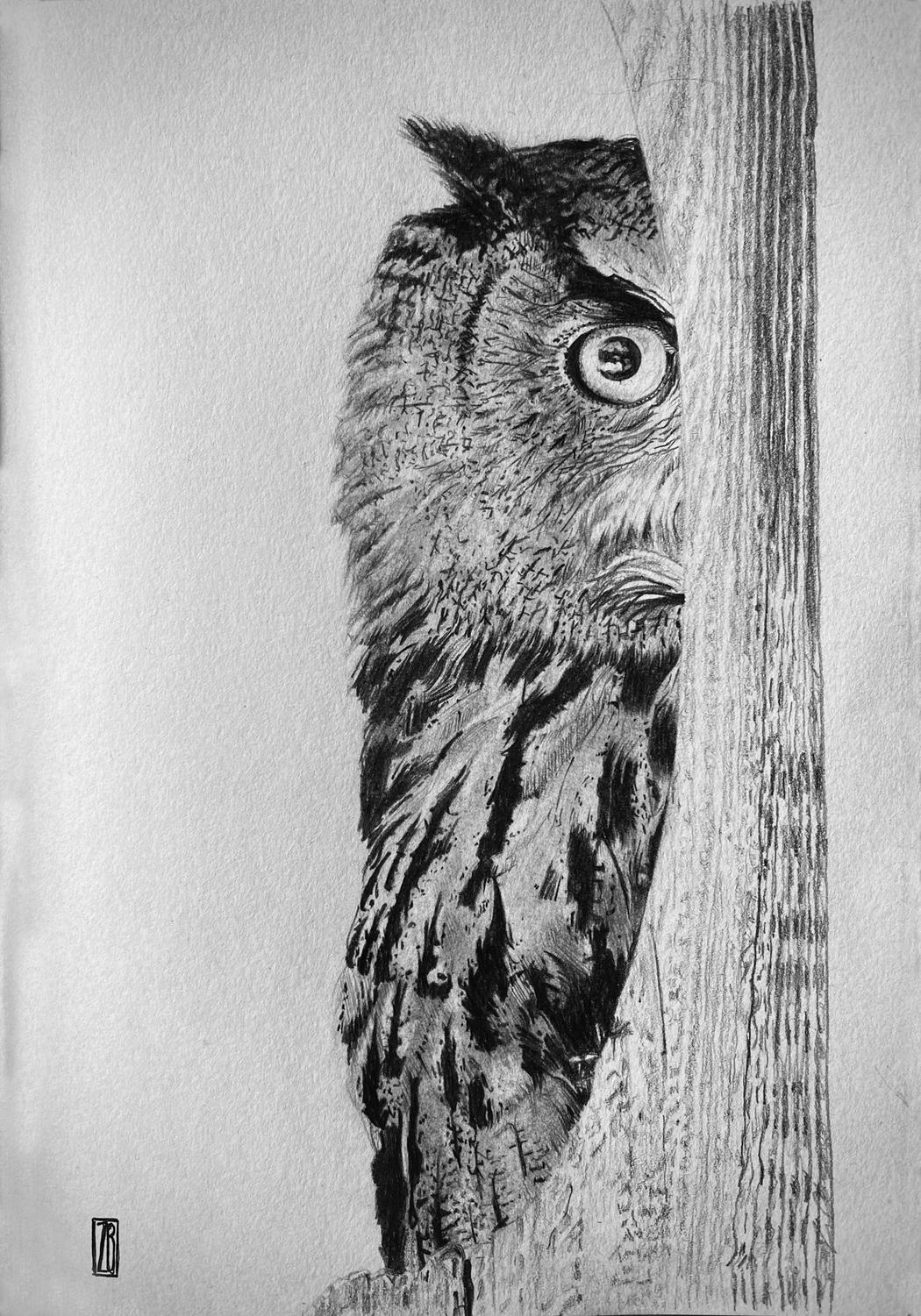 Zoe Baer | Midnight S Guardian
How do you choose the people and animals you portray? Are you primarily drawn to their appearance, their character, or the story you imagine behind them?
Character, definitely, although sometimes I recognise it through appearance first. I look for something in a face or a posture that suggests an inner life.
A large part of my work is about accepting the whole self. We all have parts of ourselves that are uncomfortable, frightened, selfish, angry or imperfect, and we often try not to look at them. But ignoring them does not make them disappear. In a Jungian sense, what we refuse to acknowledge can become more powerful. Looking at those parts allows us to understand them and, eventually, to live with them rather than being controlled by them.
But the opposite is also true. People are often extraordinarily reluctant to recognise what is beautiful in themselves. We criticise ourselves constantly and rarely stop to acknowledge our tenderness, courage or vulnerability. Even sadness can be something profoundly human rather than something we immediately need to judge or correct.
So when I choose a subject, I am usually responding to some suggestion of that complexity rather than conventional beauty alone.
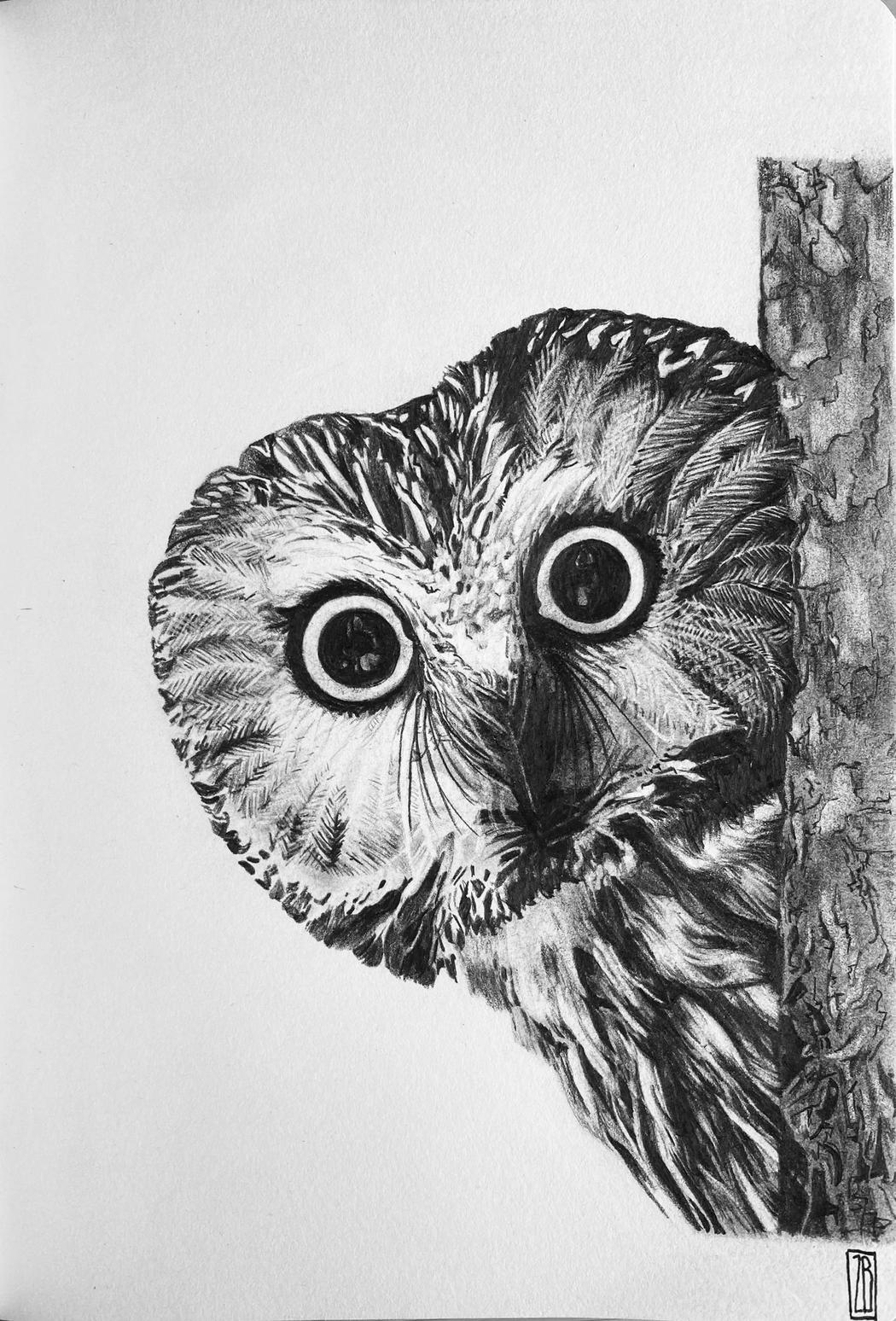 Zoe Baer | The Wise Night Prowler
Your work moves between intimate human portraits and depictions of animals, particularly owls and other creatures associated with strength or wisdom. What relationship do you see between these two sides of your practice?
To be honest, I don’t consciously choose animals because of their symbolism. I simply love animals, and particularly owls. There is something extraordinary in their faces and in the intensity of their gaze.
The fact that the owl has historically been associated with wisdom is interesting, and perhaps there is an unconscious attraction there, because wisdom and self-knowledge are important themes in my work. But I would not want to pretend that every animal is chosen according to a symbolic system.
What connects the animals and the human portraits for me is presence. I am looking for the same thing in both: a moment where the subject seems completely there. Animals can sometimes embody that even more naturally than people do. They are not performing an identity for us. They simply exist. That quality of presence and stillness is something I find deeply compelling.
What did presenting your first solo exhibition in the United States reveal to you about your own work? Did the audience’s response change the way you understood any of the drawings?
The exhibition made me realise more clearly that the individual drawings communicate differently when they are seen together. What had begun as separate portraits and studies became much more obviously one conversation about stillness, identity, vulnerability and presence.
What interested me most was seeing that people responded emotionally to the work before necessarily knowing the ideas behind it. That matters to me because I never want the philosophy to be required in order to experience the drawing. The concept should deepen the work, not explain it into existence.
I don’t think the audience changed what the drawings meant to me, but seeing people connect with them confirmed that the very quiet moments I am interested in can communicate without needing spectacle. That was important for me.
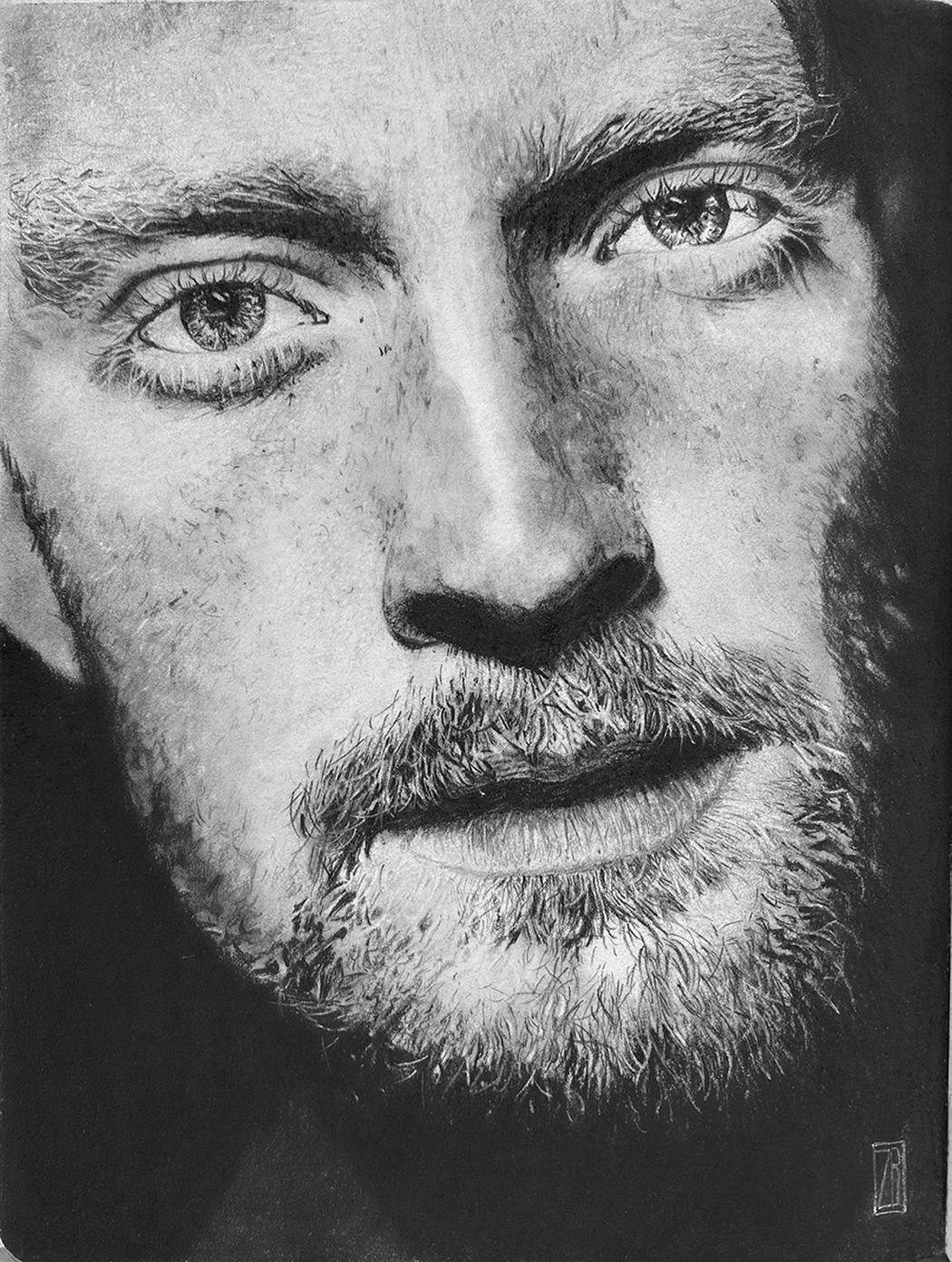 Zoe Baer | The Innocent
As you continue exploring identity and emotional presence through charcoal, what new subjects, formats, or conceptual directions would you like to investigate next?
I want to allow more imperfection into the work.
There is a slight contradiction in what I currently do: I speak a great deal about authenticity, vulnerability and accepting imperfection, yet technically I often create people who appear almost perfectly rendered. I find that contradiction increasingly interesting, but I also want to challenge it.
I would like some future drawings to become looser and more visibly human: rougher skin, exaggerated textures, erased areas, traces of charcoal, unfinished passages or marks that I deliberately choose not to correct.
For me, authenticity and imperfection are inseparable. We cannot really encounter ourselves while constantly editing ourselves into something more acceptable. Philosophically and psychologically, that is the direction I want the work to move towards: less perfection as an image, and more truth as a presence.