
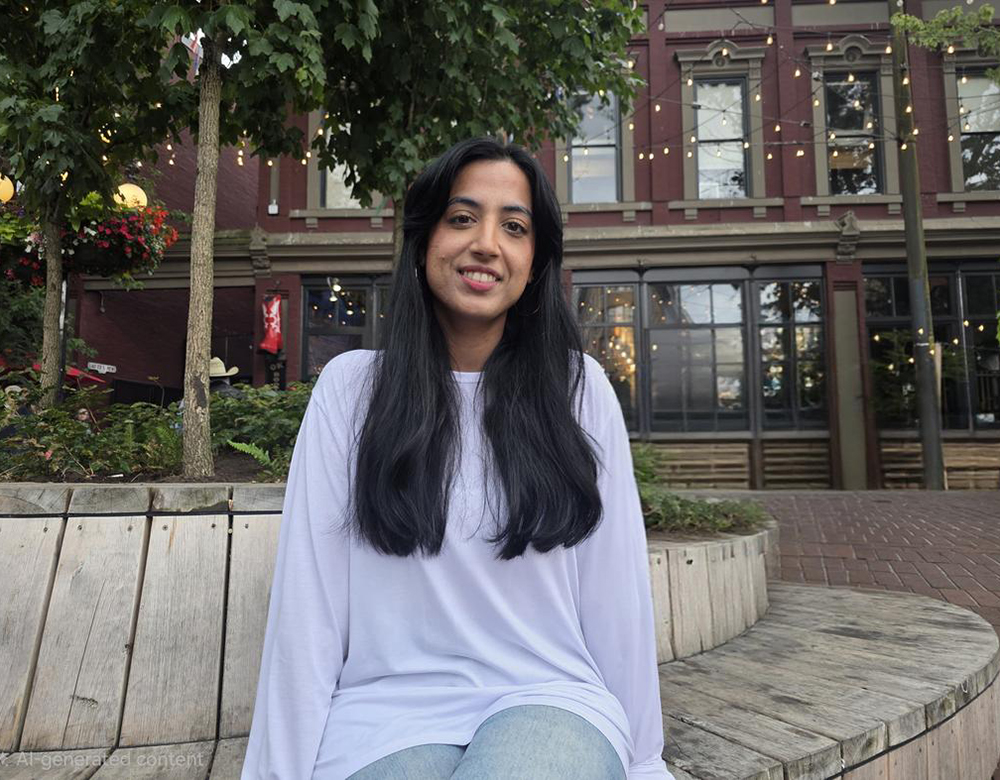
Sonia Kumari Sharma
You studied at Emily Carr Institute of Art and Design. How did your education there influence the development of your visual language and your approach to figurative painting?
My time at Emily Carr helped me understand my practice as something that could move between materials, images, and concepts rather than treating each medium separately. I was developing my skills as both a painter and a ceramicist, and that combination has directly impacted how I work and understand visual language now. In painting, I was exploring portraiture through pop culture, satire, identity, and contemporary life. I was in an environment that encouraged me to pay closer attention to how materials already speak before I even decide what image to make with them. That awareness continues to shape my figurative work today. I began seeing figures not only as subjects to represent, but also as sites where desire, consumption, vulnerability, and social meaning can be explored. Emily Carr encouraged critical language and conceptual problem-solving, which helped me explore these connections more deeply, especially the relationship between what is visually seductive and what is psychologically charged. It encouraged me to create work that can hold both pleasure and discomfort, the ordinary and the symbolic, and helped me understand that the process of making could remain part of the investigation rather than only the final result.
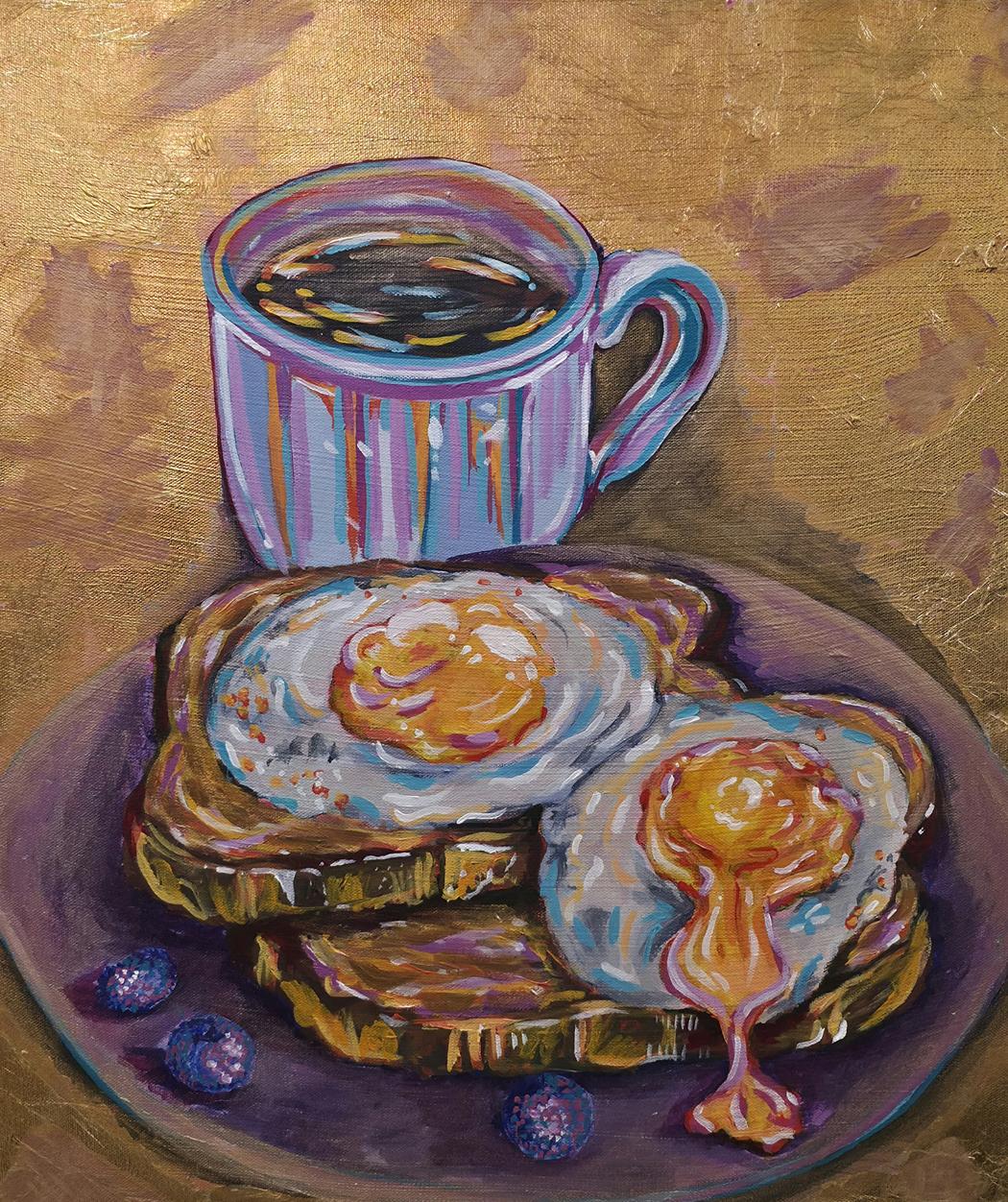 Sonia Kumari Sharma | Two Eggs
Food is a central motif in your work. What first drew you to the act of eating as a subject for exploring desire, pleasure, and vulnerability?
My interest in food as a motif began with my own relationship with food. What started as love has grown into a way for me to think about consumption, desire, and experience in a broader capacity. Food is incredibly personal, but it is also something most people understand through memory, ritual, comfort, celebration, superstition, restriction, pleasure, and even excess. I think about how quickly a specific food can bring me back to a place or feeling, like wanting bubble tea every time it rains because the bubble tea shops near me growing up used to be 50% off when it was raining, or the local Vancouver ritual of going to the Costco food court before a Canucks game at Rogers Arena because it is across the street. I think about oranges during soccer, hot dogs at baseball games, and even the way the smell of food in a room becomes part of the experience. In my paintings, I don’t want food to function only as still life or decoration. I want it to become a way of entering the psychological space around a figure, where appetite, nostalgia, vulnerability, pleasure, embarrassment, and surrender can exist simultaneously.
Your figures are often captured in private, unguarded moments of consumption. What interests you about portraying people when they are completely absorbed in a sensory experience?
These moments are interesting to me because eating is an act that can put you in a state that is both present and unguarded. When someone is absorbed in taste, texture, mess, or pleasure, they are not usually being performative; their attention turns inward toward their own sensory experience. That absorption can have tenderness, but it can also make the figure appear exposed because pleasure is not always neat or controlled. This type of consumption can become psychologically charged. A figure caught in the middle of a bite or mid-moment is surrendering, even briefly, to appetite and sensation. I want the viewer to feel invited into that intimate moment without possessing it. There is something slightly uncertain about it, as though the viewer is witnessing something ordinary that has been transformed into something more vulnerable and grander.
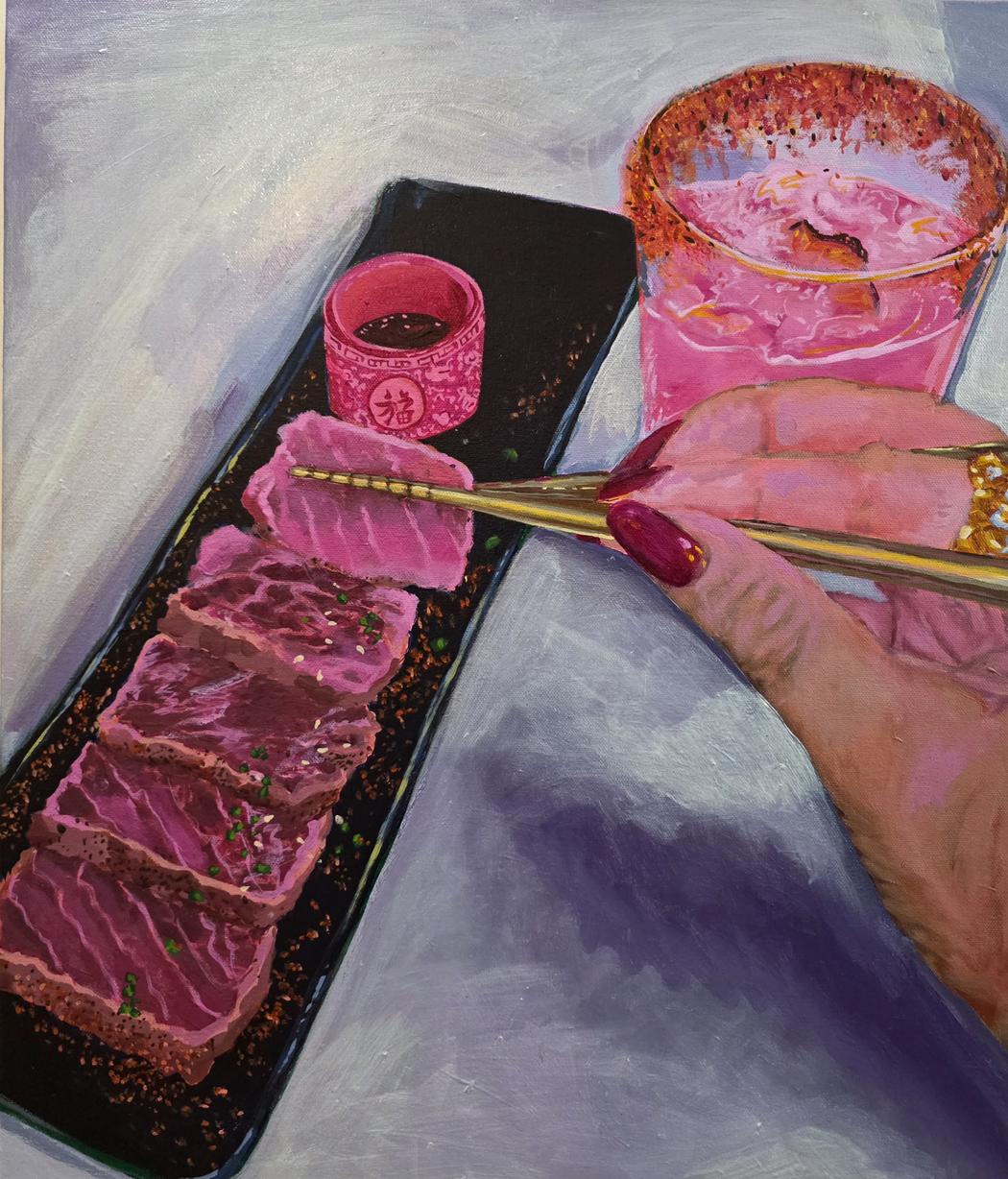 Sonia Kumari Sharma | Tuna Tataki
How do you choose the foods that appear in your paintings? Do particular textures, colours, or cultural associations influence your selection?
Sometimes I am drawn to a food because of its colour or texture, but sometimes it is because I am interested in exploring the memory or social meaning it carries. The most fun foods to paint are the ones that melt, drip, or overflow; they create a conversation about sensory experience in a more immediate way. This can make the act of consumption feel physically present instead of symbolic from a distance. Simultaneously, I think about how certain foods have their own associations: comfort, childhood, celebration, luxury, indulgence, or even embarrassment. A dessert can feel playful and nostalgic, but when it is pressed against the skin or dripping down someone’s face, the image can shift very quickly into something more intimate or psychologically charged. Because I work with models, I begin those projects through conversations about consent. I think it is important to acknowledge that ice cream on someone’s face can be funny and familiar, but it can also be read as sensual, vulnerable, or exposing depending on the viewer. That instability between pleasure and discomfort is part of what interests me, but it also requires careful consideration and respect for those I have the privilege of working with.
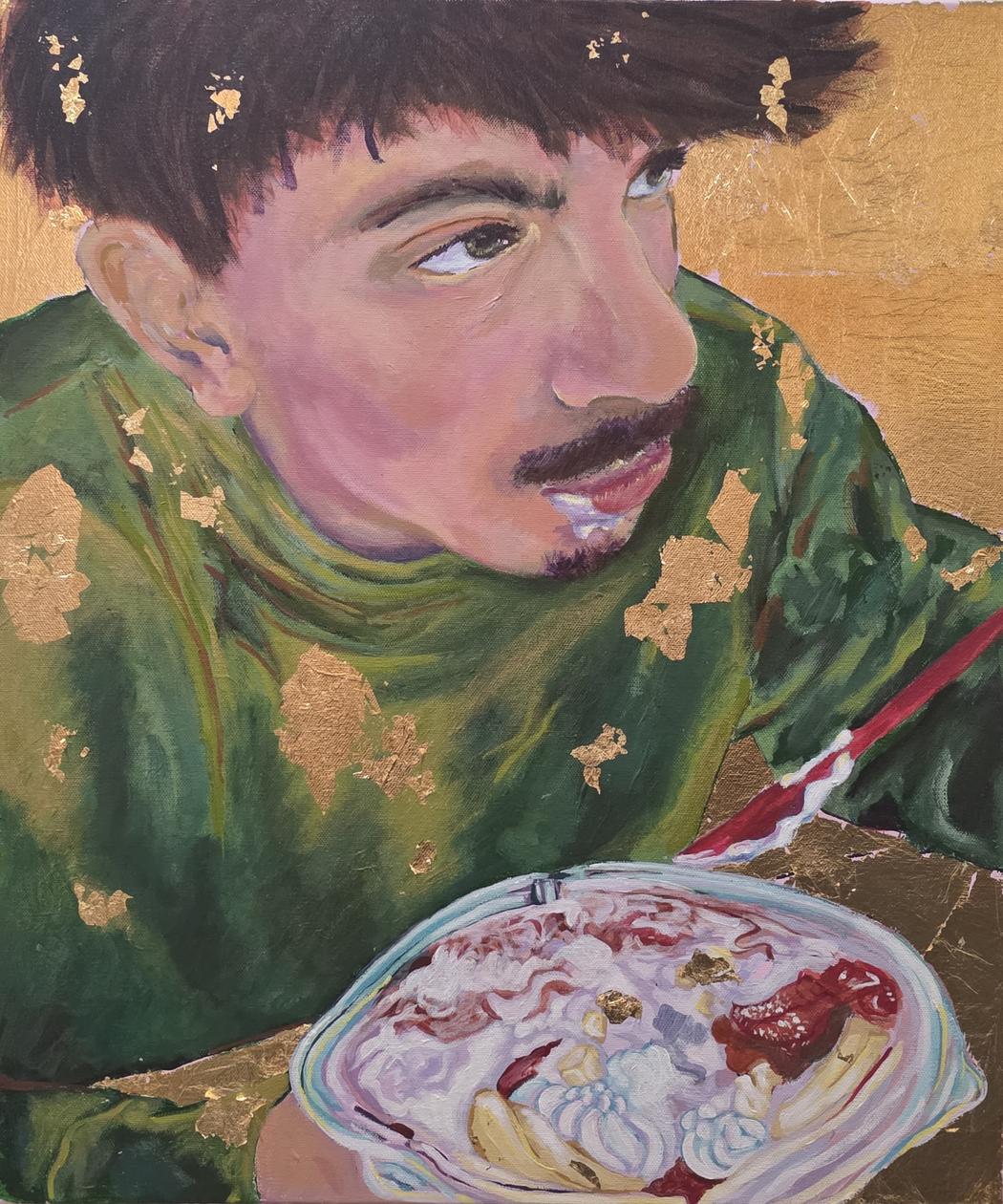 Sonia Kumari Sharma | Dairy Queen
In works such as Frosting and Dairy Queen, pleasure seems to coexist with excess, awkwardness, and exposure. How do you balance humour and discomfort within the same image?
In works like Frosting and Dairy Queen, I like exploring the unstable point where pleasure starts to become discomfort. There is something funny and familiar about food getting out of control: frosting on your face, ice cream melting faster than it can be eaten, or a dessert becoming messier than expected. Those moments can feel playful because we recognize them from everyday life, but they can also become awkward very quickly. The person in the image is caught in a moment of indulgence, but also exposure. They are being seen when they are not polished, composed, or fully in control of how they appear. I think that is where humour and discomfort begin to overlap. That shared experience can hover between amusement, desire, embarrassment, tenderness, and unease. Excess lets the scene feel seductive and ridiculous at the same time, and I like the playfulness of that instability because it reflects how complicated pleasure can be.
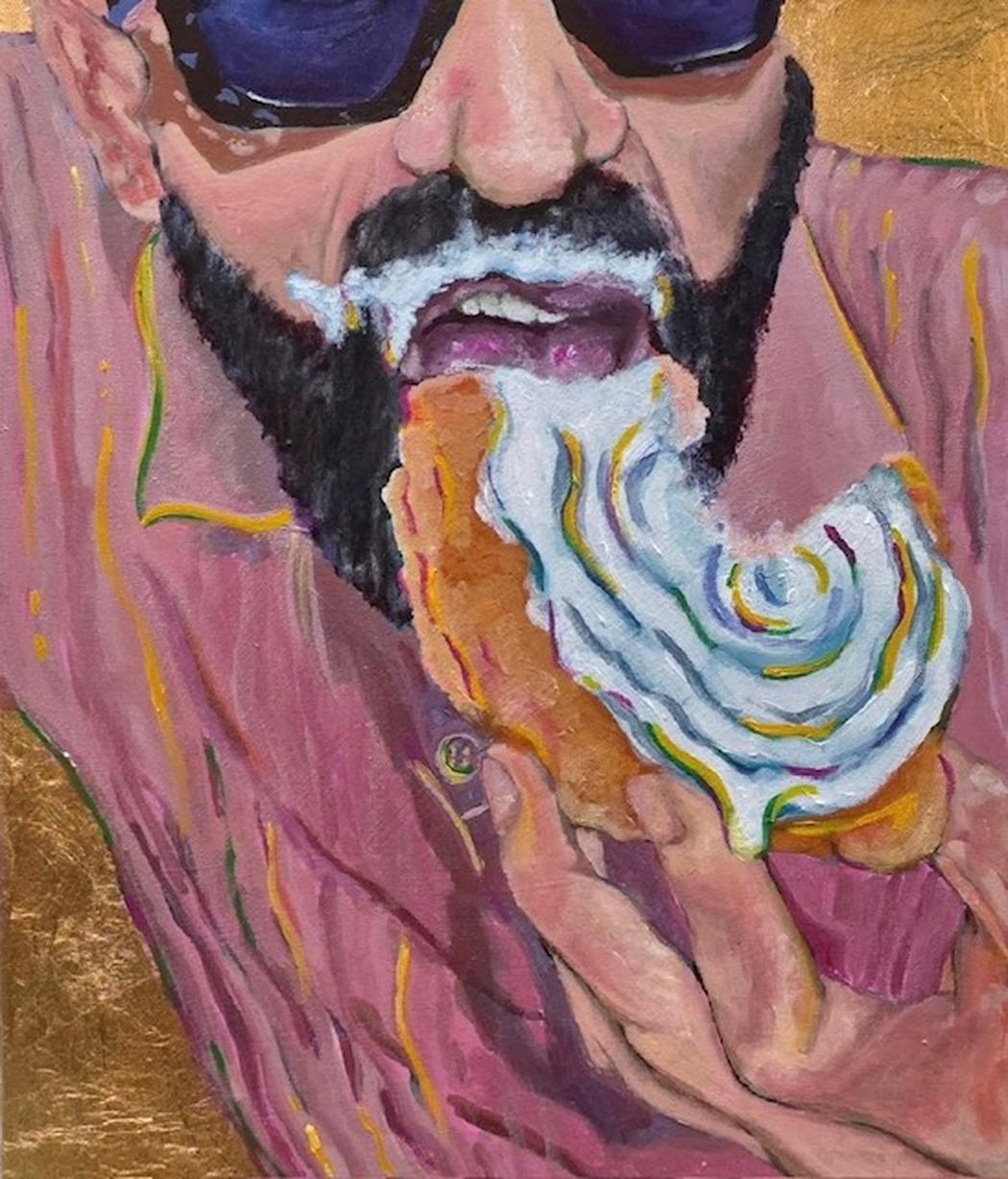 Sonia Kumari Sharma | Frosting
Gold leaf has strong associations with sacred art, wealth, ceremony, and permanence. What led you to introduce this material into scenes of ordinary, everyday indulgence?
When I initially started working with gold, I was exploring the idea of status indicators and how materials communicate value across time and culture. Gold has an expansive visual history, appearing in religious spaces, ceremonial objects, family heirlooms, offerings, ornamentation, and symbols of prosperity. It can imply devotion, wealth, permanence, reverence, and security almost immediately. What interested me was placing that material beside imagery of something as ordinary and fleeting as food. Food disappears. It is eaten, gifted, wasted, shared, craved, or remembered, but it does not last in the same way gold is expected to last. At the same time, food carries a similar value. It can be offered, celebrated, used in ritual, associated with abundance, or treated as a form of comfort and luxury. A cinnamon roll is not necessary for survival in the way rice might be, but being able to enjoy, gift, or even waste something decadent can become its own kind of wealth signifier. By bringing gold into scenes of everyday indulgence, I’m interested in the tension between the everyday and the sacred, elevating ordinary consumption while also questioning how value is constructed and assigned.
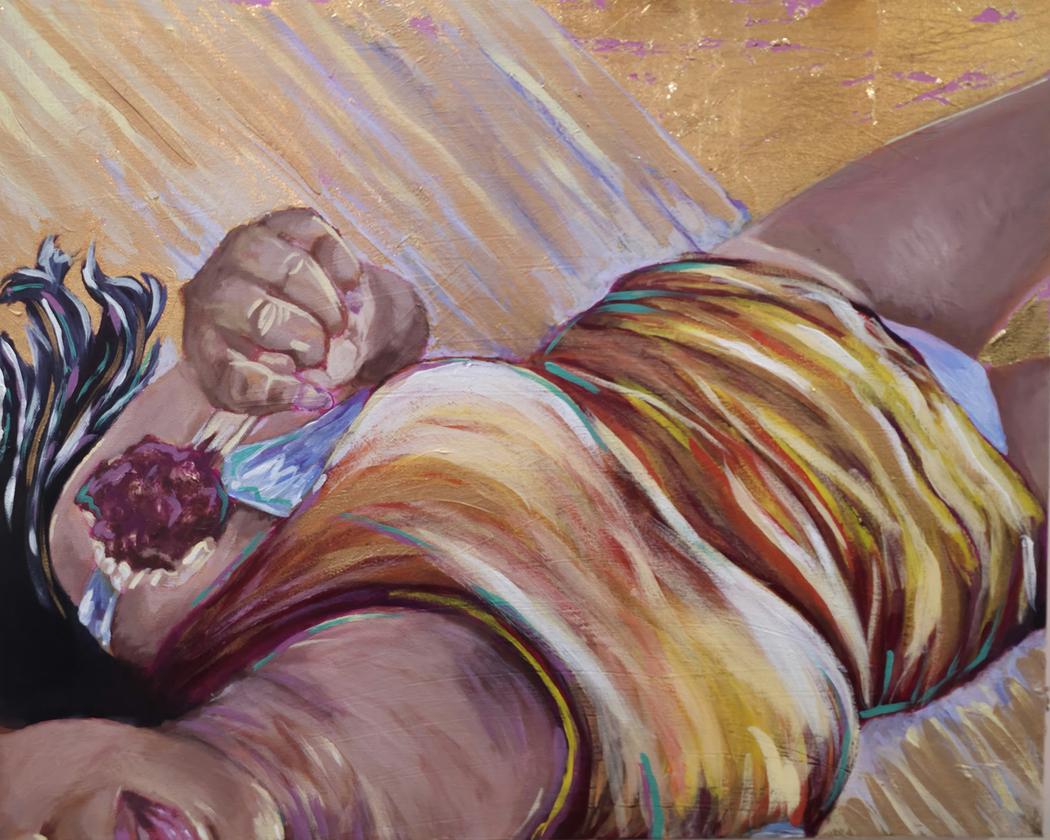 Sonia Kumari Sharma | Floor Time
Your compositions often bring the viewer very close to the figure and the food. How do cropping, scale, and perspective help create a sense of intimacy or psychological tension?
Perspective is crucial to storytelling; it determines how the viewer enters the image. Cropping, scale, and point of view can make a scene feel open and inviting, or they can make it feel almost too close. I consider where the viewer’s eyes will focus, toward the face, the mouth, the food, the hand, the mess, or the gaze of the figure. Direct eye contact can make the viewer suddenly aware of their own looking, while a more absorbed or passive figure can make the moment feel private, as though it is being witnessed without permission. What is left outside the frame matters too, because it is left to the viewer to imagine. When the figure and food fill the composition, there is less distance between the viewer and the scene, and the act of looking becomes more physical and involved. That closeness can feel warm or seductive, but it can also create psychological tension, implicating the viewer in the moment of consumption instead of allowing them to simply observe it from afar.