

Tatyana Shchulepova
What first drew you to Japanese culture, and why did the figures of the samurai and the guardian of beauty become so important in your artistic practice?
What struck me about Japan at first was not so much its philosophy—which came to me later—but its extraordinary material culture, in which every object seems to possess a soul.
When I first saw a samurai suit of armour—not in a picture, but in a museum—I was fascinated by the way layers of lacquered metal, silk, and leather came together to form a unified whole. Later, I noticed an elegant geisha’s hairpin, carved with the same care and precision as the blade of a katana. I was drawn to this shared obsession with detail: both the warrior and the guardian of beauty serve the same god—Perfection.
I came to understand that the samurai and the geisha do not belong to two separate worlds, but represent two sides of the same coin. The samurai, with his sword, embodies the readiness to cut away—not only an enemy, but also one’s own fears, doubts, and attachments. The geisha, as a guardian of beauty, embodies the ability to preserve what is fleeting, capturing perfection in the fragile ritual of a tea ceremony, the movement of a hand, or a delicate web of flowers.
The samurai represents action and determination, while the geisha represents preservation and contemplation. Together, they create the very harmony described by the Way of Bushido. True strength, as I show in my painting Among the Flowers, is born not from destruction, but from the ability to find beauty and tranquillity even at the edge of a sword.
For me, these two figures create a dialogue between the harsh truth of life and its fragile, transient beauty. Through them, I try to connect the present with the wisdom of the past, reminding both myself and the viewer that courage and self-sacrifice are timeless values that must not be forgotten.
Japan gave me the perfect language through which to speak about something that concerns everyone: how to be strong without becoming cruel, and how to remain gentle without becoming weak.
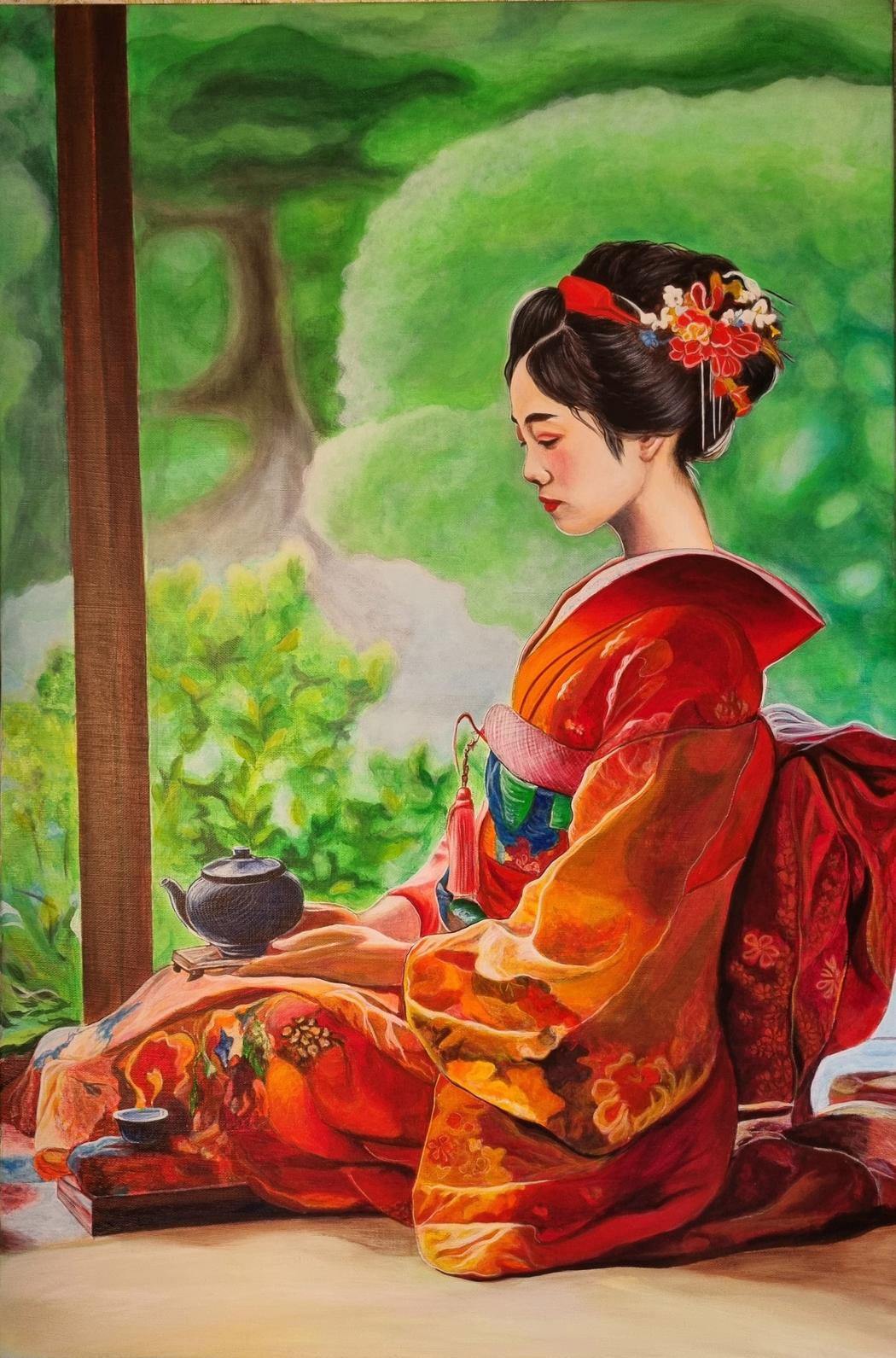 Tatyana Shchulepova | The Beauty Of The Moment | 2025
Your project explores Japan not only as a visual theme, but also as a moral and philosophical space. What does Japan symbolize for you personally?
For me, Japan is not so much a geographical location as it is a moral compass. When I first immersed myself in writings on Bushido, I was struck by one phrase: “Every morning, a samurai must first remember that he will die.” This is not pessimism; it is the greatest form of freedom. We often run from the thought of our own mortality and hide it behind the distractions of everyday life. Japanese culture, however, places death at the centre of life—not as an ending, but as a measure of the quality of every moment we live.
This culture does not recognise the word “later.” There is only “now,” but it is experienced with absolute awareness. When I paint my relief image of Mount Fuji, I am not simply depicting a mountain. I am recreating the point upon which a samurai might have gazed and, for a moment, forgotten about death. It is a reminder that the value of life lies not in its duration, but in the depth with which it is experienced.
In my project, Japan is a mirror in which both my viewers and I can see our true selves and ask the essential question: “What will remain of me when everything unnecessary has been cut away?”
In your statement, you speak about Bushido—the Way of the Samurai. Which values of this philosophy feel most relevant to contemporary life?
For me, Bushido is neither a religion nor merely a code of honour belonging to warriors from a distant past. It is a tool for the survival of the soul when the world becomes too constricting. I do not create my paintings simply to depict Japan. Through its wisdom, I want to help contemporary people discover a source of support within themselves.
Bushido places the process of self-improvement at its very centre. A samurai practised the art of the sword every day not in order to kill more enemies, but to become a better version of himself. In my work The Beauty of the Moment, there is no one except a woman, a teapot, and a cup, yet it contains an entire universe of concentration. Every movement and every pause becomes a purpose in itself.
Many people believe that Bushido is concerned only with severity and death. Yet one of its central virtues is jin—benevolence and compassion. A samurai was not supposed to be cruel without reason; his strength was justified only when it was used to protect the weak. This is why I depict a sword resting Among the Flowers and the ritual of tea drinking in The Beauty of the Moment. For me, these images serve as reminders that a true warrior is not someone who destroys, but someone capable of preserving and valuing life in all its fragility.
The concepts of honour and conscience also seem particularly relevant to contemporary life. In Bushido, honour is not determined by what others think of you, but by how you face yourself in the mirror of your own conscience.
In my painting Heart of the Sword, I depict not a battle, but a dialogue—the hand and the steel become a single nerve. It is a metaphor for the idea that remaining true to oneself requires daily, silent work. This is the value I want to restore: the ability to take responsibility for one’s words and actions, even when no one is watching.
In my practice, I am interested in translating the language of Bushido into the language of colour and texture. The relief image of Mount Fuji, which makes the warrior forget about death, and the contrast between sharp steel and delicate petals in Among the Flowers both suggest that true strength is born through harmony with the world, rather than through resistance to it.
I want viewers looking at my paintings to ask themselves: “What is my own ‘sword’? What am I prepared to cut away in order to remain true to my conscience?”
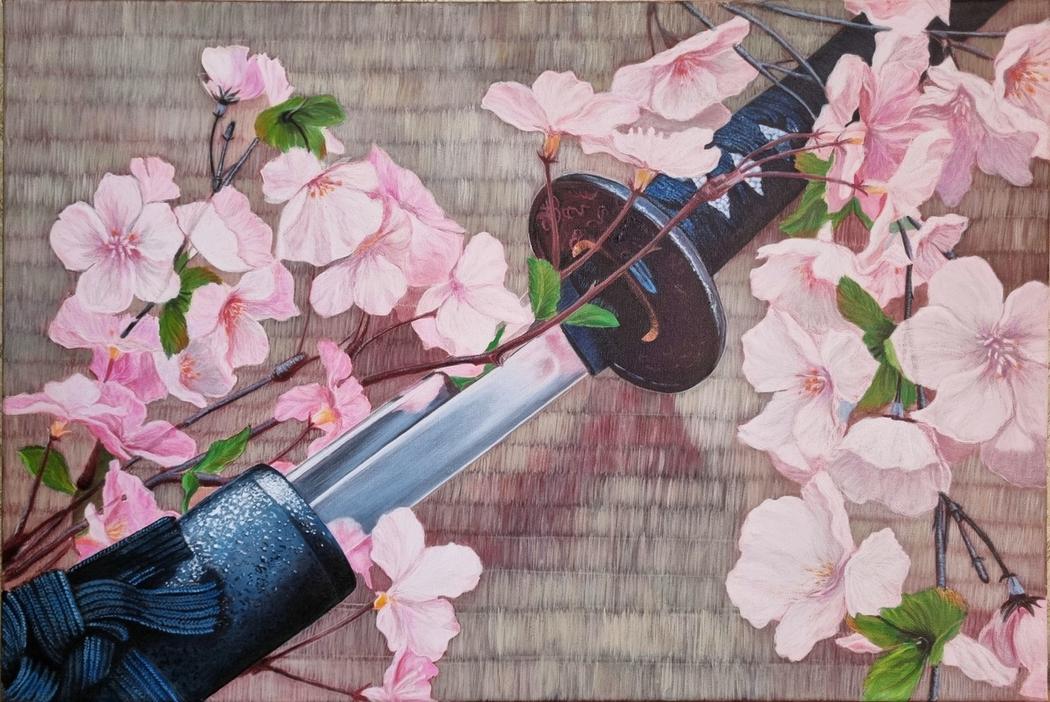 Tatyana Shchulepova | Among The Flowers | 2025
The samurai in your works appears not only as a warrior, but also as a symbol of discipline, inner strength, and self-mastery. How do you understand this image today?
That is exactly right. For me, the samurai is not so much a warrior with a sword as a symbol of a person who follows their chosen path despite external circumstances. The samurai is not simply a Japanese man in armour. He represents the inner strength that emerges at the moment when a person makes a decision and refuses to turn away from it.
He embodies the daily work of self-improvement—something I understand very well through the process of working on the details of my paintings. The samurai invests his will in the blade; I invest mine in every millimetre of the canvas. Without this daily practice, neither the warrior nor the artist can exist.
A samurai never fully achieved perfection; he merely moved closer to it with each passing day. The same is true of realistic painting. I may spend months working on a single painting, yet when it is finished, I can always see how it might have been made even better. This is not disappointment. It is movement.
Every time I pick up a brush, I follow my own small Way. And if my paintings make viewers stop, even for a moment, and sense this inner discipline, then the figure of the samurai is not confined to the past—it is alive here and now, on the canvas.
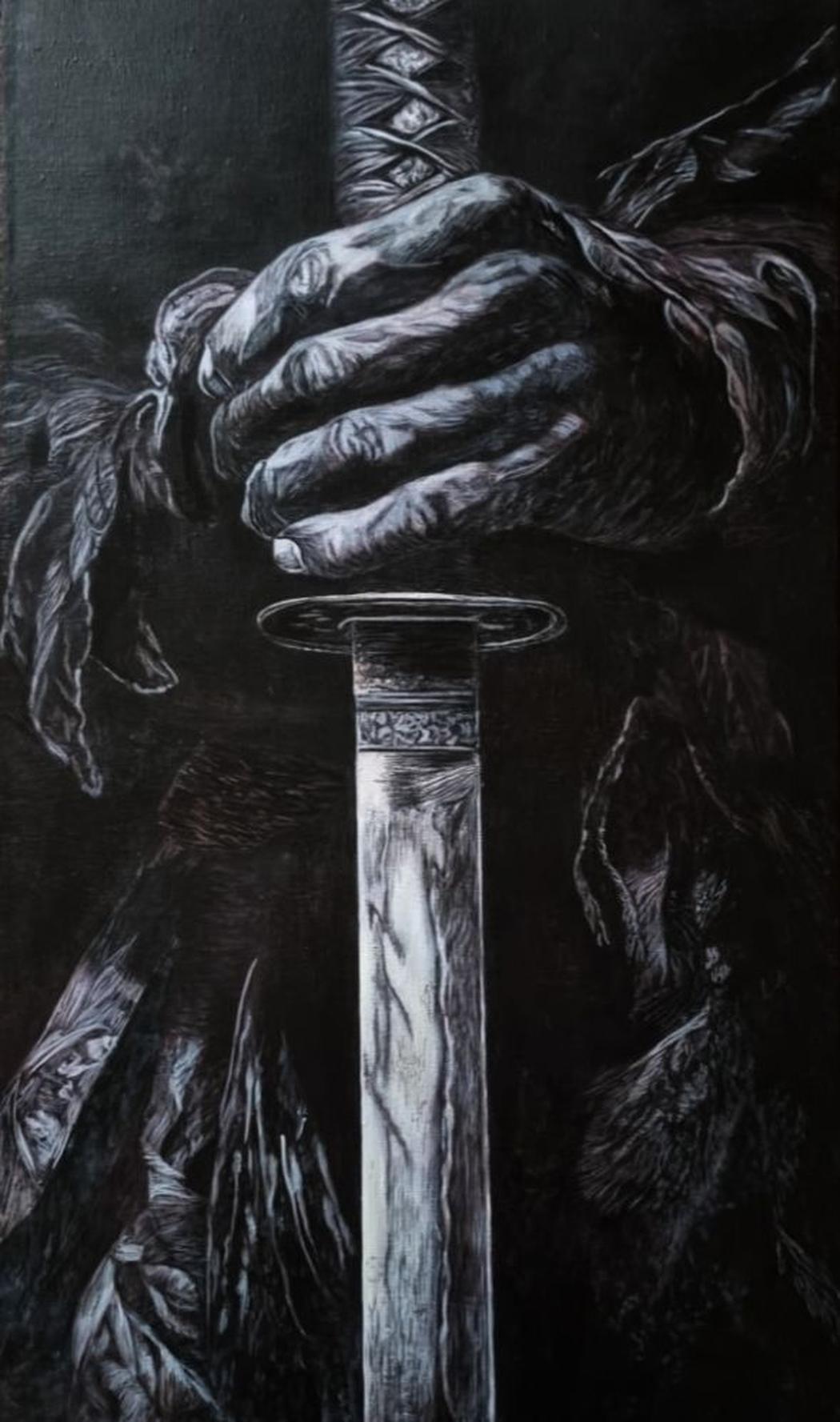 Tatyana Shchulepova | Heart Of The Sword | 2025
Your paintings are created with very precise realism and detailed acrylic layering. Why is this level of detail important for expressing the spirit of your subjects?
Detail intensifies the vitality of the moment. For me, it would be unacceptable to depict a samurai’s armour schematically or to distort the proportions of his sword, because that would show disrespect for the way of life I am studying.
I apply dozens of extremely thin layers: glazes, translucent shadows, gradients, textures, and highlights. Each layer must dry before I can apply the next one, and every minute detail must be carefully rendered. This requires tremendous patience, which I compare to the endurance of a samurai.
My painting is a visualisation of the process of self-perfection. I hope that, as viewers examine this multilayered surface, they will subconsciously sense the amount of time invested in creating the painting—and therefore feel the weight and significance of what is depicted.
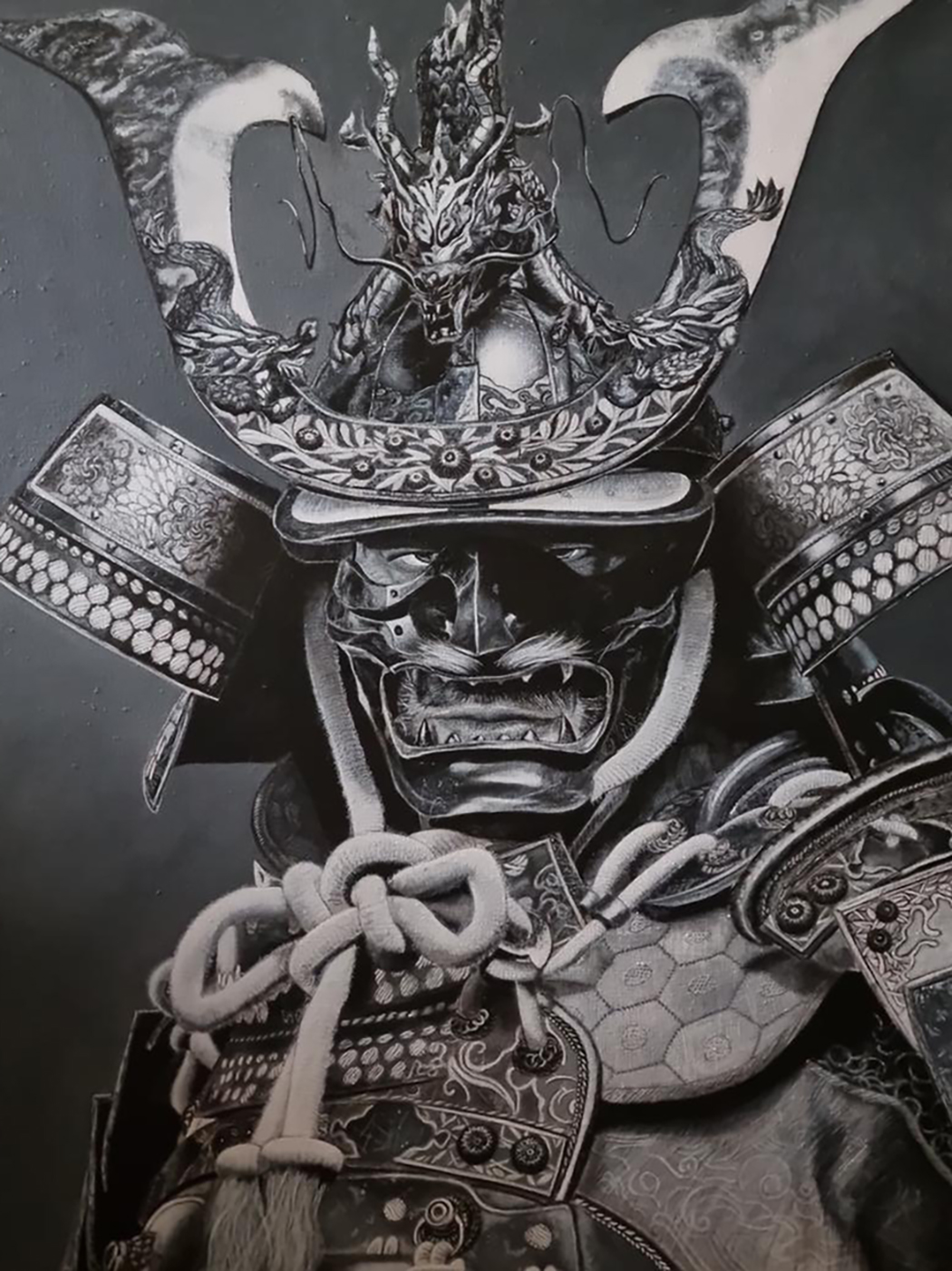 Tatyana Shchulepova | Dan (Determination)
In works such as Samurai and Heart of the Sword, the sword becomes a powerful visual and symbolic element. What does the sword represent in your project?
In my project, the sword is far more than a physical object. It is neither decoration nor a symbol of violence. It is a concentration of meaning around which the philosophy of many of my paintings is constructed. It embodies honour, discipline, harmony, determination, and the fragility of existence.
In my painting Samurai, the warrior is not raising his sword to strike—he is simply holding it in a state of complete readiness. Here, the sword is not a weapon directed against an enemy, but an instrument of inner severance. The reflection on the steel reveals to the viewer that the warrior has already made his decision. His hand does not tremble. This stillness says more than any movement of the blade.
For me, this is the sword’s most important function: to bear witness to the moment when a person stops hesitating and begins to act.
In Heart of the Sword, I depict a dialogue between the human being and the steel. The sword becomes the expression of its owner’s “heart”—his soul.
In Japanese culture, the katana was regarded as sacred. It symbolised honour, courage, and martial valour, while also carrying a spiritual connection to one’s ancestors—samurai would pray to their swords before battle. The sword was therefore not seen as lifeless metal, but as an object endowed with ancestral memory and the personal history of its owner.
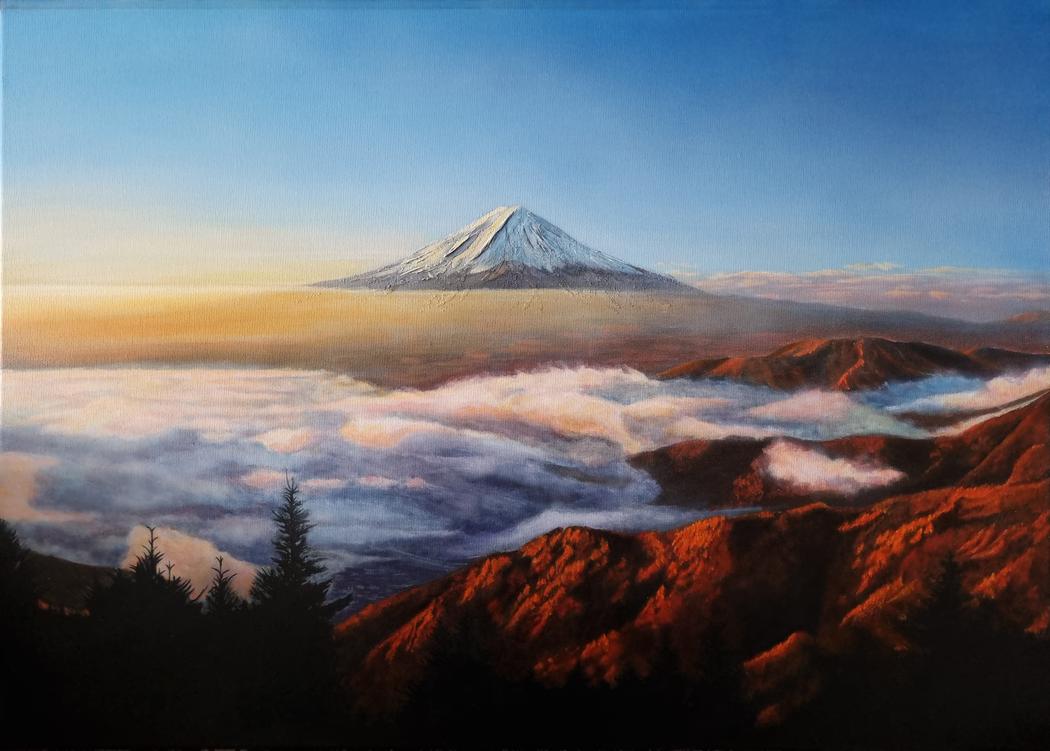 Tatyana Shchulepova | Mount Fuji | 2024
Many of your works contain a strong contrast between darkness and light, especially in the samurai portraits. How do you use light to create psychological tension?
For me, Japan represents a dialogue between the visible and the invisible. The sword contains the soul of the warrior, the tea bowl preserves the warmth of the craftsman’s hands, and every seam of a kimono breathes with the history of a family lineage. As a realist painter, my task is not merely to copy the external appearance of these objects, but to make this invisible layer visible.
I therefore use textures and strong contrasts of light and shadow so that the viewer can feel that behind the steel lies willpower, behind the flowers lies transience, and behind the ritual lies infinity.
The illuminated side speaks of a readiness to act, while the dark side represents hidden depths—the part of the soul that the samurai reveals to no one, perhaps not even to himself. The viewer sees that the warrior does not merely stand in the light; he chooses to remain within it, despite the shadow that follows him.
Psychological tension emerges precisely at the boundary between light and darkness. In the painting Dan / Determination, the light falls in such a way that it emphasises the warrior’s intense gaze, while leaving his eyes partially in shadow. This is not because I do not want to reveal them completely. It is because true determination is never entirely open or transparent. It always contains an element of the unknown, even for the warrior himself.
Here, the light represents the external challenge, while the shadow represents the inner dialogue.