
Eva Čapková
Your work often explores invisible forces, time, duration, and being. What first drew you to these themes?
It was the personality of the Czech graphic artist Vladimír Boudník that led me to the themes of the invisible, duration, and being. Boudník was an innovator of graphic techniques — the “gentle barbarian,” as his friend, the writer Bohumil Hrabal, called him. I was fascinated by the energy, the will, and the courage that Boudník devoted to art. His work in the 1960s was abstract — a word that was almost taboo under Communism at the time. He could not achieve great success with his art then. He only began to receive recognition from abroad toward the end of the 1960s, during the Prague Spring. After the invasion by the Warsaw Pact forces, freedom was lost again. An ironic twist of fate was that Boudník was actually supposed to celebrate his second wedding on August 21; his best friend, Bohumil Hrabal, could not attend the wedding because of Soviet tanks on the streets. In the end Boudník did marry his Věra, also an artist, whom I later had the honour to meeting.
Magnetic fields play an important role in your artistic process. How did you begin using magnets as a painting tool?
The idea to use magnetic fields first in printmaking and later in painting came from Oldřich Hamera; he was Boudník’s only student. I met him in 2011 and he showed me the extraordinary graphic procedures of Active and Structural graphics that he used. However, he did not himself use Magnetic Graphics and wanted to persuade me to try it. At first I did not listen — I was completely satisfied with Structural Graphics, which I liked a lot. A few months later did I begin to experiment with Magnetic Graphics. At first it was more of a game. Initially I knew nothing detailed about the method: Boudník was no longer alive, and the descriptions of the technique were incomplete. So I had to reinvent everything myself. I succeeded. In 2017 I received the General Packaging Prize and an Honorable Mention for one of my miniature prints at the 11th Biennial International Miniature Print Exhibition at the Center for Contemporary Printmaking in Norwalk.
In your works, the human body appears both familiar and unfamiliar. What does the figure represent for you in the series Total Torso?
Since last year I have been increasingly engaged with the human body. Even before, the human being was present in my paintings latently, if not visibly — for example in the cycles “Witnesses” or “Heavy Clouds.”
By “Witnesses” I mean, for example, stones like menhirs, various rock formations in the landscape, or sacred trees that share the same space with us but not the same time. For these witnesses our life is only a small episode. They bear witness to the changes in the surrounding landscape and our lives, beside them, our existence appears like that of a mayfly.
“Heavy Clouds” does not refer only to our existence — clouds have accompanied humanity since its beginnings. The ancient gods often wrapped heroes in clouds to help them escape fate. The cloud here is often part of deception and illusion. In the Bible, clouds separate the heavenly and earthly spheres, but sometimes they also represent the immediate presence of God. Clouds can also symbolise the search for something higher up there. They can conceal, yet by doing so they also point to what is being pointed at; by their presence they both reveal to some extent and awaken our curiosity.
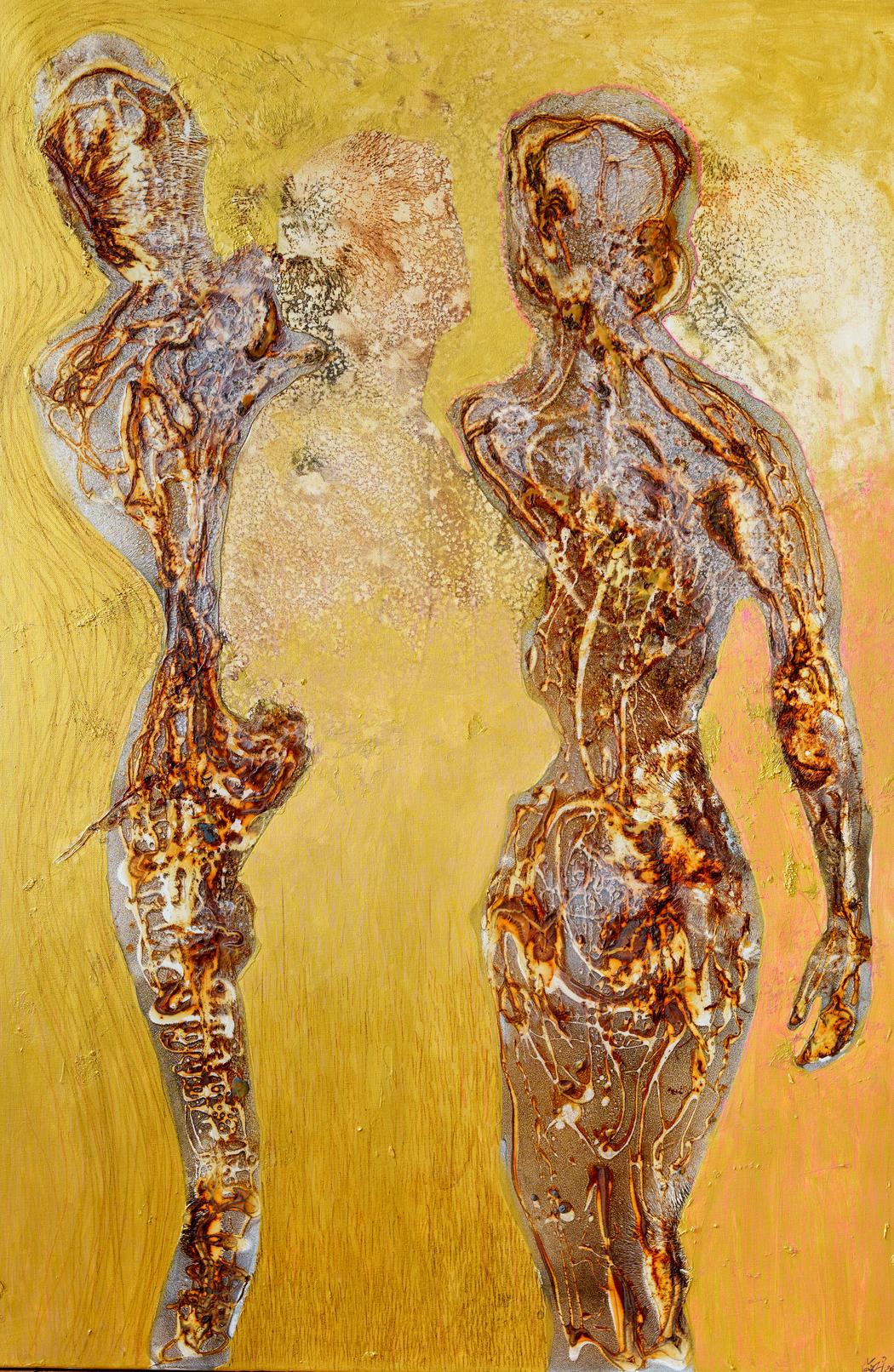
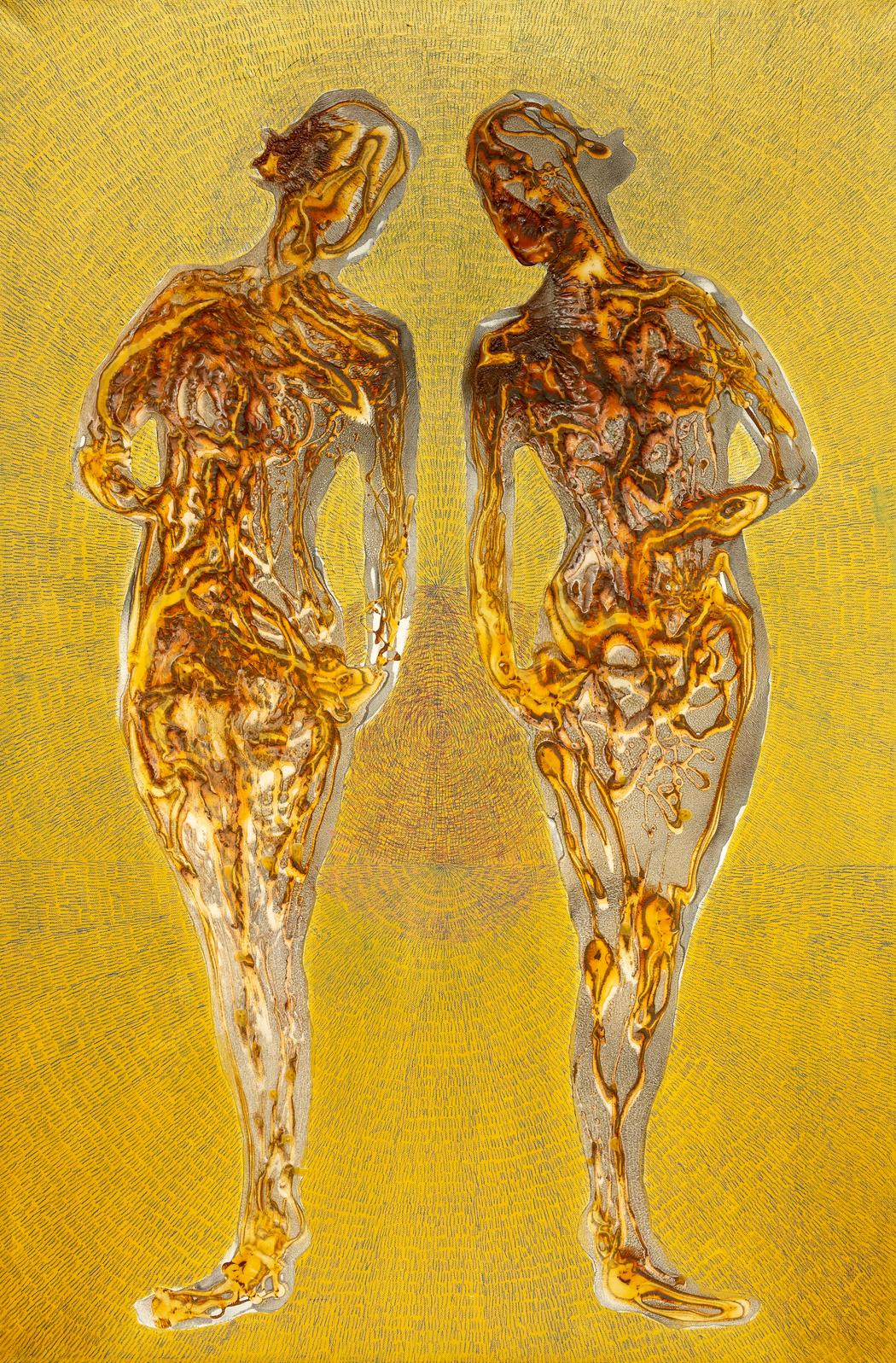
In the “Total Torsos” series I am chiefly concerned with ambiguity. My figures do not enter the world as finished identities; rather they are bodily reliefs shaped by light, time, and material transformation. By layering colours, pigments, and surface textures I create bodies that appear both present and lost: the contours are distinct, while their interiors open into networks, veins, and cavities, as if something mysterious were escaping from them or penetrating into them.
One cannot tell whether one is looking directly at the person or whether the figure turns its back. This opens space for associations: what is happening inside people? Can we see our inner life? Can we understand, control, or investigate it?
You often combine controlled intention with chance. How do you decide when to guide the material and when to let it act on its own?
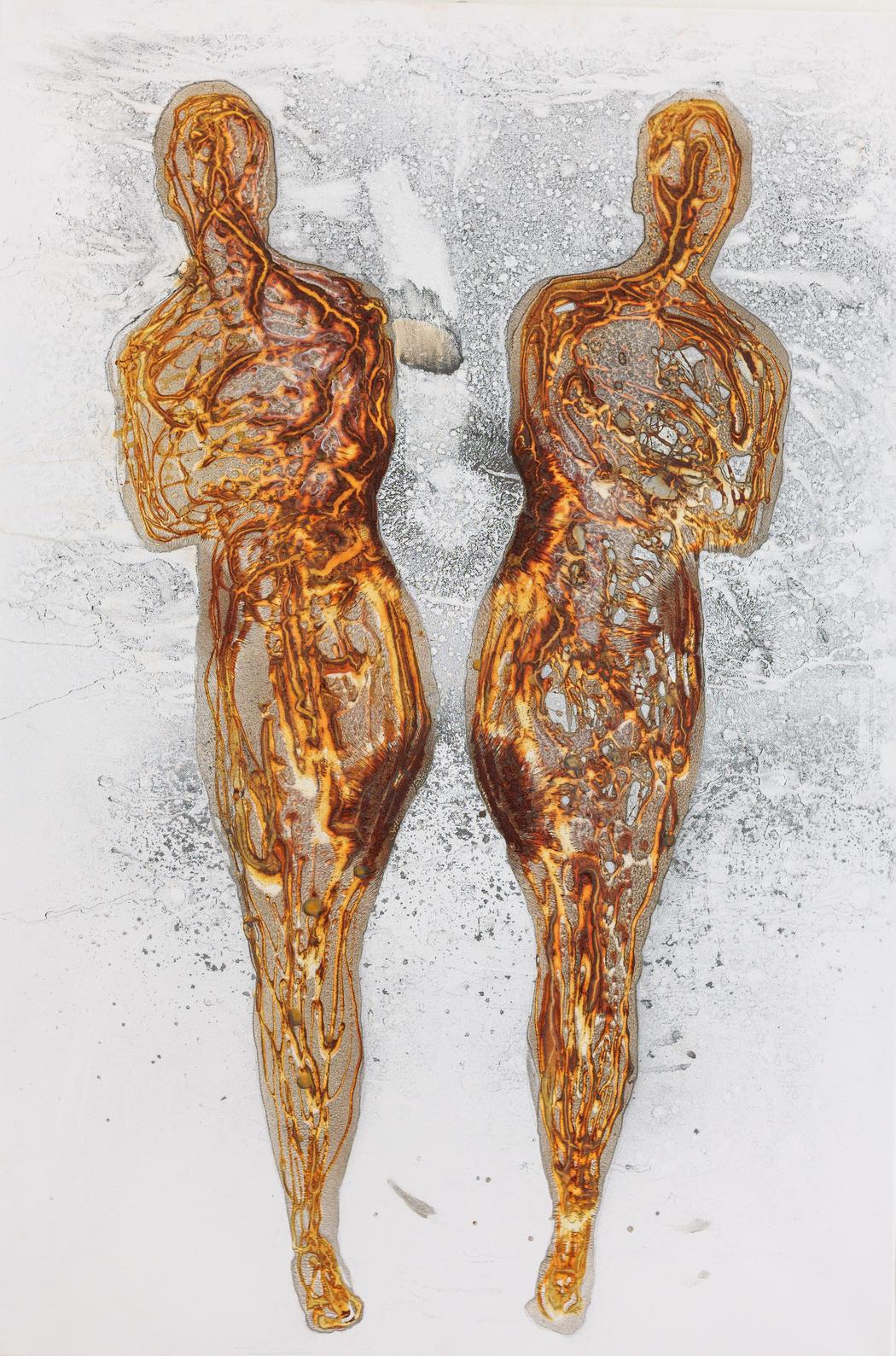
I work with chance, but also with natural laws — that is, with physical forces and, if you like, mathematical forms. I can say that I prepare the playing field for chance. I work with ferromagnets from which I can create different compositions; I decide where and how much binder I use and how many metal filings I scatter over the canvas. At the same time I am fascinated by the moment when the material reveals something I did not know was there: a hidden motif, an unexpected relief, or a break of colour that changes the meaning of the whole figure. These discoveries write an anamnetic layer into the works — layers of personal and collective memory, of traumas and joys. Golden tones and structures appear both sacred and decadent: they recall religious icons as well as oxidation, tree bark, or old reliefs that time has damaged and at the same time accentuated. The result is also a surprise to me, since my works can take several days to dry depending on temperature and the metal filings corrode slowly. Many of my paintings thus only reach their final colouring after a few days.
How has your background between the Czech Republic and Bavaria influenced your artistic language?
I cannot say for certain whether my life between Bavaria and Bohemia has influenced my artistic language. I lack the necessary distance from my own work — others might judge that better. However, I often find myself in the situation where, in the Czech Republic, I am not Czech enough for many people (“the German”), and in Bavaria I am perceived as Czech. I thus move through a kind of nowhere.
At the same time I see myself as a mediator between these two countries in the cultural field. I have the sense that, although we are neighbours, in the Czech Republic — apart from very major artists like Gerhard Richter — there is little engagement with German art, and in Germany there is little knowledge of contemporary Czech art. Perhaps it is somewhat different in Austria?
You have worked as an artist, illustrator, curator, cultural organiser, and book author. How do these different roles influence one another?
Everything I do is an organic whole. At least for me. My writing and my visual work are connected. One flows into the other. When I wrote about Boudník, I began to work with his graphic techniques. The topics I deal with theoretically naturally flow into my artistic practice. Incidentally, the graphic artist Boudník published samizdat literature in the 1950s, the writer Bohumil Hrabal made collages, and the graphic artist Oldřich Hamera ran his samizdat edition in the 1970s. In my opinion, visual art and literature are closely related.