
Nina Khmeleva
Your biography includes movement across several countries – Russia, Uzbekistan, and the United States. How has this experience of displacement and transition influenced your visual language?
My visual language became much more technically robust when I first moved to Uzbekistan and discovered the patterns and colors of Central Asia.
Later, in America, my personal voice began to shine as I started implementing this new technical vocabulary.
When you are placed in an environment that is completely different from what you are used to, both culturally and socially, it makes you realize how unique you actually are.
I usually say: “For my whole life, I thought I was just normal. After moving countries, I realized I am not normal; and ‘normal’ does not exist.”
Many of your characters seem both humorous and unsettling at the same time. How do you balance dark humor with emotional tension in your images?
The technical and conceptual aspects of my work are often separate from each other, even though they serve the same goal.
The humor comes from the technical execution: when I draw, I enjoy making the resulting image funny.
The unsettling aspect, however, comes from the underlying idea behind the image.
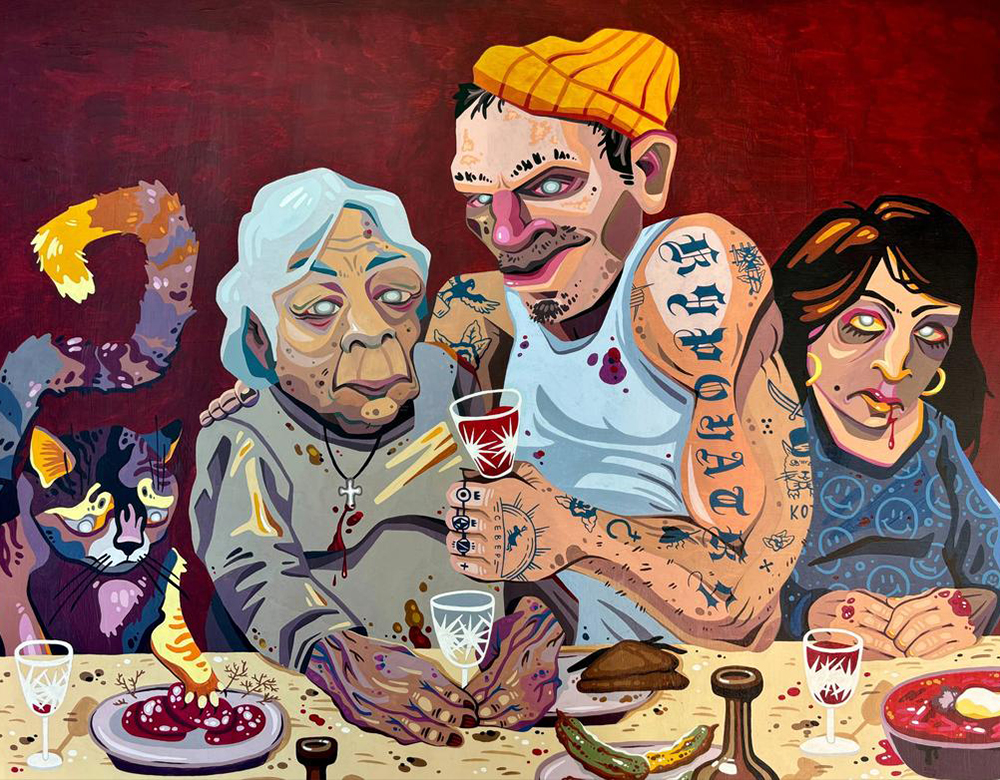
For example, in Normal People, the subject matter (the political climate in modern Russia) is extremely painful and unsettling, and the small visual joke of a cat stealing a piece of salami was something I came up with while working on the piece.
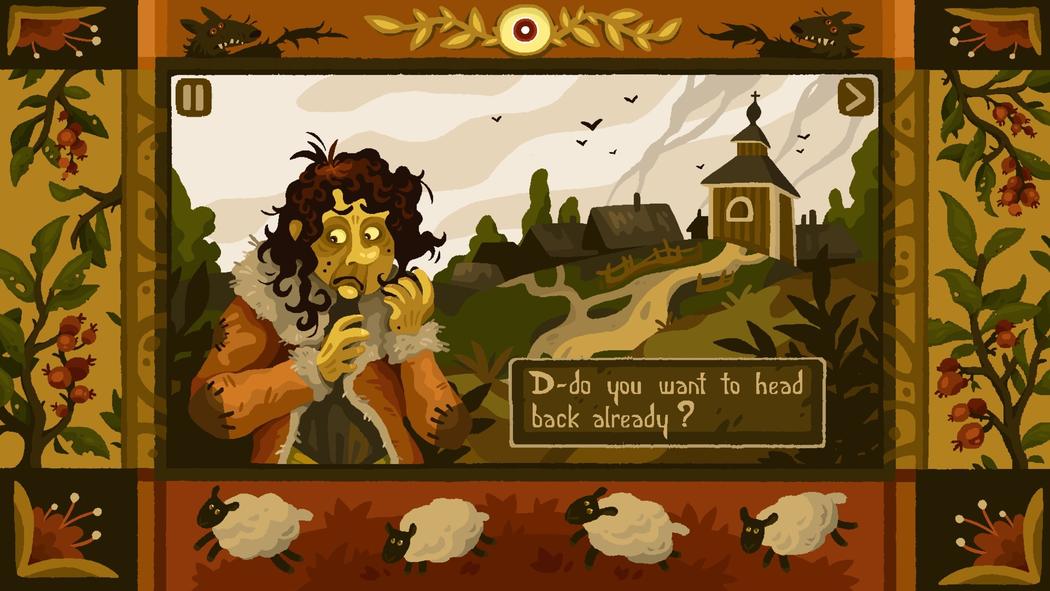 Nina Khmeleva | Werewolf Shepherd | 2026
Your compositions use flat graphic forms, but they also feel rich in narrative. How do you build a story within a single image?
I have a lot of experience creating cartoons: I did it throughout my childhood. A good cartoon needs to be expressive enough to convey its idea without words.
This can be achieved through shape language, gesture, composition, and color.
In my work, I utilize all of these tools, with a particular focus on gesture: the main expressive movement of the piece, its emotional line of action.
The figures in your works often appear distorted, theatrical, or mask-like. What role does distortion play in your artistic practice?
Thank you for this observation. I am indeed very interested in masks, and I have created many of them in the past.
To me, a mask can be “a face, but better”: something capable of expressing emotion in its purest form.
A mask also creates distance between the viewer and the character, and alienation is one of the prominent themes in my work.
Distortion serves a similar purpose by creating a “safe distance” for reflection. It is also a very enjoyable visual tool.
In my opinion, breaking and bending traditional linear perspective is something worth experimenting with.
Play and irrational logic are important elements in your work. Do you see absurdity as a form of freedom, criticism, or storytelling?
All of the above. For me, it is primarily an instrument of storytelling, as I am also a writer.
It allows both the artist and the viewer to examine familiar situations from interesting angles.
In my opinion, all great art is absurd to some degree.
You are currently developing a collection of short stories. How does writing connect with your visual art practice?
Illustration is, by definition, an accompanying image for a text.
In addition to that, I find many literary devices highly useful in illustration, including hyperbole, comparison, and rhyme.
A key aspect of writing is building the right momentum to guide the reader smoothly through the text.
In visual art, composition and form guide the viewer’s eye through the image in much the same way. There are many other technical similarities as well.
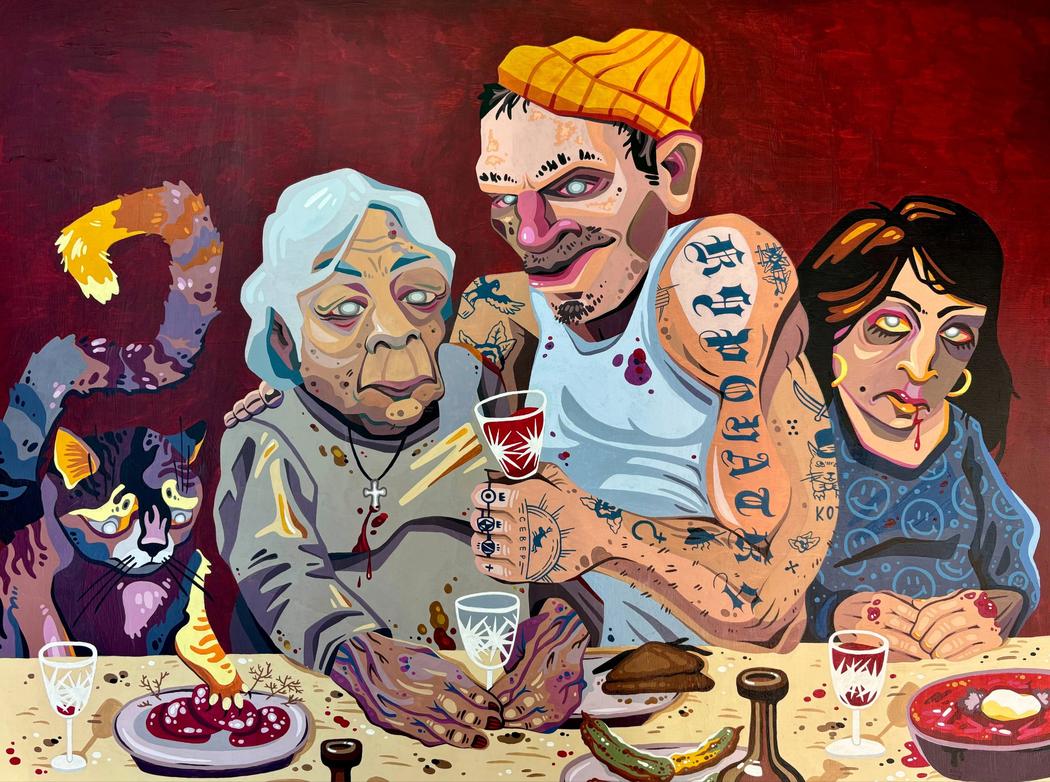 Nina Khmeleva | Normal People | 2026
You hope to write, illustrate, and publish your first book within the next two years. What kind of world do you want this book to open for the reader?
I’m not sure yet. Most likely, it will be science fiction. I am very interested in the genre, and I read many science fiction books as a child.
I draw inspiration from writers such as Henry Kuttner, Robert Asprin, and Roger Zelazny.
Their works are absurd, playful, and technically robust in a way that feels very compatible with my own artistic practice.