
Jerome Chia-Horng Lin
Your practice moves between oil painting, 3D digital tools, animation, and augmented reality. How do these different media help you explore the relationship between the spiritual cosmos and the material world?
Oil painting possesses a distinct materiality; its touchable textures arise directly from physical pigments and canvas. In contrast, digital tools feel inherently virtual, intangible, and almost spiritual during the creation process. Categorizing them this way is certainly not incorrect.
However, when considering Mihaly Csikszentmihalyi’s concept of the “Flow State” from his book Flow: The Psychology of Optimal Experience, a paradox emerges. During the creative process, I actually achieve a state of flow much more frequently while working with oil on canvas. In other words, traditional painting allows me to delve into a spiritual cosmos far more easily than digital mediums like 3D animation or AR. Traditional tools—like pencils and brushes—capture concepts efficiently and intuitively. Digital tools, conversely, present significant technical hurdles. They are rigid and highly logical, forcing artists to follow strict, procedural steps. Furthermore, the electronic fields generated by computers introduce a subtle, often unnoticed interference that disrupts this deep psychological flow.
In your statement, you describe art as part of a spiritual journey. How does this journey appear in your recent works, especially in the Look @ the Egg series?
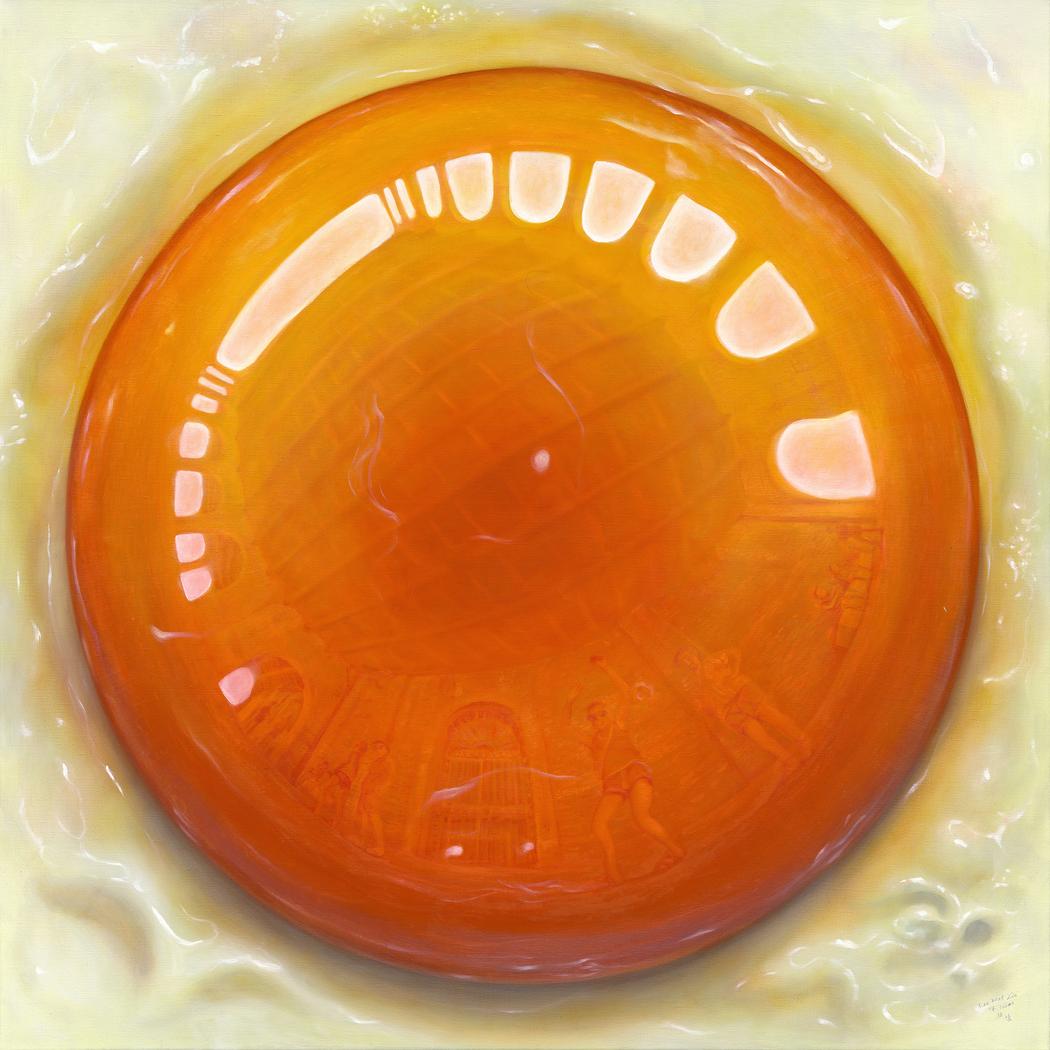
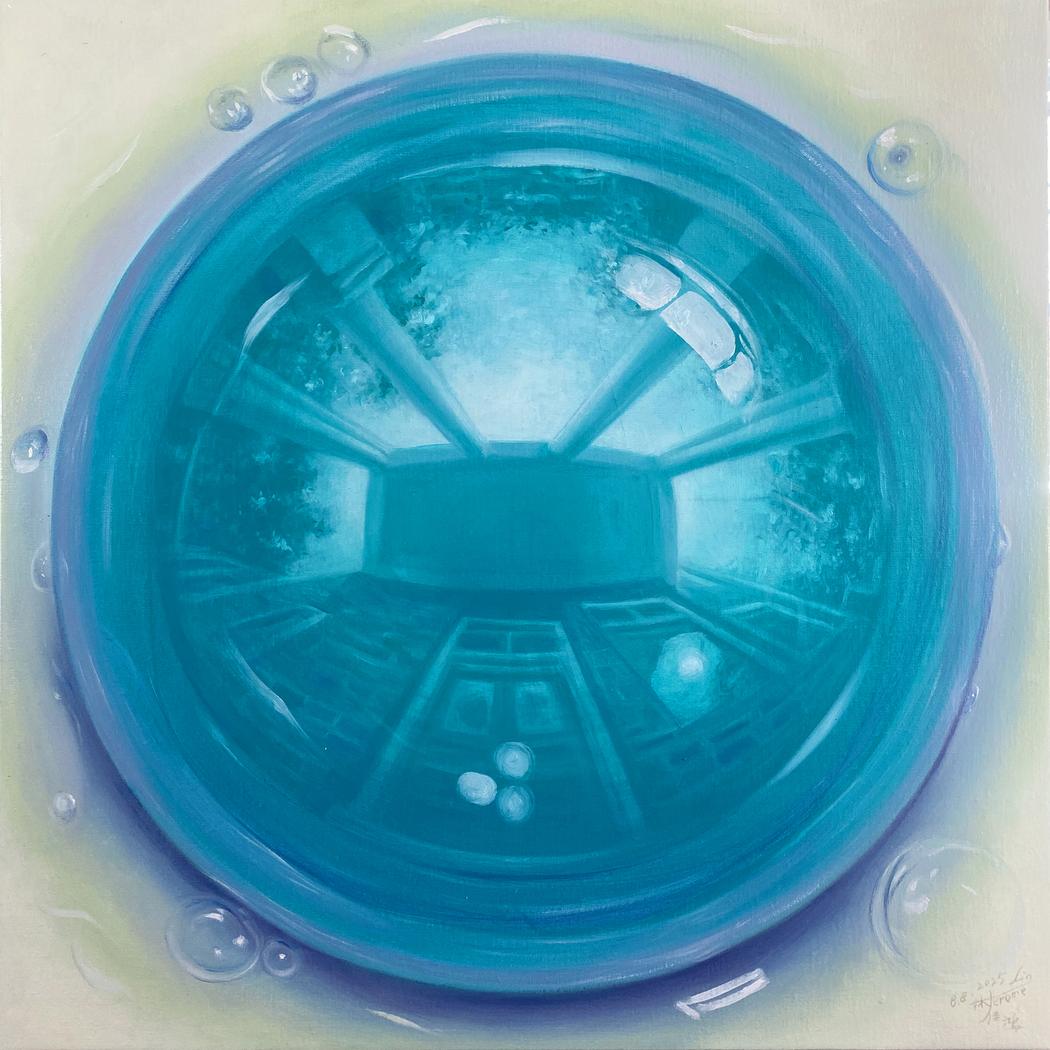
In the beginning, I simply made digital collages to map out my ideas and create the reflections inside my Egg Yolks. Later, a Google search led me to stainless steel spheres, which are perfect for capturing a 180-degree view of a location. I started traveling with these spheres, taking photos across Venice, New York, Zurich, and several towns in Germany.
Lately, I have shifted to using a panoramic camera, a technology that is becoming much more advanced and affordable. The only downside is the extra time required to post-process the videos and photos in a 3D program, but it is a time-consuming issue rather than a technical hurdle for me. This new workflow opens up great possibilities. It allows me to go beyond just collecting photos; I can now deeply explore new ideas using digital tools as a core part of my art practice.
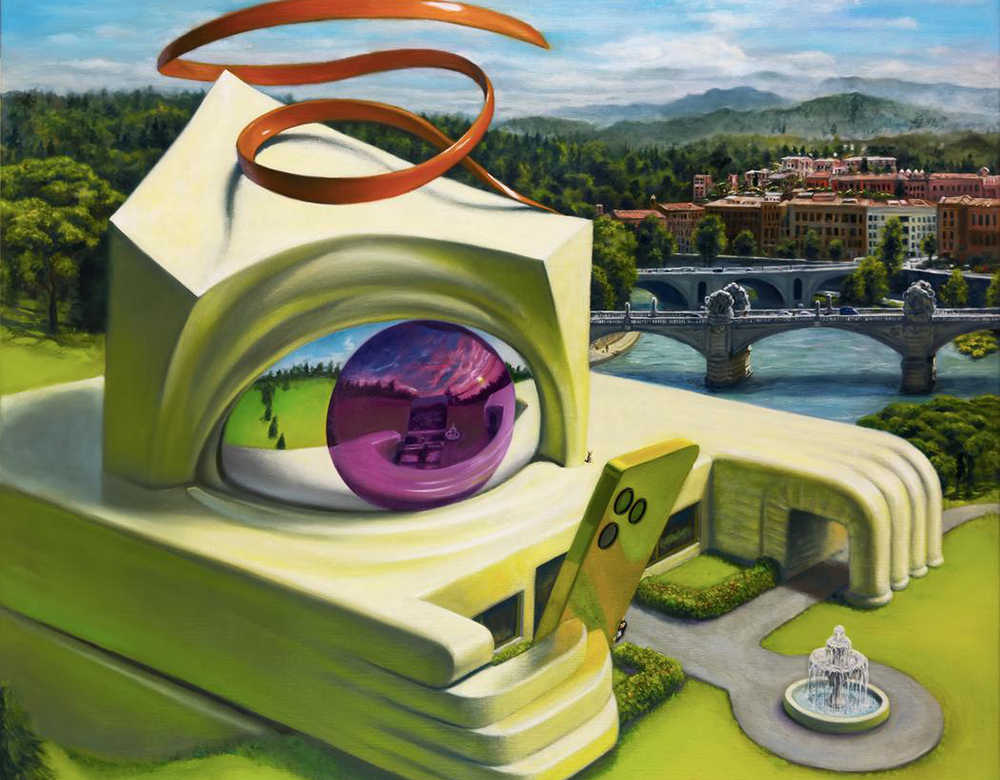
In his book Secret Knowledge, David Hockney reveals the tricks of the old masters, showing how they constantly adopted new apparatuses for their art. Traditional oil techniques might not change much, but I find it exciting to explore modern alternatives. Since I already use digital tools to compose the images I want to paint, it made perfect sense to bring them into Augmented Reality (AR). Viewers have reacted very positively to this combination of traditional oils and AR.
The egg-like forms in your paintings often function as reflective lenses or filters. What does the egg symbolize for you, and why did it become such an important visual element?
Water is the source of life, and the egg represents its very first stage. My Egg series grew out of my previous Water series, and I have spent over a decade working on both. For centuries, eggs have been filled with rich cultural metaphors. Easter eggs, for example, symbolize rebirth and renewal, where the hard shell represents a sealed tomb and cracking it open represents resurrection.
Like water, eggs are essential to our daily survival, yet we often take them for granted. They remind me to pay attention to the minor, quiet details around us—things that seem trivial but actually sustain our livelihood. I treat the reflections in the egg yolks as mirrors to observe my own inner thoughts and mindset.
In Look @ the Egg, you explore how perception is shaped by experience, mentality, prejudice, and assumptions. How do you want viewers to become aware of their own “filters” when looking at your work?
Scientists conduct the Mirror Self-Recognition (MSR) test to verify whether an animal possesses a sense of self-awareness, with a passing result widely considered a hallmark of higher intelligence. Historically, before the invention of the camera, the wealthy paid handsome sums to have their portraits painted by skillful painters. However, once photography emerged, many of these painters shifted their career path to become portrait photographers. Today, smartphones have pushed this evolution even further, igniting the global selfie phenomenon and largely pushing traditional portrait photographers out of the picture. In this contemporary landscape, one could almost claim that everyone has become an artist to some extent.
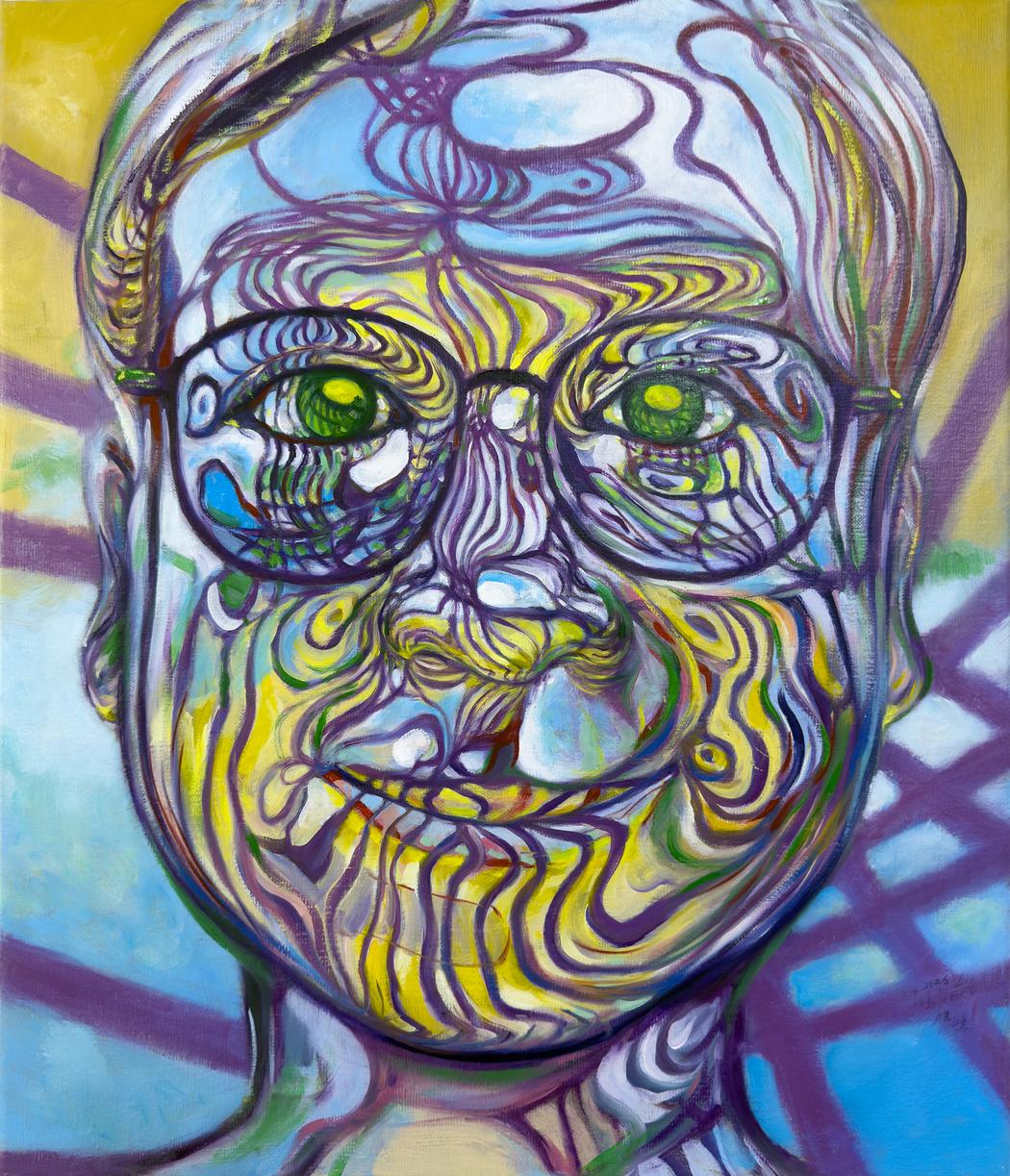
This modern obsession with taking selfies spurred me to create my artwork, Look @ the Egg II. The overwhelming presence of social media has fundamentally reshaped how we perceive ourselves, trapping people in an idealized world filled with heavily filtered and retouched images.
The Look @ the Egg series reflects its surroundings in panoramic views, resulting in an intentional image distortion. In a way, it operates as its own kind of processed image, viewed through a special camera and filter. Through this work, I aim to delve into the mental filters of the human mind. Ultimately, this touches upon the subconsciousness—a realm that may require some psychological insight to fully grasp in depth. In short, we all view the world through certain invisible filters, often without ever realizing they exist or understanding why.
Many of your paintings contain reflections of architecture, landscapes, people, or viewers holding phones. What role does reflection play in your understanding of reality?
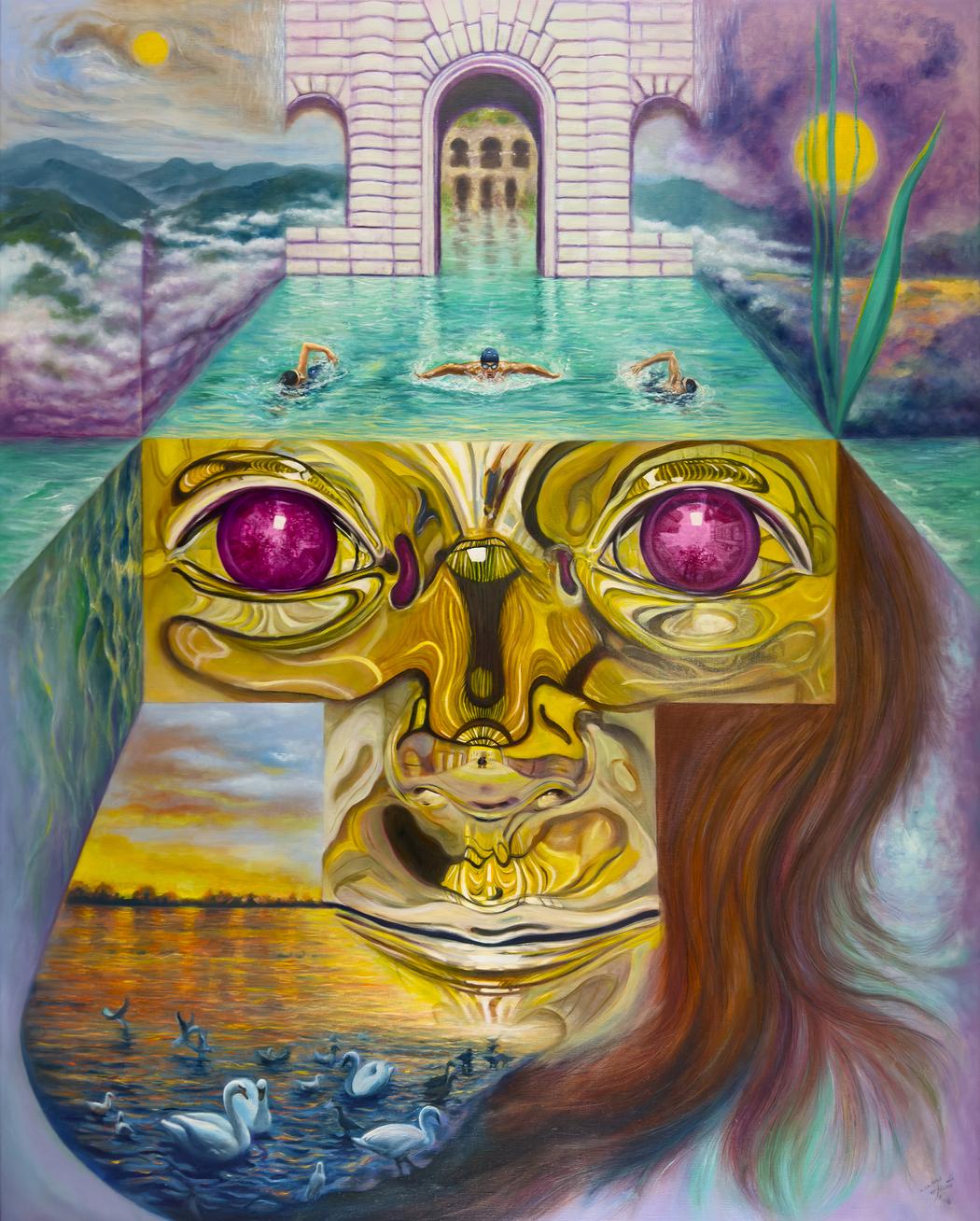
From a biological standpoint, our sensory organs—like our eyes, nose, or fingers—translate the physical world into electrical impulses. The brain then takes these various inputs and acts as a prediction engine. Rather than passively recording data like a camera, it relies heavily on past experiences, expectations, and context to actively construct our environment. When we look at the world, we often ignore this constructive process, much like a fish is unaware of the water it swims in. However, catching our reflection in a mirror can interrupt this autopilot state. It serves as a brief wakeup call, prompting us to ponder the profound gap between objective reality and our subjective perception.
In Egg Go, the traditional black and white Go pieces are replaced by yellow and purple egg yolks. How does the idea of strategy, observation, and being observed connect to this work?
Go is a globally renowned strategy board game often used to sharpen logical thinking. In this piece, the reflections on the Go pieces reveal different viewers holding cell phones from various angles. While the player contemplates their next move, the audience watches, deeply engaged in their own calculations. As we look at the Go pieces, we are simultaneously being watched from multiple perspectives.
The irony lies in the medium: the pieces are made of egg yolk—a soft, jellylike substance completely unfit for a strategic game. Adding to the surrealism, each piece reflects a totally different, unrelated environment, bizarrely juxtaposed next to one another. This imagery mirrors our chaotic world, where everyone operates within their own distinct mindset and calculation. My intention is to portrait this phenomenon while remaining detached from it, positioning myself simply as a watcher.
As both an artist and an educator in visual communication design, how does teaching influence your creative thinking, and how does your artistic practice influence your teaching?
Many artists find themselves navigating a complex, winding career path, and my journey is no exception. After college, I started out as a high school art teacher, but eventually pivoted to pursue opportunities in the 3D animation field. Once I gained substantial experience as an animator and designer, I was invited to teach at the college level. One thing led to another, and I am now back to teaching full-time. While unexpected, I believe this diverse background deeply benefits my students. Academia serves as my financial backbone, but it offers much more than stability; it immerses me in a youthful environment where I can constantly sense ongoing trends. Engaging with my students forces me to rethink my identity as both an educator and an artist. The creative surroundings spark fresh ideas, ultimately inspiring me to integrate AR and other emerging technologies into my own studio practice.