
Juan José García TL

Your work often blends animals with floral and organic elements. What draws you to this fusion of nature and symbolism?
What draws me to the fusion of nature and symbolism is that since I was a kid I always spent a lot of time with both animals and plants. My father is a nature person and at his ranch we would regularly help out at the greenhouse, the cornfield, with the cattle, chickens and other animals. Also, he would take us to the zoo often. Nonetheless, my great grandmothers’ flower garden was one of the few places where I would be calm and quiet as a child. Therefore, at an early age plants became a happy place where I would unwind. My “Blossoming Animals” collection was inspired from my love of both flora and fauna. I was the weird kid that would ask books for birthday or Christmas; many of them full of mythology, legends and fairy tales. They introduced me to the world of the archetypes I’ve been using within my work for a long time.
Many of your paintings feel both vibrant and slightly surreal. How do you balance beauty with deeper, sometimes darker themes?
I don’t balance beauty and darker themes consciously to be honest. I mainly try to think of what I want to evoke from the viewer. Whether is a dark or lighter tone subject matter, I’m always driven by the narrative. However, the narrative is always open for interpretations way beyond just my idea or original motivations. I’m definitely not the kind of artist where my original intention is the right one. I enjoy hearing the way the viewer interprets the artwork. Many of my paintings have some darker tones and themes but I tend keep the use of vibrant colors since that’s part of my style and approach. I guess the only balance I create in my work is the intention of the art being able to change according to the viewers interactions and that includes both positive and negative reactions.
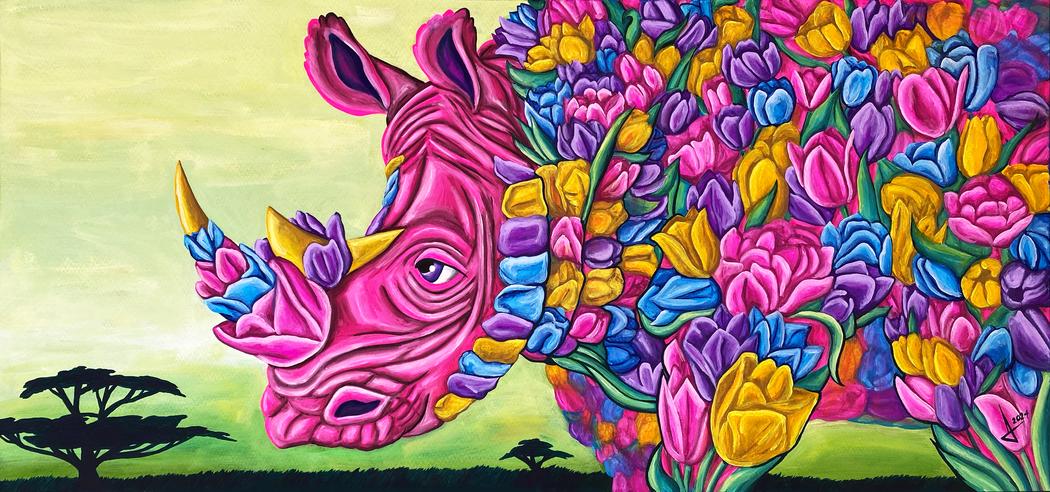 Juan José García TL | Blossoming Rhino
You studied film before focusing on visual art. How has cinema influenced your storytelling and composition?
My cinema studies influenced my creative process in many ways. The approach to my ideas is very narrative driven, therefore, a story is often within the concept for my art; the starting point. Then I begin to experiment with composition, which is likewise very cinema driven. I try to think of many ways to tell the story within the painting in an interesting and evocative way. It is similar to how a storyboard artist and a cinematographer prepare compositions before filming.
Your use of color is very bold and expressive. How do you approach building your color palettes?
I approached the building of my color palette in a different way depending on the painting I am working on. Sometimes I use very extensive color palettes where I mix many different colors, while other times I’ll use two or three hues and no more than that. Nevertheless, I’ll definitely use many color variations within those hues, especially with greens or blues. Most of my color palettes are surreal and not dictated by reality. They typically consist on mixing them in a way where one color will stand out creating a focal point. For example, in all the paintings of my cloaked character “The Red Figure” the only red in the composition is the figure itself. Moreover, I play with the temperature of the colors to create contrast or, when it’s a limited color palette, I tend to choose complimentary colors that will contrast each other as well.
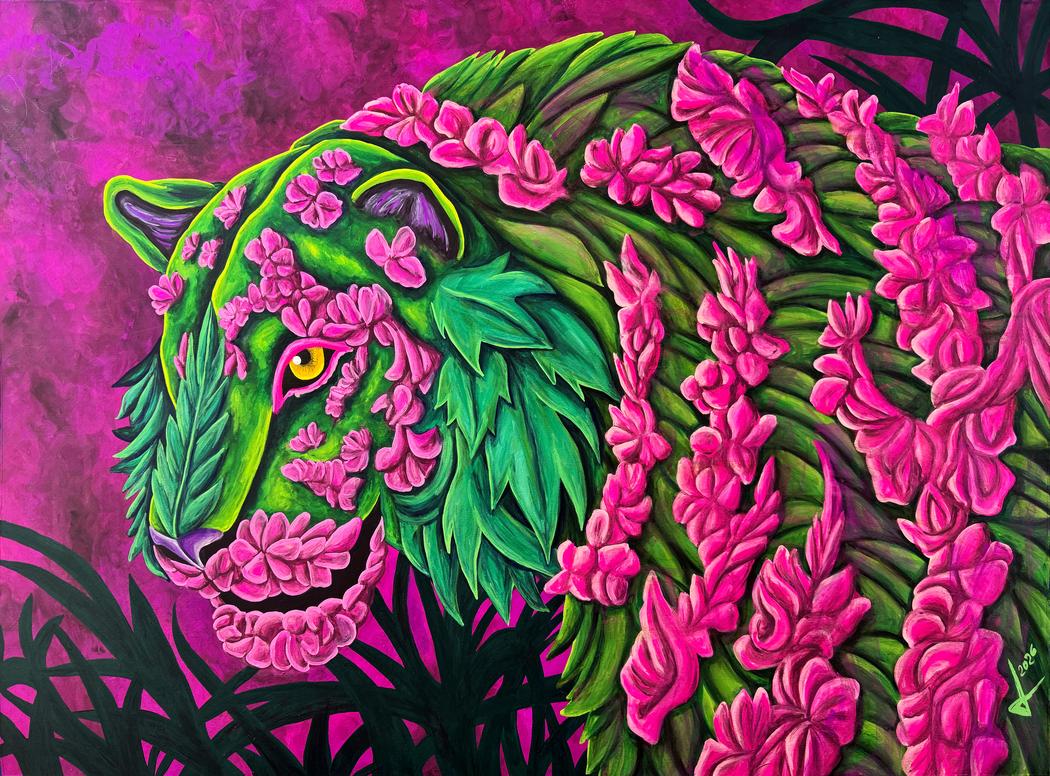 Juan José García TL | Blossoming Tiger
Animals appear as central figures in many of your works. Do they represent specific ideas, emotions, or aspects of identity?
Animals in my work are mainly chosen by the preference of my admiration towards that animal for its unique shape or strength. As an example, I painted a pink Rhino covered in tulips and this created a nice contrast of a very “feminine” color palette, with very elegant flowers on a very tough looking animal. As simple as it may sound, my animal choices are from creatures I find visually beautiful and interesting to look at, or also with animals I have interacted with closely like giraffes, tigers or flamingos. Interacting with them effectively helps when depicting the animal even when covered in flowers and plants.
How has your artistic journey evolved since your time studying in Los Angeles?
My artistic journey since studying in Los Angeles has evolved in many different aspects. I’ve been more open to embrace my darker side in terms of ideas and self expression. I’ve been more honest with my own demons and have let them out more freely. Before, the fear of those art pieces not finding an audience would stop me from creating them in the first place. Although now, I’ve learned my lesson: many people can connect to those dark paintings. Up to today, most of the pieces I’ve sold were born from those fears. So creating more genuinely rather than thinking to paint what people would buy has really helped me grow as an artist since I graduated.
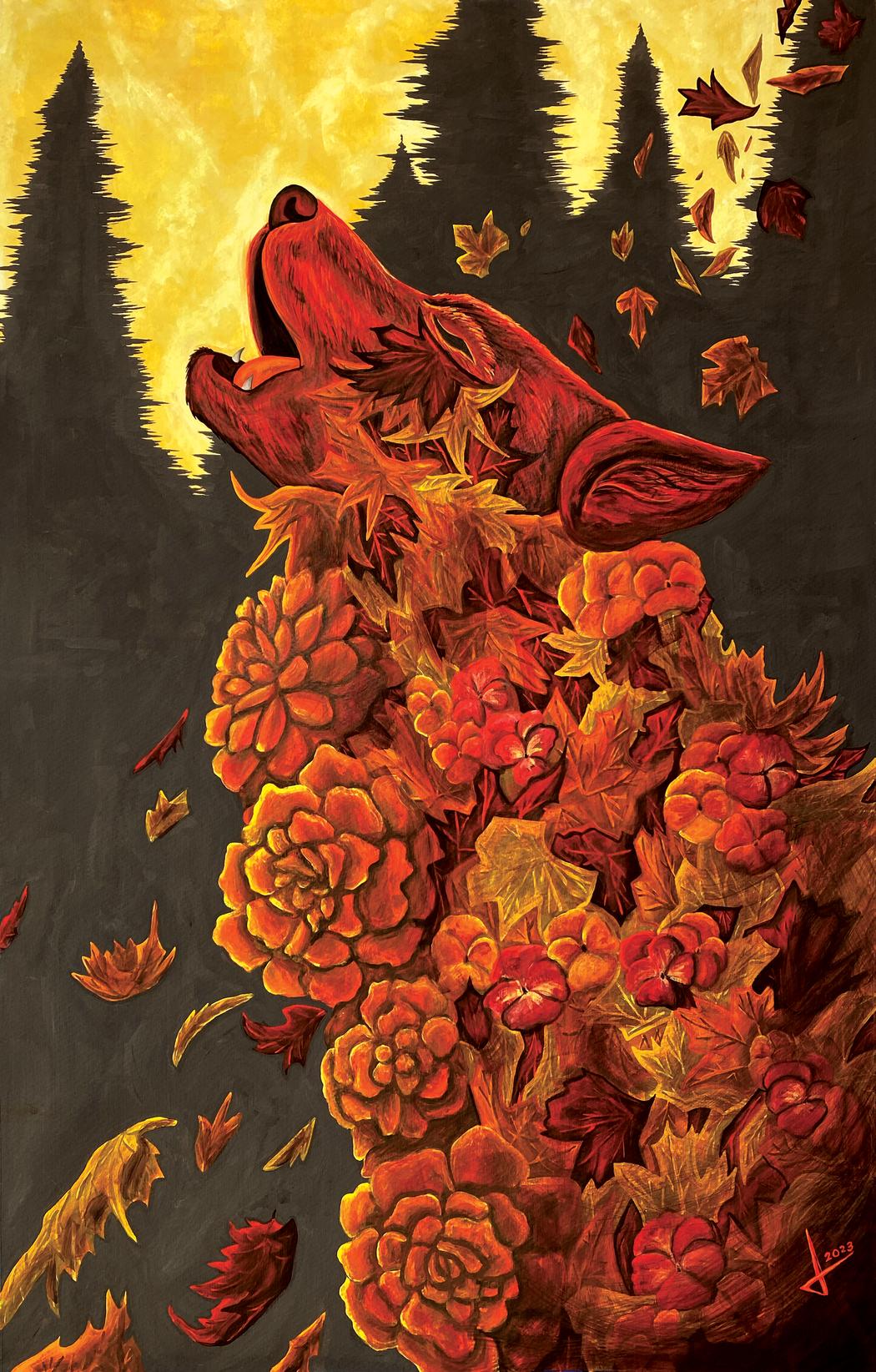 Juan José García TL | Blossoming Wolf
What role does Mexican culture or your background play in shaping your artistic vision?
I’m proud to say that my culture and background had influenced my creativity since day one. A lot of my work is influenced by death and the iconic Day of the Dead, which is my favorite Mexican holiday. This unique perception of death became a part of my daily life after my brother’s death twelve years ago, where my work started to express darker feelings that I have never felt before. Likewise, my devotion to use colors boldly is a result from growing up surrounded by color all over my country whether is on clothing, crafts, fabrics, birds, flowers, or food. Many Mexican artists used surreal symbolism and expressed their pain through their art such as José Clemente Orozco, Frida Kahlo, Leonora Carrington and many more. Like them, all of this inspiration became part of my everyday life while growing up in Mexico.

Leave a Reply
You must be logged in to post a comment.