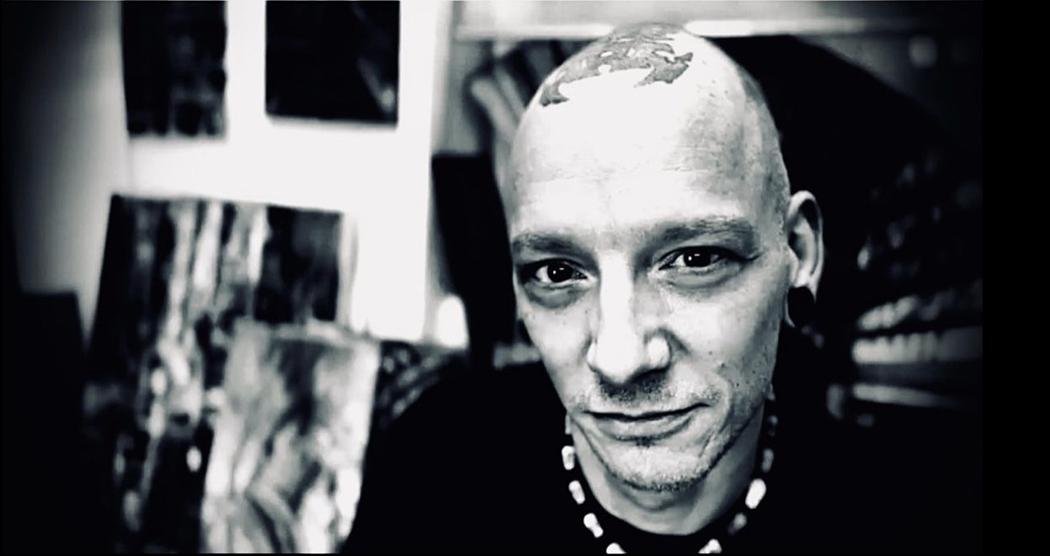
Johannes van den Bussche
In your statement, you speak about the “space between 0 and 1”. How did this concept first emerge in your practice, and how do you translate such an abstract idea into visual form?
The idea of the “space between 0 and 1” emerges from an experience of inner attention. In this attention, it becomes clear that mental concepts – including the idea of a fixed self – are constructions. They structure our lived reality and function as such in everyday life, yet they are not identical with what precedes them.
Behind these constructions, fields of awareness open up that can be experienced but not clearly named. In such moments, fixed positions and identities begin to dissolve or at least become permeable. Oppositions lose their rigidity, and what once appeared clearly defined reveals itself as fluid.
Zero and one stand for fixation, decision, and coding. What interests me, however, is the state before that fixation – the moment in which meaning has not yet solidified, in which perception has not yet been fully translated into language.
My work does not attempt to illustrate this space directly. Instead, it seeks to operate from within it. The images move in fields of tension between form and dissolution, structure and openness, assertion and suspension.
The “space between 0 and 1” is therefore not a theoretical model but a practice – a state of perception prior to naming and fixation, from which form, meaning, and identity arise in the first place.
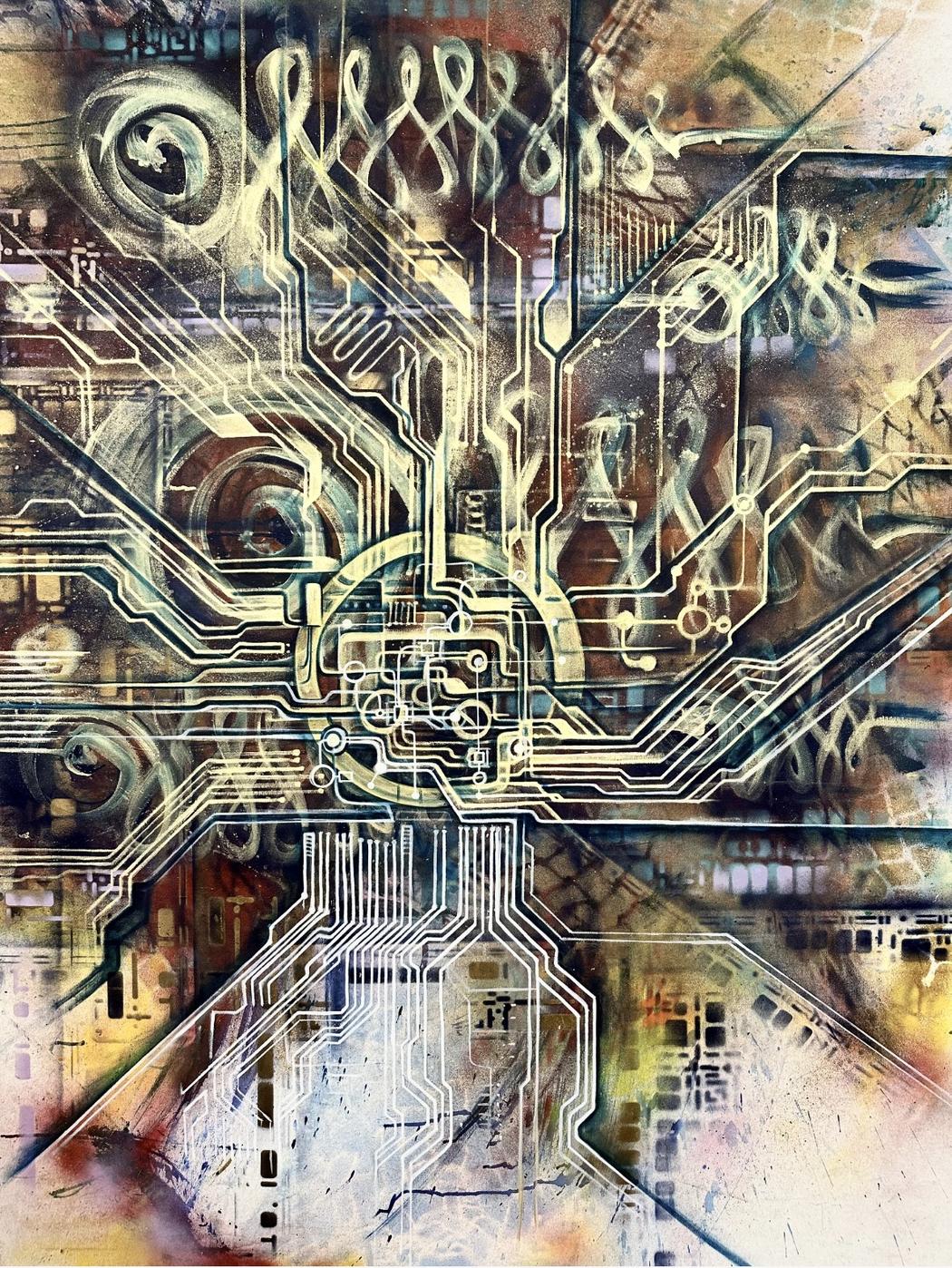
Your works reference both indigenous tattoo traditions and digital systems like circuit boards and grids. How do you navigate the tension between ancient embodied knowledge and contemporary technological structures?
While reflecting on ideas like 0 and 1, black and white, I became interested in how human beings encode identity. Across history, people have translated their sense of self, their belonging, their context — whether tribe, territory or culture — into signs. These signs are then carried outward: in cave paintings, in tribal tattoos, in symbolic markings, and today in digital icons, avatars or emojis.
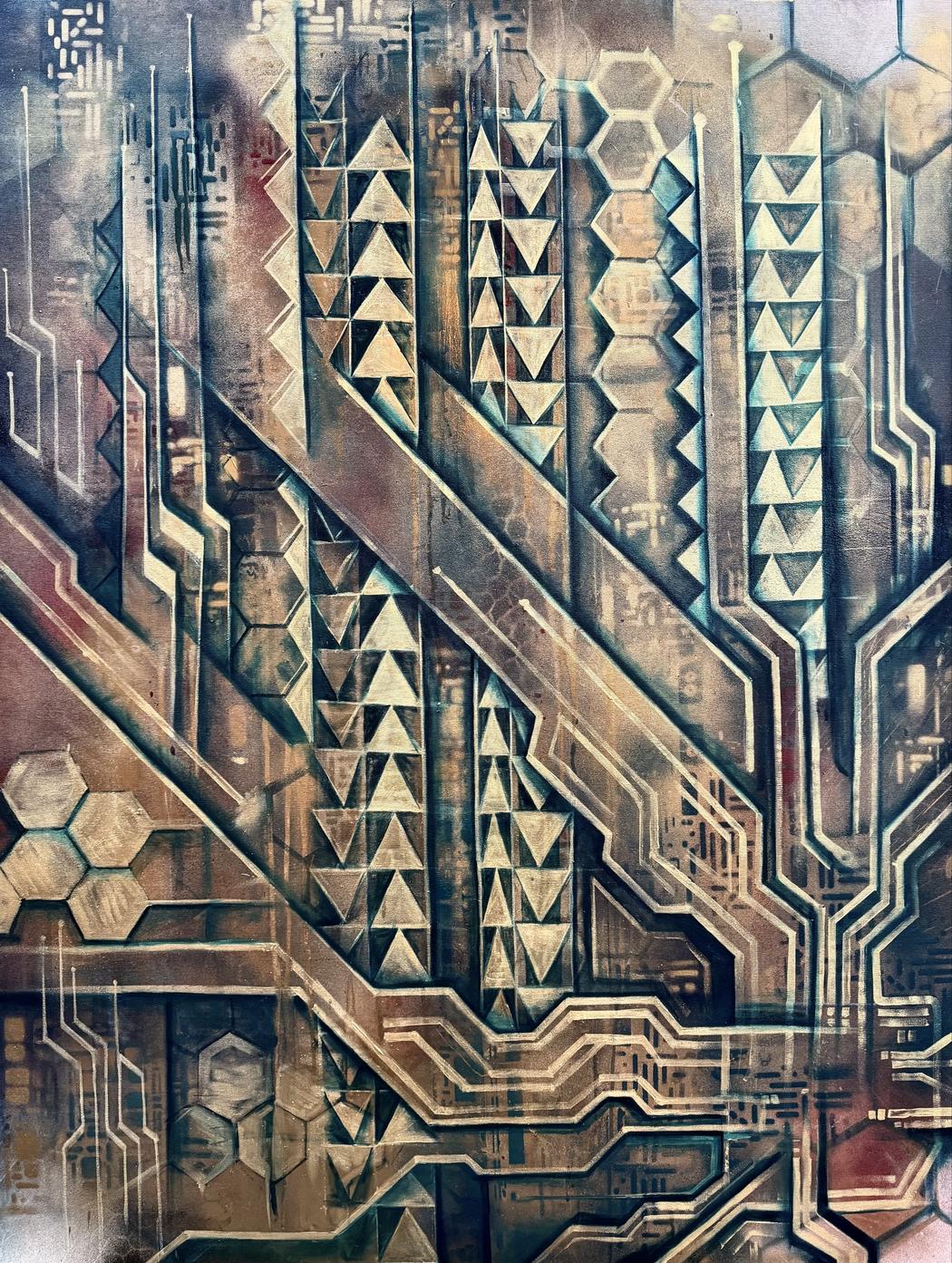
At its most basic level, coding is a distinction between presence and absence, mark and non-mark. Binary code reduces this to 0 and 1, black and white. At some point, I realized that many traditional tattoo structures operate in a similar way: information is created through the relationship between tattooed skin and untouched skin — between positive and negative space.
This parallel fascinated me. The historical contexts change, the technologies change, but the underlying human impulse remains constant: the need to encode identity, to externalize belonging, to transmit meaning.
Bringing organic, archaic visual systems into dialogue with contemporary technological structures is therefore not about contrast for its own sake. It is about continuity. The tools evolve, but the act of encoding the self persists.
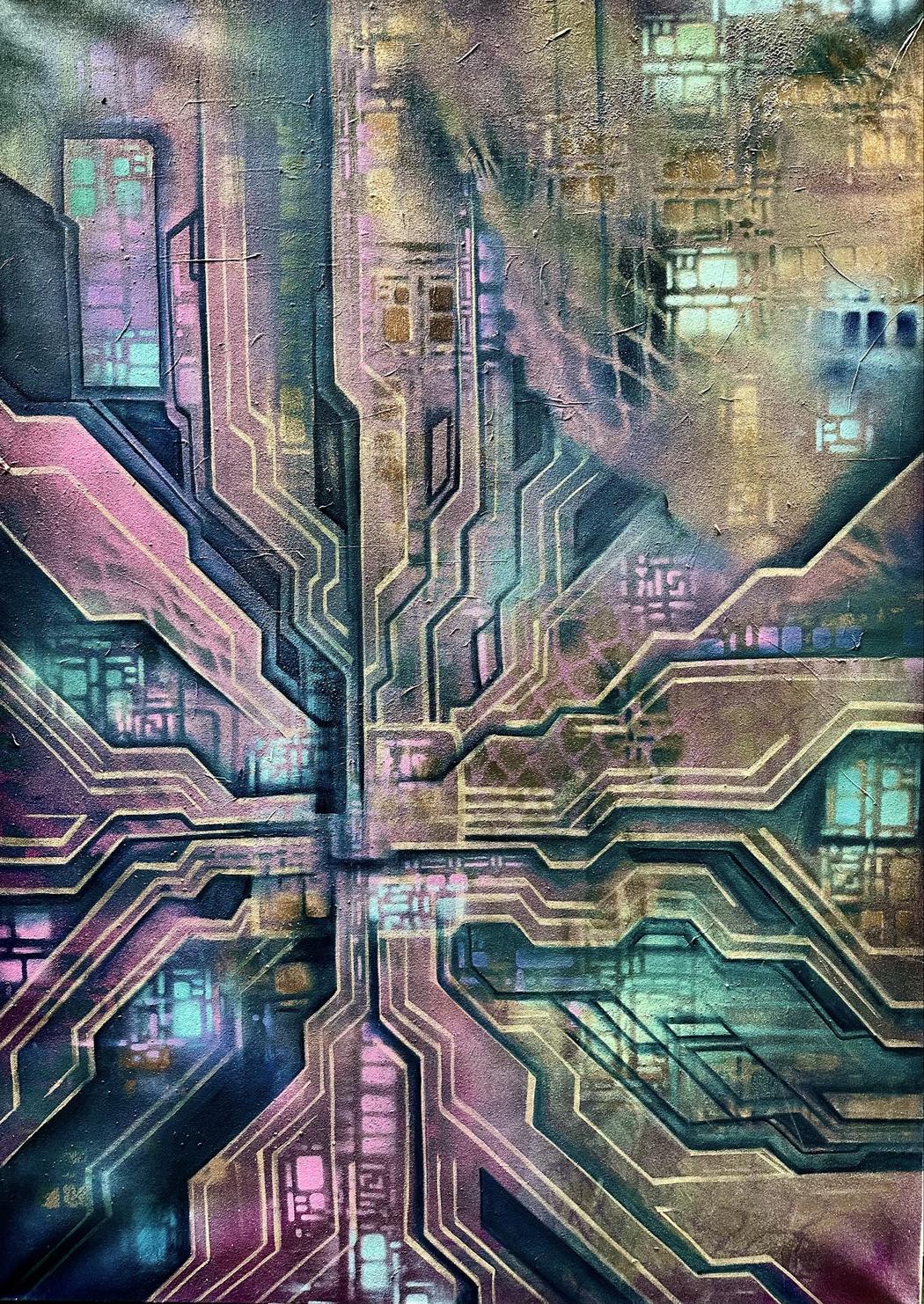
In my work, grids and circuit-like structures do not oppose indigenous forms; they mirror them. Both are systems of inscription. Both are ways of organizing information. By placing them next to each other, I explore how identity is constructed, carried and transmitted across time.
As both a painter and a tattooist, how does working directly on the human body influence your approach to painting on canvas?
Working on the human body fundamentally changes how one understands form, space and consequence. Skin is not a neutral surface. It moves, ages, breathes and carries history. Every line must respond to anatomy, to tension, to gravity. Decisions cannot be undone easily; they require precision and commitment.
This awareness carries over into my painting. Even on canvas, I do not treat the surface as flat or abstract. I approach it as something embodied — as a field with internal structure. Anatomical knowledge influences composition, layering and rhythm. Forms are rarely isolated; they relate to an implied body, even when the body is not explicitly depicted.
Tattooing also sharpens sensitivity to negative space. On skin, untouched areas are as important as inked ones. That understanding translates directly into my use of voids, interruptions and spatial breaks in painting.
Finally, tattooing involves responsibility. The image becomes part of someone’s identity. This creates a discipline of intention. In painting, I allow more freedom, but the sense of commitment to the mark remains. Every gesture carries weight.
For me, canvas and skin are not separate worlds. They are different contexts for the same investigation: how form inhabits space and becomes part of lived experience.
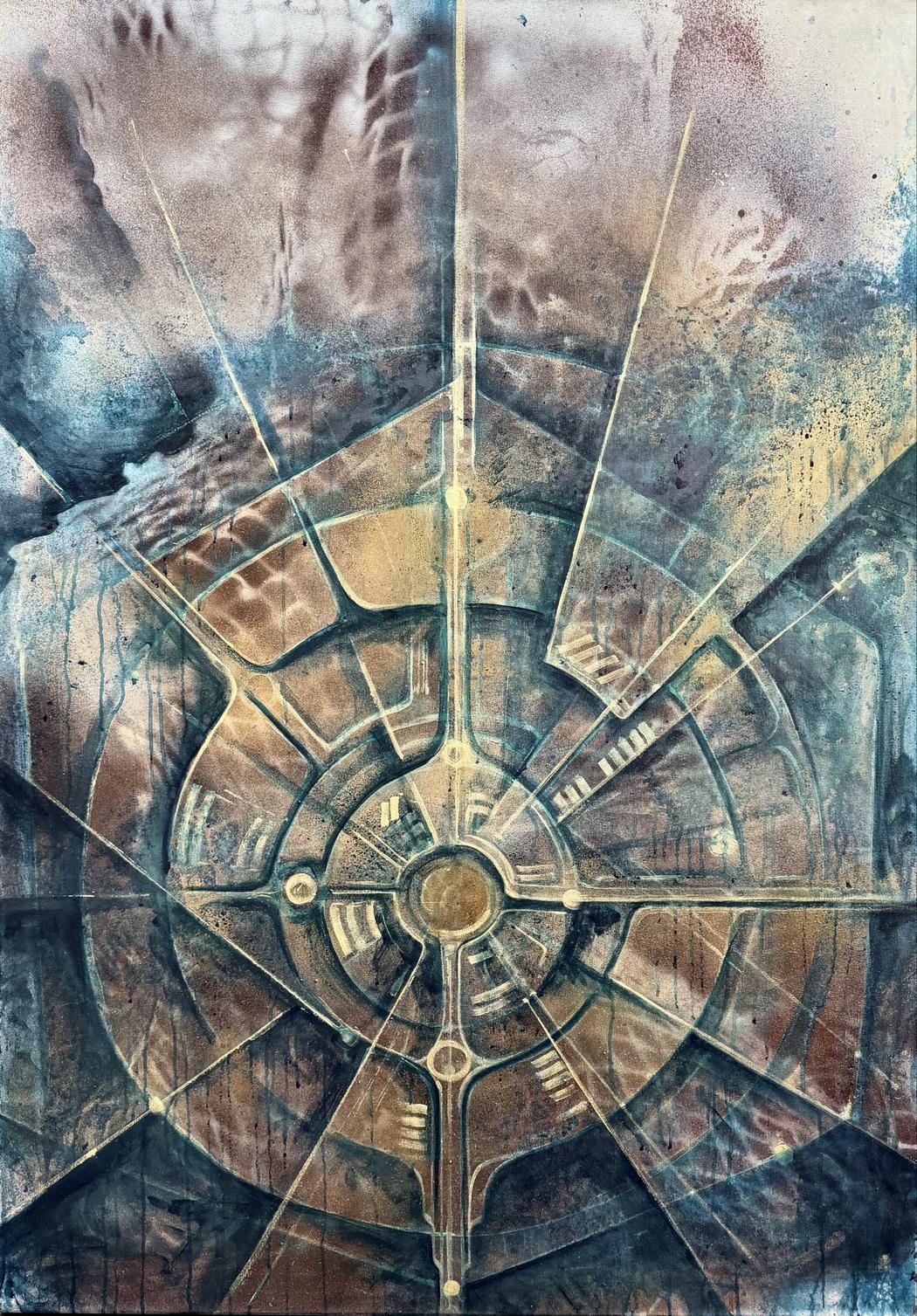
The circular compositions in several works resemble mandalas or mechanical systems. Do you see them as spiritual diagrams, technological blueprints, or something beyond those categories?
I understand why they are associated with mandalas or mechanical systems. Circular structures naturally suggest order, repetition and internal coherence. They can evoke spiritual diagrams, but they can also resemble engineered systems or technical schematics.
For me, they are neither strictly spiritual nor purely technological. They function as organizing structures. The circle allows elements to relate to one another without hierarchy. It creates a field in which tension can rotate rather than collapse.
Historically, circular forms have been used to map cosmologies, belief systems and metaphysical ideas. In contemporary culture, circular systems also appear in machinery, data visualization and network structures. I am interested in this overlap. The same geometry can carry very different meanings depending on context.
In my work, the circular compositions are not illustrations of doctrine or technology. They are frameworks for concentration. They hold movement and repetition while allowing rupture and deviation. If they resemble mandalas or mechanical systems, it is because both are attempts to give structure to complexity.
What matters to me is not the category, but the function: the circle as a container for energy, information and transformation.
Repetition and precision are central to your visual language. Is this process meditative, analytical, or somewhere in between?
It is both, but not in a romantic sense. Repetition creates rhythm, and rhythm can stabilize attention. In that way, the process has a meditative quality. It narrows focus and reduces distraction.
At the same time, precision requires analysis. Proportion, alignment and structural coherence are not accidental. They demand calculation and constant evaluation. Especially when working with grids, anatomical references or layered systems, decisions must be measured.
For me, the interesting point lies where these two modes intersect. Repetition becomes a tool for concentration, while precision prevents the work from dissolving into pure intuition. The analytical aspect anchors the process; the repetitive aspect deepens it.
I do not see meditation and analysis as opposites. In practice, they operate simultaneously. Attention becomes sharper through repetition, and structure becomes more alive through sustained focus.
The work emerges from that balance — disciplined, but not rigid; concentrated, but not detached.
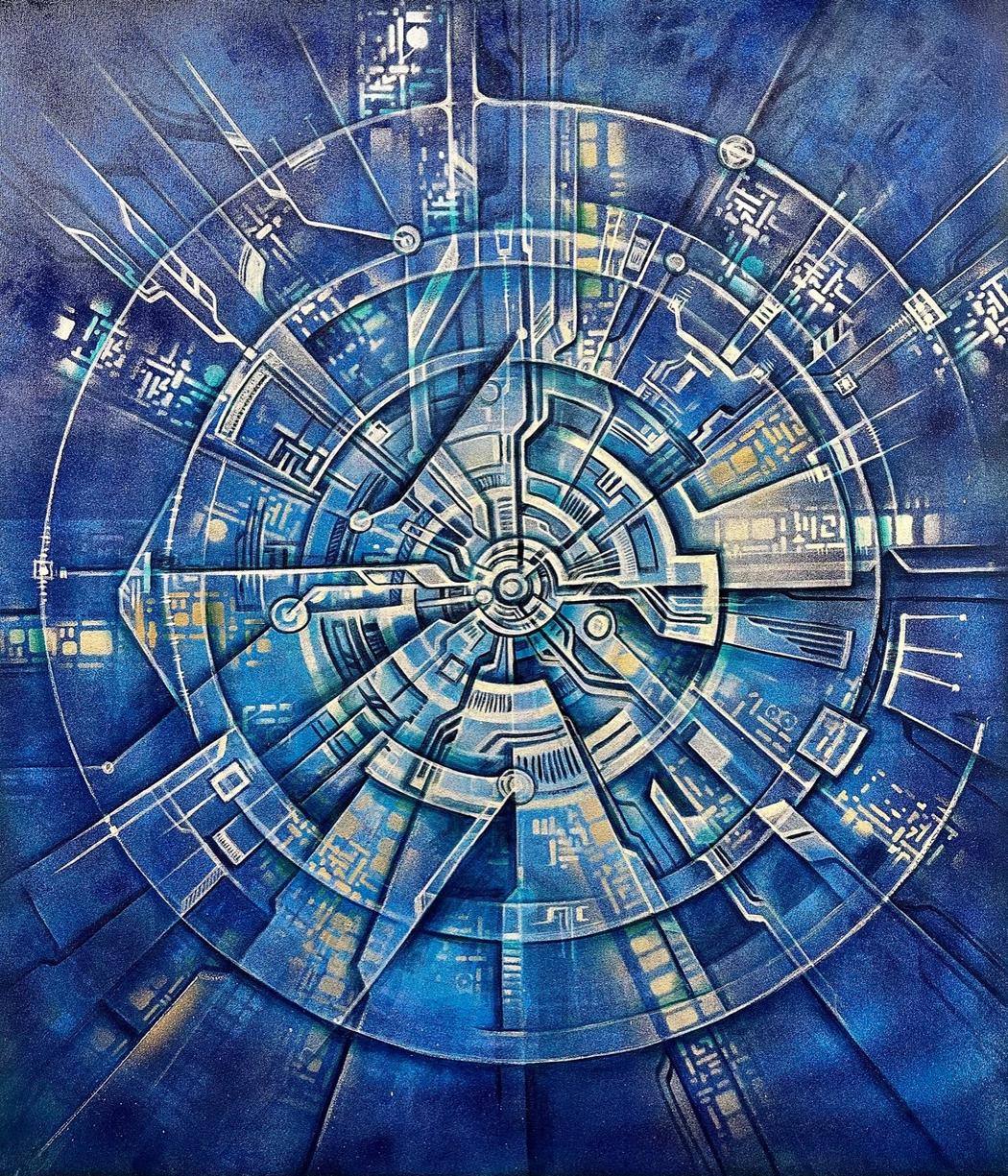
You describe your paintings as “visual interfaces”. What kind of experience do you hope the viewer has when engaging with them?
When I describe my paintings as “visual interfaces,” I do not mean that they deliver a fixed message. An interface is not content; it is a threshold. It is a point of contact between systems.
I hope the viewer experiences a shift in perception rather than a clear narrative. Ideally, there is a moment of suspension — a pause in which interpretation has not yet fully settled. The work should not explain itself immediately. It should create a field that invites attention rather than consumption.
An interface also implies participation. The image is not complete without the viewer’s projection, memory and internal associations. The tensions within the work — between structure and dissolution, organic and constructed elements — are mirrored in the viewer’s own perceptual process.
I am not aiming for comfort or for confusion. What interests me is intensity of presence. If the viewer becomes more aware of their own act of looking — of how meaning forms and stabilizes — then the interface is functioning.
The painting does not provide answers. It offers a space in which perception becomes visible to itself.
How has living and working in Hamburg shaped your artistic perspective, especially in relation to global cultural coding?
Being born and raised in Hamburg provided a strong foundation for my artistic development. The city carries a dense historical and cultural depth, and many of the themes that later became central to my work were already present in my early environment.
As a child, my father took me to the Museum of Ethnology in Hamburg, where I encountered Māori meeting houses and other cultural artifacts firsthand. I remember being deeply fascinated by these spaces and forms. At the Museum of Hamburg History, I was equally captivated by the display of the skull attributed to the pirate Klaus Störtebeker. These early experiences exposed me to both global cultural narratives and the strong maritime history of the city.
Hamburg itself has a significant tattoo heritage. Christian Warlich, one of the first professional tattooists in Germany, established his registered business here. Herbert Hoffmann also shaped the city’s tattoo culture. My own professional path began here in 1999. From Hamburg, I started traveling as a tattooist, following a tradition of departure that is deeply embedded in the city’s port history.
These travels, including two years in New Zealand, allowed me to work closely with Māori artists, carvers and tattooists. The exchange was formative. My connection to Māori forms is not stylistic appropriation; it is rooted in lived experience and personal relationships. Tattooing became a way to engage with different visual languages and cultural systems directly.
Over time, these encounters — local history, global travel, traditional tattoo structures and contemporary systems — began to converge. What has emerged is not a quotation of specific cultures, but a visual language shaped by movement, exchange and long-term immersion.
Hamburg shaped me through depth and departure: a city grounded in history, yet always oriented outward. That tension continues to inform my work.
Leave a Reply
You must be logged in to post a comment.