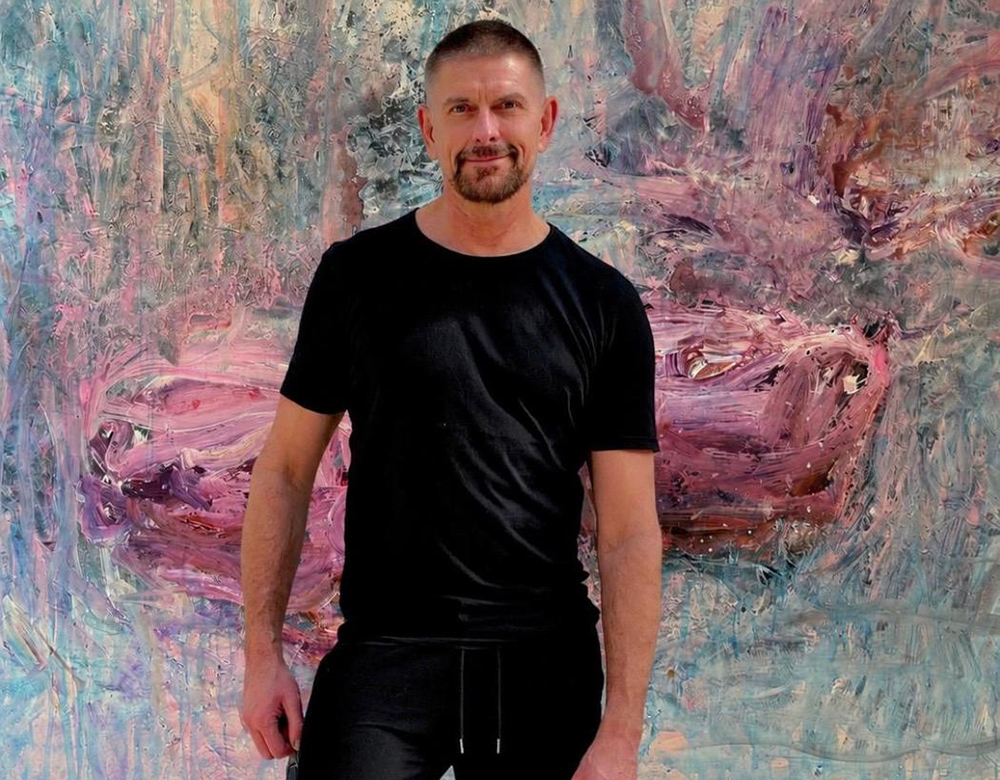
Vangelis Gavriil
Your practice brings together painting, printmaking, philosophy, and theatre. How do these different fields influence the way you think about imagemaking?
I have always viewed the visual arts as an expanded field rather than a collection of separate disciplines. Painting and printmaking were the focus of my studies at GSA, but I have often felt the need to experiment across different media as well, including photography, collage, and digital processes.
My background in philosophy and theatre has deeply informed the way I approach image-making. Philosophy provides a critical and conceptual framework through which I can reflect on questions of meaning, while theatre has heightened my sensitivity to narrative structures. I also value the fact that both are humanities disciplines, placing the human being at the centre of knowledge and experience.
Working across disciplines allows me to think of the image not as a self-contained object, but as a site where different forms of knowledge, experience, and interpretation converge.
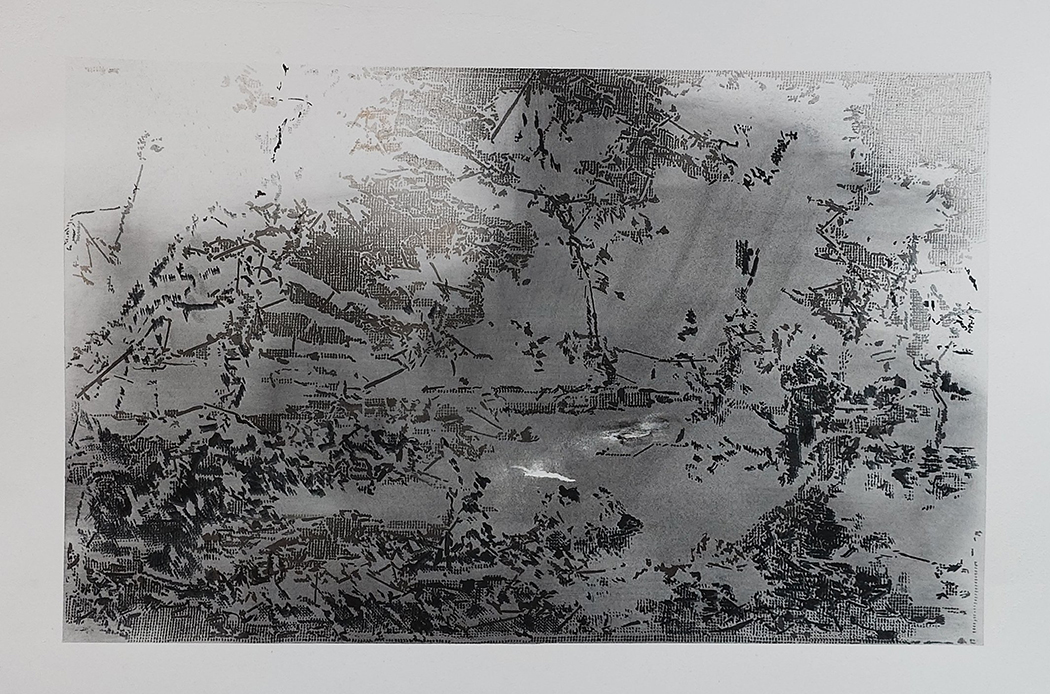 Vangelis Gavriil | Glitchy Screen | 2026
How did moving from Greece to Scotland for your studies affect the way you see your own culture and artistic identity?
Moving from Greece to Scotland gave me the distance needed to see my own culture more clearly and to understand how deeply history shapes artistic identity. Studying in the UK, within an international environment, encouraged me to focus on cultural connections rather than differences, and reinforced my belief that art can serve as a bridge between people.
This perspective became central to my final project, in which I reinterpreted “View near King’s Bromley, on Trent, Staffordshire” by Thomas Gainsborough through a version embroidered by my grandmother. The image was a popular embroidery subject in many Greek homes during the 1970s, making it an unexpected point of connection between British and Greek cultural histories. Through this project, I explored how ideas of landscape can shift across time and place, from 18th century Britain to contemporary Greece, where natural landscapes are increasingly threatened by devastating wildfires.
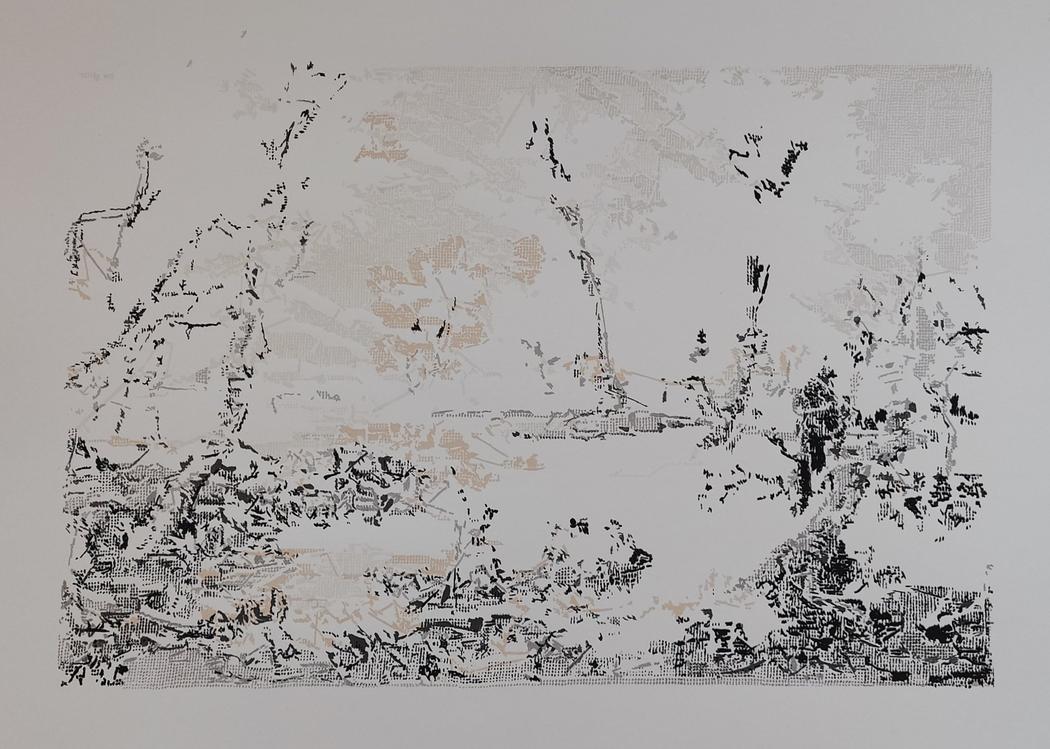 Vangelis Gavriil | Glitchy Screen | 2026
In this series, you begin with your grandmother’s embroidery based on Thomas Gainsborough’s “View near King’s Bromley, on Trent, Staffordshire”. What first drew you to the reverse side of the embroidery rather than its “finished” front?
When I first removed the embroidery from its heavy Baroque frame, I became fascinated by the stitching on its hidden reverse side. The lines formed by the threads carried my grandmother’s gesture in a direct and sincere way, much like ink does.
This discovery led me to trace the thread lines with a Posca pen, breaking the embroidery down into eighteen colour layers. Through this process, I also became aware of the visual affinities between the dense network of stitches and a glitchy screen. The work became a dialogue between our digital age and a time when embroidery was a common leisure activity, as well as a personal conversation between my grandmother and me.
I have always noticed an element of disruption in glitchy, pixelated images. At the same time, they can be understood as moments of transition, in which something dissolves while something new begins to emerge.
You separated the embroidery into eighteen colour layers. How important is this process of deconstruction in your work?
As I experimented with the reverse side of the embroidery, I became interested in exploring its complementary colours. To create the different print series, I first separated the embroidery into eighteen colour layers, which allowed me to study the original palette closely and develop new combinations based on both the traditional RYB and digital RGB colour systems. Conceptually, this process of deconstruction was just as important. The embroidery, made by my grandmother, functions as a family heirloom and a carrier of memory. By breaking it into separate layers, I wanted to reveal the latent possibilities within the image and explore how many different forms of memory could emerge from the same source. In the black-and-white series, the landscape depicted gradually disappears. Through this fading image, I wanted to evoke a sense of nostalgia for a disappearing era and perhaps also for a natural landscape that is slowly vanishing over time.
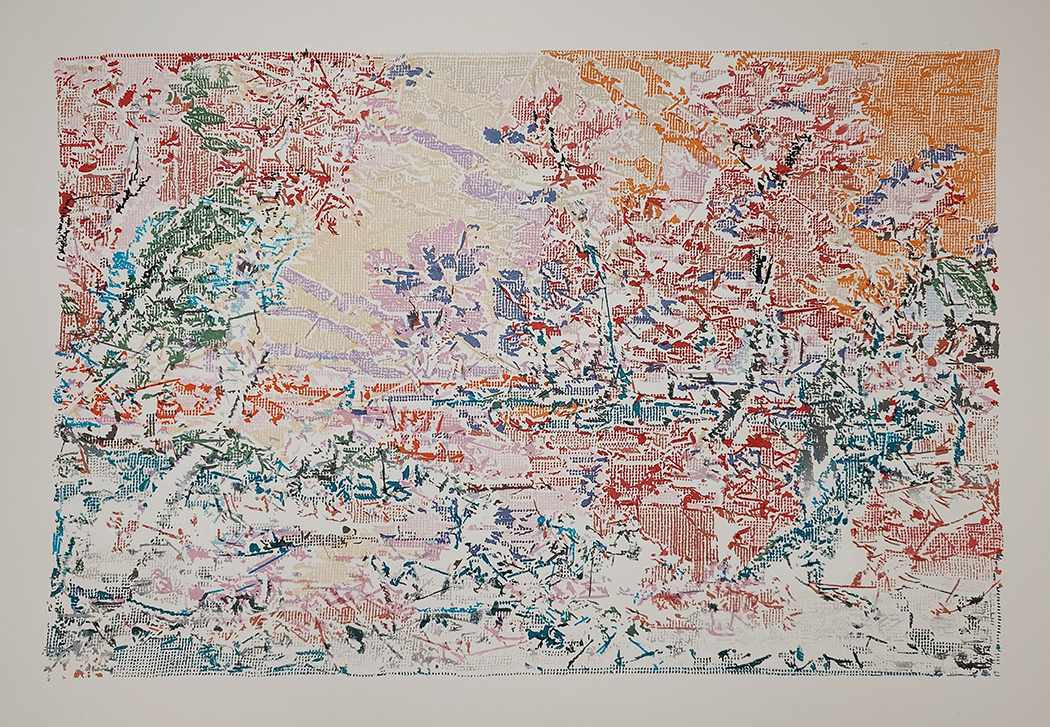 Vangelis Gavriil | Glitchy Screen | 2026
Why is it important for you to work with the themes of memory and family history?
For me, working with memory and family history is closely connected to a process of self-understanding. Over time, I realized that it is difficult to understand who we are without looking back at where we come from—our family stories, cultural background, and the histories that have shaped us, often in invisible ways.
Contemporary art has also taught me that history is not only found in archives or historical records, but in personal narratives, inherited memories, and lived experiences. I see art as a unique way of engaging with history on a human level— through emotion, memory, and storytelling.
This perspective has deeply influenced my practice. My work is woven into biographical experience and explores the connections between personal and collective memory, as well as the ways the past continues to shape our sense of identity and belonging in the present.
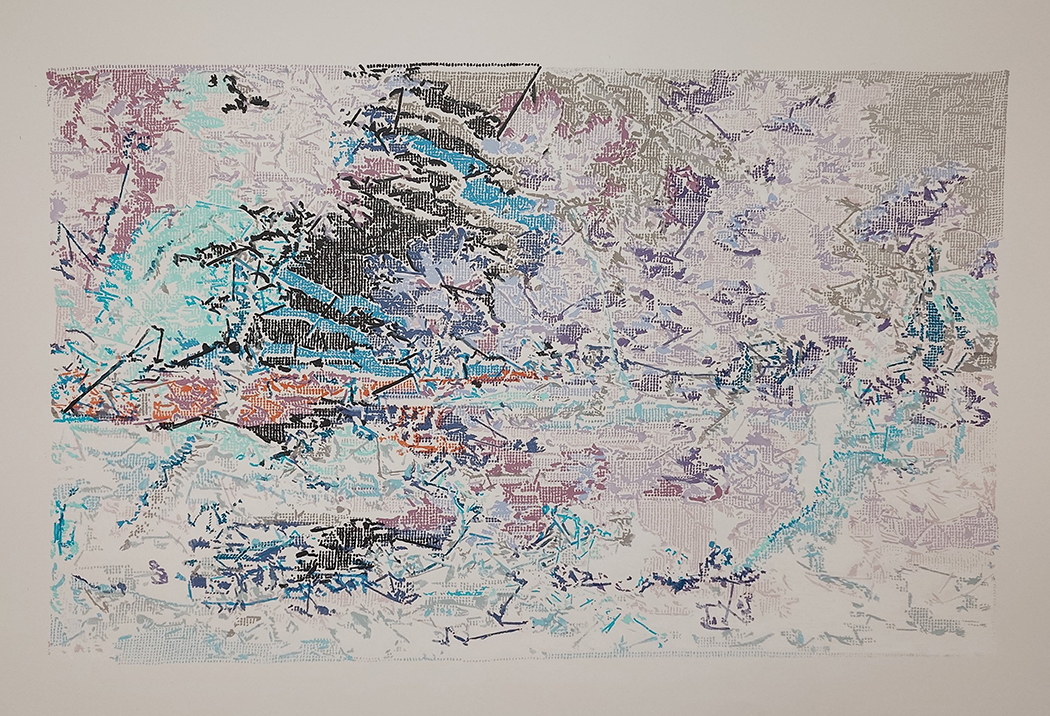 Vangelis Gavriil | Glitchy Screen | 2026
What do you like most about the silkscreen printing technique?
What I love most about silkscreen printing is the balance between repetition and uniqueness. Although the same image can be printed multiple times, each print carries subtle variations that reveal the handmade nature of the process. In an era of digital overproduction, I find this physical and human quality especially meaningful.
Silkscreen also offers a unique relationship with materials. I enjoy experimenting with inks and unexpected elements that can alter the image and create different textures. In my recent black-and-white series, for example, I incorporated ash and charcoal dust into the printing process, allowing the material itself to become part of the work.
I am also fascinated by the way silkscreen can transform an image through gradual changes, making it a powerful medium for exploring memory, loss, and the passage of time. Its ability to combine precision with chance is what keeps the process exciting and creatively rewarding for me.
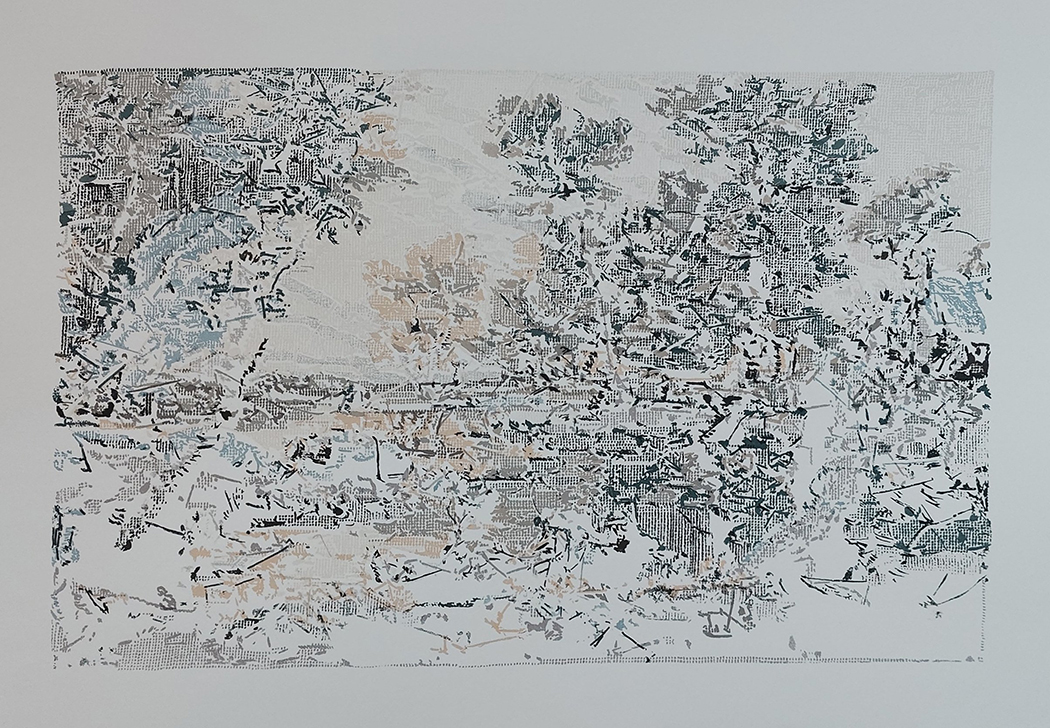 Vangelis Gavriil | Glitchy Screen | 2026
Your background includes philosophy. Are there particular philosophical ideas or questions that shape your approach to visual art?
My background in philosophy shaped my interest in art not only as a practice but also as a field of inquiry. I became interested in ontological questions about what constitutes an artwork and how meaning emerges between artist, image, and viewer.
These questions continue to inform my approach to art.
I am also drawn to reflections on the past: why we study it, how it shapes identity, and what role it can play in contemporary art. This connects closely to my interest in contemporary portraiture and self-portraiture. I often think of a self-portrait not as a direct representation of a person, but as a constellation of images, objects, materials, and memories. A building, a piece of embroidery, a reflection of light, or a trace of history can function as elements of a portrait. Through my work, I explore these connections as a way of understanding both history and myself.