
Vera Nosko
You describe clay as a material that carries memory. How does this idea influence the way you shape and finish your ceramic objects?
If I speak as a practitioner, for me this is not a metaphor — clay truly “remembers” everything that has happened to it. Every touch, the pressure of a finger, pauses in the process, even the mood at the moment of shaping — all of this is recorded in its structure. Sometimes it is visible quite literally (in lines, deformations, tensions), and sometimes it appears later — during drying or already in the kiln.
That is why I do not work like a sculptor who “imposes” a form, but rather as someone entering into a dialogue with the material.
How this affects the process:
Forming
I do not aim for a “clean” form right away. It is important for me to let the clay go through its stages: kneading, resting, and renewed intervention. If you rush the process, tension remains in its memory, and the piece later “takes revenge”: it cracks, warps, or breaks.
Traces of the hands
I often leave marks of fingers, slip, and tools. This is not “unfinished work,” but an honest record of the process. To erase them would be to erase part of the object’s history.
Pauses
Pauses are essential. Clay “absorbs” form over time. If you continue working without stopping, you may destroy the internal structure that has already begun to form.
Drying and firing
At this stage, memory reveals itself most strongly. All hidden tensions become visible. That is why I dry pieces slowly and attentively — it is almost like accompanying them, rather than simply waiting.
Completion
I do not strive for perfect symmetry or sterility. For me, a finished object is one in which its “biography” is preserved, not just its appearance.
Ultimately, when you perceive clay as a material with memory, you stop fighting for control and begin to work with attention and respect. And, paradoxically, this is precisely when forms become more alive and convincing.
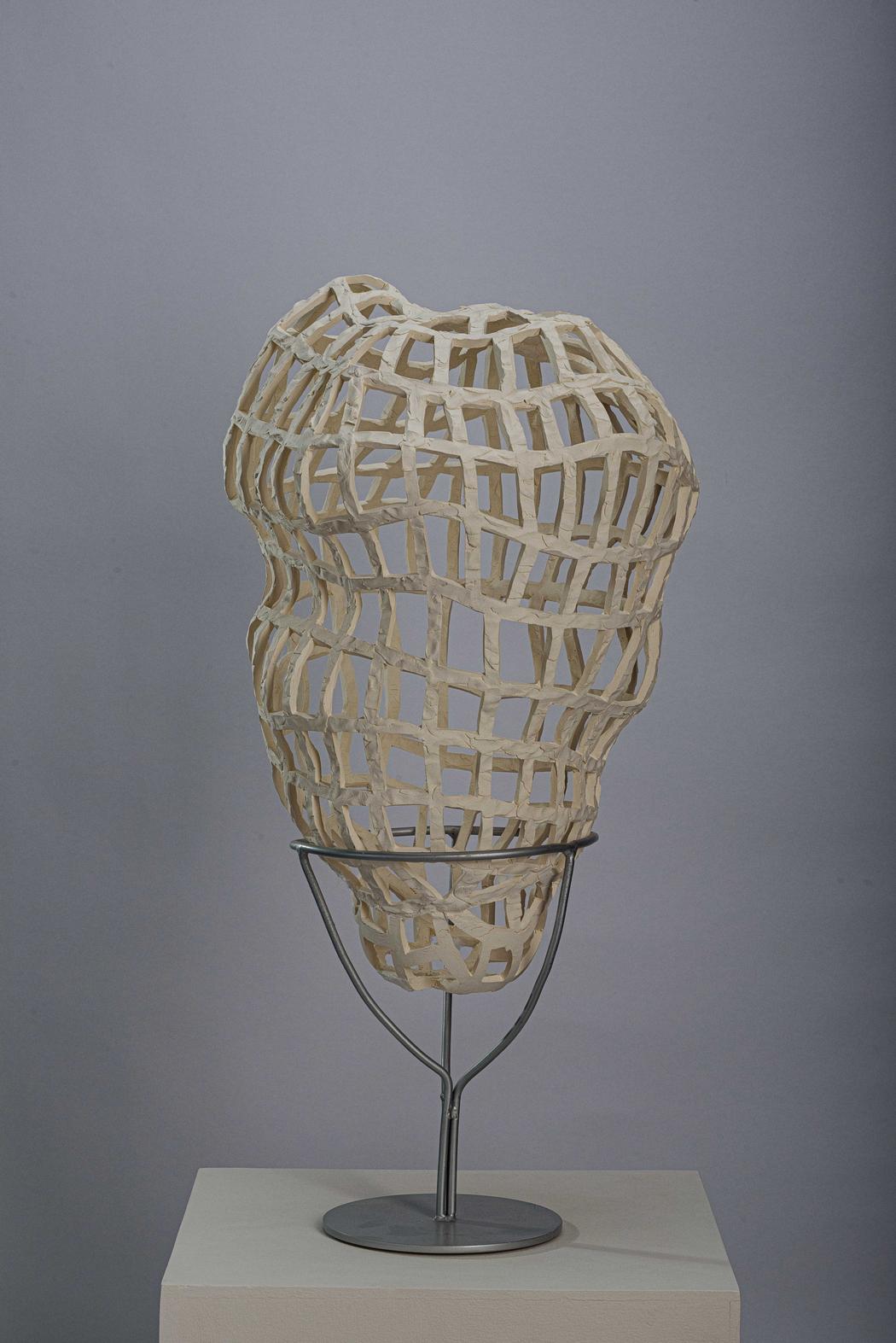 Vera Nosko | Neural Connection Object 3 | 2025
Your work often balances tradition and contemporary thinking. Which historical art references most strongly shape your current sculptural language?
This sense of balance does not arise on its own — it grows out of very specific “encounters” with tradition, which over time cease to be quotations and become an internal language.
I wouldn’t say that I borrow images directly. Rather, I am shaped by the principles of thinking that stand behind them. The strongest influence on me has been the Japanese tradition — especially what is associated with wabi-sabi.
It is not simply the “beauty of imperfection,” as it is often described, but an acceptance of time as a co-author.
From this comes:
a respect for chance
a willingness to preserve deformation if it feels “alive”
an attention to the surface as a trace of process, rather than decoration
At the same time, my visual language is formed not only through ceramics, but also through painting. I am inspired by artists such as Edgar Degas, Édouard Manet, Henri de Toulouse-Lautrec, Vasily Polenov, and Willem de Kooning.
This influence operates more on the level of sensation: gesture, rhythm, the relationship to form and presence. And through clay, through the hands, all of this transforms into my objects — not as quotation, but as lived experience.
The project “Neural Connection” compares clay to a neuron. When did this metaphor first emerge for you, and how did it evolve into a physical form?
The metaphor did not emerge instantly — rather, it gradually “assembled” itself from my experience of working with the material. Over more than fifteen years in ceramics, I increasingly found myself feeling that clay behaves like a living system: it responds, remembers, and transmits tension from one point to another.
At a certain moment, this aligned with my interest in perception and internal connections — and that is when the image of the neuron became very precise for me. Not as an illustration, but as a way of thinking about form. A neuron is not simply an object; it is a structure that exists through connections, impulses, and interactions.
As both an entrepreneur and an artist, I am used to building processes — and in this sense, “Neural Connection” also became a reflection on systems: how contact is formed, how energy is transmitted, and where disruptions occur.
In the plastic form, this manifested quite naturally. I began working with elongated, branching forms, where the focus is not the center, but the lines of connection themselves. The objects became more extended, sometimes fragile, with a sense of inner movement.
At the same time, I did not aim to literally replicate a neuron. It was important for me to preserve the feeling of a living, slightly unstable structure — one that can change, respond, and extend beyond the limits of its own form.
Ultimately, this metaphor ceased to be merely an image and became a method of working: I think of each object not as a finished piece, but as part of a larger field of connections.
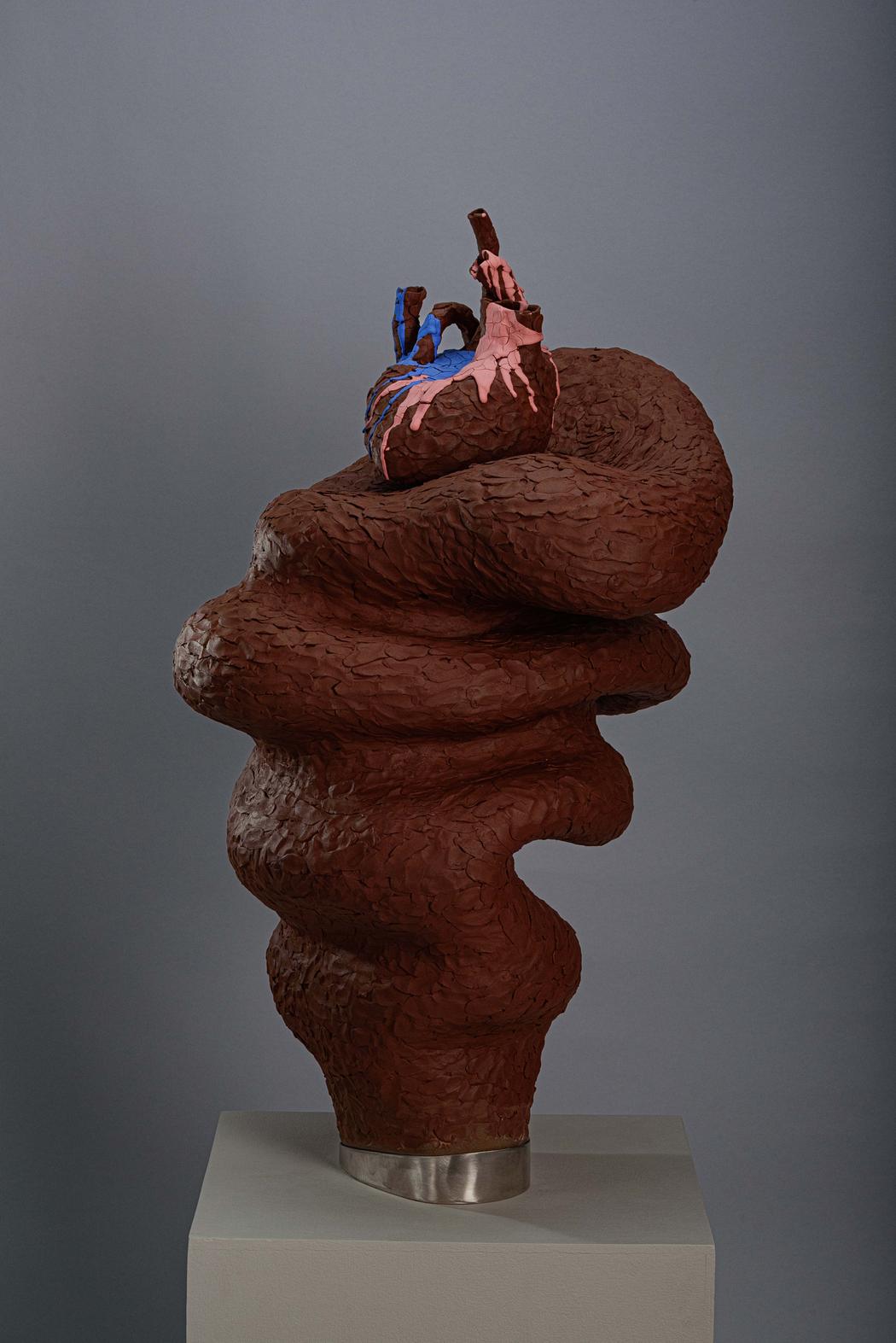 Vera Nosko | Red vase
Many of your sculptures appear both fragile and structured at the same time. How do you consciously work with this tension between vulnerability and stability?
This tension, for me, is one of the key states of form. It is important that the object is not entirely “confident” in itself, that it retains a sense of vulnerability, even if it is physically stable.
Perhaps this is largely connected to experience—both personal and professional. Over the years, I have come to understand that true stability is rarely rigid. It is more often flexible, capable of withstanding internal tensions without breaking.
In ceramics, this operates on several levels. On one hand, there is the purely technical aspect: balance of mass, wall thickness, distribution of weight. I clearly understand where the form must “hold” and where I can allow for risk.
But the intuitive process is no less important. I often deliberately leave elements that appear fragile—elongated lines, thin connections, uneven edges. They create a sense of limit, as if the form exists in a state between stability and possible disintegration.
As an artist, I likely know this condition well from within. And it is important for me to convey it through the material: when an object is not perfect, not fully fixed, yet continues to exist and hold itself together.
In the end, this is not about contrast for effect, but about an honest state—where strength and vulnerability do not contradict each other, but coexist simultaneously.
Vera Nosko | Two women by the water
How does your background in graphic design influence your sense of rhythm, line, and structure in three-dimensional ceramic forms?
My education in graphic design gave me a very clear sense of structure and rhythm even before I began working with volume.
I still think of form as composition: where there are pauses, where the accents lie, where the tension of the line exists. The only difference is that instead of a flat surface, I now work with space.
Line remains a key tool for me — even in ceramics. The edge of a form, a curve, a transition — I perceive all of these as a continuation of a graphic gesture. In this sense, I’ve been influenced by artists such as Edgar Degas and Henri de Toulouse-Lautrec — in their work, the line is alive, not decorative, but form-defining.
From design also comes an understanding of rhythm: repetition, disruption, pause. I often construct objects so that the viewer’s gaze “moves” across the form, as it would across a page or a poster.
And perhaps most importantly, there is discipline. Design taught me to recognize when a form is overloaded and when it lacks air. That’s why even in my most свободных, gestural works, there is always an underlying structure to rely on.
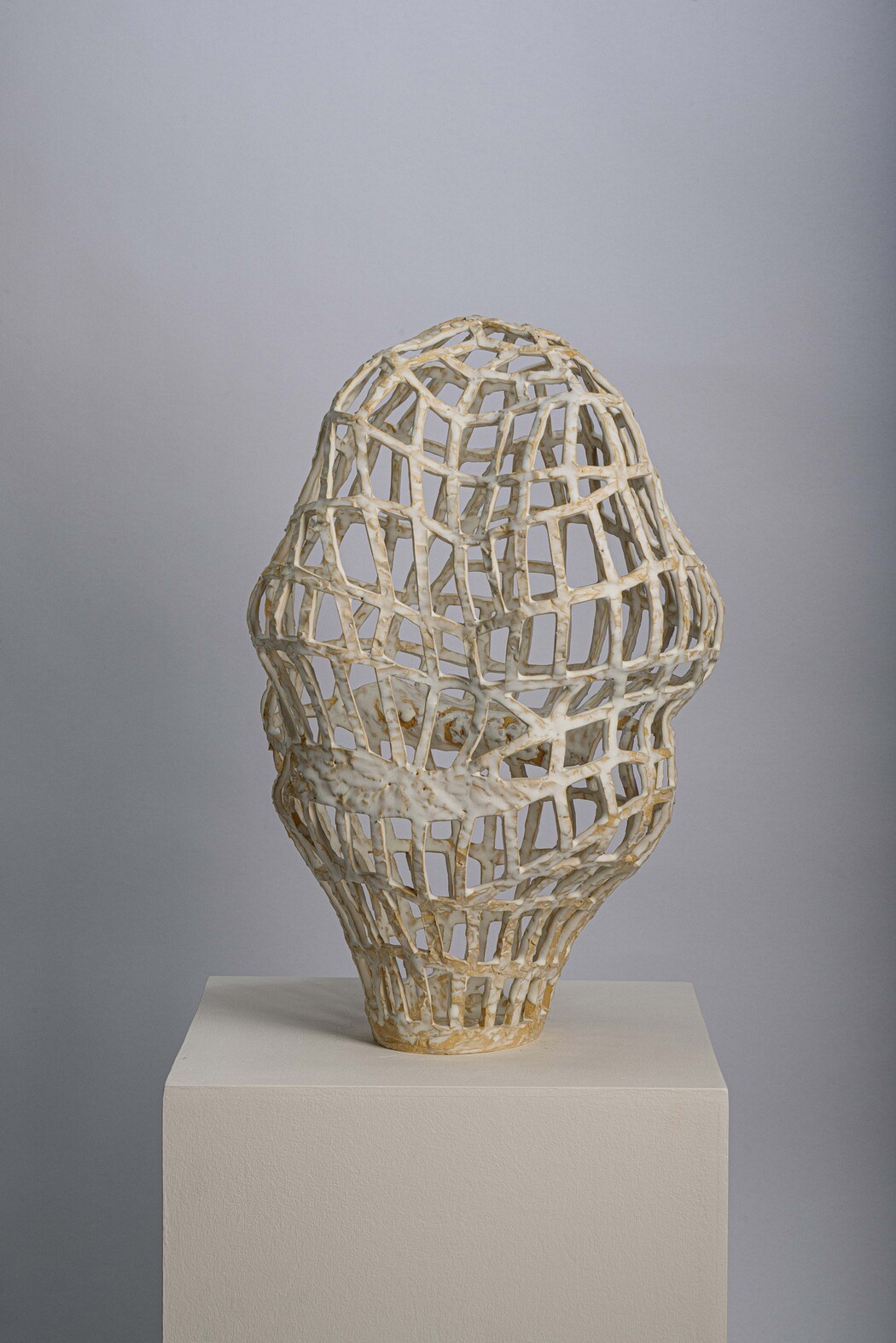
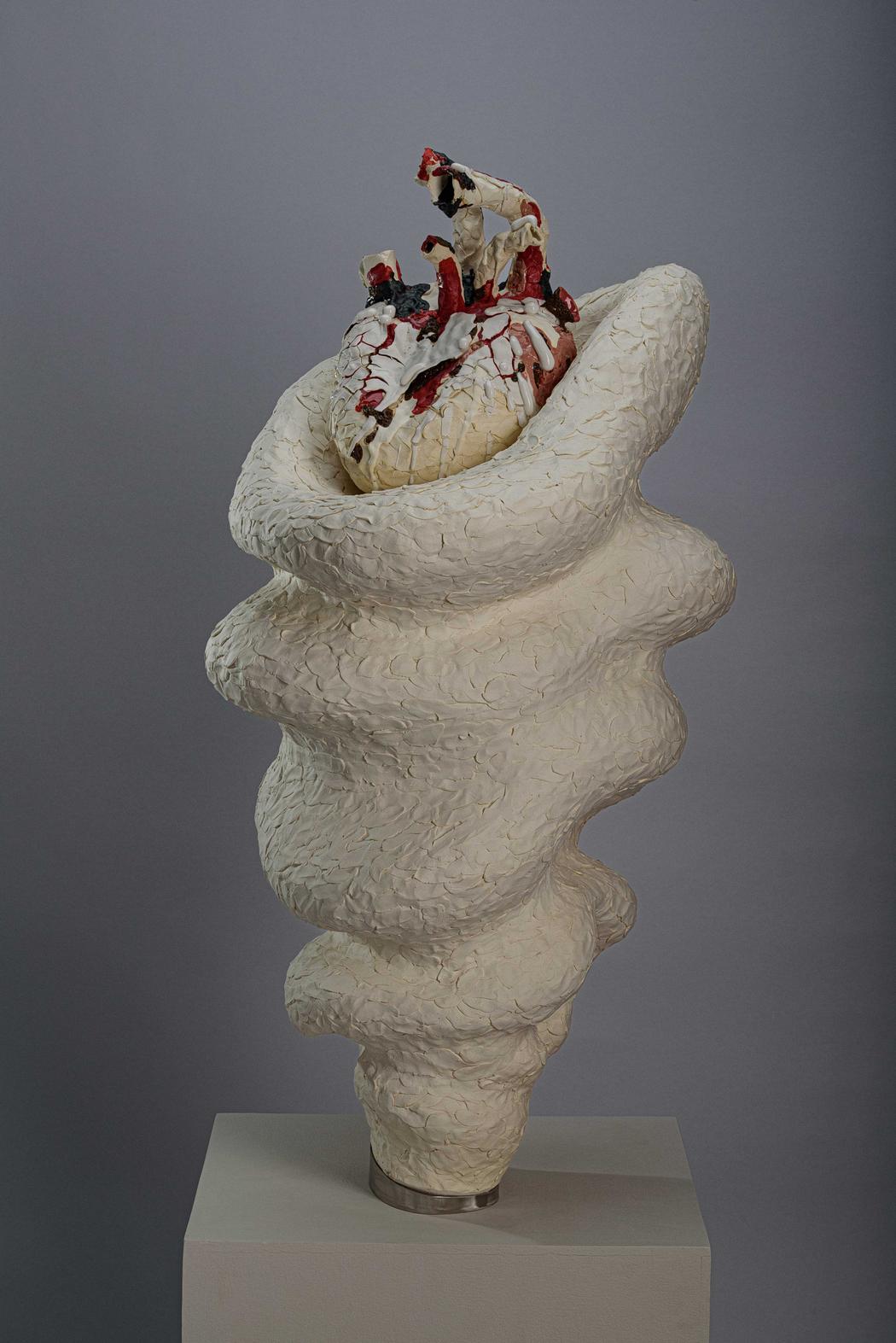 Vera Nosko | White vase
The thin ceramic walls and open lattice structures require precision and risk. How do you approach failure or unpredictability in your creative process?
I perceive error not as a failure, but as part of the process — sometimes even as its most honest moment.
When working with thin walls and open structures, it’s impossible to fully control the result. And if you try to keep everything “within bounds,” the form becomes lifeless. That’s why it’s important for me to leave space for unpredictability.
Of course, there is professional precision — an understanding of the material, the stages of drying and firing. This is the foundation; without it, risk turns into chaos. But within that foundation, I allow deviations: sometimes the form may shift, sometimes an edge may turn out differently than planned.
Often, it is precisely in these moments that true expressiveness emerges — something that could never have been conceived in advance.
I focus more on ensuring that an error does not destroy the logic of the object, but instead becomes its continuation. Then it ceases to be an error and becomes part of the form’s “memory” — something that makes it alive and unique.
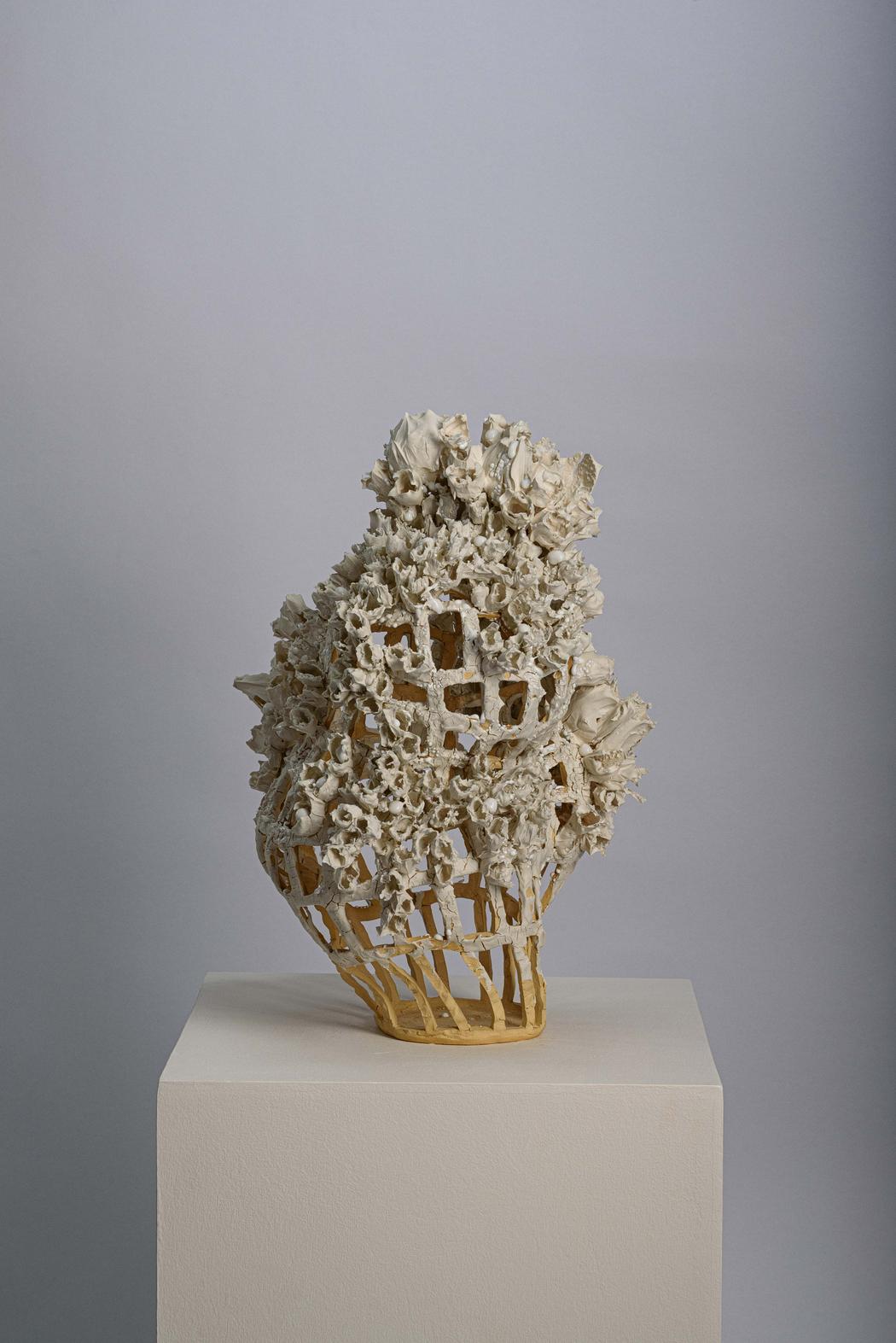 Vera Nosko | Women
Many viewers describe your sculptures as meditative or introspective. What kind of emotional or intellectual response do you hope to awaken in the viewer?
I resonate with this way of reading, but I don’t aim to impose any specific feeling on the viewer. Rather, what matters to me is creating a state in which a person can slow down a little and remain alone with their perception.
If we speak about response, I would like there to be a sense of inner quiet and concentration—when attention shifts from the external to more subtle things: rhythm, the breathing of form, pauses.
Intellectually, I am interested in the idea of connections—how we perceive the whole through fragments, how the gaze “moves” across an object and completes it. But I don’t insist on this as a necessary interpretation.
Perhaps what is most important to me is that the viewer experiences a sense of personal contact—not even with an idea, but with a state. When the object is not so much “explained” as it is lived through.
Leave a Reply
You must be logged in to post a comment.