
M.J. Hartwig
Your work often places political and social tension within natural or symbolic landscapes. How do you decide when a subject demands to be addressed through painting rather than words?
I do not really have a decision making process in deciding whether a subject should be addressed one way or the other. The only way I can describe it is that an idea manifests itself, generally when I am just going about my business, and that notion, then, is either in the form of something that demands to be expressed in words or as an image. In other words, the idea presents itself in the form it wants to take.
Having worked as a mariner, laborer, attorney, and farmer, how have these lived experiences shaped the philosophical foundation of your art?
We are, in my view, the sum of our experiences and knowledge. I have long held that view and, thus, although I left home and school when I was 15, I made a conscious effort to experience, read and learn as much as I could in order to expand my horizons. Experiences served to develop my voice, which was then sifted through my acquired knowledge. And, because the former have been fluid and the latter an ongoing process, my views have evolved over time. I firmly believe that true intellect is the capacity to abandon one’s ego, to the extent possible; mooch and plagiarize ideas; filter them objectively; and then, allow what emerges to infuse what is already there to create something new. My experiences, in the work I have done and the life I have led, exposed me to a broad array of people in all walks of life and I have learned from all of them. I also believe, again this is my point of view, that people who have done and experienced very little, no matter how well renowned and technically talented, tend towards dogmatic outlooks and ultimately have very little of any consequence to say or create.
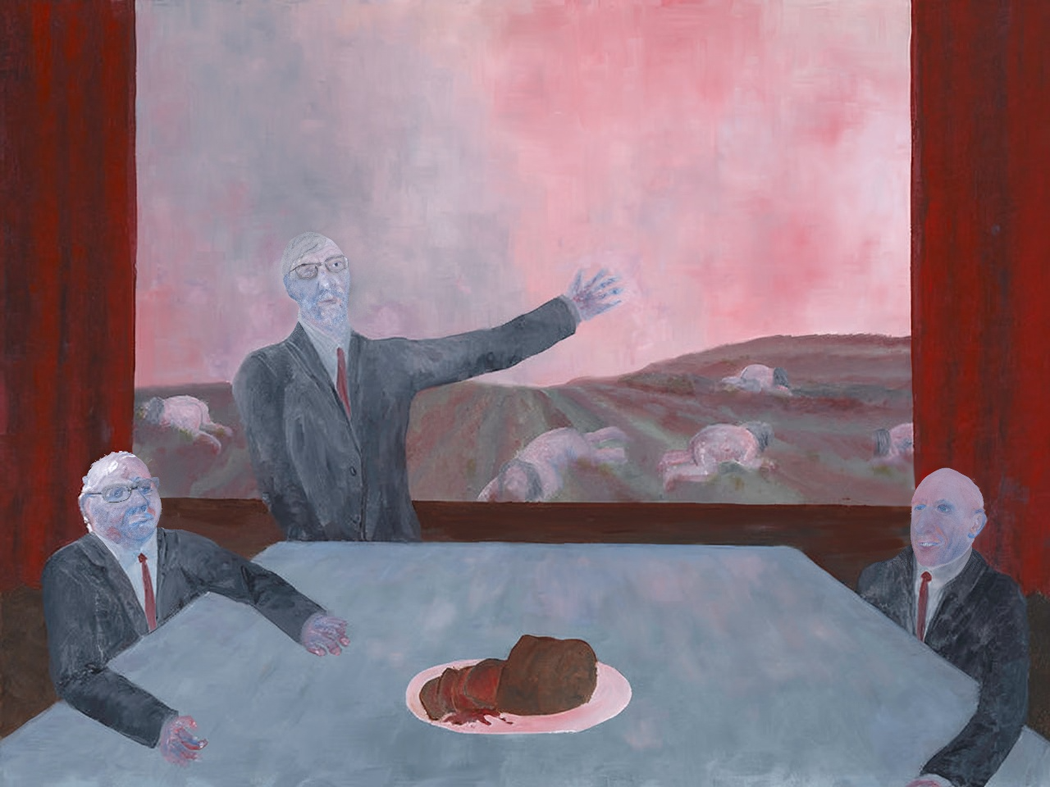 M.J. Hartwig | Let Them Eat Kale | 2024
Many of your paintings confront viewers with discomfort rather than reassurance. Do you see discomfort as a necessary condition for critical thinking?
Discomfort is necessary to critical thinking because if one is embarking on that course honestly, then the first casualties of that process are the ideas one has already allowed to become entrenched in one’s self. This is equally true of one’s audience. We humans seek security in the static universe, including worldviews, that we create for ourselves. If these are challenged with a degree of validity, it makes us feel insecure. And, if we can accept those challenges, then we can grow; if not, we become intellectually bankrupt and stagnate.
You speak about entropy and decay as natural processes. How do you translate such abstract philosophical ideas into visual form?
I do not believe that the concept of a fluid universe is an abstract concept. It is a fundamental law of nature – that nothing remains in the same state forever. That said, and perhaps this would be less of a problem if I were a better artist, I am only capable of capturing an instant in time within a sea change and hope that the viewer can envision that it is a mere instant within an ongoing transition. Thus, I can paint a shipwreck and hope that the audience will recognize that it was once something else, a living thing, home to a crew going about their business, while plying the vessel’s trade, and that it will eventually decay into even less than the moment it was captured. Or, that a painting that attempts to make a political statement raises questions about the events leading to the need to make that statement and what will ensue.
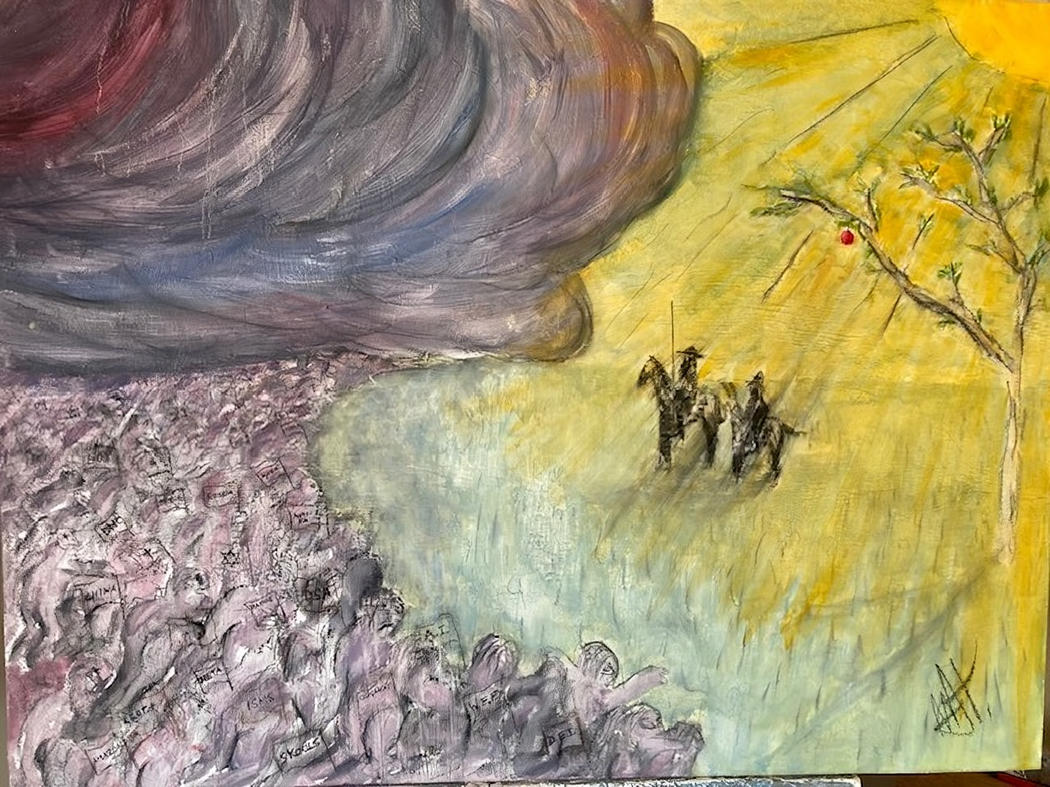 M.J. Hartwig | Mierde | 2026
Your political works critique engineered conformity and techno-totalitarianism. Do you believe painting can meaningfully resist these forces? If so, how?
The forces at work, particularly in the western democracies, will ultimately prevail in the destruction of individual liberty interests for all, save the elite. History has proven the fragility of those few democratic systems, among which I count republics, that have ever existed on any scale. The advent of the technology, including its capacity for social engineering and the concomitant ignorance, we now see, has made it more than likely that these political systems will never again see the light of day. Hence, I can only say that while I do not believe this trend to be reversible, painting, as are other art forms, is akin to a drowning man in the middle of the ocean swimming instead of allowing himself to drown, in spite of knowing that drowning is inevitable. Hope, then, is the driving force. And, while hope is the ultimate four letter word, it nonetheless urges the will to resist even that which may be inevitable.
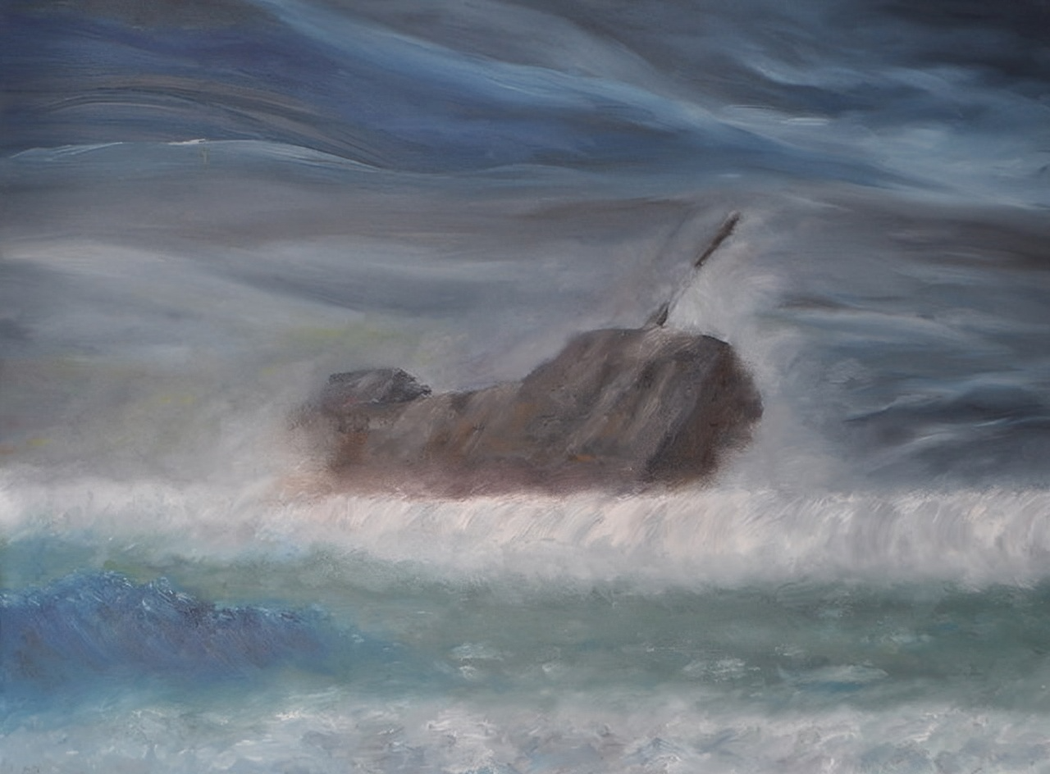 M.J. Hartwig | Ship Wreck Series No. 3 | 2022
In several pieces, human figures appear diminished, distorted, or anonymous. What role does anonymity play in your narrative language?
We have become anonymous. The notion of individuality has been displaced by our conversion into commodities, ATM machines and useful idiots manipulated by a select few with distinctly ulterior motives. Bill Gates would have us eat “kale,” while not foregoing the consumption of Wagyu for himself. Jeff Bezos has us buying cheap goods from China, while silencing those who point out that it is a totalitarian and genocidal state. Peter Thiel portrays himself as a “libertarian,” while investing in companies that suck every bit of data imaginable about all of us into a centralized collection center. Elon Musk . . . Enough said. We now have left wing/right wing/race/gender and other political movements that garner popular support through the creation of attractive ideologies, without ever revealing the realpolitik objectives of those financing them. In the interim, we have seen the diminishment of the middle class into a distinct minority, a correlating increase in the poverty class and public polarization on a scale that far outstrips anything seen in the 1960s. This, then, is the point I am trying to make when I paint human figures that depict we the masses in my political paintings. My distortion of Gates, Bezos and Buffett, for example, in “Let Them Eat Kale” is an attempt to depict my interpretation of them as they really. Corrupt and broken and dangerous. Conversely, my diminishment of Don Quixote and Sancho Pancho in “Mierde,” speaks to a lack of hope that we can, or even want to, overcome all of the foregoing.
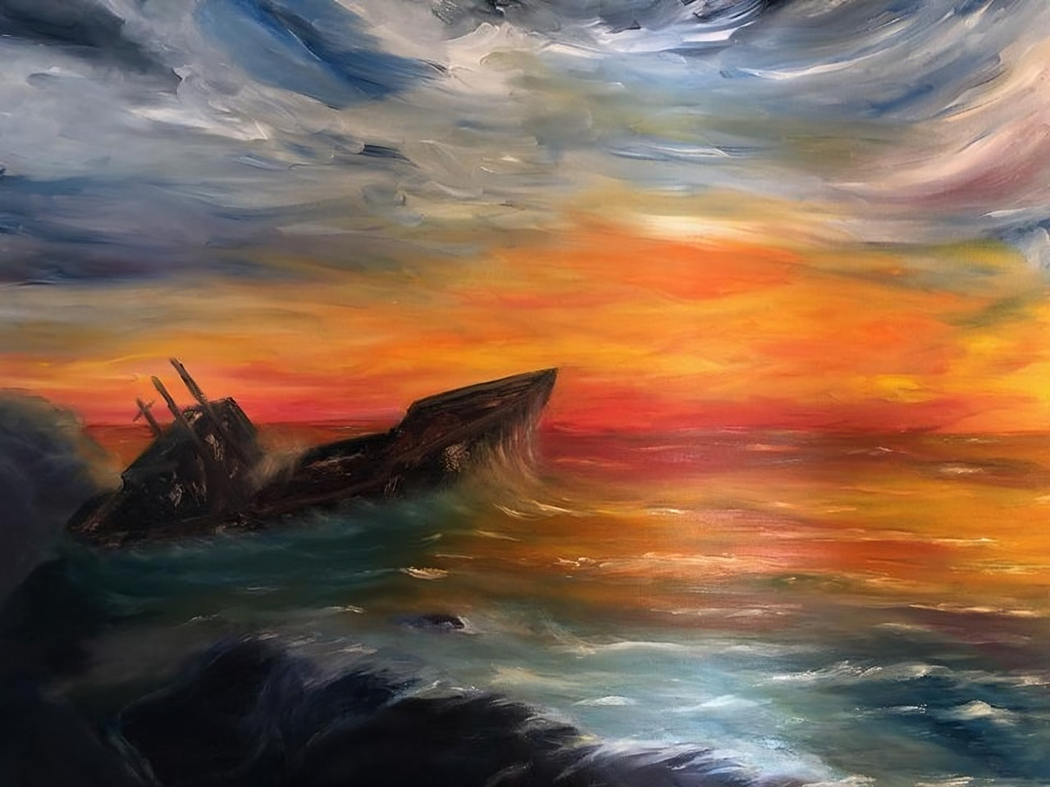 M.J. Hartwig | Ship Wreck Series No. 5 | 2020
If viewers walk away unsettled or questioning their assumptions, do you consider that a successful outcome for your work? Why or why not?
If viewers walk away feeling unsettled or questioning their assumptions then absolutely, yes, I consider this a successful outcome! The times we live in should make us feel unsettled. Let me be blunt. The political leaders we see, both on the increasingly extremes of the right and the left are not the root causes of anything. They are symptomatic of the policies and technological trends that have been in play for decades that have led us to where we are today. Thus, some form of each of these “leaders” was preordained by those trends. As a society, we have moved from responsibility to entitlement; from education aimed at teaching critical thinking to the production of “good citizens”; and, from questioning what is happening to accepting free cheese, like mice lured into a trap from which there is no escape. We have accepted that Orwell’s book, “1984,” is now a blueprint, rather than the warning it was meant to be. And, as AI and other forms of social media inputs increasingly infuse our assumptions, by designing the knowledge we are to have and the narratives we are to believe, we should increasingly question the foundations of those assumptions.
Leave a Reply
You must be logged in to post a comment.