
Marcelo Guimarães Lima
The Bestiary Series refers to one of the oldest artistic traditions — animal representation. What motivated you to return to this ancient subject today, and why does it feel urgent now?
Marcelo Guimarães Lima – My fascination with Prehistoric art and the representation of animals has two aspects: first, is the intentional act of significant mark making with its communicative and representational dimensions, that from its ancient beginnings is repeated today in drawing. I empathize, let me put this way, with the Prehistoric “artist”. There is a lineage going back to these early manifestations of cave art that synthesize in gripping visual representations mindful developments of early cultures, refined perceptive capacities, manual ability, rational and expressive behaviors. Besides, there is the sheer beauty of these works, of these animals depicted in caves with an expressive, vital power.
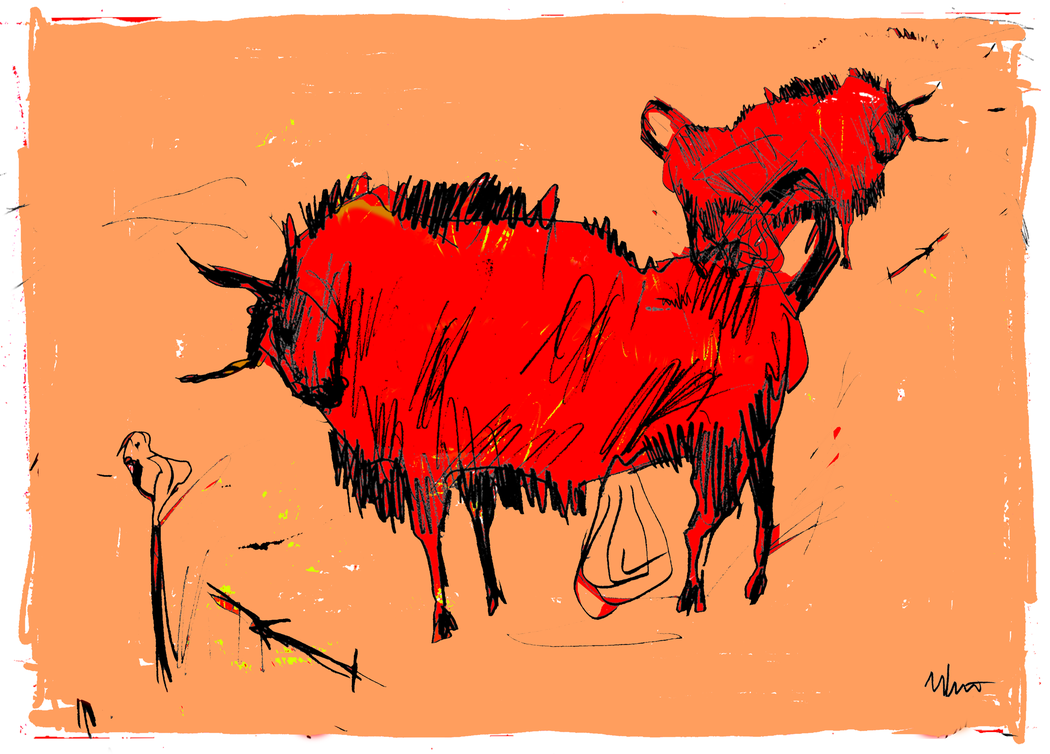 Marcelo Guimarães Lima | Bisonsoflascaux Bestiary Series
Your animals are not depicted realistically but through expressive, almost primal marks. How do you balance observation, memory, and imagination in this process?
Marcelo Guimarães Lima – I am after a certain vitality in the artwork, the one I see in the subject, for instance, and therefore, this goal becomes associated to the “method” or procedure I employ. In this way, there is a kind of “urgency” of the forms, mediated by the search for “aesthetic” realization, the formal effectiveness of the work. Whether we want it or not, it is something imposed by the demands and the limits of art. Within these “limits” or constraints, there is an infinity of possibilities and the artist must choose, that is eliminate redundant, distracting, superfluous elements and concentrate on the essentials. Of course, the “essentials” are the product of a process of discovery. Now, of course, all this requires effort, judgment, energy, trial and error, ambition and humility going together, it does not fall from the sky into the studio work…
Imagination is reinforced by knowledge. And memory for the artist, and not only for the artist, is a creative capacity, not a passive “repository” of past experiences, but the capacity to understand the meaningful dimensions of time in experience.
The education of the senses, the education of perception, has been and it is a central role of the arts. Drawing from observation was part of my artistic education and it is part of my daily practice. As I understand it, observation, description, representation of forms, already imply an active, discriminatory approach to visual experience and it requires the use of imagination to amplify that experience.
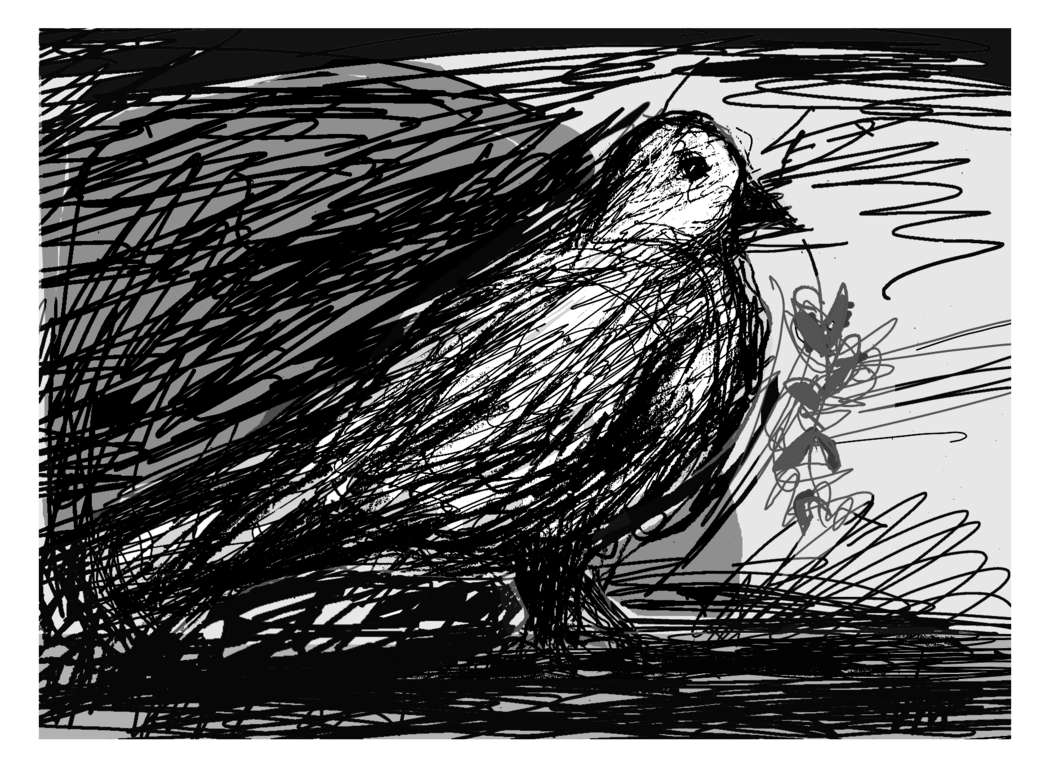 Marcelo Guimarães Lima | Dove Bestiary Series
Many of your works seem to oscillate between tenderness and raw intensity. What emotional or ethical relationship do you seek to establish between the viewer and the animal?
Marcelo Guimarães Lima – The animal is the quintessential “other”, both close and distant. In the animal we may recognize dimensions of our own being as living creatures, therefore as mortal subjects, as active beings, as natural beings living in different ways by the “gifts” of nature, and at the same time as passive receivers, confronting the imbalances and perils of the natural world, natural disasters, cataclysm and catastrophes, large and small. In our time of incipient ecological consciousness, that is, the emerging consciousness of the solidarity of all forms of life, it is important to point out, again and again, that our survival as creatures of one and the same natural world does require that we address the imbalances that certain destructive forms of activity we perform create for life in general in the planet. What I think is essential for us to realize is that our relation to nature is always mediated by our relations among ourselves, that is, we can not address the imbalances between humanity and the natural world without addressing the imbalances within present day society.
I am glad that you see both tenderness and intensity, as you write, as elements in my works. I believe they are related to my search for vitality of expression. And are related also, in the case of the representation of animals, to the idea of the animal as “other”, perhaps as the very model of “otherness” in reflection and in experience.
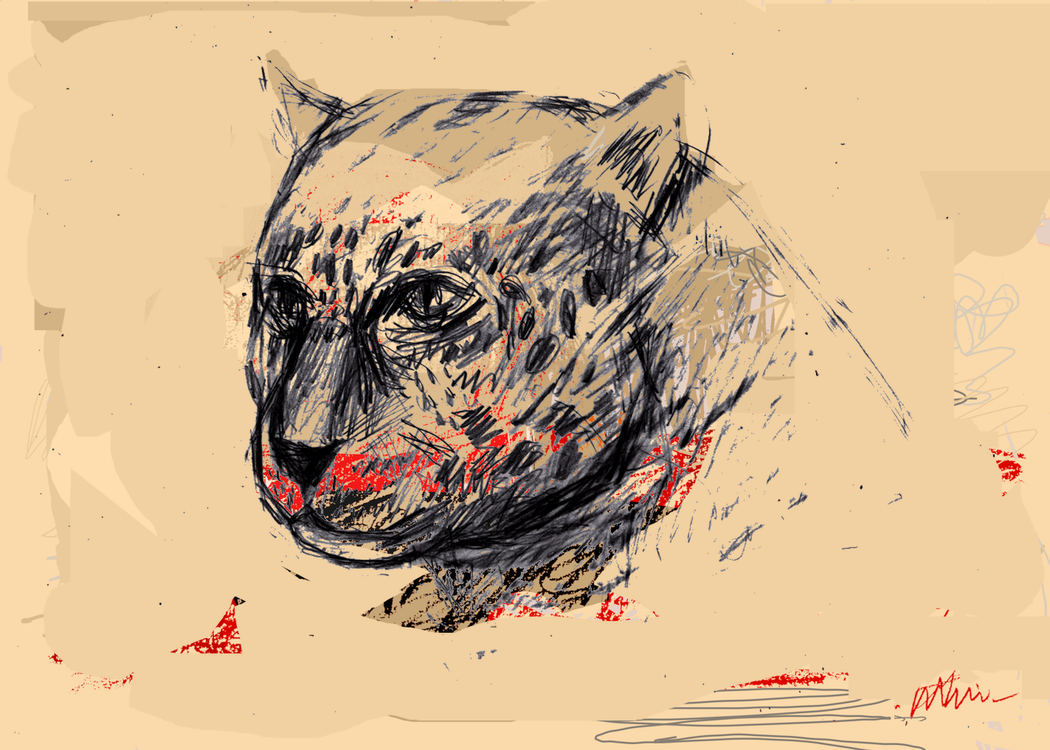 Marcelo Guimarães Lima | Jaguar Bestiary Series
You reference prehistoric cave art in your statement. Do you see your drawings as a form of contemporary cave painting, and if so, what is today’s “cave”?
Marcelo Guimarães Lima – That is an interesting way of putting it. As I said, I see the affinities, in a phenomenological sense, between the Prehistoric image maker and the artist of today. In my case, in the importance of mark making and the tactile and gestural aspects of drawing. On the other hand, the cave may be an interesting metaphor of our present day situation, of this more and more troubled historical period. There are archaeological and anthropological studies that point out some important characteristics of the so called Prehistoric cave art: the activity of painting was done in a context of ritualistic practices, the location of the paintings in the deep recesses of caves, with difficulty of access and lack of natural light, indicate that these works were not made for conspicuous display. Rather they were actions that aimed at disclosing the structures of reality, to locate, to map the place of human society in the cosmos and to facilitate communications between levels of reality, the underworld or infrastructural level, the daily world and the supernatural domain. Animal representation replicated life itself by the power of “personification” proper to the image, as a guarantee, for a society of hunters, of the natural fertility of species and survival in the real world. The artist as mediator, as a type of shaman, had indeed great responsibility in Prehistoric society.
If we think “cave” as a place of obscurity in need of light, we can see our time as such a place. We can also think of Plato´s cave as a domain of shadows that obstruct our knowledge of the light of reality. Indeed, our time of wars, of material and spiritual poverty for the many, of a genocide transmitted over the internet, is in need of the light that artists may be able to bring to the context. Artists as mediators, “returning”, so to speak, to “ancient” roles, may be able once more to gather the powers of knowledge and imagination to surpass the obscurity of the times. In this sense, the paradox of art can be said to be able to disclose reality by means of “appearances”: the artwork appeals to our sensory and sentient imagination in order to produce knowledge about the world and about ourselves in it.
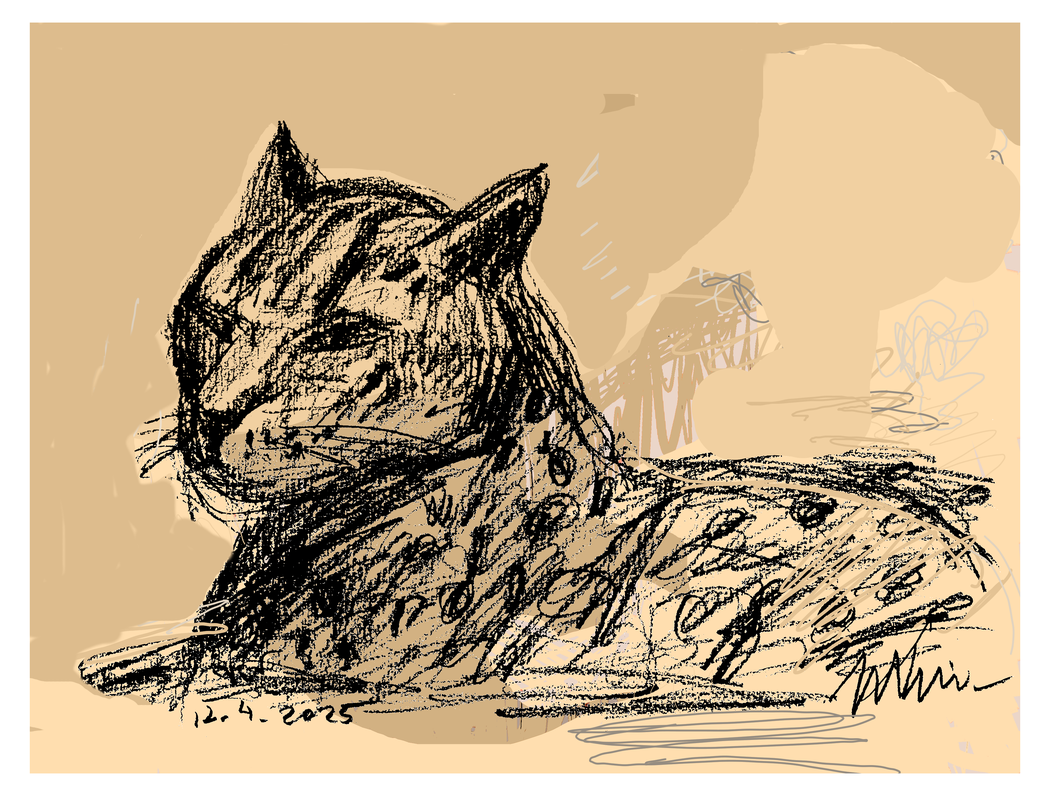 Marcelo Guimarães Lima | Jaguatirica Bestiary Series
As an artist and art historian, how does your academic knowledge influence your intuitive, gestural drawing practice — or do you try to keep them separate?
Marcelo Guimarães Lima – Both separate and together. There are different requirements. Academic work requires objectivity, rigor and mastery of given subjects. There is no compromise here. There are no shortcuts. On the other hand, knowledge is a requirement for art making. Knowledge enlarges experience, and therefore it feeds imagination. Poor knowledge, lack of experience, poverty of imagination go hand in hand. And that is a fatal combination for the artist. The knowledge of works of imagination is also what feeds imagination. Hence the importance of the history of art, and of appreciation of different arts such as literature, music, drama, etc.
The limited color palette, especially the use of red, black, and earth tones, is striking. What role does color play in conveying life, vulnerability, or violence in your work?
Marcelo Guimarães Lima – In making a drawing or a painting, for instance, the artist will chose what to include and, as important, what to exclude. In this sense, art making is also a reductive process. So goes with color. As in other aspects of a work of visual art, here effectiveness requires the capacity to synthesize, to say more with less. Your characterization is indeed to the point in my view, and I have to thank you for this: life, vulnerability, violence expressed with the help of color choices.
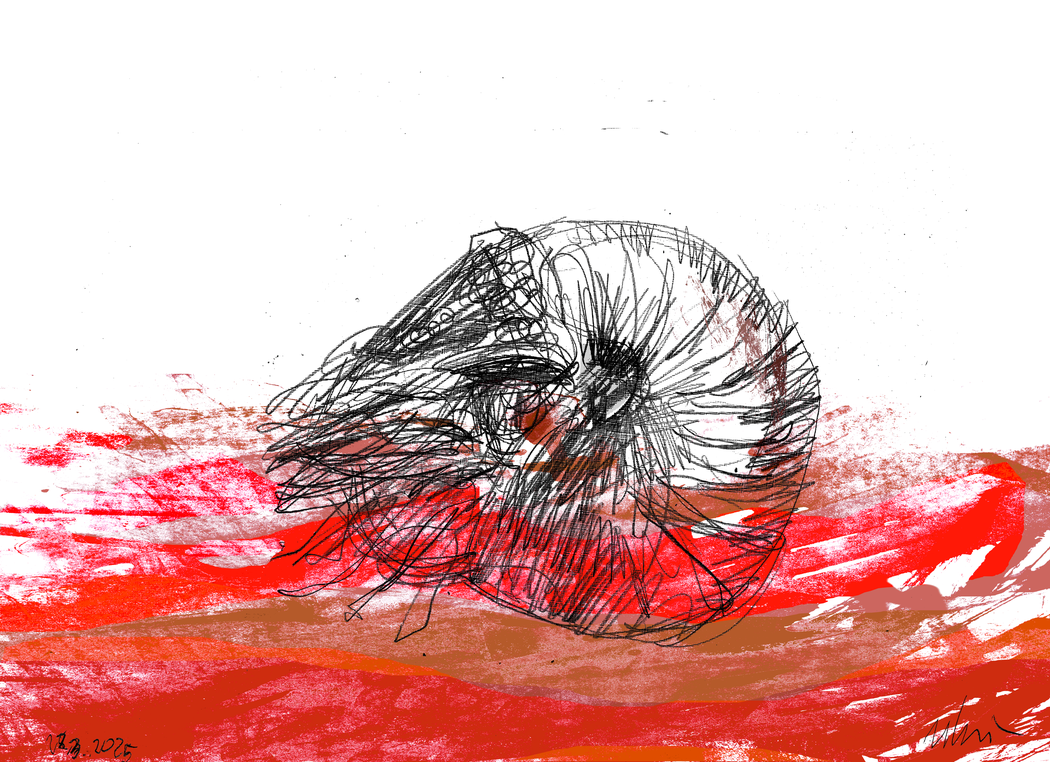 Marcelo Guimarães Lima | Nautilus Bestiary Series
Having worked extensively as a teacher and community art project director, how has education shaped your understanding of art as a social practice?
Understanding the vital roles that art can play at different times in the life of individuals, from early to late ages. Understanding the contributions of art to cultural and intellectual development. In short, understanding that art indeed is for everybody. That it can contribute to enhance life, and that everybody can bring its own contributions to clarify the impact of art in society, to the appreciation of art and that everyone of us can contribute to art production itself, challenging and bypassing the social division of work, the permanent functional divisions in society that imprison the individual and distorts personal development, the division between mind and matter, sensibility and intellect, between actors and spectators, and other reified divisions within our life worlds that separate human collectivities and splits the human subject.
Leave a Reply
You must be logged in to post a comment.