
ESINA ART Ekaterina Esina
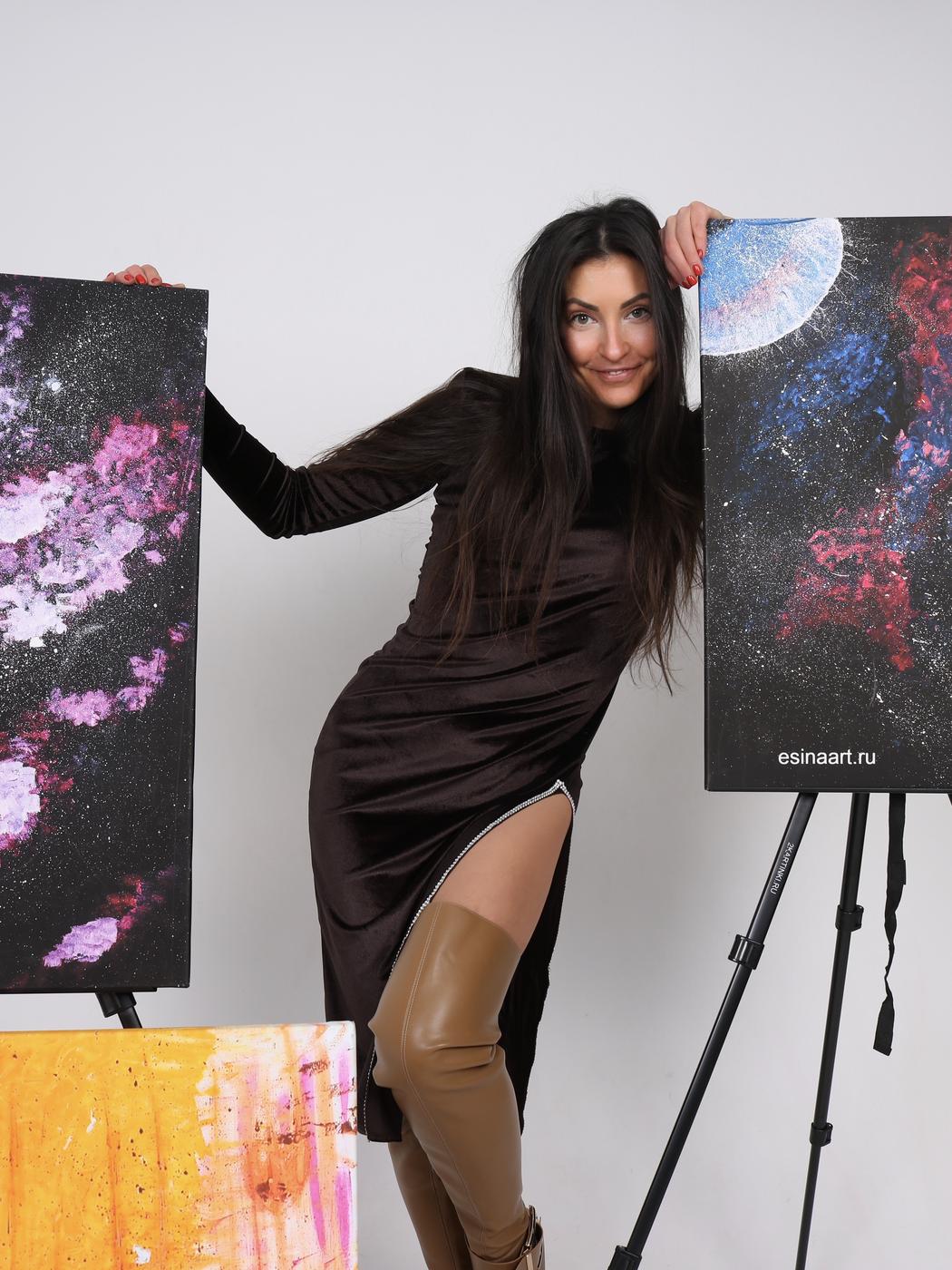
Your works often explore the connection between the material and the spiritual. How does this dialogue begin for you when you approach a new piece?
One may recall Van Gogh, who once said: “The only time I feel alive is when I am painting.”
I do not see a finished painting — I hear it. A dialogue is born from silence. I pour all my energy into the work, because there is no goal more desirable than creating beauty.
This is not merely the absence of sound, but a special, deliberate state of inner emptiness. Before a blank canvas, I make no plans. I create a space for an encounter — I spread the canvas, arrange stones and pigments, breathe.
And then it is not an image that arrives, but a sensation. A pull toward a particular color. A physical impulse in the hand, calling either for a broad gesture or, on the contrary, a precise touch. It is resonance — as if the materials themselves, the earth and the light, begin to speak through me. In this moment, the material (canvas, minerals, water) and the spiritual (intuition, memory) cease to be opposites. They become the poles of a single magnet, between which a spark leaps.
My task is not to invent, but to transmit. To hold this fragile bridge along which the inexpressible descends into the world of form. Each new layer on the canvas is a step in this journey, where decisions are made not by the mind, but by the whole being. The painting grows like a crystal, following its own logic, one I can only intuit. I do not create a masterpiece from the outset — I allow it to reveal itself through a dialogue with silence.
You frequently use natural stones, organic textures and layered pigments. What role do natural materials play in shaping the meaning of your artworks?
In the rhythm of contemporary life, in this constant rush between screens and obligations, we lose touch with the true measure of things. We forget that we ourselves are made of the same substance as mountains, seas, and stars. My art is an attempt to restore this broken dialogue. Natural materials here are not merely a palette, but principal co-authors and guides.
They are material carriers of eternity. At the center of the painting Winning by Loving from the Sanskrit collection, a shell is a compressed geological epoch, serving as a symbol of harmony and inner peace. Moss and shells in the painting Yggdrasil are a memory of the myth of the Tree of Life, where a mystery is created—one that invites unraveling. By creating works from organic materials, I invite Time itself into the process, in its purest, non-human dimension. These textures become traces of an authentic process—an alchemical transformation rather than an illusory image.
Materials possess their own soul and vibration. When I use organic and natural elements, I invite a living, ancient presence into the space of the painting. The viewer often senses this energy on a subconscious, tactile level, even without putting it into words.
This is precisely where the essential meaning lies. The contrast between the fragility of a leaf and the eternity of stone, between the fluidity of pigment and the hardness of crystal, forms a microcosm of our own existence.
We are at once fragile and eternal, temporary and yet part of the great cycle of matter. My works are a reminder, materialized in stone and paint: look around. Touch. You are part of this. You are here.

Many of your pieces resemble cosmic or mythological landscapes. How do cosmology and mythology influence your visual language?
For me, cosmology and mythology are both external sources of inspiration and two native languages of the same reality. Put simply, cosmology gives me scale, and mythology gives me narrative. But this is not illustration. I do not paint nebulae, nor do I retell sagas.
I work with the primordial states they describe. The cosmos is a single act of creation from chaos. Galaxies are an ode to transformation. My paintings are always an inner cosmos, a cartography of the soul—a direct, nonverbal translation of inner processes for which we simply have no words.
This is pure alchemy of perception, and in my works it meets on a single plane of the canvas. For example, in the painting “Aura of Power: The Golden Ratio of Chaos”—this is not something you look at. It is something that looks at you.
Ultimately, my works are not an answer, but a space in which one can ask questions and experience them physically—encountering something as ancient as the sky itself, and as intimate as one’s own heartbeat.
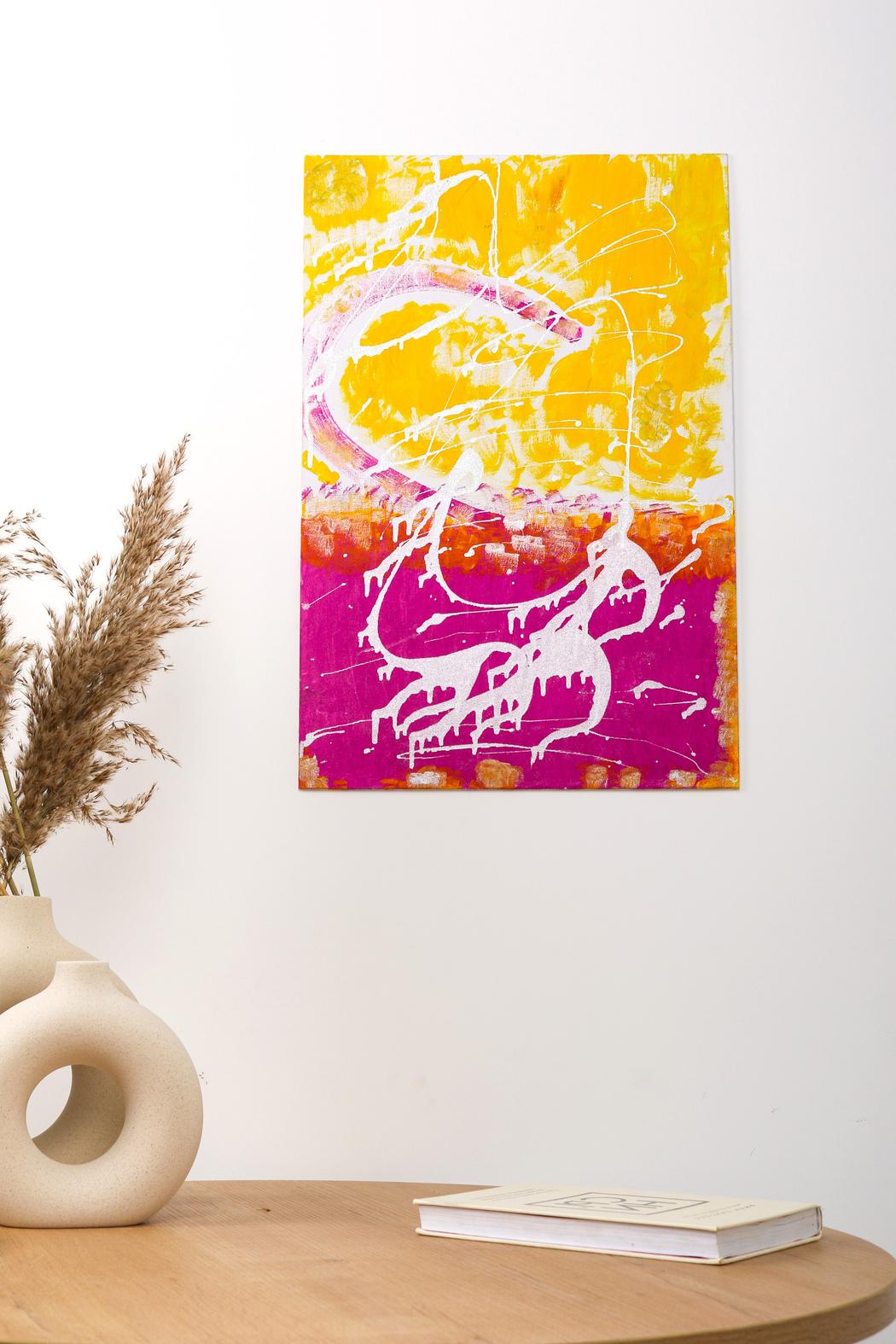
Your paintings feel like visual meditations — dynamic yet contemplative. What internal states or practices guide your creative process?
Absolutely right — this is visual meditation. The core practice is mindful presence. I do not “compose” the image in advance; instead, I follow the process the way one follows the breath. The first layers are often chaotic, intuitive gestures, as in the interior painting Cosmos, resembling a meditative state in which the mind releases control.
Then a phase of deep contemplation begins: I study the emerging forms as one looks at clouds or fire, allowing images to reveal themselves naturally. The sense of dynamism arises from spontaneous bodily movements, while contemplation grows out of hours of attentive observation and precise, almost jeweler-like interventions. It is a dance between action and non-action, between impulse and patience. I do not paint — I listen.
The first layers almost always emerge in a state close to free meditation. It is within this state that the layers are born: one from chaos, another from silence, a third from a flash of light.
You mentioned that each artwork is a multilayered metaphor. Could you share an example of a hidden layer or meaning that viewers rarely notice?
Certainly. Let us take the painting “…” (Ellipsis). On the surface, it reads as a poetic metaphor of a journey: a golden trace within a black abyss, a flash of pink light, shells as markers along the way. It is a visual invitation for the viewer to complete the narrative, to find a personal answer within the silence.
The golden path, born from the black abyss, becomes a dialogue of opposites, where a vivid pink beam meets mysterious depth. The whimsical shells appear as milestones on a route leading into the unknown. This is a painting-as-question, a painting-as-contemplation. In its meaningful silence, each viewer discovers their own answer.
Each day inspires movement forward—each day serves as a reminder of your own path and the possibilities it holds.
Thus, the painting transforms from a landscape into a cartography of thought in the making. It functions as a visual catalyst: the viewer projects unrealized possibilities onto this field, and the encounter with the bold flash grants an inner permission to take a step. The title “Ellipsis” is the key—the meaning is not complete; it continues within the space of the observer. The hidden layer lies not in the details, but in the resonance between them; this is why many feel that the work somehow “knows” something intimate about them.

Your art exists at the intersection of philosophy, symbolism, and contemporary aesthetics. How do you balance intellectual concepts with visual emotion?
I believe that true intellectual depth must be emotionally felt; otherwise, it is nothing more than rhetoric.
Conversely, a powerful emotion, when passed through the prism of philosophical reflection, acquires universality. Balance is born through sequence: first comes a pure, unfiltered emotional and sensory impulse (color, texture, gesture). Then, through a process of layering, intellect and intuition enter the work — I recognize, construct visual analogies, and engage with symbols as a living fabric rather than as fixed signs.
Contemporary aesthetics is the language through which I speak. I do not illustrate a concept; I cultivate it from the material itself, allowing idea and emotion to fuse into one.
I never begin with an idea. The idea comes later — as an explanation of feeling. First comes emotion. Then the material that embodies it. Only at the very end does a philosophical context emerge, like an echo.
Balance is achieved when the viewer feels the work with the body and thinks about it later, lying awake at night with open eyes. Art must first pierce — and only then explain.
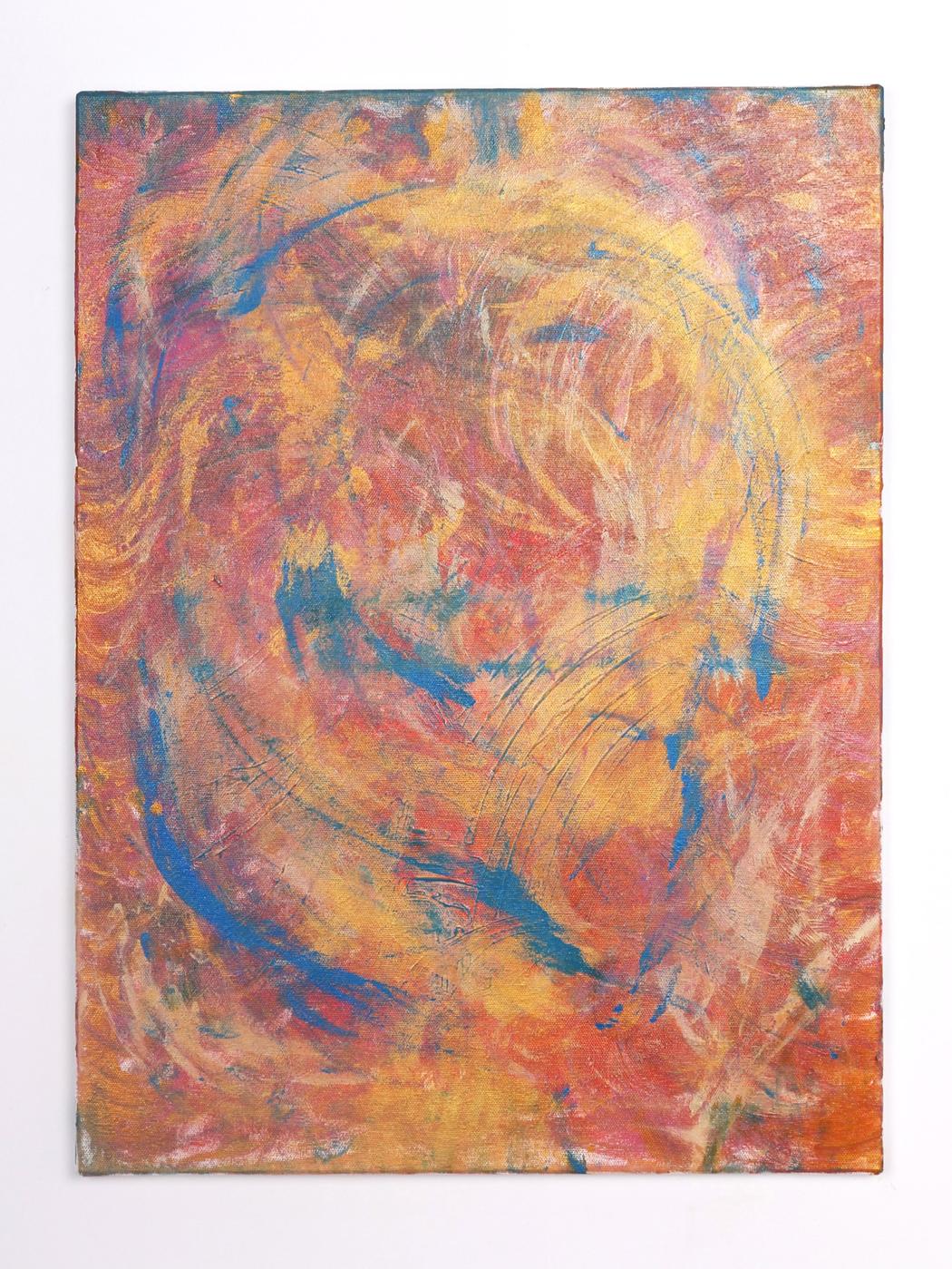
Some of your artworks integrate reflective or gem-like elements. How does light influence your compositions and the interpretation of the piece?
Light and organic elements act as a final, living co-author. They transform the artwork from a static object into a dynamic event that changes depending on the time of day, the viewer’s movement, and the angle of perception. The composition is constructed with this in mind: there are zones of stillness (matte, deep surfaces) and zones of activation (light-bearing areas). This creates a rhythm and draws the viewer into a physical dialogue with the work and into reflection. You do not simply look at it—you search for the light, moving around it.
Reflected light and materials symbolize not external luxury, but inner enlightenment—something that cannot be seen directly, only caught in the corner of the eye by changing one’s position.
All of this makes the paintings alive: they change together with the viewer. In this lies a metaphor of perception—truth reveals itself only through movement.
Leave a Reply
You must be logged in to post a comment.