

Alexandra Uryasova
How has your background in interior design influenced the way you approach painting, particularly your attention to space and composition?
I have always been more interested in depicting not the human figure itself, but the space around it — rooms, buildings, objects, and traces of human activity. Small signs of human presence in the world inspire me much more than the direct depiction of a person.
For this reason, my education in interior design did not radically change my artistic perspective. Rather, it expanded it and helped me understand and articulate things that I had previously felt intuitively. I have always wanted to treat space as an independent, and sometimes even the primary, protagonist of a painting. I genuinely believe that a space can sometimes reveal much more about a person than their direct representation.
Studying interior design made me much more attentive to the ways in which people organize the spaces around them: what makes a place comfortable, personal, functional, and safe, and which details determine how we behave within it. I began to notice many things that I had previously perceived almost subconsciously.
At the same time, I have never wanted to reproduce space with absolute correctness in my paintings. On the contrary, I am interested in slightly disrupting it — shifting perspective, simplifying, or distorting certain elements. I do not want the viewer’s first response to be an assessment of how realistically a space has been represented. I am much more interested in directing their attention towards the meaning within the painting.
This is where a professional understanding of perspective and composition became particularly valuable to me. To deliberately disrupt a space, you first need to understand how it works. Knowing where the eye naturally falls and how visual hierarchy operates allows me to alter it consciously — shifting the viewer’s focus away from external accuracy and towards the internal content of the work.
What draws you to ordinary objects and familiar surroundings as subjects for your work?
What fascinates me most are the traces of human presence and the ways in which people make the world around them familiar, intimate, and their own.
Every place has small, almost unnoticeable characteristics that create an atmosphere belonging specifically to that particular corner of the world. Most often, these are not monumental buildings, recognized works of art, or objects of great value. They can be completely ordinary details of everyday life: an old object, something strangely positioned, something broken or hastily repaired, or an incidental piece of urban infrastructure.
In everyday life, we gradually stop noticing these things. But if we imagine removing all of them at once, the space suddenly becomes too perfect, polished, and impersonal. It may remain beautiful, but it loses the feeling of recognition and warmth.
This idea runs through different series in my practice, although the scale of observation changes. In The Small Beauty of the World, for example, I approached a new environment through the small details of everyday American life. In my new series, Inhabited, I bring the same interest into a much more intimate setting — the home, the private room, the place a person considers their own and where they feel most protected.
An everyday object interests me precisely because it can cease to be simply an object. Through use, habit, memory, and attachment, it becomes a carrier of human presence.
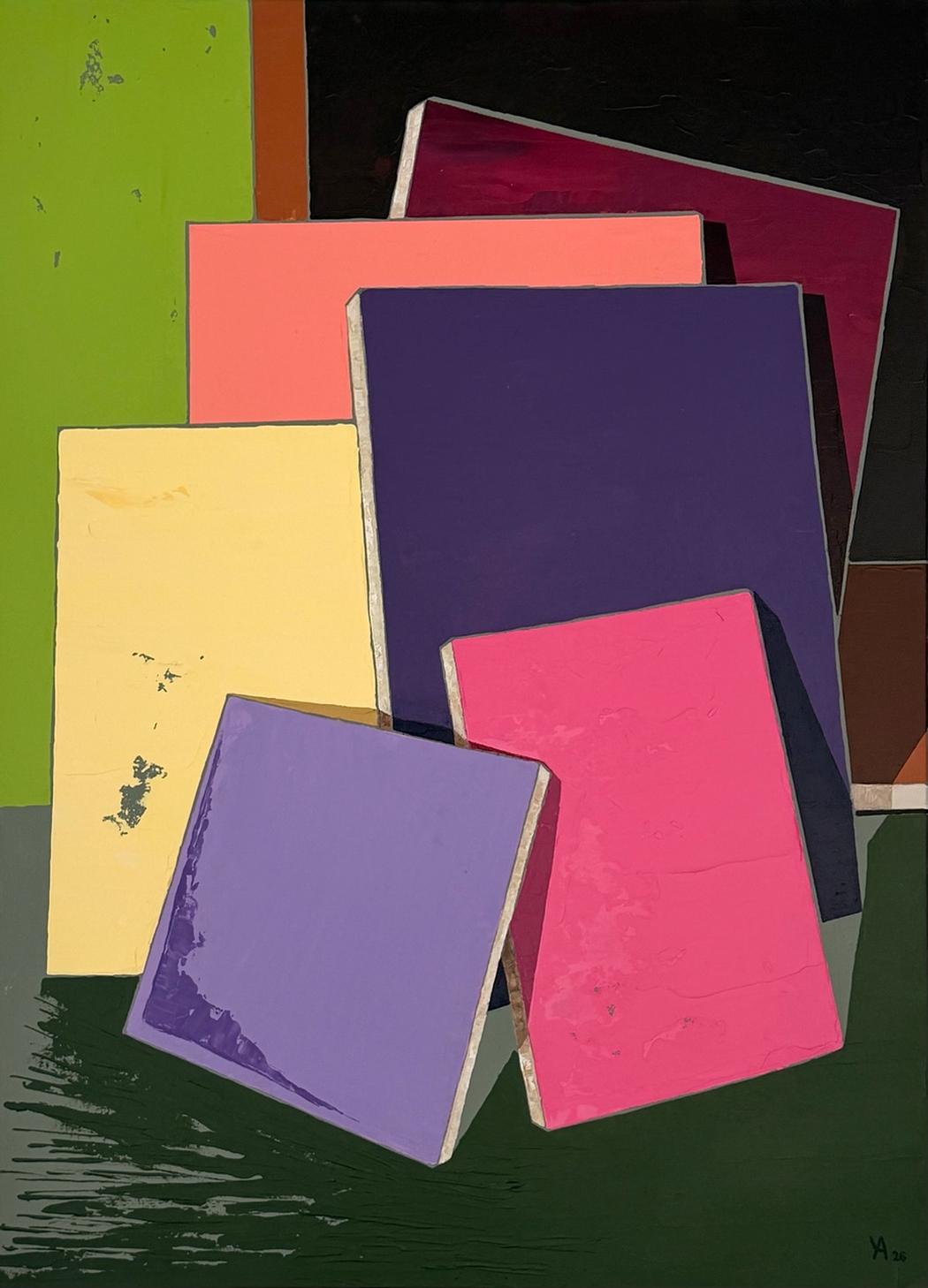 Alexandra Uryasova | Canvases In Waiting | 2026
Your practice often explores moments of preparation, waiting and uncertainty in the studio. Why is it important for you to make these usually unseen stages visible?
This question relates directly to my series Inside of the Studio. I wanted to show the process of creating a painting from the inside — not as a sequence of technical stages or an instruction on how a work is made, but through the psychological stages of creation: doubt, anticipation, searching, preparation, moments of confidence followed by new uncertainty, all of which exist alongside the original idea almost from the very beginning.
Usually, the viewer encounters a work only after this process has ended. The painting hangs on a wall as an independent, finished object, while everything that happened before that moment becomes invisible. For the artist, however, its existence begins much earlier — sometimes before the first image even appears on the canvas.
Before the finished painting, there are sketches, the search for colour, prepared canvases, unsuccessful decisions, and periods when a work simply remains in the studio because the artist does not yet know what to do next. There are moments of complete certainty and others when the entire original idea suddenly seems mistaken.
I am interested in restoring artistic value to these intermediate states. Preparation is already part of creating a work. Waiting is also part of the work. Even uncertainty is not simply an obstacle on the way towards art; it is one of the states through which art emerges.
This is why prepared canvases, easels, materials, unfinished works, and the studio itself appear throughout the series. What normally exists outside the viewer’s experience becomes the subject of the painting.
I am particularly interested in the moment when the original idea ceases to be the work’s only meaning. The painting remains part of me and my experience, but during the process of making it, it gradually acquires additional meanings that I may not have consciously placed there at the beginning.
Material, colour, unexpected decisions, changes in composition, doubt, and the duration of the process itself all begin to influence the work alongside me. At some point, I realize that what I originally wanted to express has already moved beyond the boundaries of that initial intention.
This is why these intermediate stages fascinate me so much: they reveal not only how an artist creates a work, but also how the work gradually transforms the artist’s original intention. For me, this is not a separation between the artist and the painting. Rather, it is the moment when the relationship between them ceases to be one-directional.
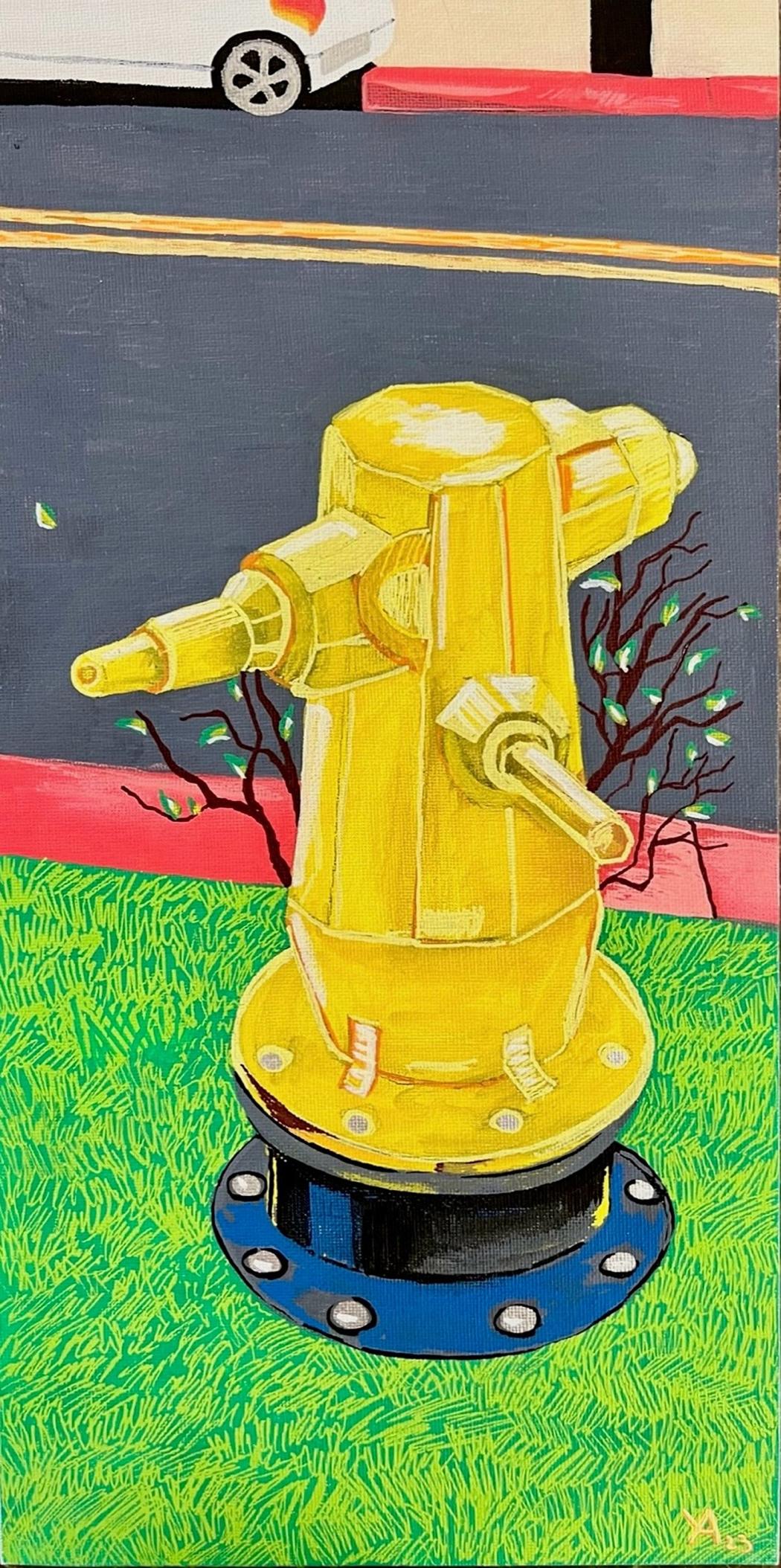 Alexandra Uryasova | Fire Hydrant | 2023
How do you decide which details of a space to include and which to simplify or leave out?
The answer usually becomes clear during the process of working. I ask myself a very simple question: what would I have to remove from this space for it to stop feeling like the individual place of a particular person and start looking like a perfectly polished photograph from an interior design magazine?
Whatever would cause the space to lose its individuality if removed is what I try to preserve. Then I ask a second question: which objects belong specifically to this moment in time? What explains why a person is here right now, what they are doing, and what state they are in? Anything that answers neither of these questions can gradually disappear from the composition.
It is very important to me not to select the most beautiful or expensive objects, symbols of status, or things that possess obvious cultural value. Instead, I look for emotional anchors. An old stained blanket can sometimes be far more important than an expensive vase. If someone has come into a room to cover themselves, get warm, and feel at home, the blanket tells the truth about that moment, while the vase does not.
Function and emotional significance therefore come first.
Something similar happens with simplification. Excessive detail can sometimes make the viewer look in completely the wrong direction. If I meticulously reproduce a box of paints, for example, attention may shift towards the manufacturer, the packaging, or the technical skill with which it has been painted, while what actually matters to me may simply be the carefully selected colours inside it.
Conversely, an object that carries less emotional significance can sometimes be represented in considerable detail. An easel, for example, may be compositionally necessary simply because it holds the painting. Its presence is needed to understand the space, but it remains near the bottom of my hierarchy of meaning.
For this reason, the degree of detail in my work does not necessarily indicate the importance of an object. Instead, it helps me control how the viewer reads it.
People are often absent from your paintings, yet their presence can be felt through the objects around them. What interests you about suggesting a person without depicting them directly?
I genuinely believe that a space — particularly a private room or a beloved place — can sometimes reveal more about a person than the person themselves.
While someone is present in a room, our attention inevitably focuses on them: their appearance, movements, words, and actions. But once they leave, the space continues to preserve the consequences of their presence.
What particularly interests me is that this information often appears completely unintentionally. A person may leave in a hurry, leave a room in complete disorder, and give no thought whatsoever to how it looks. Yet even within that chaos, a hierarchy emerges. A favourite watch might be carefully placed on a clean surface, a book by a beloved author may be put away separately, while an expensive object might be left carelessly to one side.
Priorities reveal themselves even when the person never intended to reveal them.
For this reason, the absence of a figure does not mean the absence of a person. On the contrary, sometimes absence allows me to speak about someone more precisely. The viewer begins to look for the person through their traces: in the arrangement of objects, habits, choices, and in what has been preserved, abandoned, used, or left waiting for their return.
I am interested in creating a kind of portrait without depicting the person — one in which a personality emerges through the space they have formed around themselves.
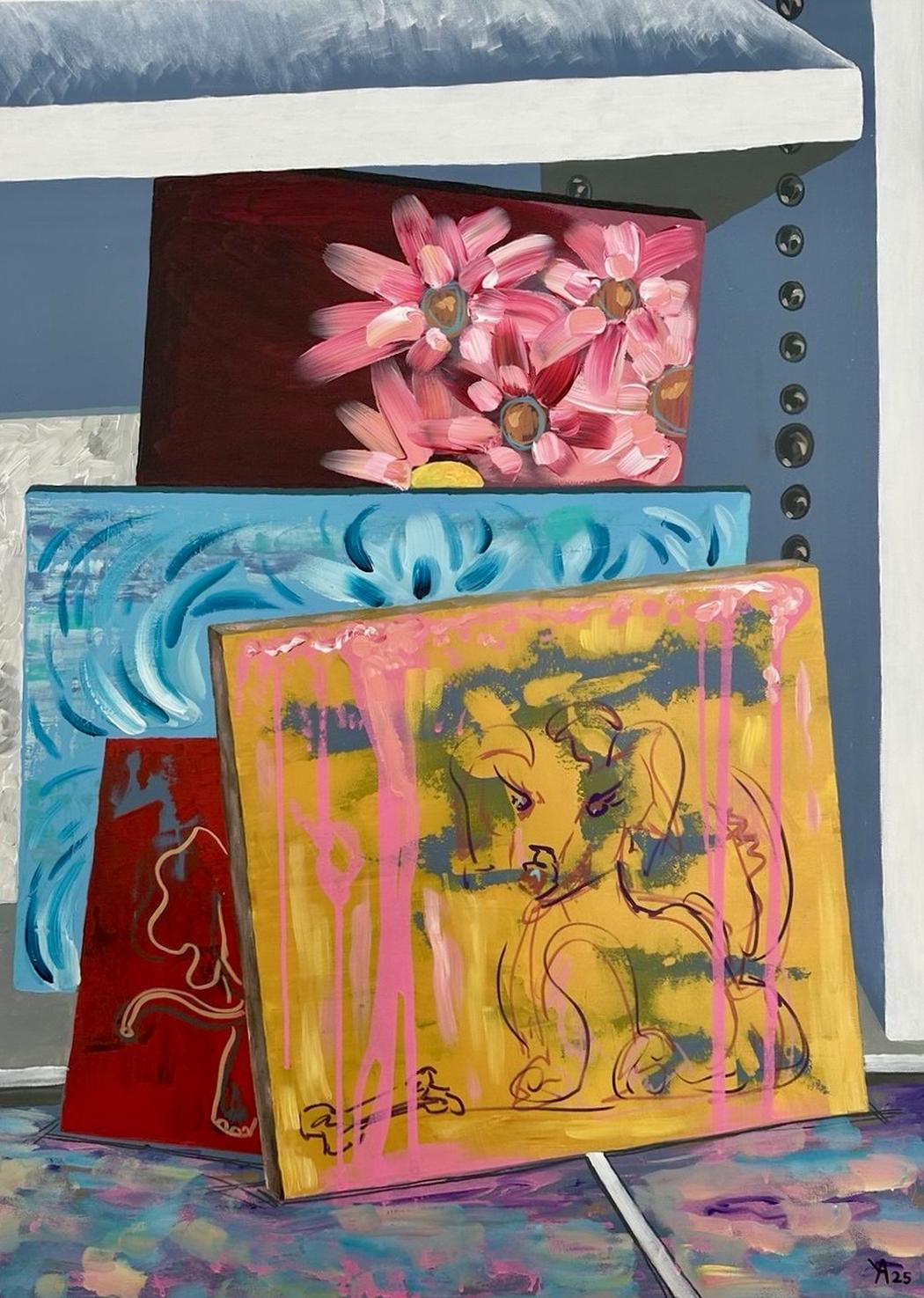 Alexandra Uryasova | In Expectation | 2025
Colour plays a strong role in your work. Do you begin with a particular palette, or does it emerge as the painting develops?
For me, colour means much more than the realistic visual description of an object. Above all, it represents an emotional state.
As soon as I have an approximate idea for a new painting and understand the feeling I want it to convey, I choose its primary colour — most often the background colour. Only after this colour space already exists on the canvas do I begin sketching the painting itself and developing the composition.
It is important for me to leave enough “air” in a painting — areas where the eye can move freely and rest between significant objects. The background is therefore never simply empty space. When the viewer’s gaze momentarily moves away from the main composition, the colour continues to affect them and maintains the emotional state of the painting.
In Inside of the Studio, for example, I often use a particular shade of turquoise. For me, it is deliberately uncomfortable. It feels almost artificial — a colour that is difficult to encounter in nature. At first it can appear bright and even joyful, but when viewed for longer, that sensation quickly develops into tension, fatigue, and an absence of inner calm.
This makes it particularly appropriate for paintings dealing with doubt and the psychological tension involved in creating a work. It also reflects that strange moment when a painting is finished, yet the artist has absolutely no idea what will happen to it next or whether it has any meaning or value beyond the studio.
In Inhabited, by contrast, I use a deep burgundy-brown background. At first, burgundy can seem heavy or even aggressive, but the longer I look at it, the more domestic it becomes. For me, it evokes the muted light of a warm lamp, an evening with a favourite book, the space beside a fireplace, or a glass of red wine in the kitchen with someone you love.
The key colour is therefore established almost at the beginning, while the other colours can emerge and be refined throughout the process. In this sense, the composition develops within a pre-existing emotional atmosphere, rather than the other way around.
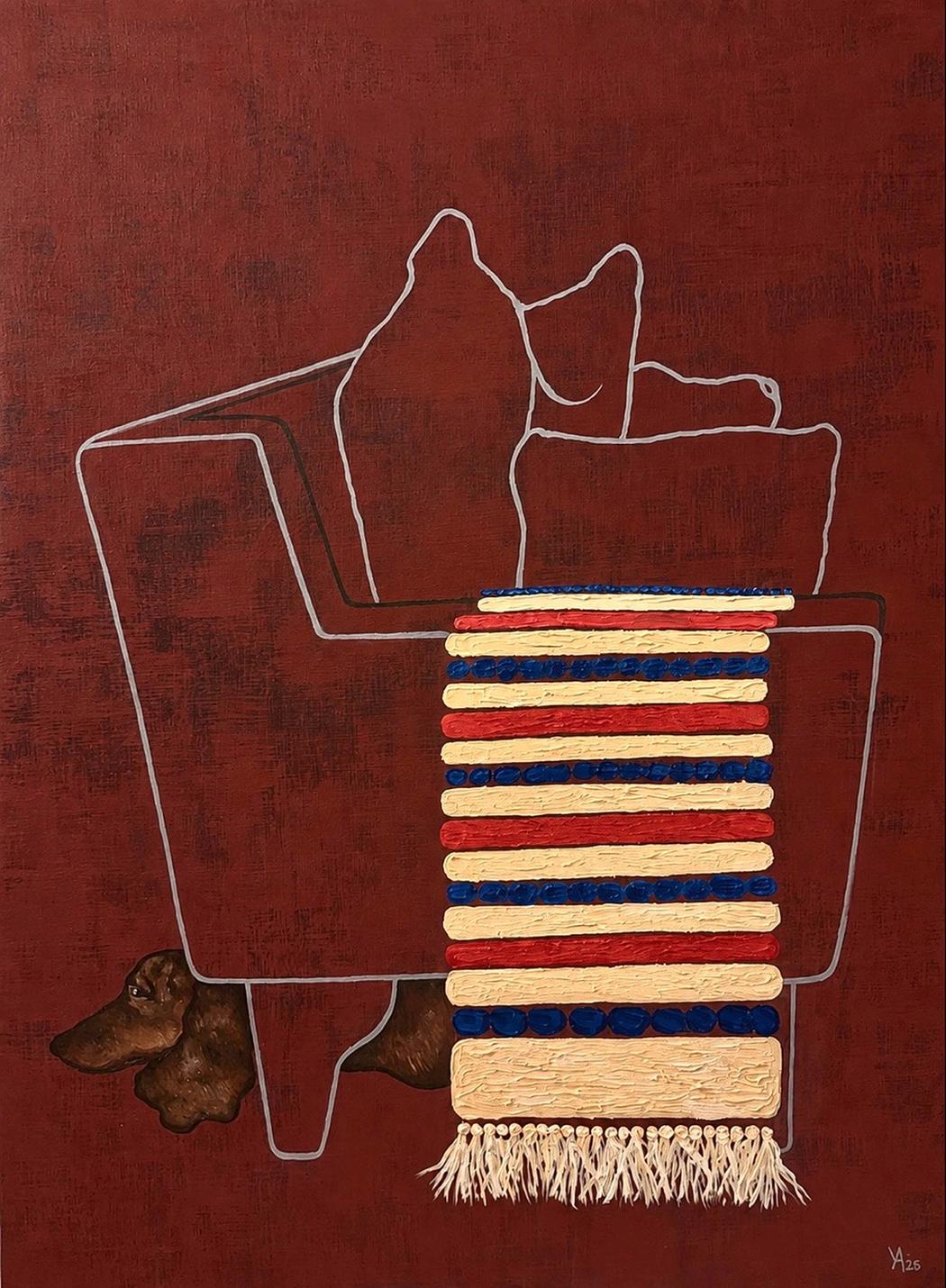 Alexandra Uryasova | In Its Place | 2026
Your compositions often combine solid forms, outlines and layered spaces. How do you use these elements to guide the viewer’s attention?
Outline, colour, and degree of detail form a kind of visual hierarchy in my work, but it does not operate according to the traditional principle that the most detailed object must necessarily be the most important.
Quite often, the opposite is true. If I leave an object only as an outline, it can mean that the object is particularly significant to me. In that case, what matters is not its physical appearance — its texture, material, or exact construction — but the idea of the object, its function, and its role within the space.
An outline allows me to preserve the object while removing unnecessary visual information. In a way, it tells the viewer that what matters here is not what this object looks like, but why it is here.
When a fully rendered object appears beside an outlined one, the conceptual emphasis is therefore often on the outlined or less detailed element. For particularly significant objects, I frequently choose a monochromatic form, an outline, a partial fill, or even leave empty space inside the object itself.
In my current work, layered space functions primarily as a compositional device. I use different spatial planes to organize the movement of the eye, while creating the hierarchy of meaning through other means: outline, detail, colour, or, conversely, the deliberate absence of colour and visual information within a form.
I am interested in this paradox: sometimes, to make the viewer pay more attention to an object, I need not to add something to it, but to take something away. Emptiness and omission can create a stronger emphasis than the most detailed representation.