
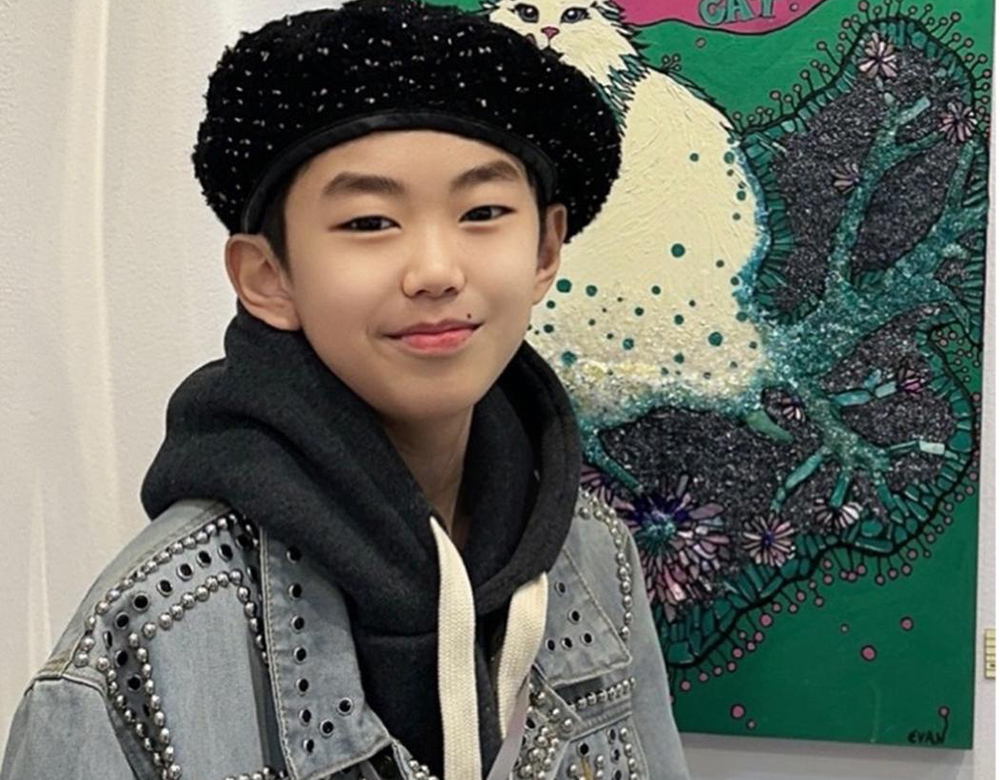
EVAN ARTIST BOY
When you begin a painting, do you already know its story, or do you discover it as you work?
Usually, before I begin a painting, I already have a small scene or story somewhere in my imagination. Sometimes it begins with a dream, sometimes with a memory, and sometimes I see something very ordinary and suddenly imagine it as something completely different.
But I almost never decide exactly what the finished painting will look like from the beginning.
Once I start painting, the story begins to change little by little. A certain color might make me think of a new place, or an accidental shape might suddenly look like an animal, a plant, a planet, or a strange character. Then I start wondering where that character came from and what it might be doing there. One idea leads to another, and the world inside the painting gradually becomes bigger.
That is why painting feels a lot like traveling to me.
I may know where I am starting, but I do not always know where I will arrive.
Sometimes I even surprise myself. Something I originally thought would be a tiny part of the painting can suddenly become the most important character, or an empty space can grow into an entirely new world. Instead of trying to plan and control everything, I enjoy allowing accidents and unexpected ideas to happen naturally.
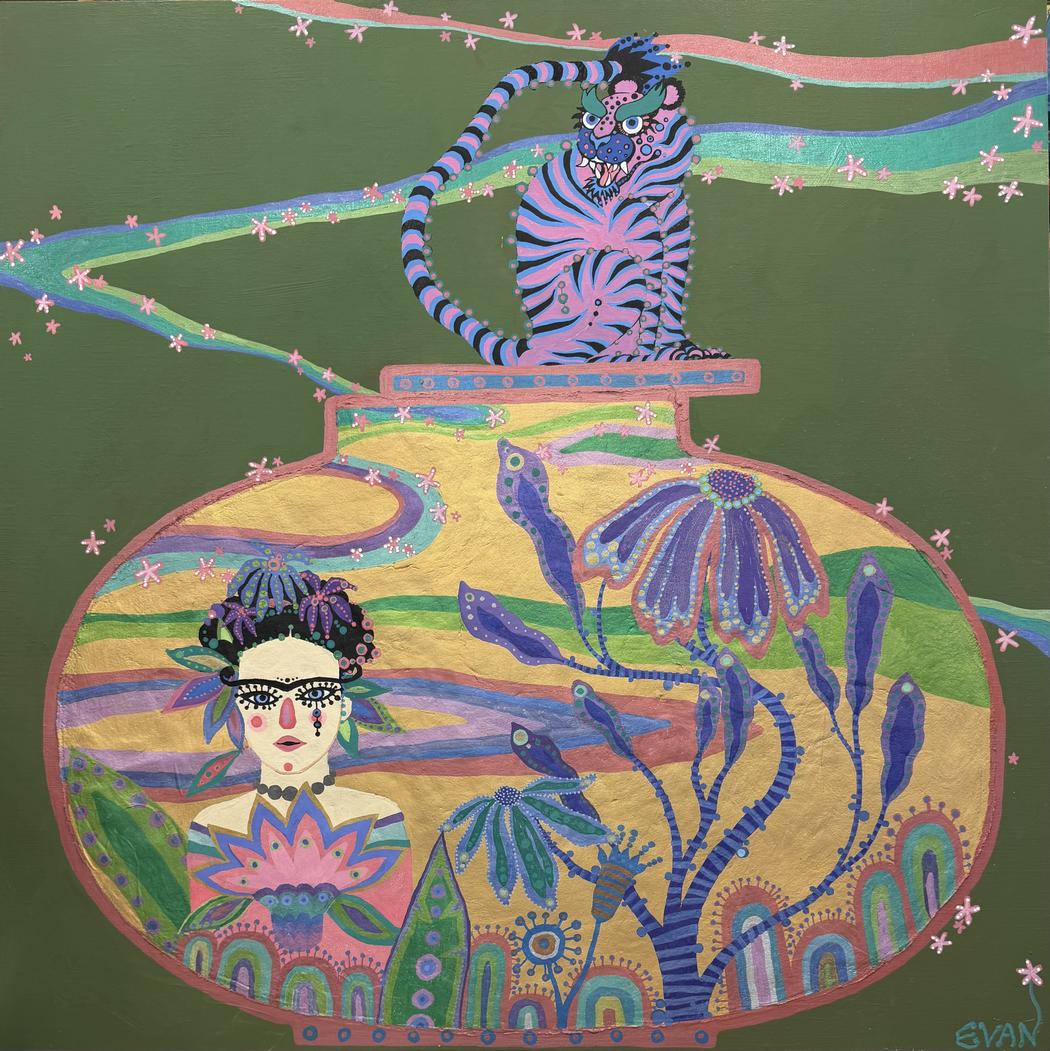
Maybe that is why my paintings often feel like dreams. In a dream, something can suddenly transform into something else without needing an explanation. An animal can fly, a jar can become a house, a machine can have feelings, or a flower can grow larger than a person. None of those things seem strange when you are dreaming.
I want to keep that same freedom inside my paintings.
So, for me, the first idea is only the beginning of the story. I discover the rest of it, little by little, while I paint.
 EVAN ARTIST BOY | Once Upon A Time
The stories your parents told you as a child helped shape your imagination. How do those stories find their way into your paintings today?
Stories have been part of my life for as long as I can remember.
When I was very young, my parents read many stories and fairy tales to me. I loved listening because I could imagine all the places and characters in my head.
Even after a story ended, I would continue thinking about its world. I would wonder what happened to the characters afterward, or what might exist beyond the parts of the world that the book did not show me.
Looking back, I think this habit of continuing a story in my own imagination has had a very strong influence on the way I create my work today.
When I was little, I was also fascinated by trains and Thomas & Friends. I loved the idea that locomotives, which are machines, could have faces, emotions, friendships, worries, and completely different personalities. I would play with my trains, invent my own stories for them, and draw the worlds I imagined around them.
I think the idea that something that is not alive in reality can become alive through imagination has stayed with me ever since.
I still do something similar when I paint today.
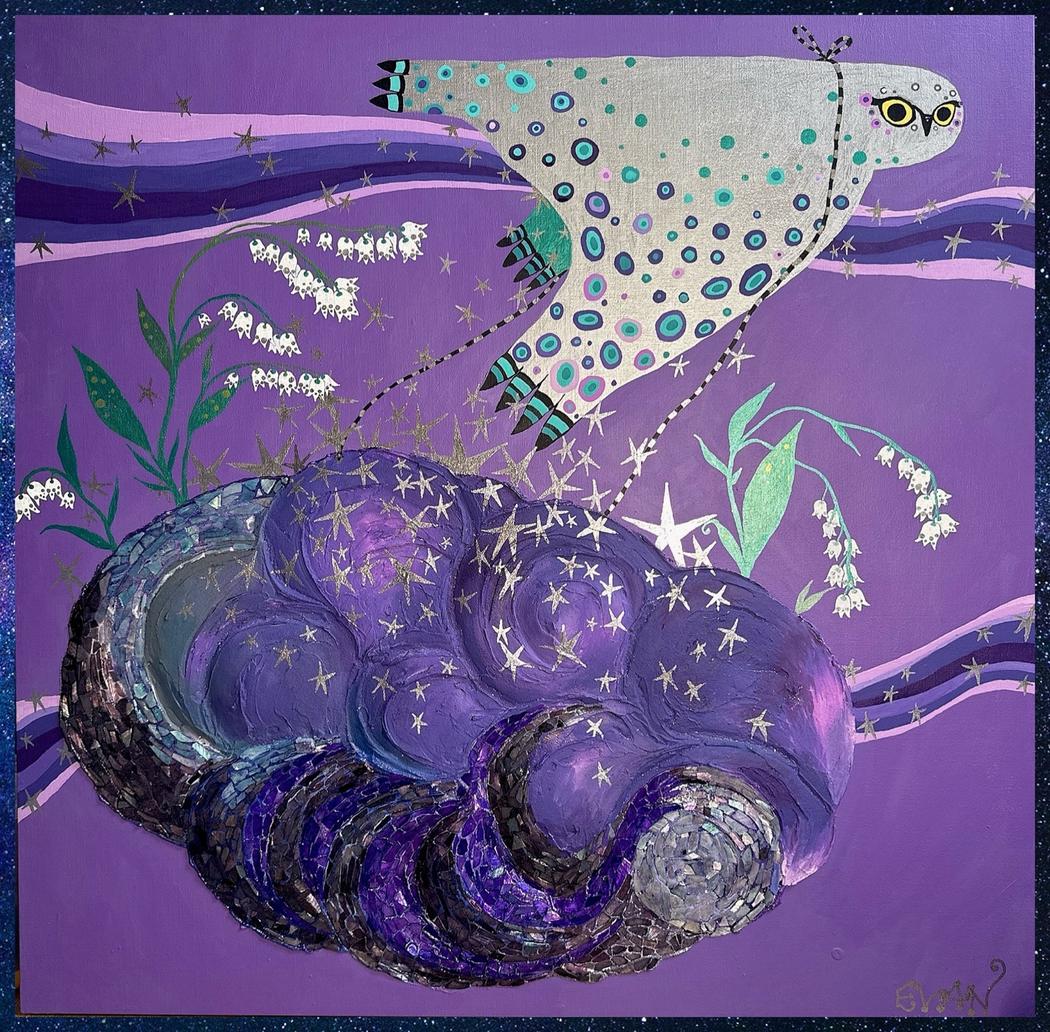
Animals can speak, and machines can have emotions. Flowers can grow to an enormous size, and an entire world can exist inside a Moon Jar. A creature might carry stars on its back, and an ordinary landscape can suddenly transform into a place that could exist only in a dream.
I especially love the feeling of the words “Once upon a time…”
When I hear those words, I feel as though absolutely anything could happen next.
That is also how I hope people feel when they enter one of my paintings. I do not want the painting to explain the whole story from beginning to end.
I would rather it feel like opening a storybook somewhere in the middle and wondering, “What happened before this scene?” and “What will happen next?”
The stories I heard as a child do not appear literally in my paintings.
Instead, I think they taught me how to imagine.
And they taught me that the real world does not have to be the limit of a story.
 EVAN ARTIST BOY | Once Upon A Time
Your grandmother dreamed of a phoenix transforming into a dragon before you were born. What did you feel when you first heard about that dream, and how did you make the story your own?
In Korea, there is a special kind of dream called taemong. Traditionally, it is believed to be a dream connected to a child before they are born, and these dreams are often remembered and passed down as family stories.
My grandmother told me that before I was born, she had a very unusual dream that continued over several days.
In the dream, there was clear blue water beneath a waterfall. From that water appeared an enormous dark phoenix covered with beautiful and mysterious patterns.
The phoenix rose into the air beneath the moonlight and flew toward the sky. After passing through the clouds, it transformed into a blue dragon and continued flying through the sky.
My grandmother told me that the creature was so beautiful that she thought the child connected to the dream might someday grow up to become an artist.
When I first heard the story, I was fascinated.
It felt strange and exciting to imagine that there was already a story connected to me before I was even born.
To me, the dream did not feel like an ordinary dream. It felt more like the opening scene of an ancient legend or fairy tale.
As I grew older, I began thinking about the dream in a different way.
I did not want simply to illustrate exactly what my grandmother had seen. Instead, I became curious about what might have happened before and after the dream.
Where did the phoenix come from?
Why was it beneath the water?
Where was the dragon flying?
What kind of world existed beyond the clouds?
Those questions became much more interesting to me than simply reproducing the original dream.
So I began creating my own world around it.
Water and moonlight, unusual animals and plants, mysterious patterns, birds and dragons, imaginary landscapes, and creatures transforming from one form into another began appearing in my work.
Some of these things are directly connected to my grandmother’s dream, while others began there and then grew into something completely new through my imagination.
Sometimes I think of my taemong as the first page of a very long story.
My grandmother gave me that first page before I was born, and now, through my paintings, I feel as though I am continuing to create the pages that come after it.
That is why this dream is so special to me.
It is a memory that belongs to my family, but at the same time, it has now become part of the world I create as an artist.
The traditional Korean Moon Jar appears throughout your work. What does this form mean to you, and why do you return to it?
I love the Moon Jar because its form is very simple, yet I can imagine so many different things within it.
A traditional Korean Moon Jar is round, quiet, and simple.
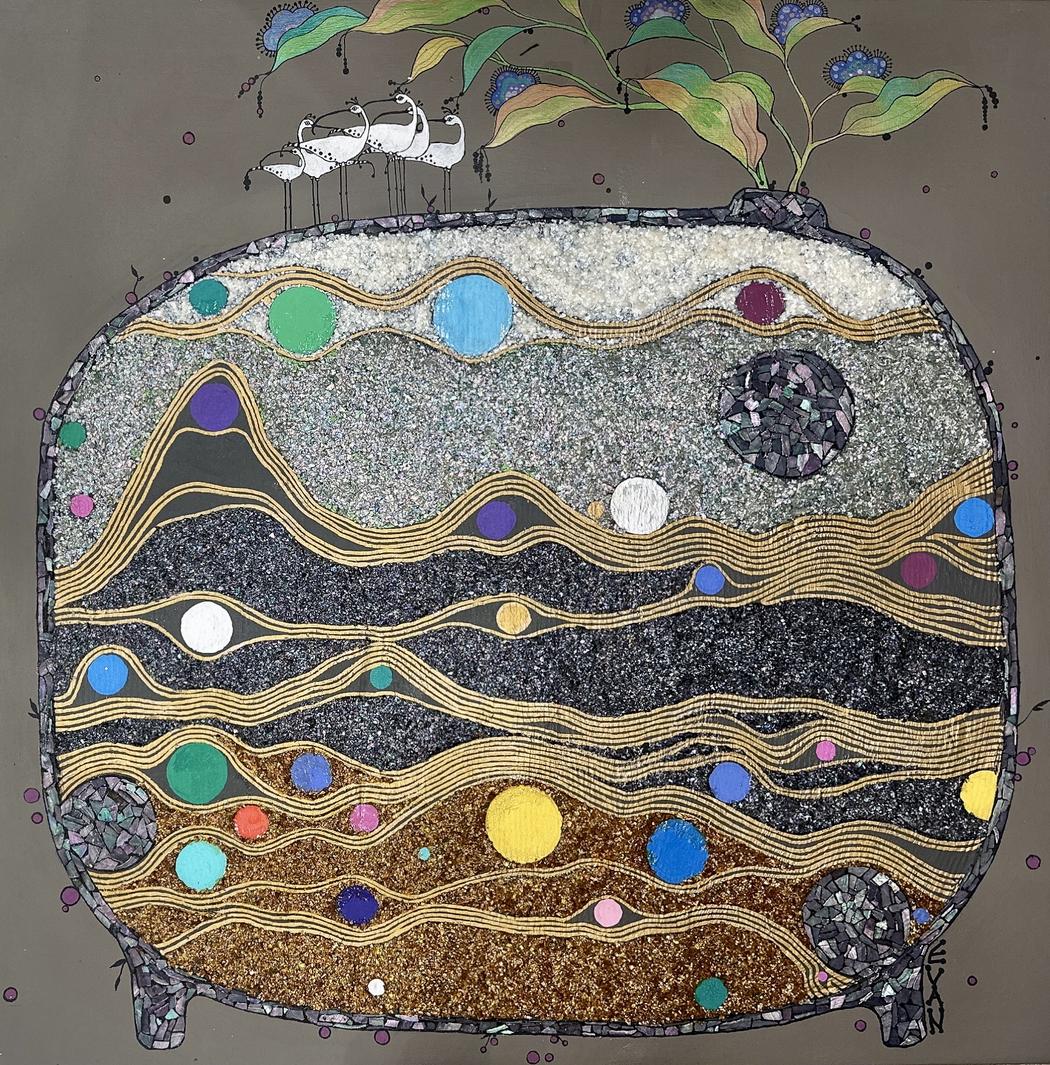
When I look at one, I sometimes see the moon. At other times, it reminds me of a planet, a house, a giant egg, a mysterious container, or even an entrance to another world.
So in my paintings, the Moon Jar does not exist only as a traditional Korean object.
I like transforming it into something else.
In one painting, it might become a house where a family lives. In another, flowers and strange plants may grow from it. Animals and imaginary creatures may appear around it, or I might imagine that an enormous world is hidden inside.
One of the things I love most about the Moon Jar is the idea that something that looks so simple from the outside can contain an enormous world within it.
I think people can be a little like that too.
Someone may look ordinary from the outside, but inside every person there are memories, dreams, emotions, fears, stories, and imaginary worlds that other people cannot see.
For me, the Moon Jar can become a vessel that holds all of those invisible things.
It also connects me naturally to Korea.
I like taking a form that comes from Korean tradition without feeling that I must always represent it in a traditional way.
I can fill it with intense colors, strange plants, animals, patterns, stars, and characters that could never exist in reality.
So each time a Moon Jar appears in my work, its meaning can change.
Sometimes it is a home.
Sometimes it is a memory.
Sometimes it is a planet.
Sometimes it is a dream.
And sometimes it is simply an entrance into another story.
I think that freedom—the possibility for one simple form to keep transforming into different worlds—is what makes me return to the Moon Jar again and again.
 EVAN ARTIST BOY | Once Upon A Time
Circles, lines, and patterns often fill your paintings. How do you use them to show something invisible, such as a thought, a memory, or a feeling?
I use circles, lines, and patterns very naturally when I work.
I do not always decide beforehand that a particular circle has to mean one thing or that a certain line has to represent something specific.
Sometimes, while I am painting, my hand naturally begins repeating the same shapes. As I continue, those shapes start creating movement or energy within the painting.
I like the idea that even things we cannot see might have some kind of shape.
For example, if we could actually see a memory, what would it look like?
What shape would happiness have?
If we could see imagination moving through someone’s mind, what would it look like?
I find those questions interesting.
A circle can become many different things in my paintings.
It might be a planet, an eye, a bubble, a seed, a memory, the moon, or something mysterious floating through space.
Lines can become paths or connections.
Sometimes they feel like traces showing where something has come from or where it might be going next.
Repeating patterns can also feel like energy spreading throughout the painting.
Sometimes I repeat the same form again and again because repetition creates a kind of rhythm. I think a painting can have rhythm, just as music does.
There are also times when I simply feel that a line or shape needs to be somewhere without knowing exactly why.
Then, after the painting is finished and I look at it again, I sometimes understand why that shape needed to be there.
I like leaving room for that unconscious part of making art.
I do not think imagination always needs an explanation.
After all, not everything that happens in a dream needs a logical reason.
Your animals sometimes fly, carry stars, or seem to speak. How do you imagine their personalities and the roles they play in your world?
The animals in my paintings are not just ordinary animals to me.
I think of them as characters.
Whenever I create one, I naturally begin imagining what kind of personality it might have.
Some are brave, and some are curious. Some are strange or funny, while others are very quiet. Some look as though they might cause trouble at any moment.
And sometimes there is an animal that seems to know a secret that nobody else in the painting knows.
I like imagining that these animals continue living their own lives even when nobody is looking at the painting.
Maybe they travel at night.
Maybe they talk to one another.
Maybe they are protecting something.
Or perhaps they know how to travel freely between the real world and the dream world.
I do not think the animals in my paintings need to follow the rules that real animals have to follow.
They can fly without wings. They can carry stars on their backs. They can live inside flowers or travel through space. They can speak to machines, people, and imaginary creatures.
I enjoy giving them abilities that would be impossible in reality.
My paintings are places where the rules of reality can disappear.
Sometimes I imagine myself as a traveler inside that world too.
I do not necessarily think of the animals as characters that belong to me simply because I created them.
Instead, they often feel like creatures I happened to meet while traveling through my imagination.
It is almost as if they were already living their own lives there, and I simply discovered them while I was painting.
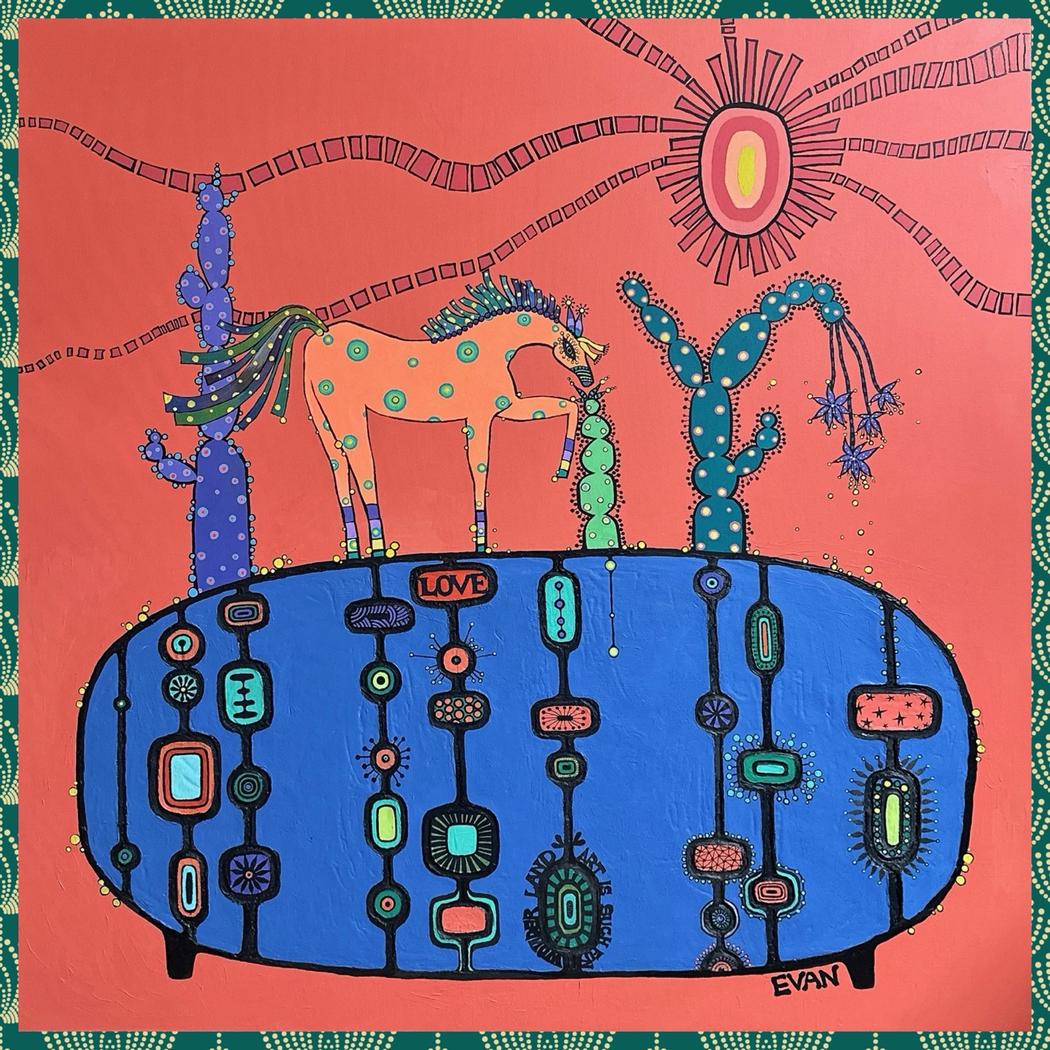
That is why I often think of the imaginary world I create as “My Wonderland.”
In that world, everything can freely change its size, color, personality, or role depending on the story.
There are no fixed rules about what something has to be.
 EVAN ARTIST BOY | Once Upon A Time
Has a viewer ever noticed something in one of your paintings that you had not seen yourself?
Yes, and I think this is one of the most interesting parts of showing my work to other people.
Sometimes someone looks at one of my paintings and tells me that they have discovered a face, an animal, a person, or even an entirely new story in a part of the painting where I did not intentionally put one.
At first, I sometimes say, “Really? Where?”
Then they show me, and when I look again, suddenly I can see it too.
I really enjoy those moments.
They also make me realize that once I finish a painting, it no longer belongs only to my imagination.
Everyone brings their own memories and experiences with them when they look at a painting.
For example, a shape that I imagined as a plant might look like an animal to someone else.
A place I imagined as part of a dream might remind another person of somewhere they visited as a child.
I do not think one interpretation has to be right and the other wrong.
I think that is one of the beautiful things about art.
An artist can begin a story, but the viewer can continue it.
I do not want everyone to look at my paintings and understand exactly the same thing.
If ten people look at one of my paintings and imagine ten different stories, I think that makes the painting even more interesting.
Sometimes viewers even help me rediscover my own work.
It feels as though they are showing me another entrance into the world I created.