
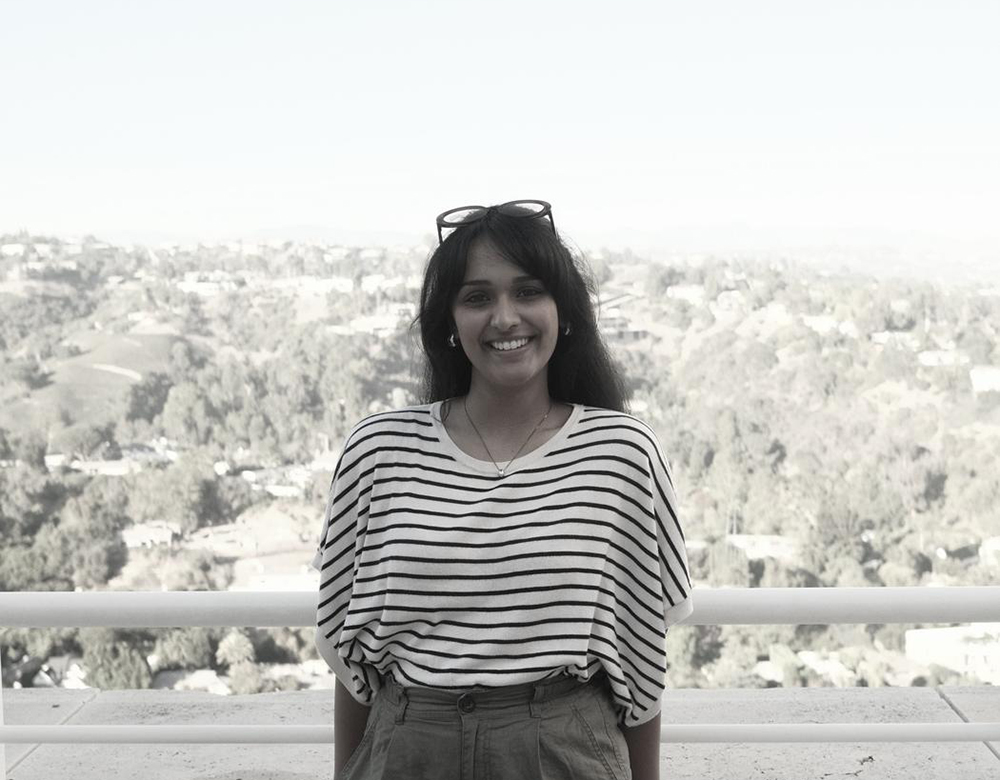
Tanisha Jha
You studied History and Politics before working in IT consulting. What prompted you to leave that career in 2026 and commit yourself fully to art?
I didn’t know it growing up, but I’ve always been what people now call a multi-hyphenate, caught between competing interests. During school, I struggled to pick a coherent set of GCSEs and A-levels and further struggled to pick one degree that really felt like “me”. After graduating, I joined consulting because another part of me really enjoys organisation, planning, engaging with clients, and making things work better. Despite leaving art as an educational part of my life, a constant in my life has been loving creativity. Throughout university and working, I still carved out small moments of creating by designing material for events at my college, doing a design internship, and painting during the pandemic.
The shift came in the winter of 2025, when I started a daily art habit after almost a decade and, for the first time, recognised that this was where I found a flow state I’d been missing in my career. Like a lot of people in their mid-twenties, I hit a bit of an existential crisis wondering whether the thing I was doing was actually what I wanted to do for a long-term career. I realised I’d been climbing the wrong ladder, so I decided to take the leap now and see where this one goes. I had this nagging sense that I’d abandoned the artist in me after school, so going for it properly felt instinctively right. Parts of it have been scary and unstable, but I’ve never felt this kind of excitement about the ambiguity, or about how much I might learn in the process, even if I do return to a full-time role after this sabbatical experiment.
Having lived in Switzerland, Madrid, Surrey, and London, while also maintaining a connection to your Indian heritage, how has this experience of belonging to multiple places shaped your visual language?
A few things, I think. Living across Europe and spending time in India gave me an eye for architecture and environment. Madrid, London, and India are all intensely creative places, visually and culturally, and moving between them made me nostalgic for the different eras of my life and who I was in each place.
Travel is deeply important to me and my family, and I’ve found it unlocks a huge amount of inspiration, either on the go or once I’m back and have had time to reflect. I’m actually writing these answers on the way to India, and what I’m most excited about is knowing I’m about to collect so many new visual and personal experiences that will feed the next round of pieces. India especially brings up nostalgia and childhood memories of visiting family, and that’s exactly what I love putting into my work. The hazy, colourful, grainy, luminous quality of my art is really my way of documenting what nostalgia feels like.
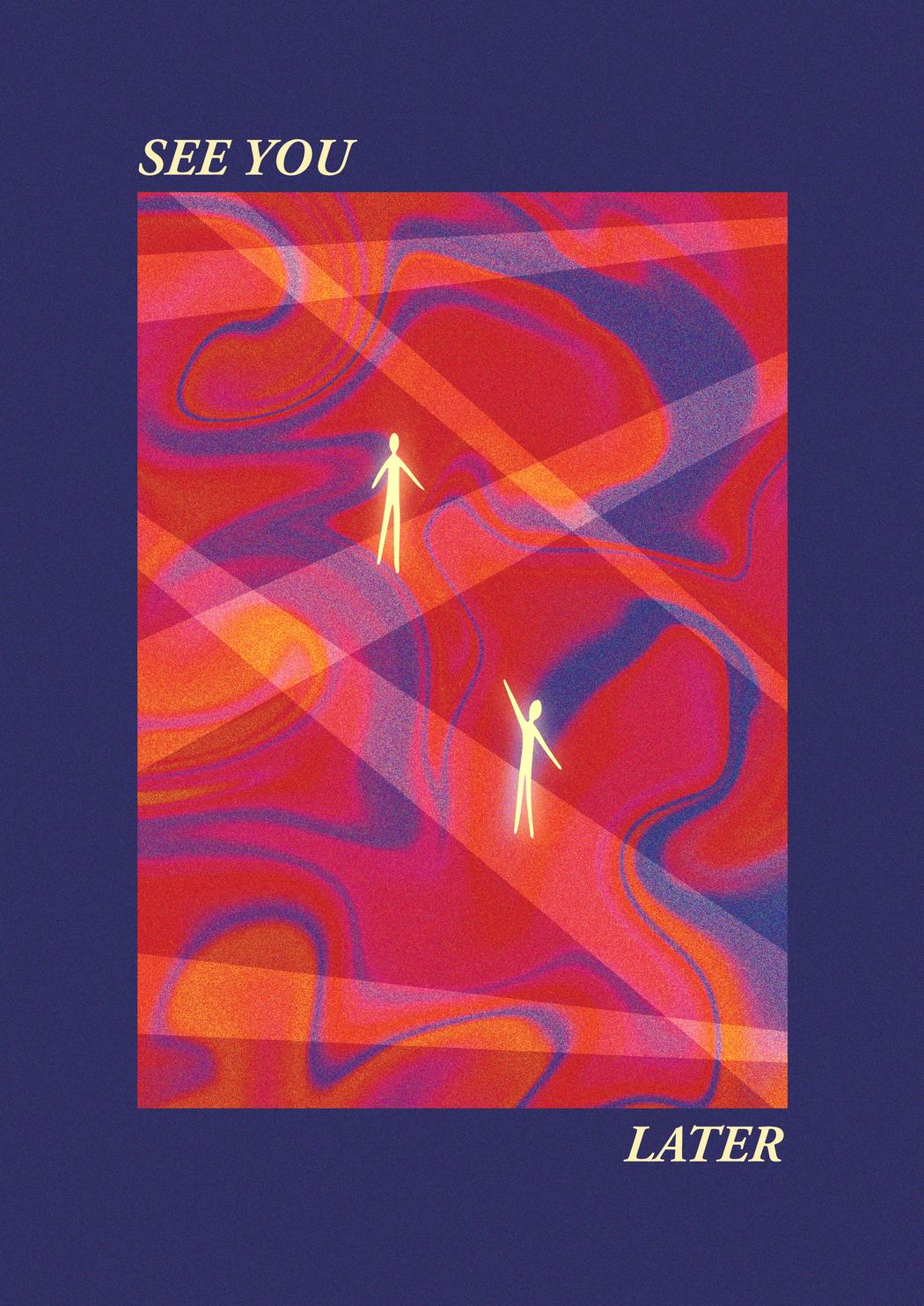 Tanisha Jha | See You Later
Repetition is central to your practice. What draws you back to the same forms and symbols, and what do you discover by revisiting them in different colours and contexts?
It actually started out of fear. I was nervous getting back into art and had low confidence in my ability to execute the ideas in my head, so I kept returning to the same patterns and symbols as a comfort zone. Restricting myself to a single star, or a grid, forced me to play with the emotional weight of colour, and to notice how changing one or two elements can shift an entire piece. My confidence grew as the restriction stopped feeling like a limit on my ability to create anything, and started feeling like an experiment. That’s where the series came from: changing colours, adding organic shapes, bringing in photographic elements. I know I’ve pushed a symbol or format as far as it can go when I feel excited to try a new composition, and that excitement is how I keep breaking out of my comfort zone. Now I restrict and repeat out of experimentation rather than fear. It was a useful lesson for me not to let the gap between my taste and my current skill overwhelm me. I start simple, pick one idea, and push it until I’m thoroughly bored of it.
Geometry provides structure in your work, while colour carries emotion. How do you balance these two elements when developing a composition?
Inspiration usually comes from all sorts of different places, but I’m mostly inspired by seeing different colour palettes together and noticing what I feel when I look at them. Geometry is an ongoing experiment, and so I always have a few up my sleeve to choose from or experiment with, and this sets up the rules for how I use and place colour. For example, in a standard square grid, I have just two colours, or two gradients, and that’s the extent of it. Then the emotion comes from how much movement and texture I add, or how saturated the colours are, and if they’re complementary or if they’re just different tones. Once I’m happy with the grid and colour in harmony, I can bring out further interesting elements to add to the composition.
Your images often appear ordered and carefully constructed, yet you describe something restless beneath their surfaces. How do you create this tension between control and unease?
The restlessness comes from everything that sits beyond the geometry and colour, and is the next step in my creative process. It’s usually what feels “missing” once I’ve built a neat, ordered grid. Marbled texture, circular patterns, heavy grain, and contrasting elements are what bring movement into a piece that a clean grid can lack. The organic layer, plus a bit of luminosity, is what builds the nostalgic, surreal, almost out-of-body feeling I’m after. It’s also where I spend the most time, because the amount of movement and swirl is what decides how slow and hazy a piece is, versus chaotic and loud.
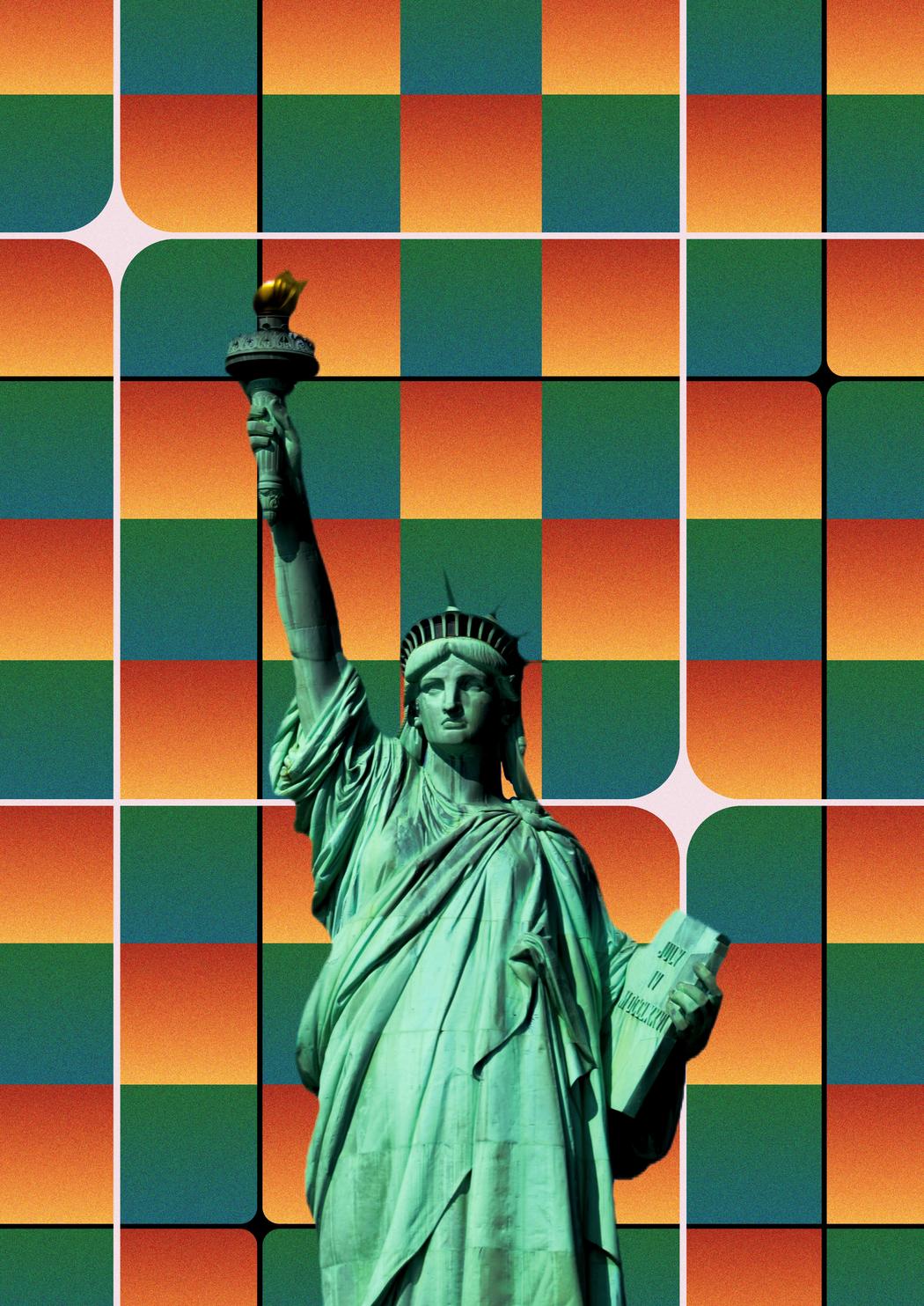 Tanisha Jha | Liberty
Cultural, spiritual and architectural icons recur throughout your practice. How do you choose the symbols you work with, and how does their meaning change when you reconstruct them through colour and pattern?
The starting point is almost always a colour or an emotion rather than the symbol itself, so I don’t decide what a piece means before I make it. I follow the colour, and the distinct icons fit in as I develop the composition. That order matters to me, because if I started from the symbol I think I’d end up illustrating something I’ve seen a thousand times before or making a postcard, and I’d rather discover the idea in the making, pushing it beyond something predictable.
“Liberty, Gridded” is a good example of how that plays out. I noticed, after building the background, that the rusty orange and bright green I’d been pulled to were the colours of the Statue of Liberty as she oxidised. I hadn’t set out to make a New York piece, I’d just been chasing a palette stuck in my head and only once it was down did I recognise what it was pointing at. Once I saw it, leaning in made sense, so I started experimenting with photographic elements and that bold, American imagery until the icon felt natural rather than imposed. What’s left is closer to the nostalgia of actually travelling to a place, whether that’s New York in “Liberty, Gridded” or Marrakech in “Solar Quarter”. It stops being a cliché and becomes the feeling and memory of a place, or a time, or who I was when I was there.
The eyes, or nazar, work the same way but come from somewhere far more personal than a country or a landmark. They’re tied to flicking through my brother’s collection of art books as a child, specifically the collections of M.C. Escher and Alex Grey. That’s deeply ingrained in me. It’s where my sense of engaging with geometric art, bright colours, and weird composition began. So when I use the eye now, it comes with that childhood reminiscence instead, sitting with something odd and cool and trying to understand it. In my palette, the eye becomes a much more vivid portrayal of what remembering my childhood actually feels like, rather than a literal recreation of the protective charm it starts out as.
Alongside your artistic practice, you are developing a Notion consulting studio and writing about building a portfolio career. How do these different activities influence one another, and what does a sustainable creative life mean to you?
When I left my corporate job, I knew I wanted to test a completely different way of working, built around the things that played to my strengths. I wanted to connect my organisational and project management skills with my creative side, rather than keep them in separate boxes. A portfolio career lets me do that.
The activities feed each other more than I expected, mostly in a practical way. The organised, ops side of me clears the space for the art. When my admin, projects, outreach, and ideas are tracked somewhere I trust, my head is quiet enough to actually make things. To me, a sustainable creative life means having enough structure to keep showing up for the art, and enough freedom to let it change. It also means not letting the admin become the thing I avoid until it’s scary.
I’m currently building a “Notion for Artists” package for people who hate the admin side, aren’t that confident with Notion, or get overwhelmed when they have to set up a workspace. I find Notion creative in its own right, too. I enjoy finding clever ways to bend the tool to my purpose and I think it’s as useful for a solo artist as it is for a business.