
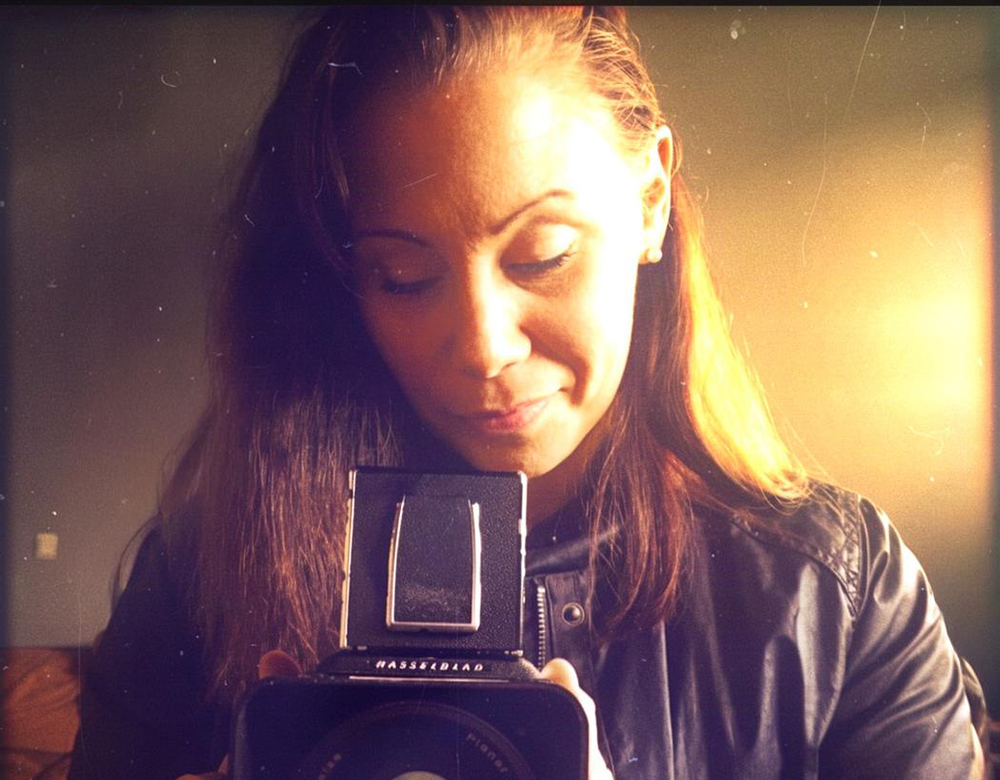
Sofia-Karla Axelsson
Your work moves between photography, music, dance, and visual storytelling. How did these different creative disciplines become connected in your artistic practice?
From childhood, creativity was always very present in my life. My father photographed with an analogue camera, which eventually became the first camera I used myself. I started taking photographs of my sisters, styling them and creating little scenes around them. He also filmed us with a VHS camera, so images, movement and storytelling were part of my everyday life from an early age.
I also had the opportunity to assist photographer Håkan Olsen on one photoshoot and took part in his photography courses at Photo International in the north of Sweden. Being able to learn through both practical experience and his courses gave me an important foundation in photography.
Storytelling was another natural part of my childhood. I was always making up stories, and later I took literature courses and drama classes. When it came time to choose my education, I remember feeling very divided between media and dance and theatre. I didn’t really want to choose just one subject.
Music was equally important. I played the violin because of my father’s musical background, and although I learned the instrument traditionally, I often found myself wanting to improvise rather than simply play exactly as the teacher instructed. I also took piano and singing lessons. My musical influences came from both of my parents in different ways. Through my father I discovered classical music and artists such as Itzhak Perlman, while my mother introduced me to The Beatles, The Rolling Stones, Jimi Hendrix and other music that became part of my creative world.
Looking back, I think that instinct to move between different forms of expression has remained at the centre of my artistic practice. Photography, music, movement and storytelling have become different ways for me to explore the same things: emotion, atmosphere, identity and the stories we carry within us.

Nature plays a strong role in your images, often appearing almost like a character rather than simply a setting. What draws you to forests, fields, and other natural environments?
I grew up in the north, surrounded by greenery and nature, so being close to the natural world has always felt very familiar to me. Even after moving into more urban environments, I have often found myself wanting to return to that feeling of complete stillness.
There is something about being in a forest where you can feel completely anonymous. You can have your own space, your integrity and your peace, away from the noise and expectations of everyday life. I think that feeling has stayed with me and naturally found its way into my photography.
At the same time, I have realised that you can carry that feeling of stillness within you, even when you are living in a big city. The environment may be completely different, but there can still be an inner sense of solitude, freedom and peace. I think that contrast interests me—the relationship between the outside world and the inner landscape we carry with us.
For me, nature therefore becomes more than a setting. It represents a state of mind, a place of freedom and introspection, and sometimes a way of returning to something very essential within myself.
Many of your photographs have a dreamlike, cinematic atmosphere and seem to suggest a story beyond the frame. How do you develop the narratives behind your images?
I think I have a very visuospatial way of thinking. I often see things as images, compositions, movements and atmospheres before I have put them into words. An image can appear in my mind almost like a scene from a film, and from there a narrative begins to develop.
I also really enjoy the way dreams communicate through metaphors. Dreams don’t always explain themselves literally; they use images, symbols, emotions and unexpected connections. I think that has influenced the way I approach photography. I am interested in creating images that suggest something rather than explain everything.
Often there is a story behind an image, but I don’t necessarily want to give the viewer the entire story. I prefer to leave something open, so that the photograph can become a fragment of a larger narrative and the viewer can bring their own memories, feelings and imagination into it.
For me, the dreamlike quality comes from that space between what is real and what is imagined. I want the images to feel as though they could be a memory, a dream, or a moment from a story that continues beyond the frame.

In several of your photographs, people are partially hidden, cropped, or obscured from view. What interests you about showing the human figure in this way?
A human being is complex, and so is a human story. I think there is something beautiful about not revealing everything. When the face is hidden, cropped, or obscured, the image becomes less about a specific identity and more about the feeling, the gesture, or the story that might be taking place.
One of the mysterious qualities of a photograph is that it can leave you guessing. I don’t always want to tell the viewer exactly who someone is or what has happened. I would rather leave small clues and allow them to wonder, imagine and create their own interpretation.
For me, what is left unseen can sometimes be just as important as what is visible. It creates a sense that there is a larger story beyond the frame, and I like giving the viewer that space to enter the image with their own imagination.

You have lived in Stockholm, London, and Spain. Have these different places and cultural environments influenced your visual language or artistic identity?
I think each place has influenced me in a different way, not only visually but also in how I understand people, culture and creative expression.
I studied both in Stockholm and London, but my time in London opened up something very strongly in me. The contemporary dance scene, the galleries and exhibitions, and the opportunity to meet different artists, choreographers and teachers exposed me to many different ways of thinking and creating. I found a sense of openness and experimentation in the way people approached art and the world around them, and that was deeply inspiring to me. It expanded my own way of seeing and made me more curious about what is possible when different disciplines and perspectives meet.
In Spain, I found inspiration through a local choreographer whose dance classes I attended, and I also made an effort to learn and practise the language. I wanted to connect more deeply with the people who actually lived there, rather than remaining on the outside as a visitor or experiencing only the commercial and tourist-oriented side of the country.
I think I have always liked entering a new environment and adapting to it while still bringing my own story with me. For me, it is not about leaving one identity behind and taking on another, but about allowing yourself to flow with a new place and letting it become part of you.
At the same time, Stockholm and the northern environment where I grew up are deeply connected to my visual language. There is a relationship to nature, stillness and space that I carry with me wherever I go.
I don’t think these places have given me separate identities. Rather, they have become different layers of my visual language and the way I experience and interpret the world.

When creating a new project, what usually comes first for you: an image, an emotion, a piece of music, a personal experience, or something else?
Often, it begins with a feeling. That feeling might create a visual image in my mind, or sometimes it becomes a movement in my body. I can feel when it is something I want to work further on, and then I develop the idea from that very seed.
I might start drawing what I see on paper, making a rough sketch, or writing down words and fragments of ideas. Sometimes it becomes almost like creating a scenography—I begin to imagine the space, the movement, the atmosphere, the people and the story within it.
From there, the different disciplines can naturally come together. A visual idea might lead to photography, movement might become music, or words might develop into a larger visual world. For me, the creative process is intuitive, but also very deliberate in the way I nurture that first idea and allow it to grow.

Across your work, you often invite the viewer into moments of introspection and emotional ambiguity. What do you hope people experience or discover when spending time with your art?
I hope people can experience the many feelings that the journey of life takes us through. The deep, raw emotions—the joy as well as the sadness—are all part of being human. I don’t think we can separate one from the other, because it is often through experiencing the full range of emotions that we grow and understand ourselves more deeply.
I would like my work to create a space where people can pause and perhaps recognise something of themselves. Maybe an emotion, a memory, a longing, or a moment they have experienced in their own life.
For me, we are all human travellers. We move through different landscapes, both externally and within ourselves. I think art can accompany us on that journey—not necessarily by giving us answers, but by allowing us to feel, reflect and perhaps see something from a different perspective.