
Fanyun Peng, Yue Hu, Xinyao Wang, Chad Xu
Rain Rite draws on the ancient Chinese tradition of Nuoxi. What first inspired you to reinterpret this ritual through contemporary performance and digital media?
Fanyun: It started with a conversation between us, about how quickly technology is evolving, and how AI already unsettles people in ways that feel almost primal. That led us to wonder: has this feeling always existed? We started thinking about how, in ancient times, witches and shamans occupied a similar space in the collective imagination that forces beyond ordinary understanding, both feared and needed.
From there, we found ourselves drawn to rain rituals: the idea that communities once gathered, performed, and genuinely believed that human action could move the heavens. We asked ourselves: what would it mean to recreate that kind of moment today, using the most advanced tools we have? Could the technology be turned into an instrument of connection rather than anxiety?
Nuoxi felt like a natural anchor, but our interest was never in reconstructing a historical practice. What fascinated us was the human emotion behind it. On the surface, Rain Rite tells the story of a community facing devastating drought, without scientific knowledge or technological solutions, people turn to dance, music, and ritual as a way of reaching toward the divine. But beneath that, it’s really about something timeless: even when confronted with forces far greater than ourselves, we continue to seek connection, meaning, and hope. Through contemporary performance and digital media, we wanted to reinterpret that impulse in a form that speaks to audiences today.
How did you approach the cultural and spiritual meanings of Nuoxi while transforming it into a work for a contemporary international audience?
Yue: Rather than reproducing specific historical forms, we focused on preserving the spirit of the ritual. We were interested in themes that feel universal: uncertainty, resilience, the relationship between humans and nature, and the search for meaning in difficult times.
Nuoxi has a rich cultural history, but the emotional questions at its core transcend geography and time. How do people respond when faced with forces they cannot control? How do communities maintain hope during periods of crisis?
By translating these ideas into movement, drumming, light, and digital imagery, we hoped to create an experience that could resonate with audiences regardless of their cultural background.
 Fanyun Peng, Yue Hu, Xinyao Wang, Chad Xu | Rain Rite Cover
The performance creates a striking liminal space between ritual, theatre, installation, and digital art. How do you define Rain Rite within your broader artistic practice?
Yue: My work lives between disciplines, as an artist, engineer, and drummer, I’m drawn to experiences where sound, technology, visual systems, and human presence continuously shape one another. Rain Rite reflects that. It combines live performance, generative visuals, ritual-inspired storytelling, and interactive media into a space that is simultaneously physical and symbolic. Technology here isn’t spectacle, it’s a medium for exploring memory, emotion, and collective transformation.
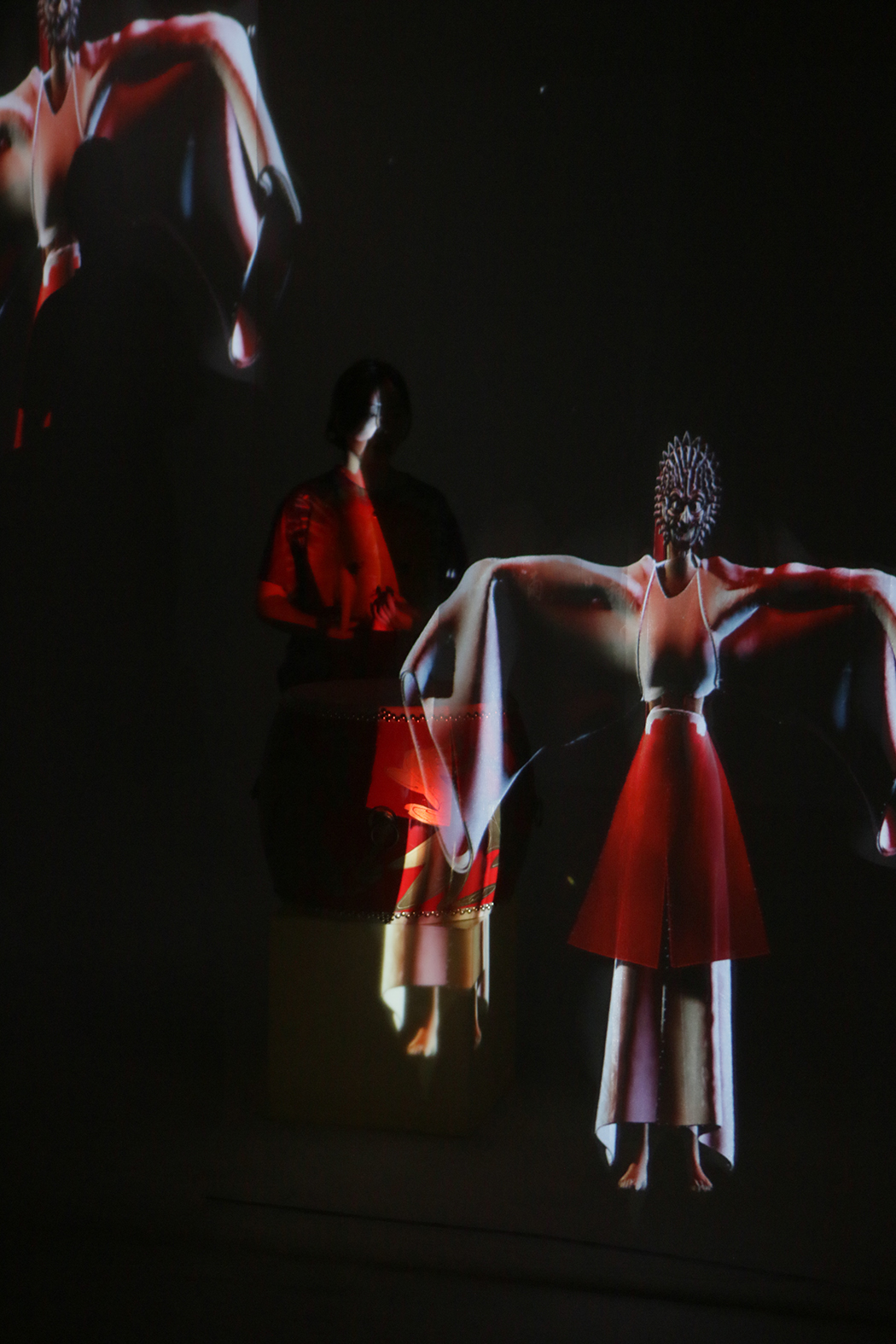
Yao: I don’t think of Rain Rite as belonging to any one form, and that in-between is exactly where my work lives. It’s a ritual first. Theatre gives it an arc, installation gives it an environment, digital art gives it the ability to respond in real time. But what holds them together isn’t a medium, it’s the ceremony itself. Rain Rite is built as a single feedback loop: a mic over the drum drives audio-reactive visuals, motion capture turns the dancer’s body into a second projected presence, and the projection wraps back around the performer. Dancer, instrument, and image share one nervous system. What I’m ultimately after is a liminal space where people forget there’s technology at all, where they feel part of something being summoned, together.
Fanyun: With a background in both computer science and art, blending multiple mediums feels natural to me. I’ve always believed that every medium, every material, every tool is simply a means of conveying an idea, the work is in finding the right form to carry it. For Rain Rite, that form is inherently plural. The dance shapes the rhythm, the rhythm drives the visuals, and the visuals in turn elevate the dance. Nothing exists in isolation; each element breathes with the others. That interconnection isn’t just an aesthetic choice, it’s the argument the piece is making. When ancient ritual and real-time technology speak the same language, the boundary between them dissolves, and something truer emerges.
Red light, shadow, projected landscapes, and circular solar or halo-like imagery play a central role in the work. What symbolic meanings do these visual elements carry for you?
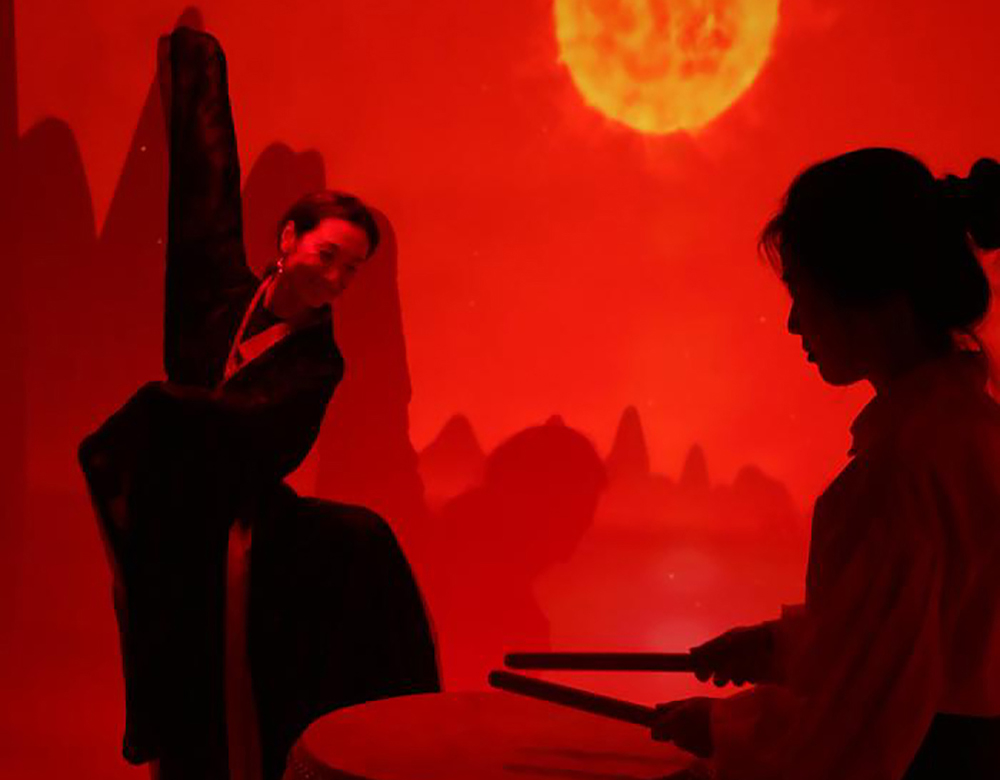
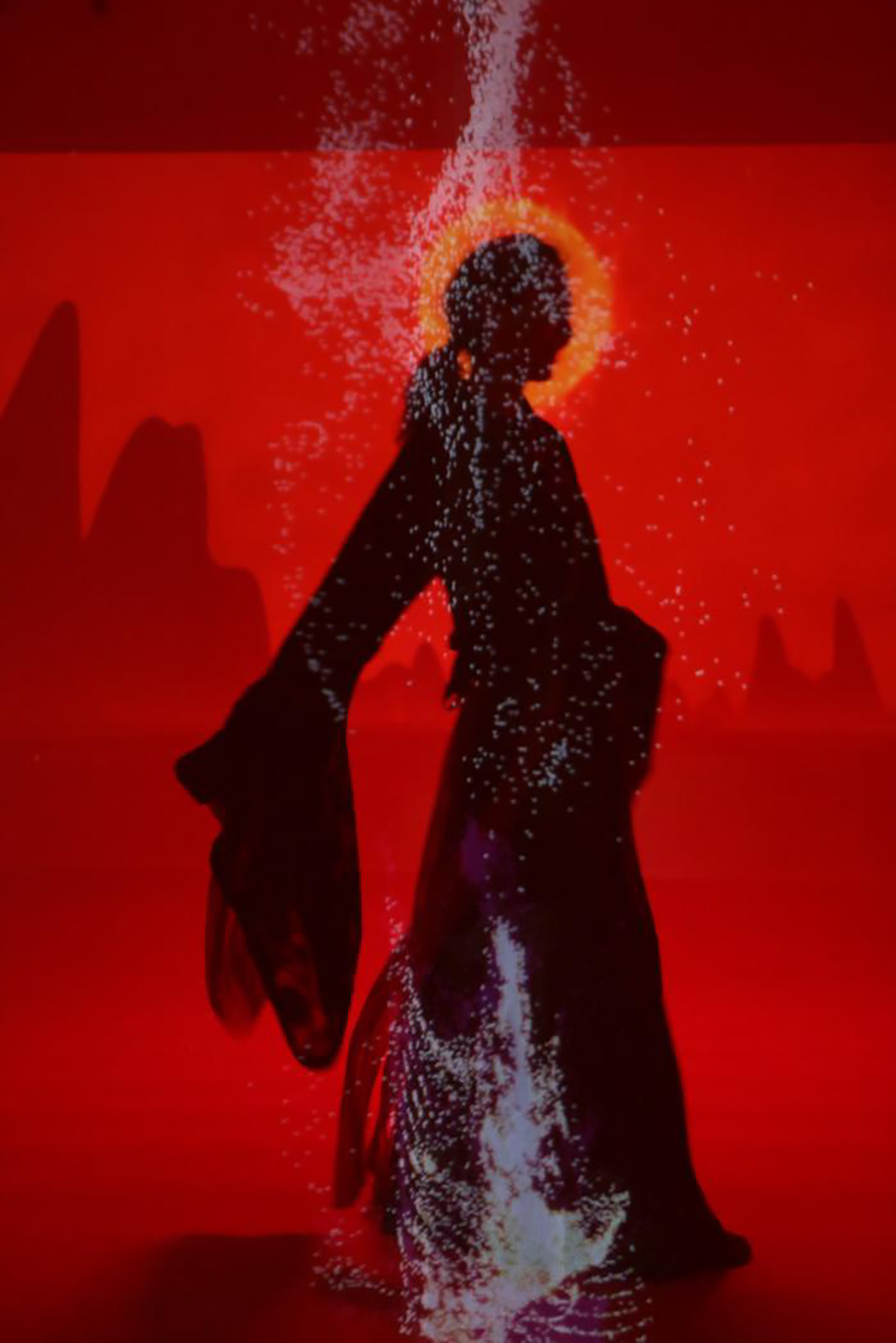
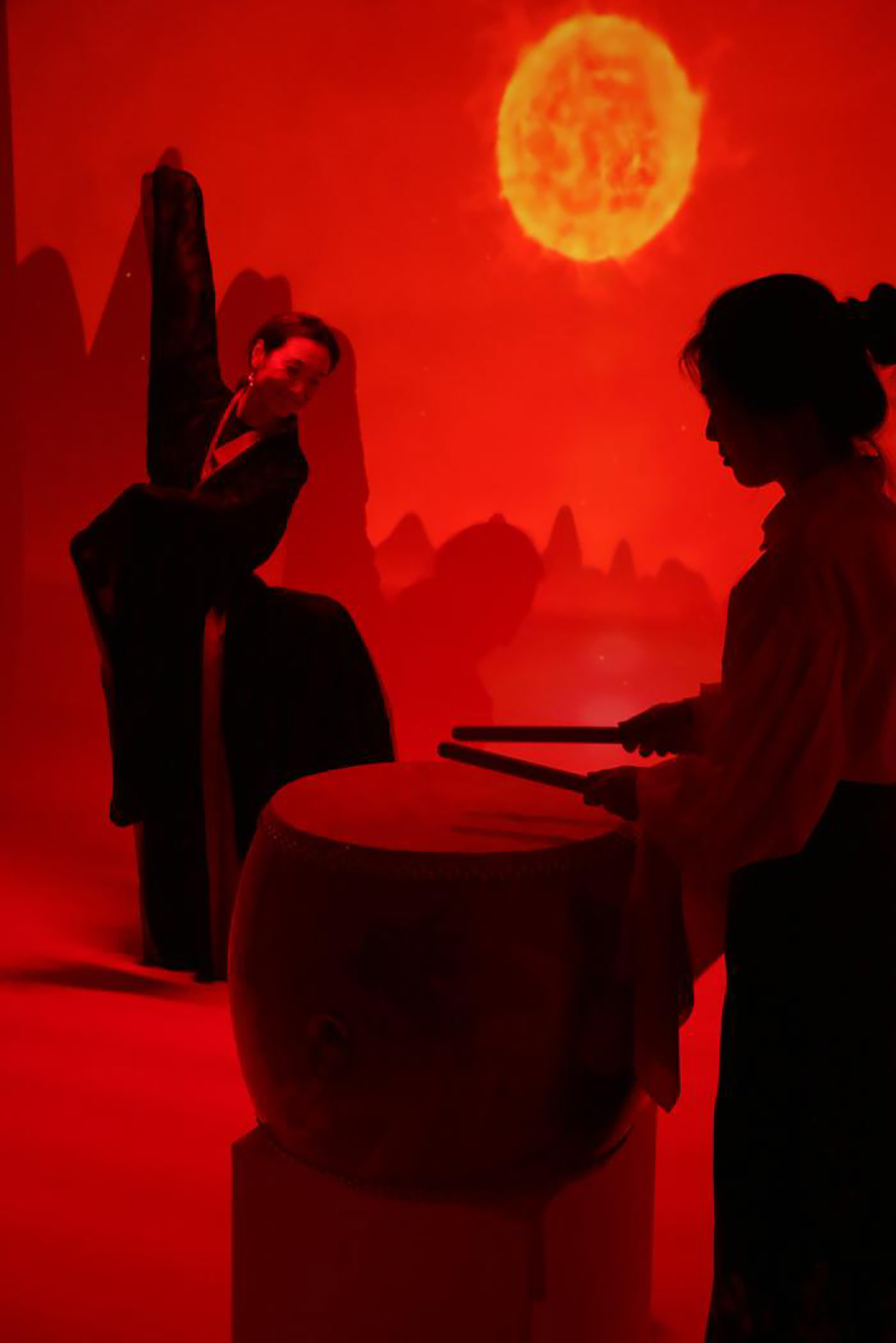
Chad: The visual language of Rain Rite grew directly from the narrative arc of the piece. It opens in a scorched world of red and gold, colors of heat, drought, and a civilization at the edge. Pulsating solar imagery amplifies that oppression, reflecting nature’s overwhelming indifference to human vulnerability.
As the ritual unfolds, the environment transforms. Clouds gather, mist thickens, thunder emerges, rain falls in rhythm with the drums embodying the central tension between human will and forces beyond our control.
By the final act, the storm clears. Golden wheat fields and rising Kongming lanterns bring renewal and hope. The circular forms woven throughout — sun, halo, portal — carry a quieter meaning: that drought and rain, loss and renewal, destruction and rebirth are not opposites but parts of the same unbroken cycle. The circle is the piece’s argument: what feels like an ending is always, also, a return.
 Fanyun Peng, Yue Hu, Xinyao Wang, Chad Xu | Rain Rite Performance
The human body appears both physically present and transformed by projection. How does this relationship between the body and the digital image reflect your interest in the boundaries between the real and the virtual?
Yao: What I care about is the seam between the two, not either side on its own. In Rain Rite, the body that’s really there is the drummer, present, physical, striking with real force. The dancer is virtual: conjured out of the sound the drummer is making, reacting to it in real time, living only as long as the drummer keeps playing. It isn’t a person standing next to a copy of themselves; it’s a real body calling a virtual one into being. The line between real and virtual goes quiet because one is so clearly listening to the other.
In ritual terms, that’s exactly the point. The drummer plays, and something appears, a spirit, an ancestor, a dancer made of light. The real and the virtual stop being two categories and become one gesture. Technology amplifies real presence, it never replaces it.
Fanyun: The dance itself is rooted in Nuo. I choreographed the movement drawing from that tradition, and Yao reinterpreted it through the character she designed. From there, we layered the live performance on top, building outward from that ritual core. I’m drawn to that process of layering, each element adds depth until the whole becomes something you can feel rather than just watch. The digital environment is what makes full immersion possible: a space where the physical and the virtual reinforce each other, and where the audience isn’t observing a ritual so much as being drawn into one.
Rain Rite was created in collaboration with Fanyun Peng, Yue Hu, Xinyao Wang, and Chad Xu. How did each collaborator’s artistic or technical background shape the final work?
Yue: Rain Rite was shaped through a genuinely interdisciplinary collaboration, and the final work would not exist without the different perspectives each collaborator brought to the project.
Fanyun Peng led the interaction design and the audio-reactive system, exploring how live drumming could become a real-time visual language. Her work allowed the performance to respond dynamically to sound, making each presentation unique.
Yue focused on storytelling, visual worldbuilding, and animation design. Her role was to translate the emotional journey of the ritual into a symbolic visual landscape—from drought and desolation to rain, renewal, and hope.
Xinyao Wang contributed both stage design and choreography. She developed the spatial relationship between projections, lighting, and performers, while also drawing inspiration from traditional Nuo dance to create a movement language that connected the physical body to the ritual narrative.
Chad Xu composed the original score and helped shape the overall artistic direction of the project. His music provided the emotional structure of the work, guiding the audience through invocation, conflict, transformation, and rebirth.
Although each of us worked in different disciplines, the project evolved through constant dialogue between sound, movement, storytelling, and technology. Rather than functioning as separate layers, these elements became part of a single living system.
 Fanyun Peng, Yue Hu, Xinyao Wang, Chad Xu | Rain Rite Cover Performance
Your work often brings spiritual or cultural ideas into dialogue with technologies such as AR, VR, AI, and interactive media. Do you see technology as a tool, a collaborator, or an active presence within your work?
Yao: For me, technology is most alive when it’s listening, when a real physical action reaches across and summons something digital into the same room. In Rain Rite, the drummer plays and the virtual dancer appears, reacting in real time, existing only as long as the rhythm continues. That’s not technology as tool or spectacle; it’s technology as presence, as the seam where the physical and virtual become one gesture. In ritual terms, that’s always been the point: you perform, and something answers.
Yue: I see technology primarily as a medium rather than a subject. Human beings have always sought ways to communicate with forces beyond their understanding: in ancient times through ritual, music, and dance; today through digital media and interactive systems. The tools have changed, but the impulse hasn’t. In Rain Rite, technology isn’t there for spectacle — it creates a contemporary ritual space where projection and sound reactivity become vehicles for exploring hope, uncertainty, and our relationship with nature. What interests me is whether these tools can help us recover something modern life often overlooks: wonder, collective experience, and spiritual connection.
Fanyun: I’ve never seen technology as something to fear or resist, it’s simply a product of the society we live in, and using it is a way of reflecting the world that has shaped us. That exchange feels mutual to me: we shape technology, and it shapes us back. I don’t set boundaries around my art forms. Whatever is around me, I’ll use it to express what I’m thinking and feeling right now. Living in this moment, that naturally includes digital tools alongside everything else. I try not to overcomplicate it, just live, embrace, and express.