
Raasuke
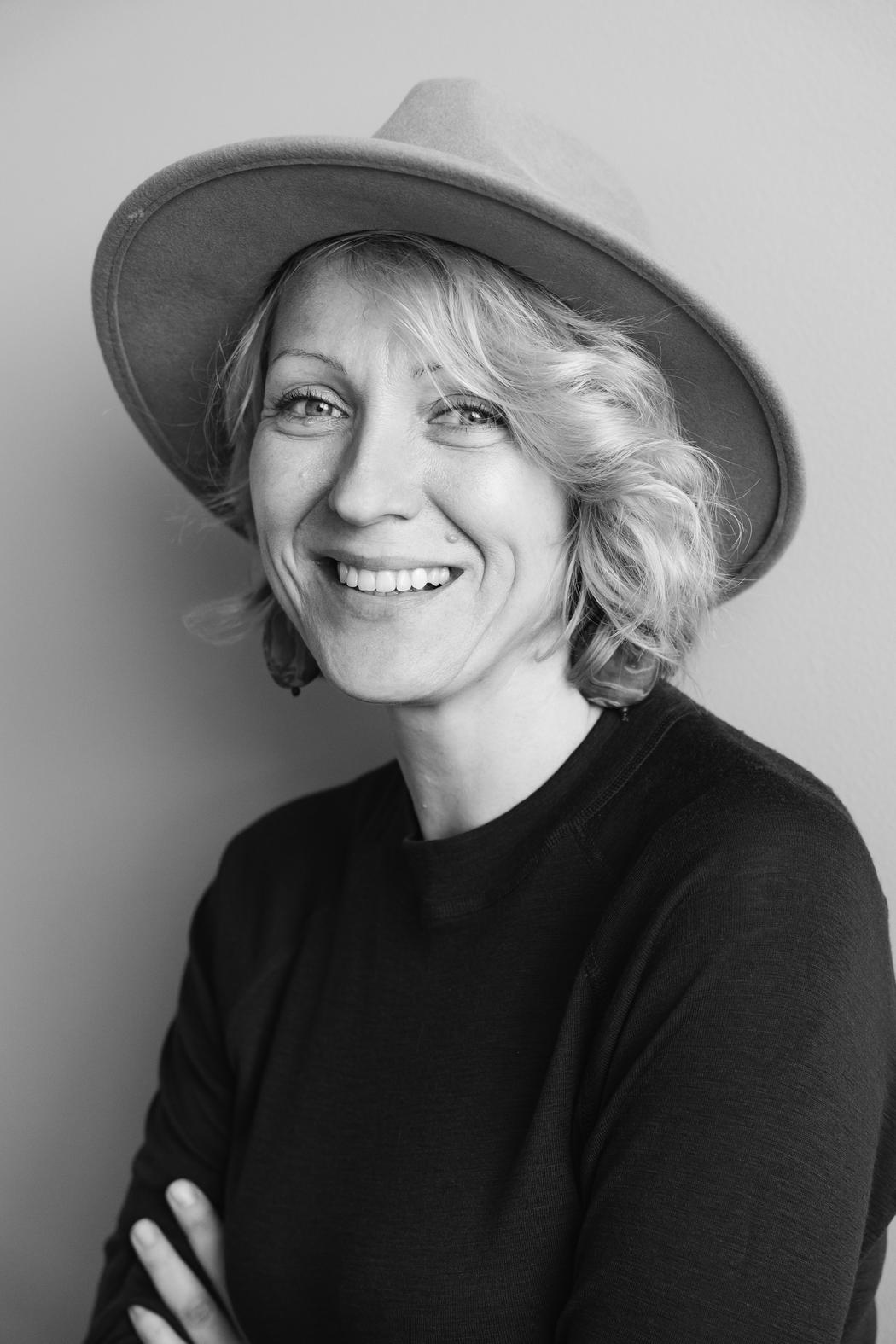
Your artistic journey began outside formal academic institutions. How did this independent path shape your visual language and creative freedom?
Indeed, I did not come to art through academic education, although I hold great respect for it. It simply happened that my life’s goals were initially connected to a different field: for more than 30 years, I dedicated myself to voluntary educational work.
Painting became part of my life in a very natural way. For example, when I reach certain depths inside me, I don’t feel the urge to sing or dance. It immediately becomes color, form, an inner image that demands to be released onto the canvas, where this state can acquire visible density.
My visual language is born from freedom—not as a rejection of rules, but by giving myself space to explore with curiosity. It grows out of an ongoing dialogue with myself, with the poet Toivo Arumets, with whom I have a wonderful creative collaboration, and with artists of the past and present.
I ask myself simple yet uncomfortable questions: what and why. Toivo adds his own why, which complicates everything even further. When I look at the works of other artists, I study their solutions, how things are done, and I inevitably ask myself: how would this resonate in my own visual language?
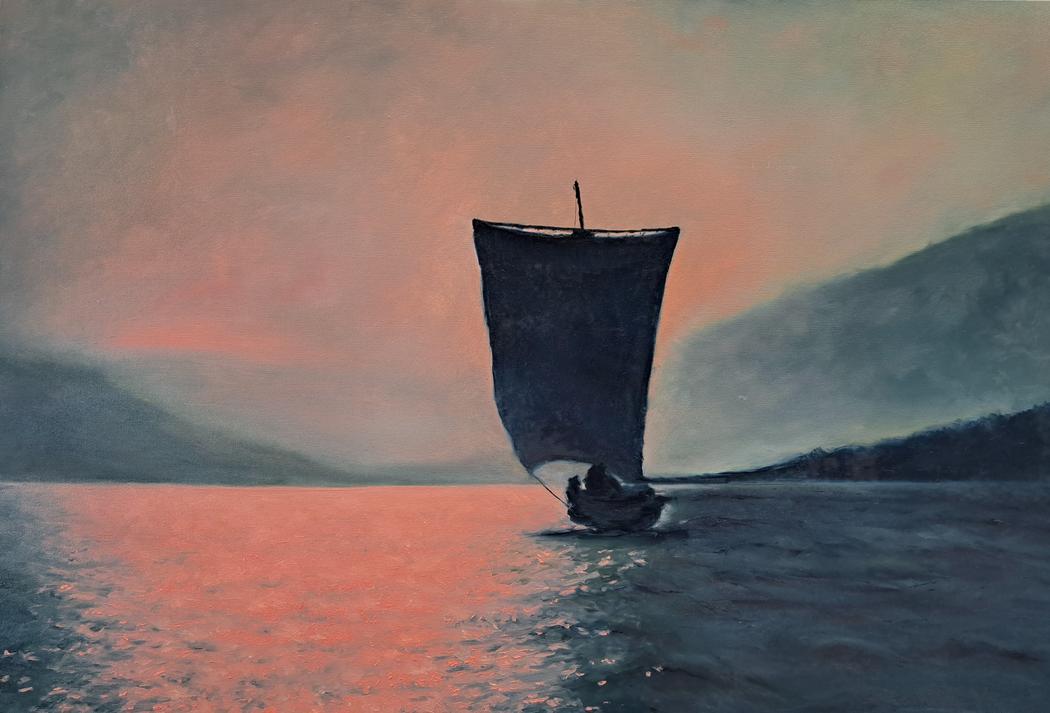 Raasuke | The Best Road Is the Road Home | 2025
You describe yourself as a metamodernist artist embracing “new sincerity”. What does this concept mean to you in your daily practice?
When I think about who I am in art, I recall Kandinsky’s words: “Attempts to revive the principles of past art, create, et their best, works that resemble a stillborn child.” Art lives alongside life. It continually reinterprets timeless values and our human experiences.
I resonate with David Foster Wallace’s idea that the exhaustion with irony (characteristic of postmodernism) can be overcome only by being sincere. This speaks to me personally, and I believe, to our contemporary society and to a new stage in art.
For me, metamodernism is a return to sincerity through searching and vulnerability. It is about forming a holistic perspective that can freely hold opposing attitudes, emotions, and styles—bringing together the real and the abstract.
In my daily practice it means that my inner emotional state urges me to create, that is my sincerity, while constantly asking: what? why? for what purpose? Personal experience becomes an equal artistic material alongside the social and the conceptual. In dialogue with tradition, I clarify rather than submit. My forms may be simple or “quiet,” but behind them there is always depth and a sense of aesthetics.
Your works often feel intimate and dreamlike, almost suspended between reality and memory. How do you approach creating this atmosphere?
One of my guiding principles in life is: “A joyful heart always has a feast.” Our feelings are an extension of our thoughts. This is not about ignoring difficulties. And not all complex emotions are harmful. Rather, it is about conscious choice. I understand that my emotional resources are limited, and it matters deeply where I direct them.
Sometimes I think of it as a house with many rooms: I can choose which one to enter and where to spend my day. The same happens in my art. I invite the viewer, as a guest, into the brightest spaces of my inner world—places where the air feels lighter, where there is a sense of pause. These are the rooms where one can briefly return to childhood, to feel wonder, ease, safety, and inner warmth.
This is why I often turn to a childlike way of seeing the world as a source of sincerity and vivid perception. It is a way of looking without cynicism, with curiosity and humor. In this state, things do not lose their complexity, but they gain transparency and fragility.
I am also fortunate to work closely with my husband, the poet Toivo. We work at the intersection of painting and ekphrasis. Our process is filled with dialogue, humor, and mutual trust. Ideas are born in an atmosphere of love and understanding. It is a great happiness for me to be engaged in a shared creative endeavor with someone so close.
Among the artists I like to return to is Peter Doig. What resonates with me in his work is that he is not concerned with accurately reproducing nature, but with conveying his own sensations of a places and the fantasies connected to it.
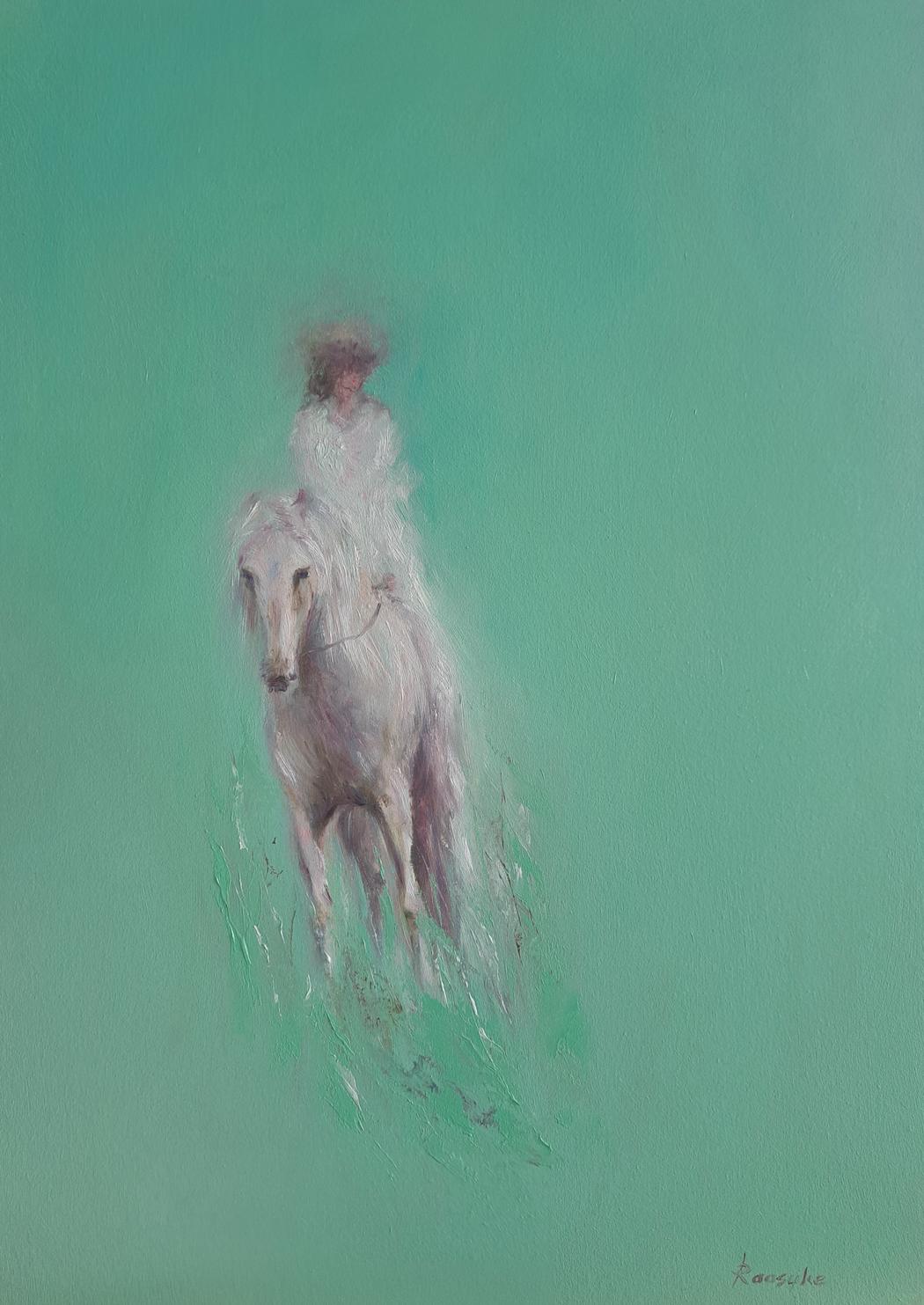 Raasuke | My Childhood Friends | 2025
The idea of the “inner child” is central to your artistic identity. How does this presence guide your decisions while painting?
I remember the words of a professor from an art university who once said in an interview that what upsets him most is precise copying of a landscape, a portrait, or anything. Because painting is not retelling. It is poetry. That thought gave me courage to stop being correct and to start trusting my inner child.
For me, this state is not about childishness, but about freedom from excessive control. It removes the fear of making a mistake and opens space for risk: to play with form, color, rhythm, visual rhyme. In this state I am not making decisions but allowing them to happen.
Very often it is the spontaneous brushstroke, the sudden feeling, the moment of sincere wonder that turns out to be more accurate than any carefully constructed plan. I don’t try to correct it or force it to fit an idea, I follow it.
In a sense, the inner child helps preserve sensitivity, not to grow numb and to keep my painting from turning into a formula. Because of this, my works remain fluid, vulnerable, alive—and the viewer recognizes this feeling.
Having lived in multiple countries and worked with people from diverse cultural backgrounds, how have these experiences shaped your understanding of humanity in your art?
Over time I realized that almost all of my paintings include a human figure, and without it something in the composition feels incomplete. For me, a human is the most astonishing and beautiful creature, with immense potential. And because people and their lives are inseparable, that connection naturally appears in my work.
It’s hard for me to judge how deeply I understand human nature, because people’s view of life and their values can differ so dramatically. Just like sometimes it is impossible to convey the exact meaning of a world in another language, living in different countries makes you notice subtle shades of meaning in traditions and everyday habits that you simply didn’t notice before. What once seemed like the only “right” way to behave, to value things, or to express emotions turns out to be just one of many possibilities. At first this can create inner resistance, but with time you begin to see the beauty of the other types of behaviors.
For example, I became interested in Ruth Benedict’s ideas about shame‑based and guilt‑based cultures. Of course, both mechanisms exist everywhere, the difference is only which one is more prevalent. I grew up in a culture built on an internal sense of responsibility, where a person evaluates their own actions. So, at first it was difficult for me to understand societies where the external opinion, the reaction of others plays a larger role. But once I understood that this is simply another way of perceiving and living, I began to see its harmony and beauty: the strength of family ties, the care shown both to loved ones and to strangers, and the resilience and richness of traditions.
This experience taught me to feel and respect differences and at the same time to look for what connects us. In this sense, my perspective has become more whole — less dividing, more unifying. Despite all our differences, something deeply human remains: vulnerability, the desire for closeness, the need to be seen and understood. What matters to me is not so much speaking about differences, but finding those inner states that resonate beyond language and geography.
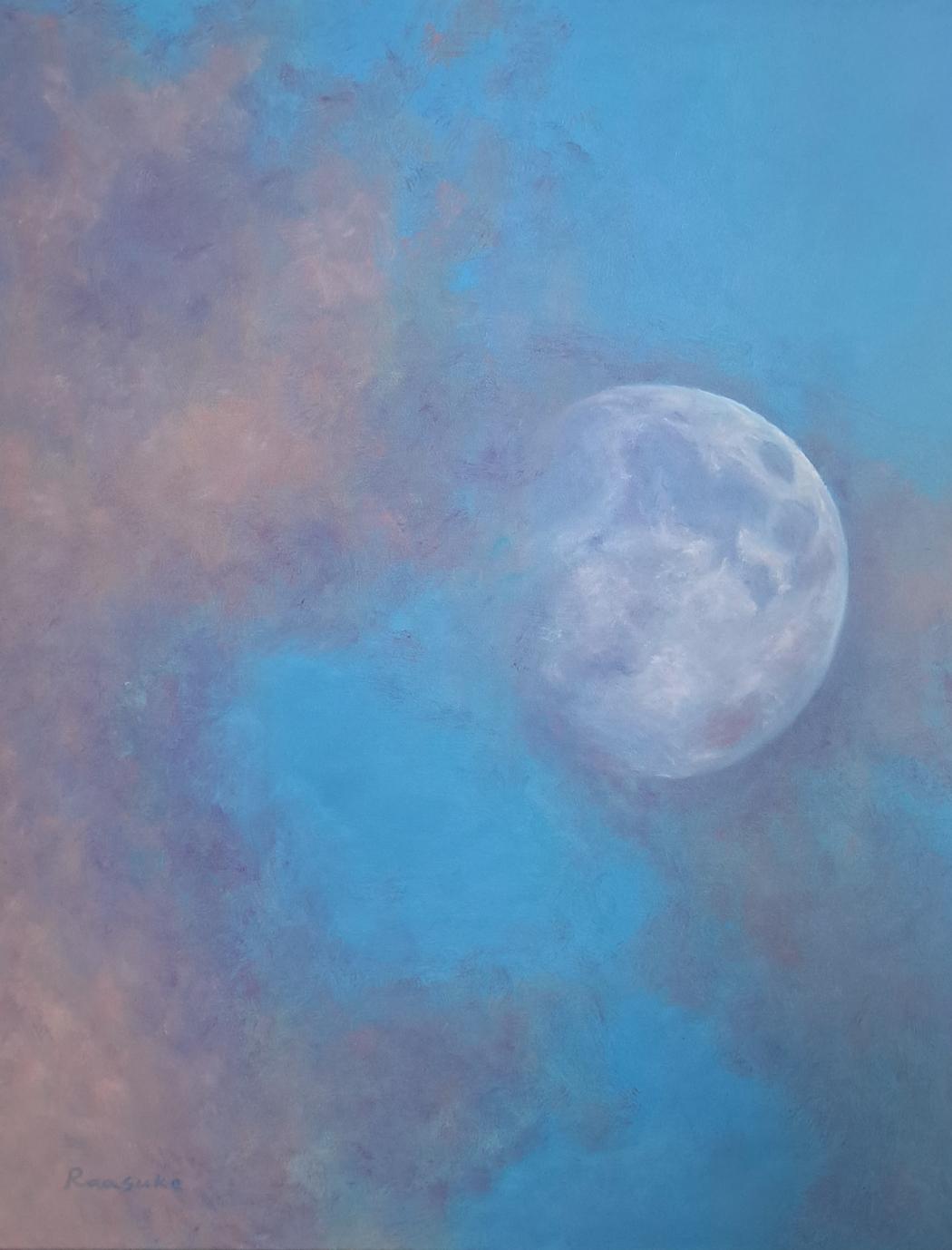 Raasuke | Moon’s Lullaby | 2026
You mention that you often paint with your fingers. What does this physical, direct interaction with the material give you that brushes cannot?
When I paint with my fingers, I’m literally in direct contact with the painting. I feel the paint with my skin, its thickness, its viscosity, the way it yields to movement or, at times, resists it. It’s a very physical, almost instinctive process, where the hand becomes an extension of an inner emotions.
A brush brings a certain discipline, while fingers return me to a more intuitive, almost childlike way of interacting with the material. With fingers I do more than depicting the form, I live it: smearing, pressing, dissolving edges. There’s something very raw in it — as if you’re learning to feel the material all over again, learning to trust it.
For me, there’s a special honesty in that: when an image is born not from control, but from being physically present in the moment.
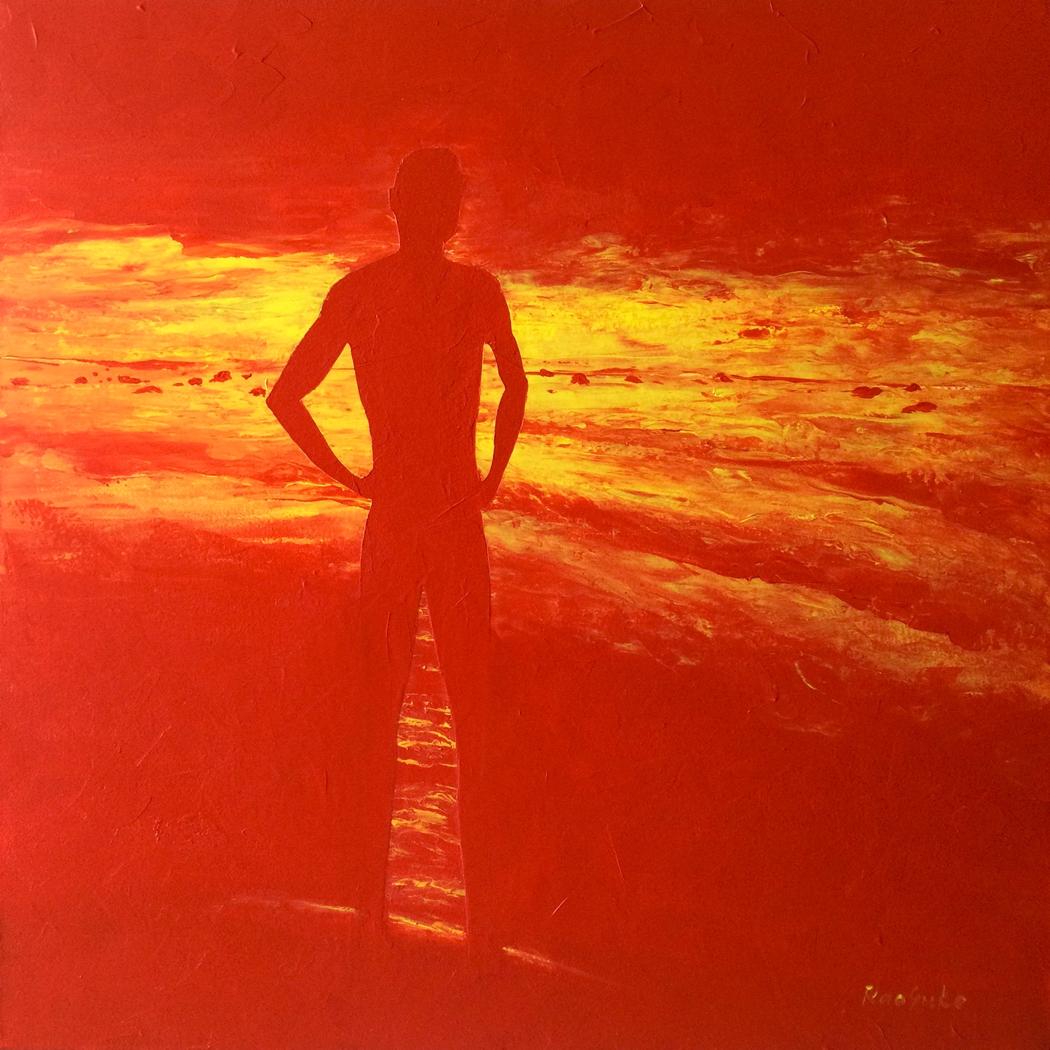 Raasuke | Man like Sun | 2024
If your art is a “self-portrait”, as you describe it, what do you hope the viewer discovers about themselves through encountering your work?
I’ve learned a great deal from artists for whom art was a form of inner expression. Frida Kahlo said that her paintings reflect her personal story and her feelings. In Egon Schiele’s paintings, even his depictions of other people feel intensely personal, almost like extreme self‑portraits. And the remarkable Jenny Holzer captured perfectly this movement toward sincerity: “I gave up generalities and began to speak in the first person.”
This approach resonates with me. Honesty and speaking from one’s own experience create an emotional bridge with the viewer — they build trust and a sense of inner calm.
When someone encounters my work, I hope they discover a kind of inner permission to feel joy. The sincere light in art gives an important message: gentle, bright emotions are just as real and meaningful as the complex and contradictory ones.
This positivity isn’t superficial, it almost always comes through experience. It doesn’t deny complexity — it includes it. That’s why my paintings feel more like the peace after tension rather than an attempt to escape reality. In this sense, there’s also an element of emotional restoration: a chance to exhale, to feel warmth, to regain inner balance.
I asked my friends what they find in my art. They all spoke about the synergy between painting and ekphrasis, about the sense of rhythm that emerges from my collaboration with my husband — a rhythm that feels like a harmonious whole. To be honest, Toivo is still surprised that he’s a poet. He started writing poems for my paintings simply to make me happy. We share similar spiritual values and life goals, and perhaps that’s why our work reflects harmony, lightness and humor.
Sincerity always carries a risk. I know I might seem too open, yet I choose this path anyway. For me, it isn’t naivety but a conscious, living practice of speaking through art.
Leave a Reply
You must be logged in to post a comment.