
Mohsen Saeb
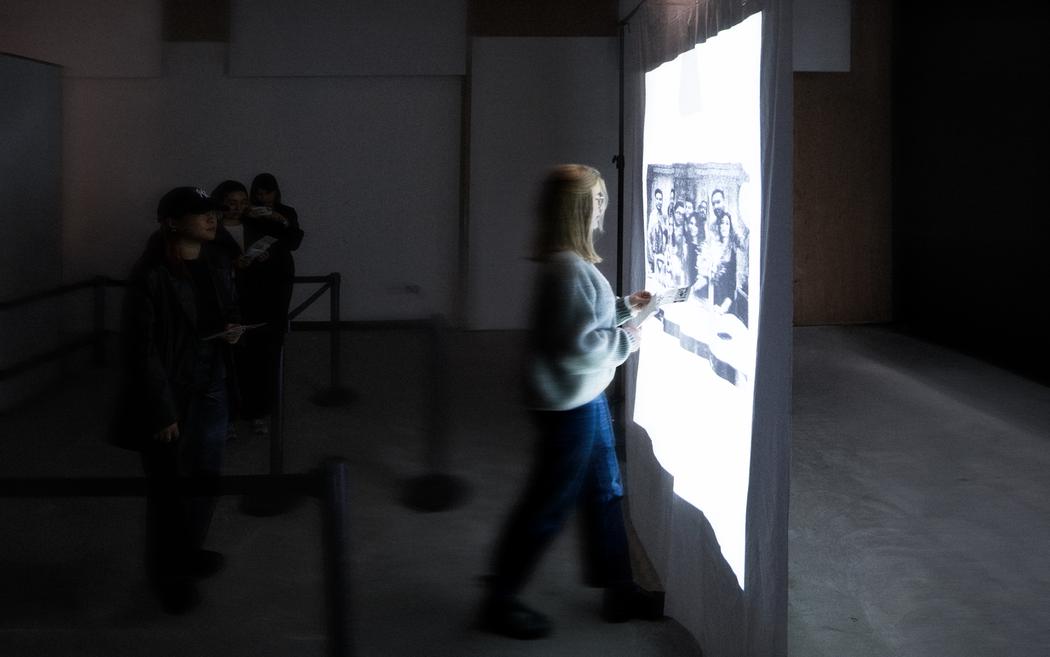
Your practice spans many different artistic mediums. What draws you to immersive experience as a mode of expression?
Immersive experience helps me bring different parts of my practice together in a way that feels more natural and complete. I work with image, object, sound, moving image, and space, and for me they feel most alive when they can speak to each other rather than exist separately.
What keeps drawing me to immersion is that it lets meaning grow through experience, not only through explanation. Some emotions or tensions are difficult to hold inside a single image or object; they need atmosphere, rhythm, movement, and the presence of the body. So for me, immersion is not just a formal decision, but a more honest way of expressing how experience is actually lived and felt.
Your work often translates deeply personal experiences of migration into shared spaces. At what moment did you realize that migration would become a central theme in your artistic practice?
It became central when I realised migration wasn’t staying in the “past tense.” It wasn’t just something people did; it was something they continued to live inside. When I started documenting oral histories and interviewing 15 Iranian students who had left in the last few years, I saw how the emotional intensity of migration is compressed into a very short period, but the impact doesn’t end.
Their stories weren’t only about moving countries; they were about a permanent shift in perception — of home, of self, of belonging. As an artist, I wanted to translate that invisible inner landscape into something physical: an experience people can step into, move through, and feel.
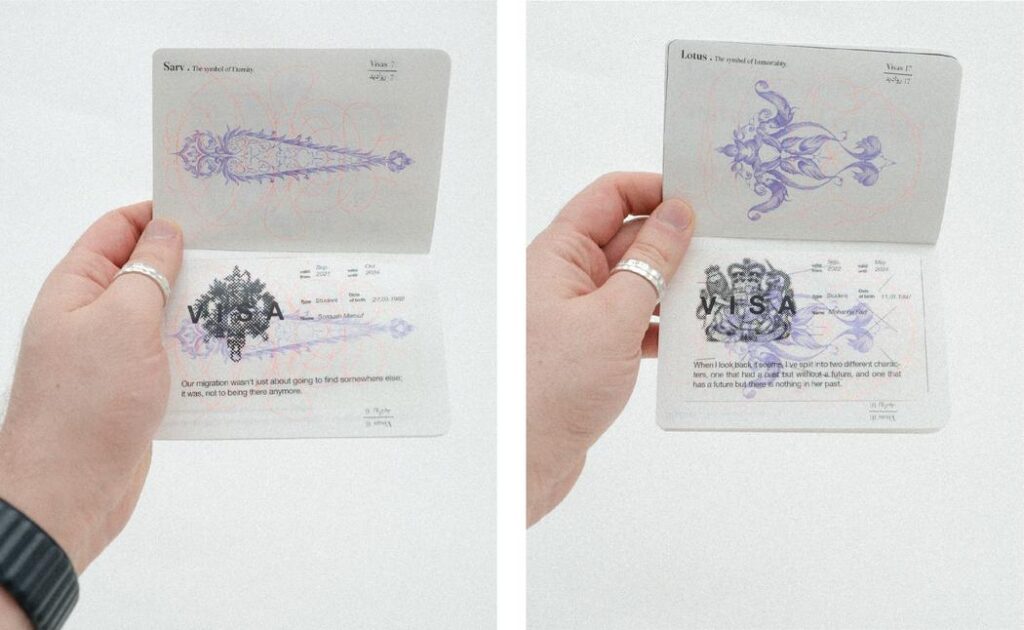
This project uses hand-crafted objects like passports and boarding passes as key elements. What do these objects symbolize for you beyond their functional role?
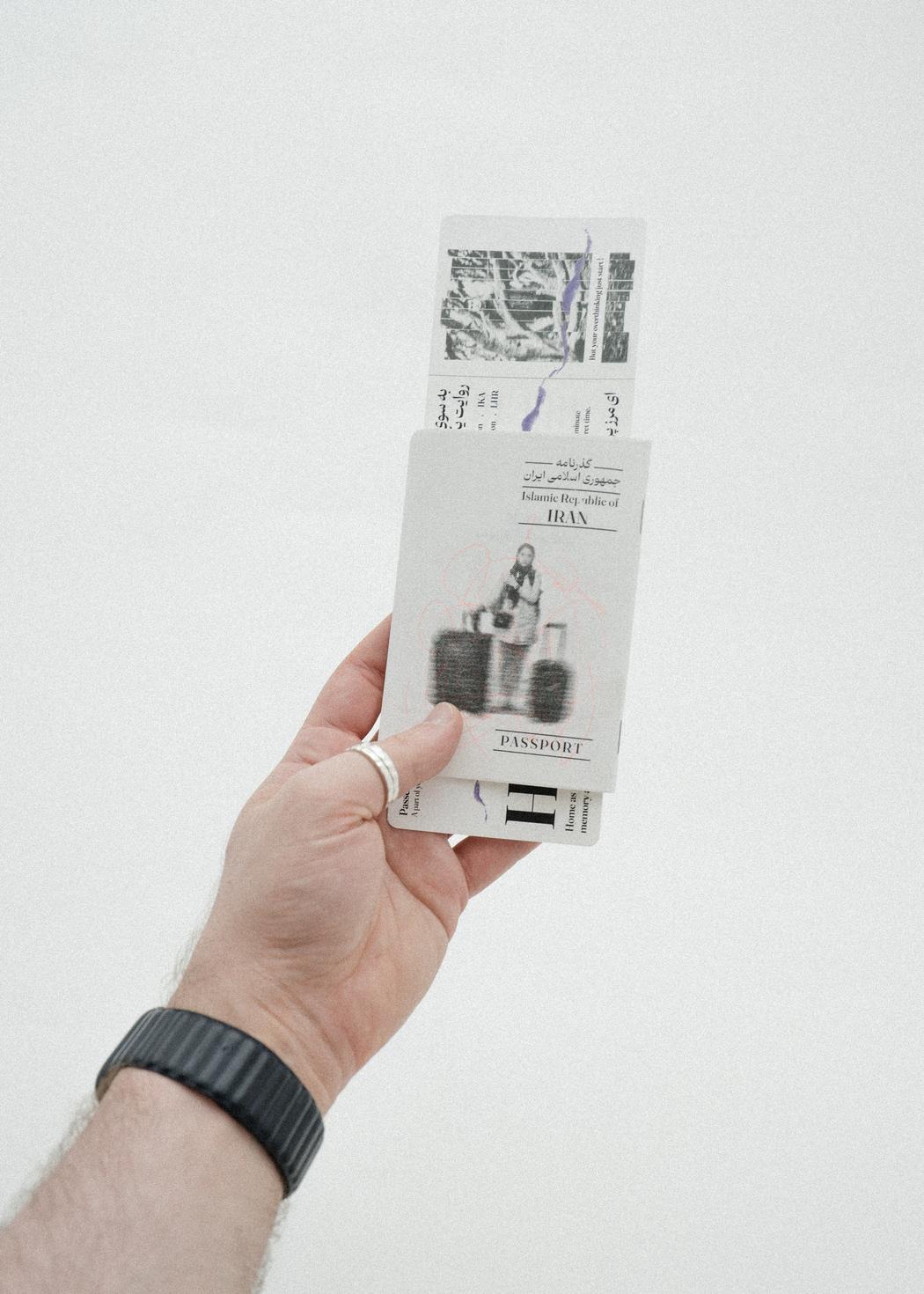
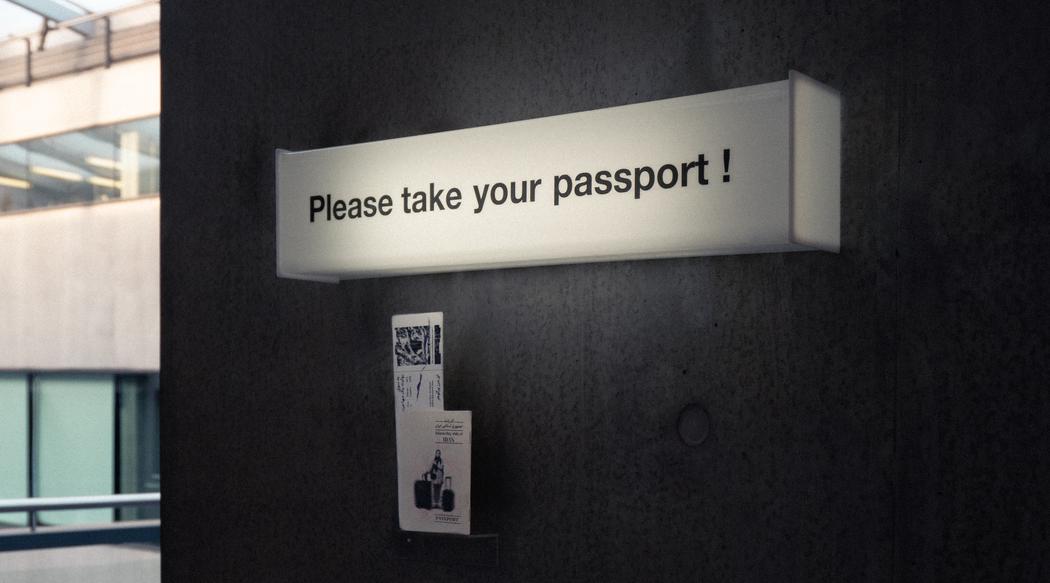
For me, passports and boarding passes are already poems — compressed biographies reduced to a few official fields, stamps, and permissions. They hold bonds, and even visually they carry traces of history and culture: older illustrations and identities that get covered over by new layers of permission—visas, stamps, new borders—like fresh layers of story hiding what came before.
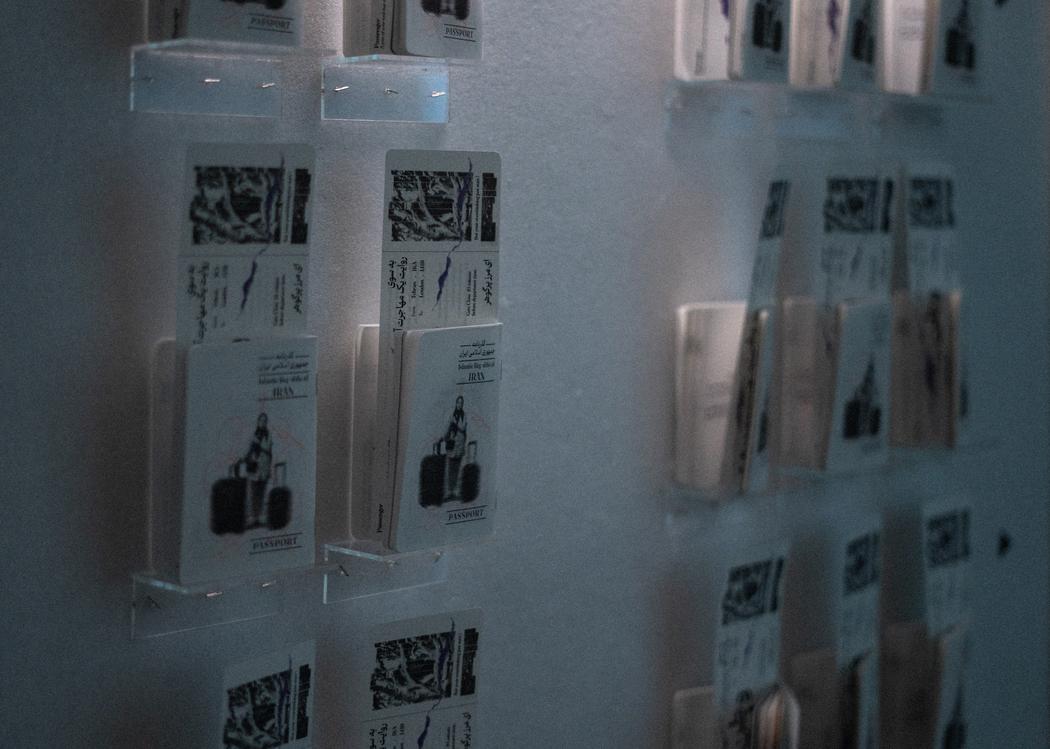
Boarding passes are brutal in a quiet way. They get torn, and you keep a small piece. That fragment—your last physical bond—becomes proof that you crossed a line, and a reminder that nothing will be the same again. By crafting these artifacts, I pull them out and return them to the body: touch, fragility, labour, memory.They stop being neutral documents and become intimate carriers of identity and absence.
You describe the installation as participatory. How important is the viewer’s physical presence and movement within the space to completing the work?
It’s essential.
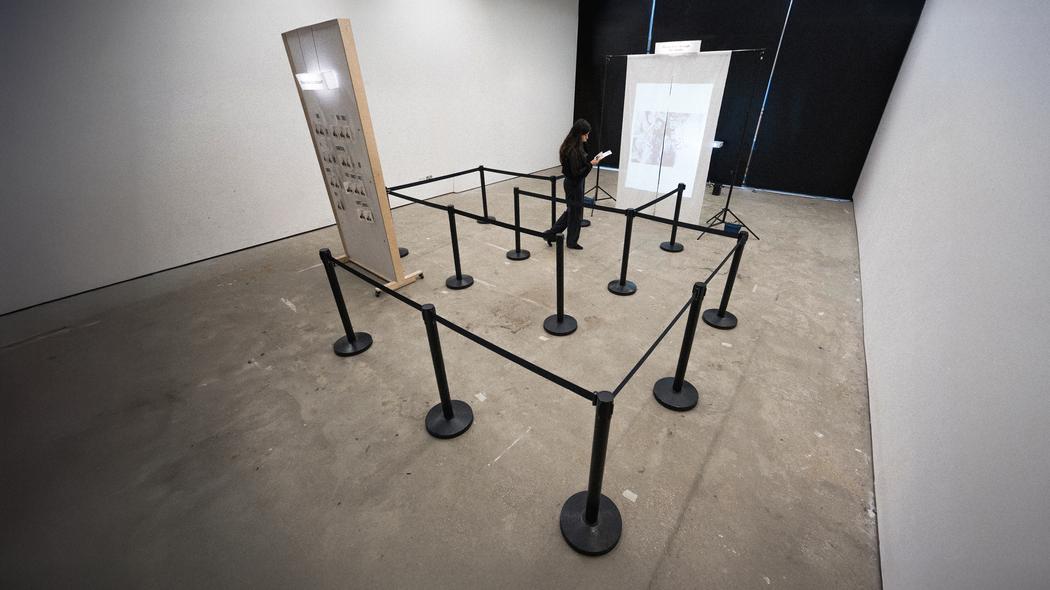
The work isn’t meant to be understood from a distance, because migration itself is not a distant idea. It’s a sequence you move through, and I wanted the audience to feel that physically. I’ve learned that nothing creates empathy like being present inside a space: you don’t just understand it, you absorb it.That’s why I structured the installation in three phases “Queue, Border, and Departure” so the audience’s body performs the logic of the journey: waiting, crossing, and in the final phase, they’re asked to tear the boarding pass and keep a small piece. It’s a simple gesture, but it carries irreversibility — That bodily involvement is where empathy becomes real.
Airports appear as a conceptual reference in this project. What emotional or psychological states do you associate most strongly with airports, and why?
Airports are the most intense form of “in-between.” On paper they’re almost non-places—spaces we pass through without story—but in migration they become unforgettable. In the interviews, people remembered airports in extreme detail, because that’s where the last moments happen: the last goodbye, the last face, the last physical connection to a familiar world.
At the same time, airports are spaces of control—queues, labyrinths behind border checks, and that strange silence when a passport is stamped and your identity becomes “accepted” or “rejected.” For immigrants, that single moment can hold happiness and sorrow at once.Airports compress grief, hope, fear, and transformation into one architecture.
Your work has been exhibited in different cultural contexts – from Tehran to London. How do audience reactions differ across these locations?
It was really interesting to see how viewers’ culture and nationality shaped their reactions. For people from Iran; and for others who’ve experienced migration more widely in recent years the work often feels immediately lived. They recognise the emotional texture without needing much explanation, and their responses can become personal very quickly.
For some audiences, especially those with less direct connection to migration, the first entry point is the installation language itself—space, sound, objects. They engage through the atmosphere and the structure, and then connect it back to their own stories of movement, family separation, or belonging.
But the most surprising reactions came from people who had never experienced displacement at all. For them, the work sometimes became a first real confrontation with how complicated migration can be. And when tears appeared, it wasn’t about familiarity—it was empathy breaking through their assumptions.
As someone living between cultures, how does your own experience of displacement or adaptation shape your creative decisions?
Living between cultures teaches you that identity isn’t stable — it’s negotiated every day. You’re always translating: language, behaviour, humour, even silence. It also makes you aware of how meaning can slip, and how nostalgia can become both support and distortion.
That’s why my works often relies on fragments and linking objects — small artifacts or gestures that carry an emotional weight. And it’s also why I work in hybrid forms: physical craft alongside moving image, sound, and light. My own adaptation isn’t one single medium; it’s a layered condition. so the artwork has to be layered too.
What do you hope visitors carry with them after leaving this installation – emotionally, intellectually, or even physically?
I’d probably answer this from the way I naturally make work. Most of the time, I’m not trying to send a message in a straight line from me to the audience—as if it travels one direction and arrives “complete.” What I’m more interested in is building an atmosphere: a space where feeling, memory and meaning can appear gradually.
The “sequence” audiences experience in my works isn’t only storytelling—it’s a way of feeling the work. It becomes an emotional environment that can hold different layers at once: the visible and the invisible, the personal and the collective, the physical and the psychological. Somehow it grows from the grey areas between experiences—those multi-layered moments where things aren’t fully clear, but they’re deeply real.And it’s rarely one-sided.
The work isn’t finished without the audience. Their presence—how they move, where they pause, the pace they choose, even their hesitation—becomes part of it. In that sense, the atmosphere is shared. It’s less about delivering one fixed truth, and more about creating the conditions for recognition: a moment where someone can enter, feel something human, and maybe understand it before they even have the words for it.
Leave a Reply
You must be logged in to post a comment.