
Dimitar Triffonov (Dime.trf)
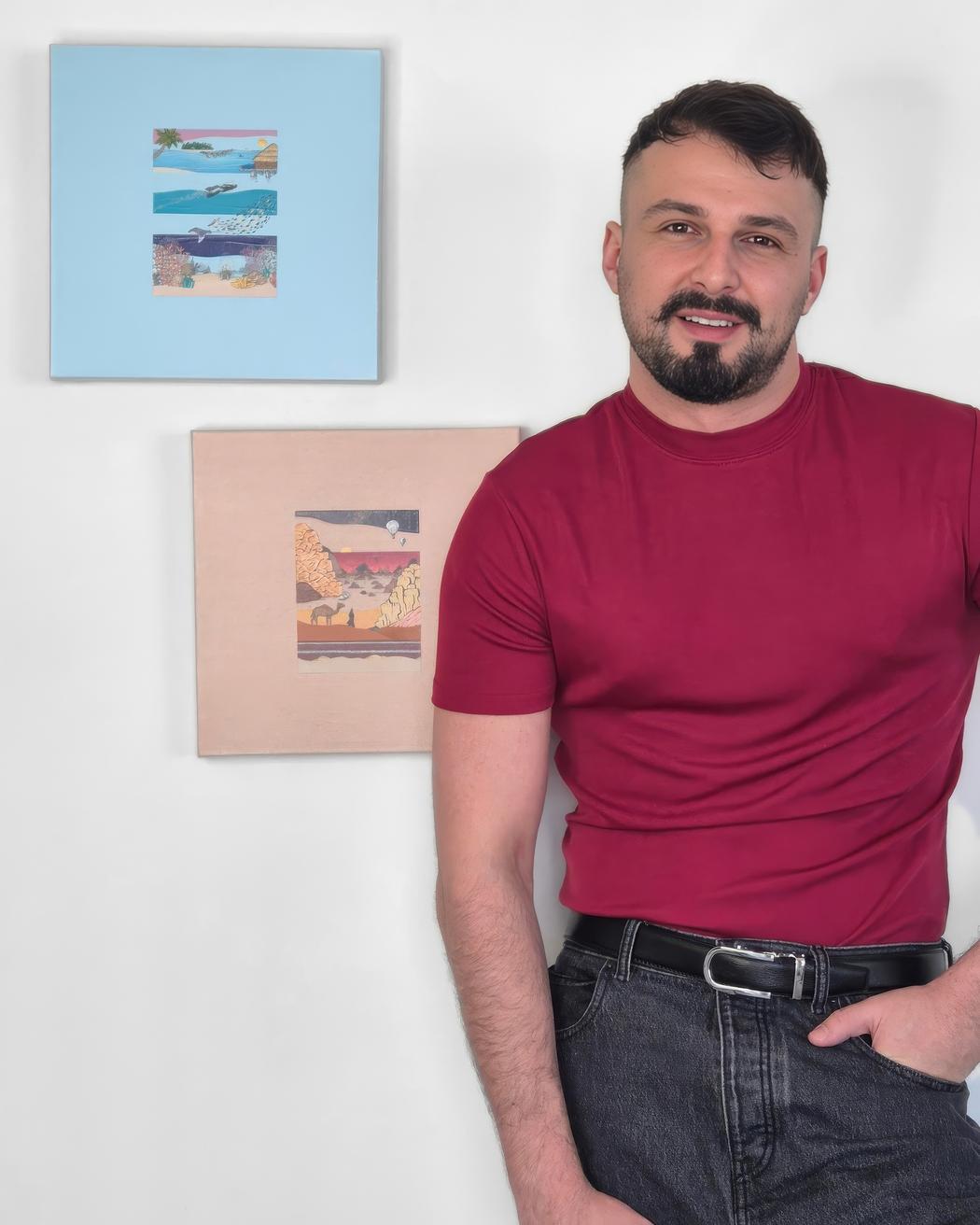
Working at the intersection of painting and graphic precision, the artist develops a distinct visual language defined by rhythm, structure, and a quiet intensity. His works translate lived experiences – from remote landscapes to the disciplined movement of the human body – into layered, stylized compositions that invite both distance and intimacy. In his debut series, Places Worth Skip Blinking, environments are not simply depicted but distilled into moments of heightened awareness, where time slows and perception sharpens. Through a meticulous process combining acrylic, ink, textured mediums, and metallic accents, he constructs immersive surfaces that unfold gradually, revealing micro-worlds within seemingly calm compositions. Balancing personal memory with universal presence, his practice explores the relationship between human and environment – not as opposition, but as a continuous, evolving dialogue.
Your series “Places Worth Skip Blinking” captures very specific moments and atmospheres. What made these particular places stay with you so deeply?
Over the past few years, I’ve had the opportunity to travel through different places and cultures, each leaving its own kind of impression. Among them, Baa Atoll in the Maldives, Wadi Rum in Jordan, and Ubud in Bali stayed with me in a particularly strong way. They are completely different environments, yet all of them gave me the same rare and almost unexplainable feeling of being exactly where I was meant to be, with the right people, at the right moment. I remember that afternoon in the Maldives, sitting in front of the endless blue, when my friend Elina suddenly said, “I feel like we don’t have enough time to take it all in. I just don’t wanna blink.” At the time, it was simply a fleeting thought, but years later I realized it had quietly marked the beginning of this series.
I don’t know if I will ever return to these places, and most likely not in the same way. That is why I felt the need to translate them into paintings, to preserve them in a form I can return to. The canvas becomes a way of holding onto that moment, of revisiting it beyond time and circumstance.
These places have stayed with me not as geographical locations, but as states of awareness. They are moments in which time seems to expand, distractions fall away, and what remains is a heightened sense of presence – light, rhythm, and structure that imprint themselves more deeply than the image itself.
I am not interested in literal representation. What I try to access is that precise instant when perception sharpens, the moment you look and instinctively resist blinking, afraid to interrupt it. The title of the series emerged directly from that experience.
The works are, in essence, reconstructed memories. They are filtered, reduced, and carefully reorganized to preserve what felt essential rather than what was visibly there. Each piece becomes a projection of how a place was internalized and carried forward.
At the moment, I am allowing myself the time to discover the next place that will be translated onto canvas, so the series can continue to evolve.
You mention a strong connection to coastal environments. How does this influence differ when you approach works like Desert or Terraces?
My connection to coastal environments is intuitive. They carry a sense of continuity, rhythm, and breath that strongly resonates with me. At the same time, I was never interested in approaching this influence in a purely literal or descriptive way.
In Atoll, this relationship is direct and immersive, as water fully defines the space. In Desert, it becomes more subtle, yet conceptually present. The landscape of Wadi Rum holds traces of ancient coastal zones, shallow seas, and river deltas. What appears today as arid and monumental was once shaped by water, which creates a quiet but essential counterpoint between two environments that seem opposite, yet remain deeply connected through time.
This way of thinking is also informed by a broader, almost universal idea, articulated as early as Heraclitus – that nature exists in a constant state of transformation. Everything flows, everything shifts. What was once water becomes land, and what was once land may become water again. This perspective allows me to approach these places not as fixed images, but as moments within an ongoing process.
Terraces introduces another layer, where human intervention becomes visible. Water is no longer expansive, but structured and guided, transformed into rhythm and repetition. Through this shift, the coastal element in my work expands into a reflection on transformation itself, on how environments evolve while still carrying the memory of what they once were.
Ultimately, the coastal influence in my work is less about geography and more about an underlying rhythm that connects seemingly distant environments.
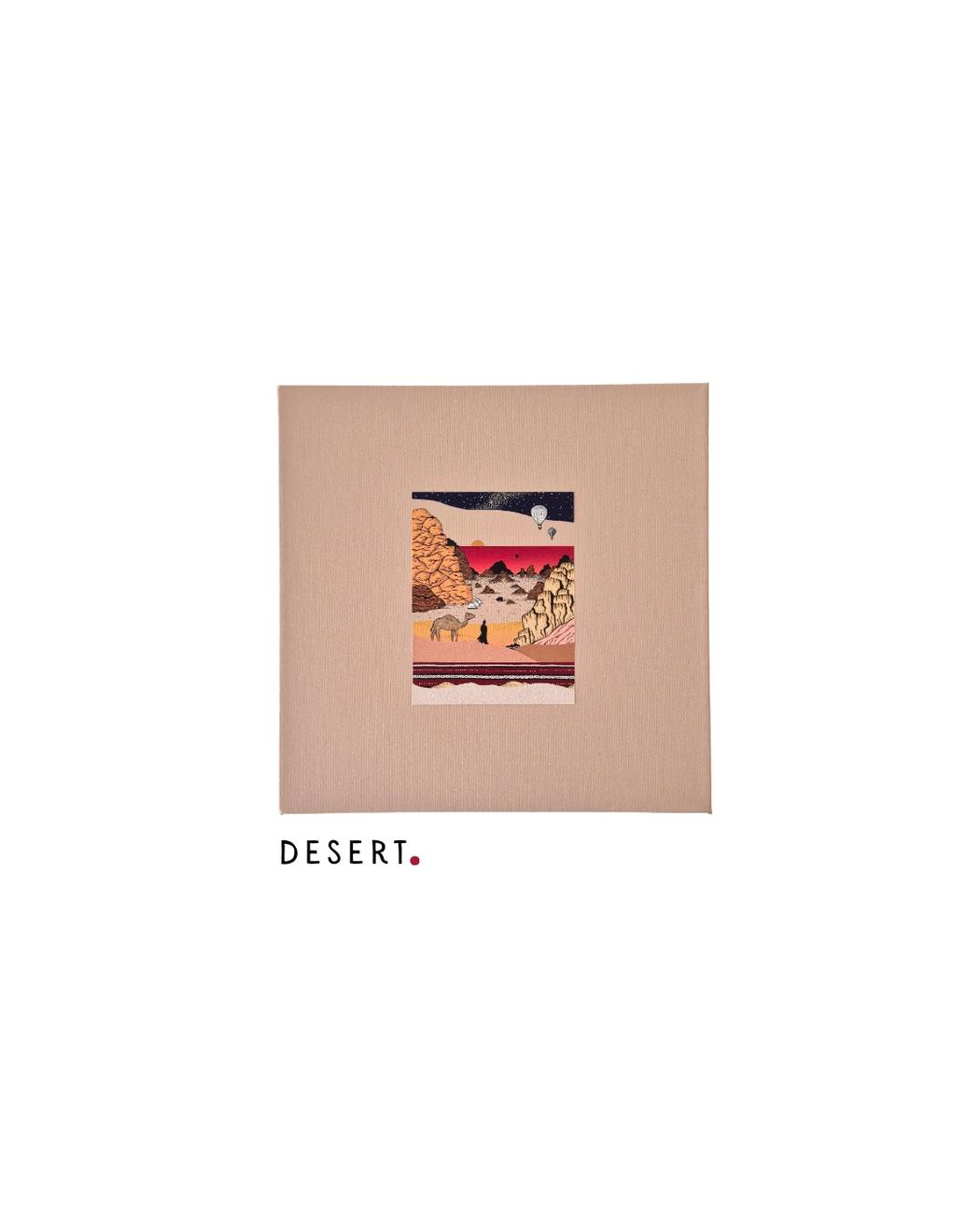 Dimitar Triffonov (Dime.trf) | Desert | 2026
Your works invite the viewer to come closer and discover micro-worlds. At what moment did this idea become central to your practice?
There was a moment when I realized I was no longer interested in creating images that reveal themselves instantly. I wanted the work to hold attention and require time, to unfold gradually.
This led me to develop a layered visual language built on detail, extending vertically and in depth. The micro-elements such as dots, lines, textures are not decorative additions, but structural components. They create an internal rhythm that becomes visible only through proximity.
There is also a personal aspect to this approach. My tendency toward precision and control, something close to perfectionism, finds a constructive outlet in this process. The act of building these intricate surfaces becomes a way of staying within the work, of extending the moment.
From a distance, the compositions appear calm and resolved. Up close, they reveal density and movement. That shift in perception is essential, it transforms the viewer from observer into participant in the search for the hidden and the meditative.
Can you describe your process of translating travel photographs into these layered, stylized compositions?
Photography serves as an initial anchor – a way to retain the authenticity of light and color as it existed in a specific moment. However, it is never the final reference. The gallery on my phone often becomes the starting point for selecting colors, forms, and organizing space, and the fact that I use personal photographs – in which, by the way, I am not good at all – adds for me an additional sense of value and responsibility toward myself.
From there, the process becomes one of transformation. I reduce, reorganize, and reconstruct the image. My practice exists between painting and drawing. Acrylic establishes the base, ink defines structure and precision, textured mediums introduce physical depth, and metallic accents add a responsive layer of light that shifts with the viewer’s position.
Rather than relying on traditional perspective, I build depth through layering, repetition, and controlled visual movement across the surface. The goal is not to recreate a place, but to construct a spatial experience, something that can be entered rather than simply observed.
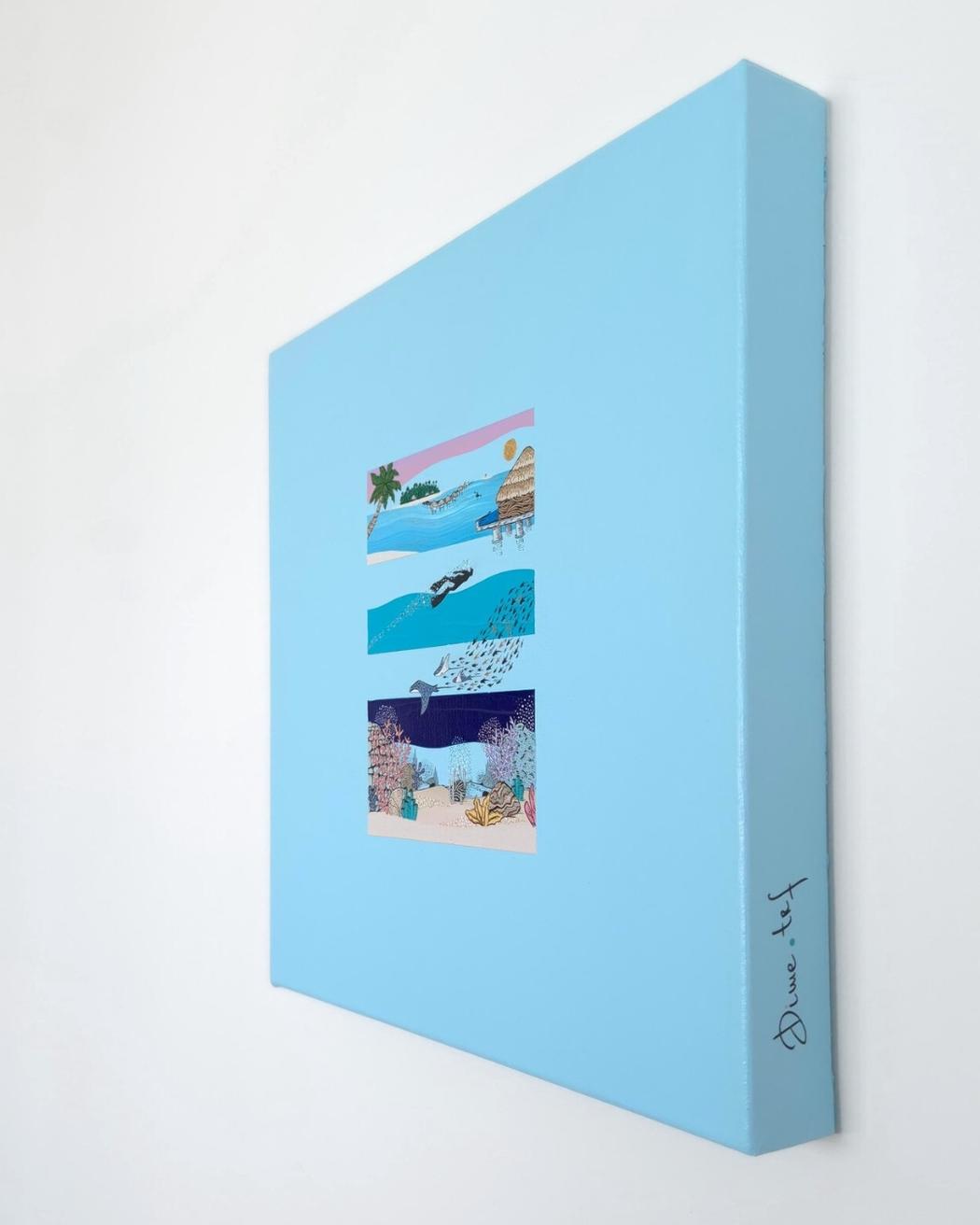 Dimitar Triffonov (Dime.trf) | Atoll | 2026
There is a balance between calm, almost meditative scenes and highly detailed textures. How do you approach this contrast?
This balance is central to my work. I am interested in the tension between stillness and intensity, between what appears quiet and what reveals complexity over time.
From a distance, the works carry a sense of calm, almost suspended in time. As the viewer moves closer, a dense internal structure begins to emerge, layers of detail, repetition, and subtle movement. I am drawn to that sense of a “pulse” beneath the surface.
This idea of counterpoint extends beyond texture. It is also present in the way I approach subject matter, from the human figure as a central, dynamic presence in my Medley series, which is the second series I am working on in parallel, to the reduced, almost silhouette-like presence of the human within the landscape in Places Worth Skip Blinking. These two directions are different, yet they operate within the same underlying logic.
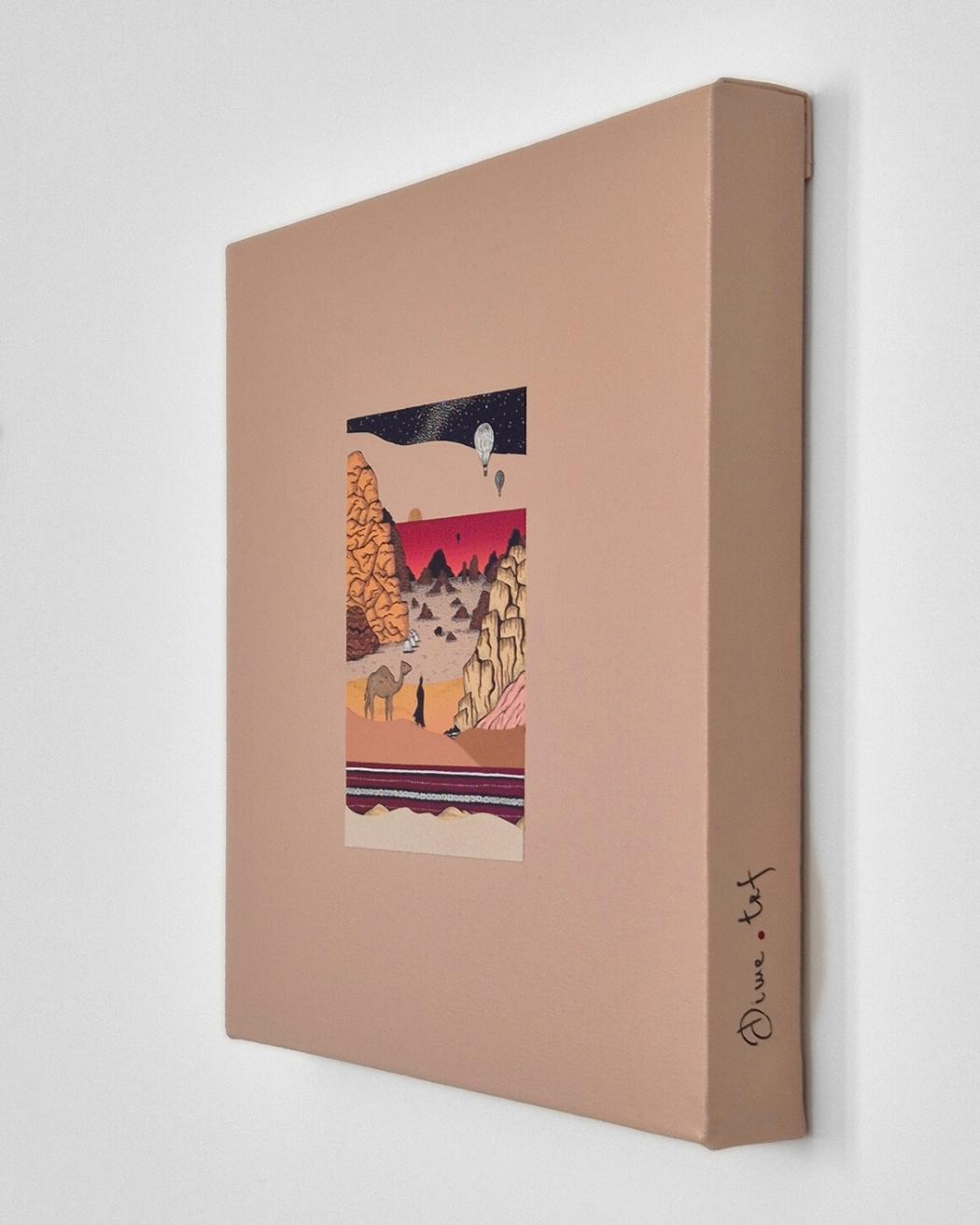 Dimitar Triffonov (Dime.trf) | Desert | 2026
Your works feel both intimate and expansive at the same time. Is this duality something you consciously aim for?
Yes, this duality is intentional. The intimacy comes from the level of detail and from the personal nature of the imagery. These works are rooted in lived experiences, in places and moments that have left a lasting impression.
The sense of expansiveness emerges from the way space is constructed, through rhythm, repetition, and the suggestion that the composition continues beyond its physical limits.
I am particularly interested in this threshold, how a relatively small format can hold a sense of vastness, and how the viewer can transition from looking at an image to feeling immersed within it.
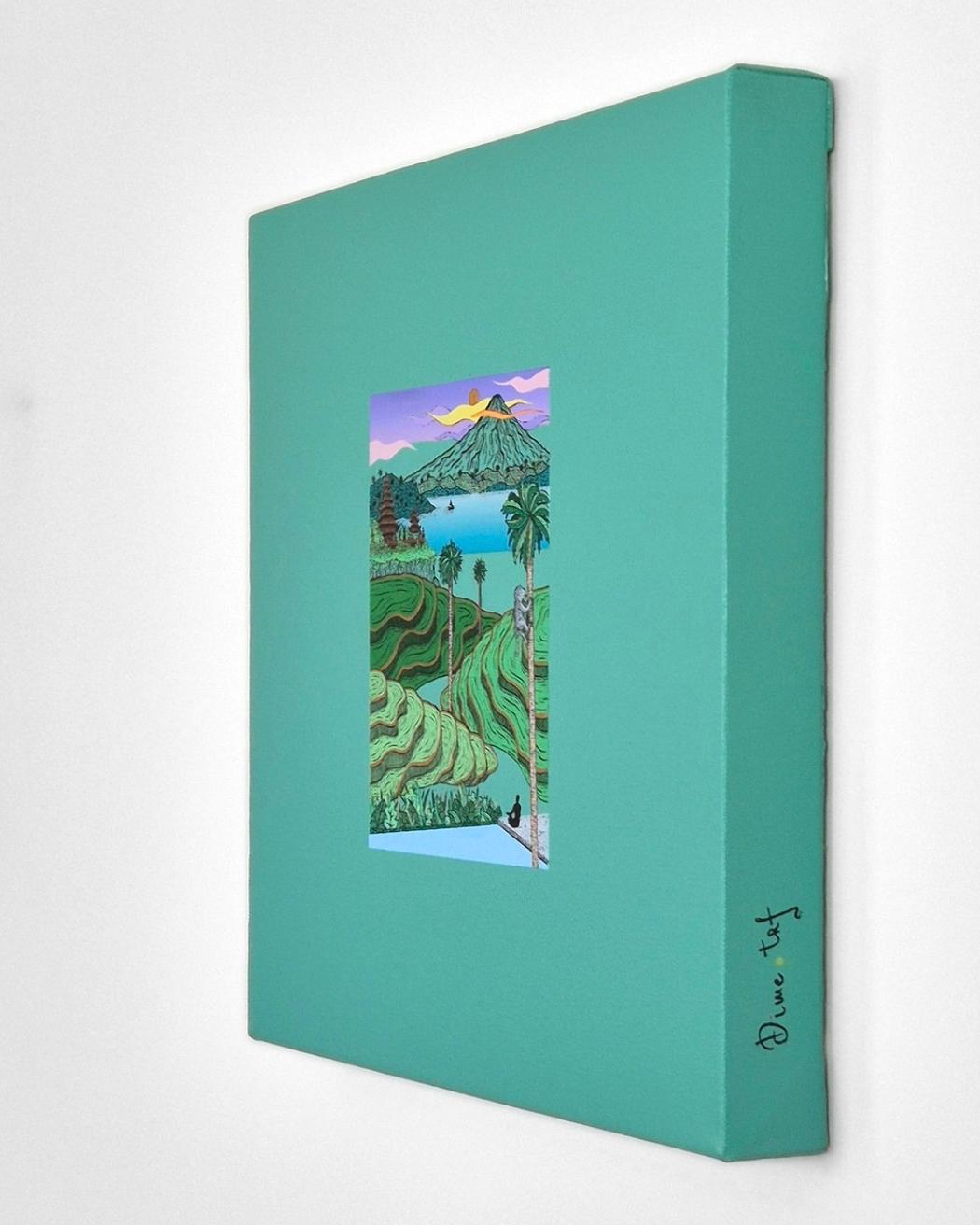 Dimitar Triffonov (Dime.trf) | Terraces | 2026
As this is your debut official series, what did you discover about your artistic identity during its creation?
This series allowed me to clearly recognize the foundation of my practice. I understood that my work is built on counterpoint, between human presence and environment, movement and stillness, detail and totality.
I also became more aware that I am not seeking to document, but to interpret. Everything I create passes through a personal filter shaped by my travels, the environments that have left a strong imprint, and my ongoing engagement with swimming, which naturally led to the development of my following series, Medley, where the human body becomes a central subject explored in parallel.
Places Worth Skip Blinking is not a closed series. It continues to evolve as I look for moments across different geographies that carry the same intensity of presence.
Ultimately, I realized that my focus is not a fixed stylistic definition, but a consistent visual language, one that remains grounded in how I construct space, rhythm, and presence, regardless of subject or location.
Leave a Reply
You must be logged in to post a comment.