
Dina Goldstein
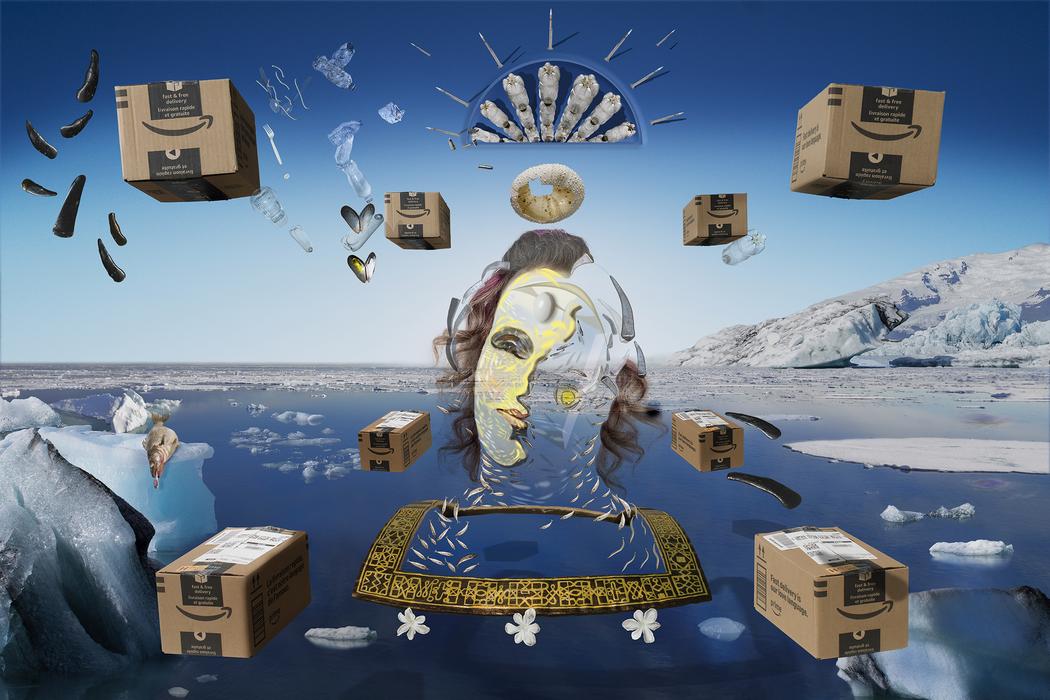 Dina Goldstein | Mistresspieces, Galatea at the moment of creation
Your work often combines pop surrealism with sharp social critique. How do you balance visual seduction with discomfort or confrontation in your images?
It’s truly a fine balance. The photographs must be compelling to draw in the viewer. The message is clear to those that see beyond the first impression.
The work can be experienced on many levels. The photograph itself can be pure entertainment, or become the subject of an academic paper.
Having started your career as a photojournalist, how does that documentary background continue to shape your approach to staged, cinematic photography today?
While I value my roots in photojournalism, I recognize that our relationship with the ‘authentic’ image has shifted. In a world that is hyper-aware of the camera and now complicated by AI capturing a raw, un-self-conscious moment is increasingly difficult. I’ve found that by moving toward staged, cinematic photography, I can achieve a different kind of precision.
My documentary background still dictates my ‘deep dive’ into research, but the theatrical methodology allows me to build a specific, intentional storyline. I’m no longer waiting for a story to happen; I’m constructing a visual language that addresses complex themes like power and belief with a clarity that spontaneous photography sometimes obscures. The beauty of the aesthetic acts as an invitation for the viewer to engage with a much deeper, more difficult narrative
Your images frequently address themes of power, gender, consumption, and belief systems. Do you begin a project with a clear message, or does the meaning evolve during production?
I’m deeply fascinated by how Western culture’s collective imagination shapes characters that become instantly recognizable icons. My process usually begins with an intuitive theme, but the specific narratives are always anchored in my lived experience as a woman and a mother.I don’t start with a rigid message; instead, I place these archetypes into a modern context and allow them to confront the ‘challenging existence’ of the 21st century. For instance, Fallen Princesses was born from watching my toddler daughter’s early encounters with Disney tropes, while In the Dollhouse emerged from observing my second daughter’s play with Barbie and Ken. My work in Gods of Suburbia shifted that focus toward belief systems after an art residency in Mumbai sparked an interest in how personal gods function within our landscape of technology and hyper-information. The meaning always evolves through the character’s struggle.
Your production process is described as highly precise, from pre-production to post-production. Could you walk us through how a single image typically comes to life?
My process is a disciplined cycle of Research, Production, and Post-production. It begins with an intensive deep dive into the subject so I can shape a narrative with total authority. The casting is perhaps the most critical stage; whether it’s a professional actor or someone I’ve scouted on the street, they must possess a lived-in quality that makes the character believable.
I approach the environment with that same level of scrutiny, either scouting a location that breathes life into the story or building a set from the ground up. Every detail, from the ‘set dec’ to the texture of a costume, the makeup and hair, is a deliberate narrative choice. Finally, I shoot in digital plates, which gives me the technical freedom to ‘knit’ the image together in post-production. This is where the story truly crystallizes; I can layer in those small, essential details that guide the viewer’s eye and complete the world I’ve built
The scale and complexity of your tableaux are striking. What role do collaboration and direction play in realizing your visual worlds?
The scale of my work naturally demands a high level of collaborative synergy. I view my role much like a film director; I provide the initial vision, the research, and the narrative boundaries, but I rely on a team of experts—stylists, set builders, hair and makeup artists—to help bring that world into the physical realm.
For a tableau to be successful, every collaborator must be on the ‘same page’ I spend a significant amount of time in pre-production communicating the emotional subtext of the series so that when we are on set, every choice contributes to the overall commentary. While I am precise about the final frame, I value the creative problem-solving my team brings to the table. Realizing these visual worlds is a communal effort, but my direction ensures that the final ‘succinct’ image remains true to the core message I’m exploring.
What questions do you hope viewers ask themselves after encountering your work for the first time?
Ultimately, I hope viewers ask themselves: ‘How much of my identity and my beliefs have been shaped by the myths I’ve been fed?’
I want my work to act as a mirror to the collective imagination. When someone encounters a ‘Fallen Princess’ or a ‘God,’ I want them to move past the initial aesthetic beauty and start peeling back the layers of the narrative. I hope they ask why these archetypes feel so familiar, yet so out of place in our modern, consumer-driven reality.
If a viewer walks away questioning the authenticity of the ‘perfect’ lives we see on social media, or reflecting on how technology has become a new form of worship, then the image has done its job. My goal isn’t to provide an answer, but to spark a personal interrogation of the power structures and belief systems we navigate every day.

Leave a Reply
You must be logged in to post a comment.