
Elise Rowland
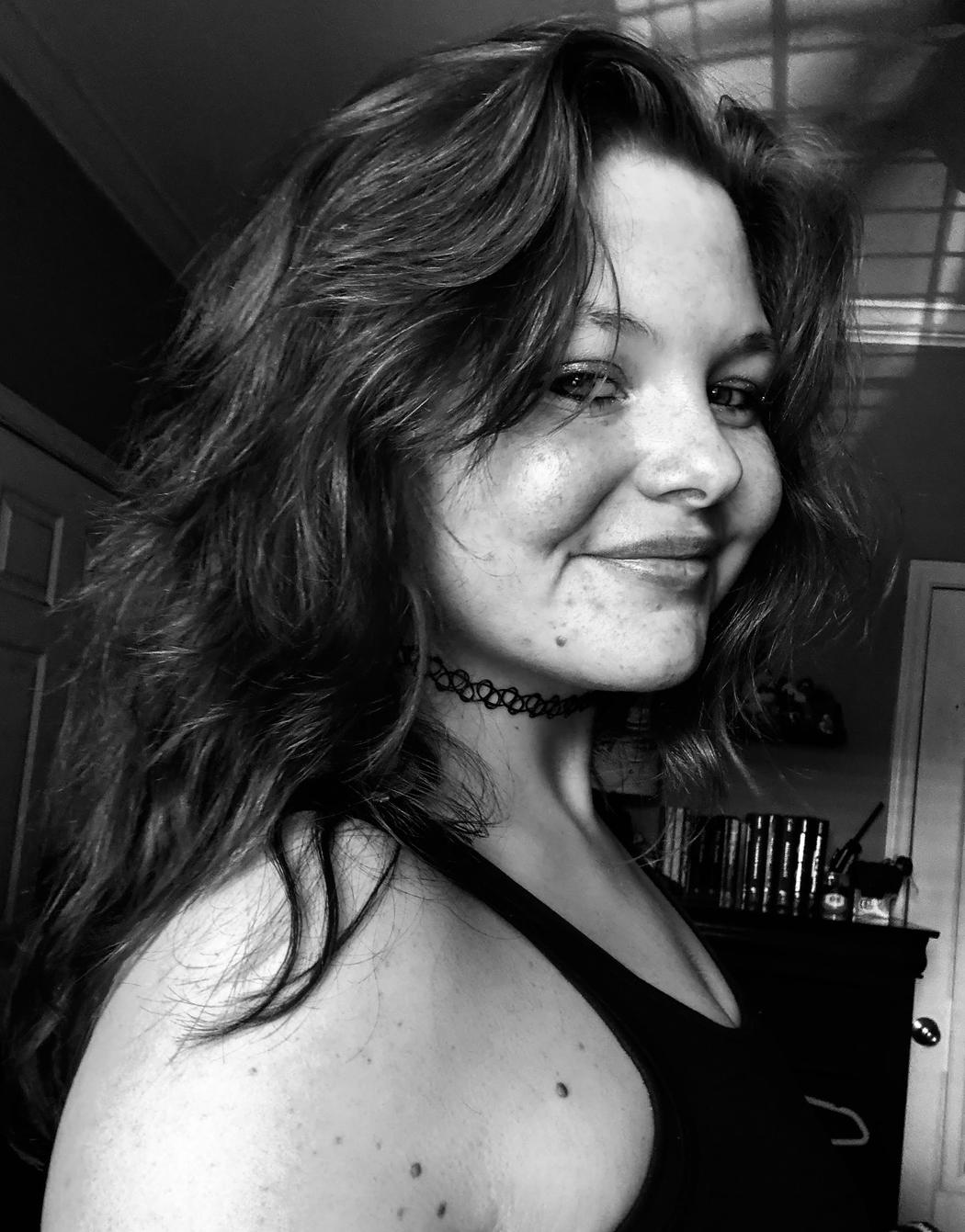
Your crochet portraits have a strong graphic, almost pixelated quality. Do you plan your compositions digitally beforehand, or do they evolve directly through the crocheting process?
Nothing you see is ever freehand when it comes to the art of tapestry crochet. It’s a meticulous process to be honest. First I choose the photo and edit it in photoshop. Most of the time I make the background solid and heighten the contrast. I use a website called Stitch Fiddle that helps you transform pictures into grids. From there, you can adjust the brightness, contrast, stitch count, colors, and more. It can be a lot of trial and error. After that, I will follow the grid to make the tapestry!
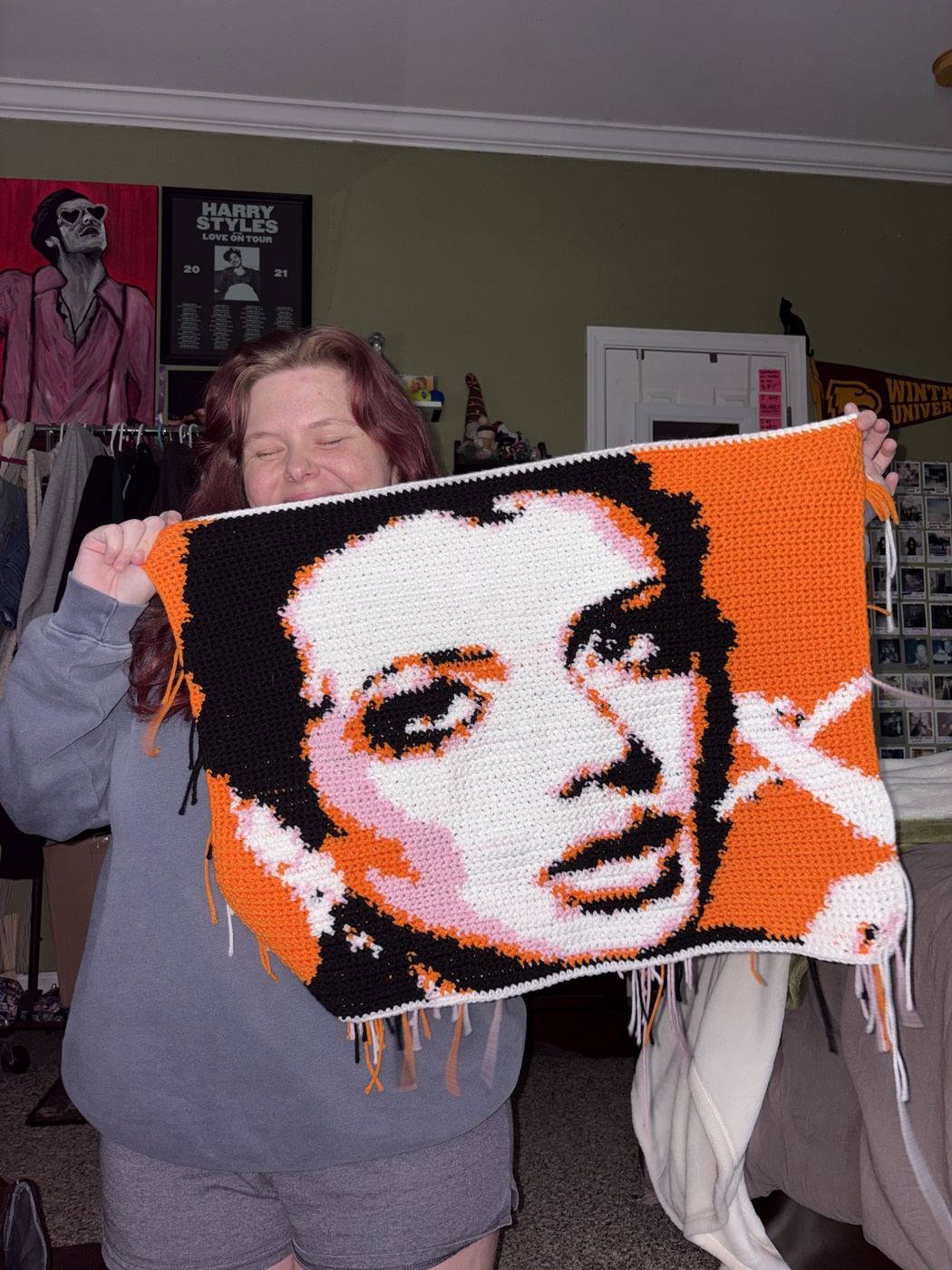 Elise Rowland | Vanillamace tapestry
Many of your works reinterpret recognizable figures through yarn. How do you decide which details to simplify and which to preserve to maintain likeness?
It honestly really depends on the size, subject, and what I think is right for the project. With my Heated Rivalry tapestries, I wanted to make sure they were immediately recognizable. Because Connor Storrie and Hudson Williams have very distinct facial features, especially their lips and eyes, I simply had no choice but to make these big, intricate pieces! It’s kind of the same for my Scream cardigan. Everyone knows Scream and its iconography so I had to make sure there was more than enough detail to make the legendary Drew Barrymore’s face. For my Harry Styles “Kiss All The Time, Disco Occasionally” tapestry, I wanted something simple and almost abstract because the focal point wasn’t really his face. I also made it in a time crunch and didn’t want the project to be too big. That’s why it’s not as detailed as my other pieces. Like I said, it all depends on the project!
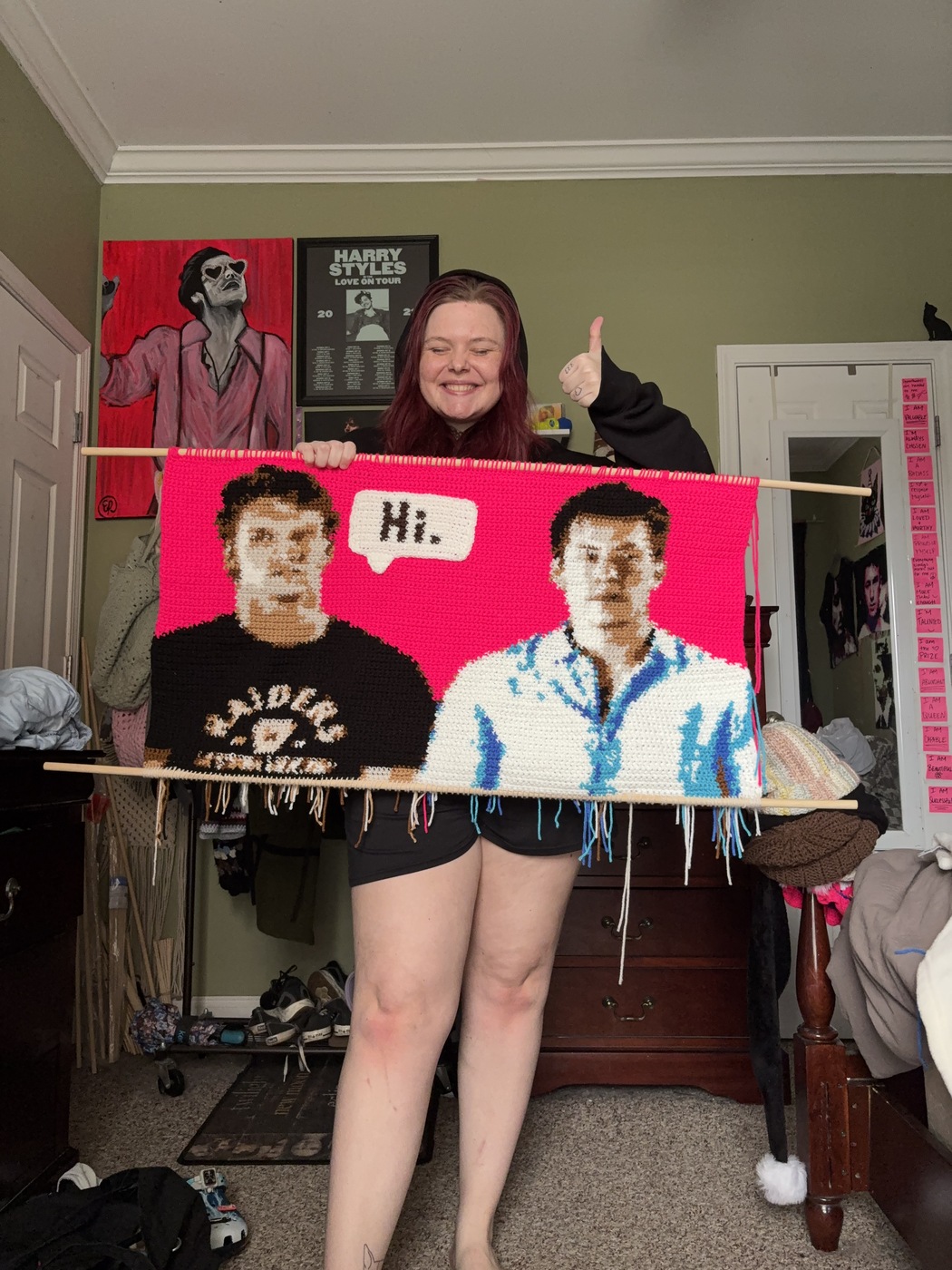 Elise Rowland | Heated Rivalry Shane & Ilya tapestry
Your use of bold, contrasting colors is very striking. How do you choose your color palettes for each piece?
Everyone always asks me this question on Instagram and the truth is there’s not really a method to my madness when it comes to colors. I’ve been an artist since I was a kid so I’d just say I have a good eye for color and I’m a really big fan of hot pinks, purples, and blues. Before making tapestries, my yarn basket was full of neon and pastel colors because I was making bags, cardigans, and other miscellaneous items. Now that I’ve made over 20 tapestries, I know what colors will create a cohesive look. I stick with 4 to 6 colors in a tapestry because using any more than that will make me lose my marbles.
Crochet is often associated with craft rather than fine art. Do you see your work as challenging this distinction?
Absolutely. I could definitely go into a rant about misogyny but I won’t. I will say that fiber art is heavily associated with women, older women especially, and is often underappreciated. Fiber artists tend to undersell their work because most people would choke hearing the prices crochet and knit pieces should be. In a world riddled with AI, fiber art should be uplifted. To answer your question, I do see my work challenging this distinction. My tapestries are being purchased and used as wall decor, the same as any other fine art painting. My tapestries have been praised by the people they’re inspired by, as well as thousands of others. Why is it not considered fine art?
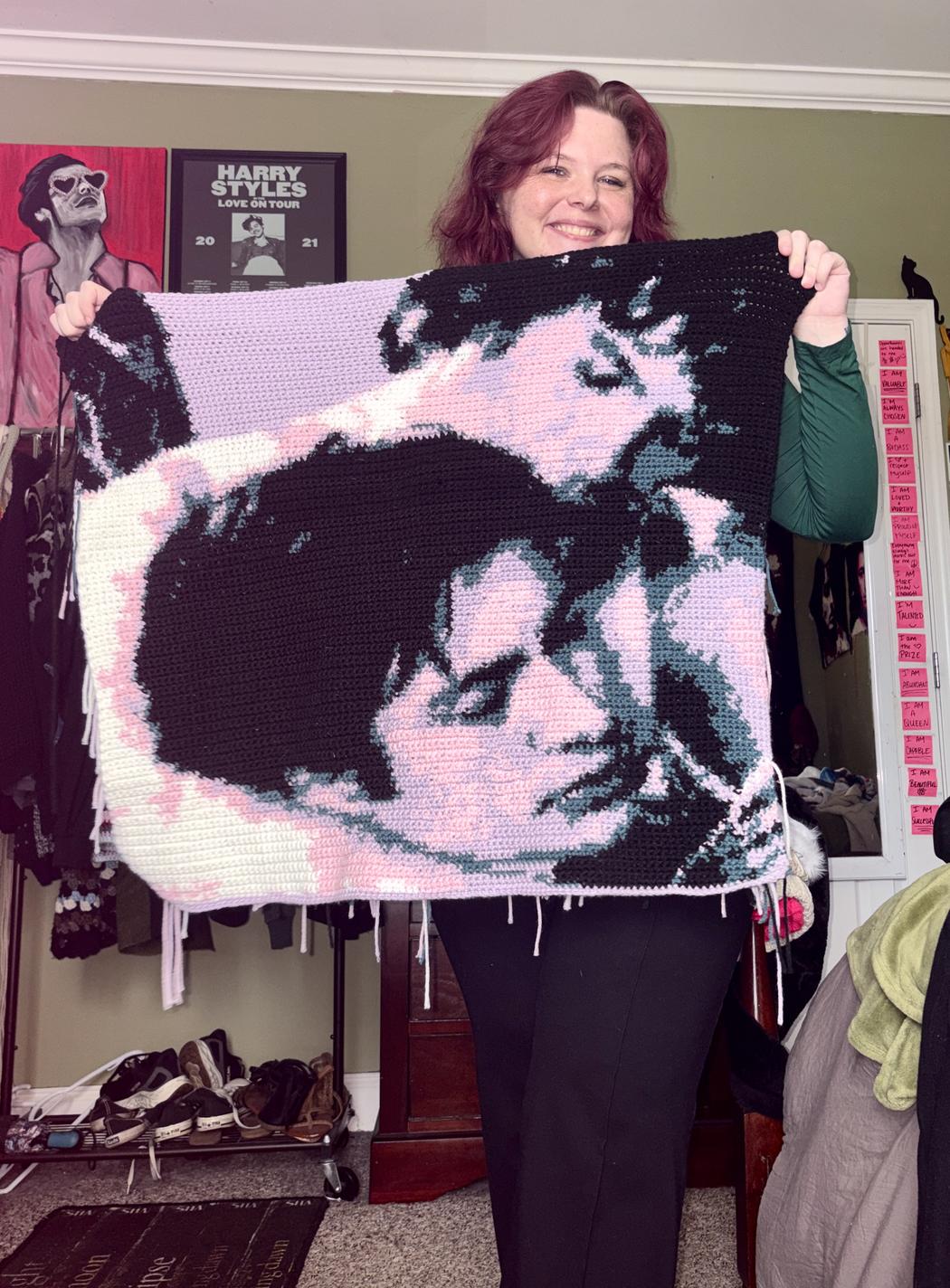 Elise Rowland | Hudson & Connor ember and ice
Your pieces feel both nostalgic and contemporary. How important is nostalgia in your work?
I’m inspired by various nostalgic elements like vintage comic art and Andy Warhol’s pop art but that might be the only thing creating a sense of nostalgia. I’d say it’s a big part of my inspiration so it’s pretty important but not required for me to make something.
In your opinion, how does translating pop culture imagery into fiber change the way viewers perceive it?
Not to be biased here but I would say fiber art makes pop culture imagery like scenes/characters/etc more interesting and visually striking than some other forms of art. You’re turning a 2D something into a physical manifestation. My sister always says I’m making 3D pictures and there’s only one version of it, so it’s almost comparable to a polaroid picture.
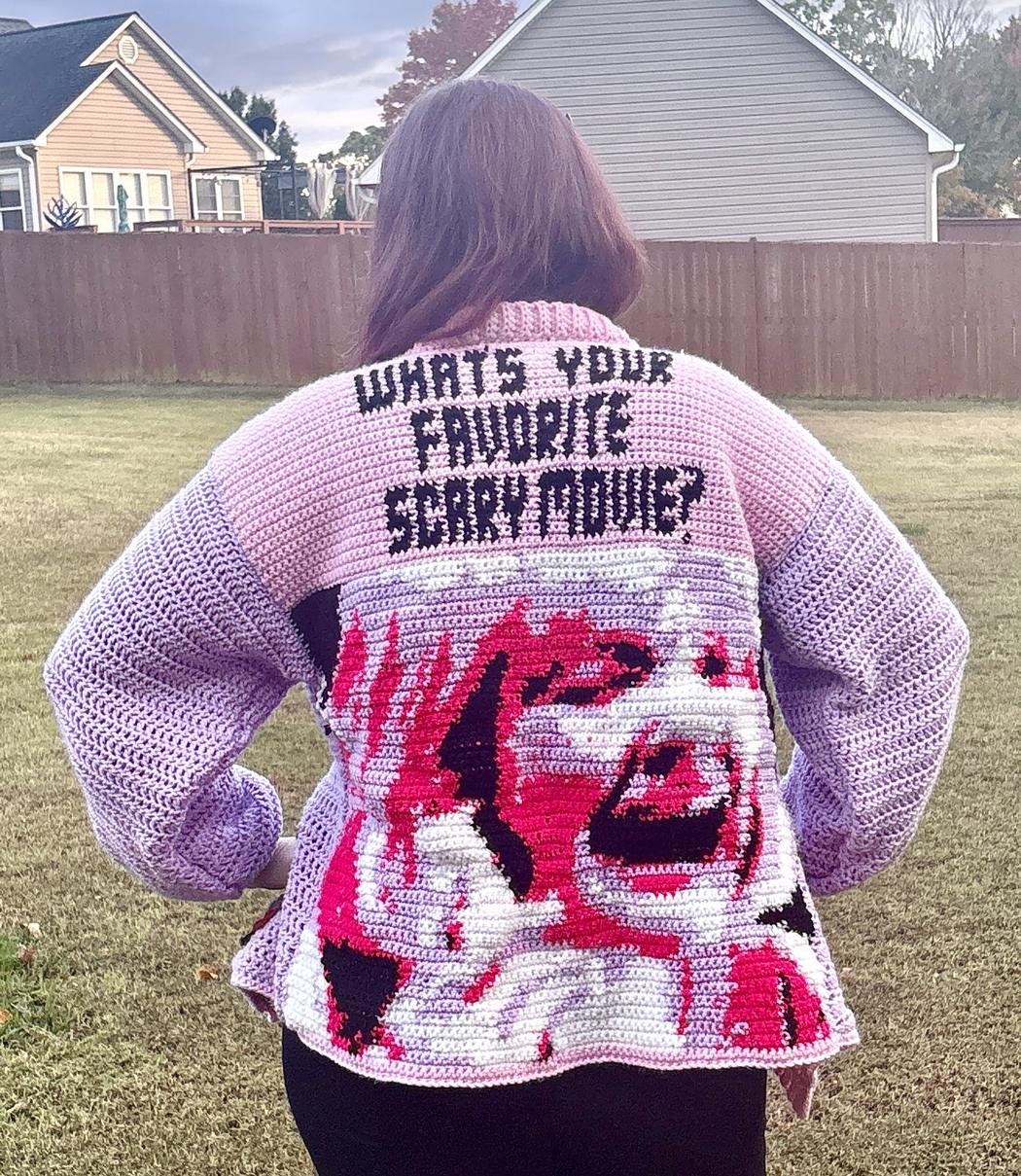 Elise Rowland | Scream cardigan
Imperfections and texture are inherent in crochet. Do you embrace these qualities or strive for visual precision?
Although I can certainly be a perfectionist, I tend to embrace imperfections more in crochet than any other art form. Sometimes I’ll miscount a row and redo it. Sometimes I’ll miscount a row, shrug it off, and keep following the grid. Realistically, one wrong stitch won’t hurt a giant tapestry. With traditional art, you can always paint over your mistakes. With digital art, you can hit the undo button. Crochet allows me to make mistakes, accept them, and keep moving forward.
Leave a Reply
You must be logged in to post a comment.