
Anahita Darabbeigi (Anna Darab)
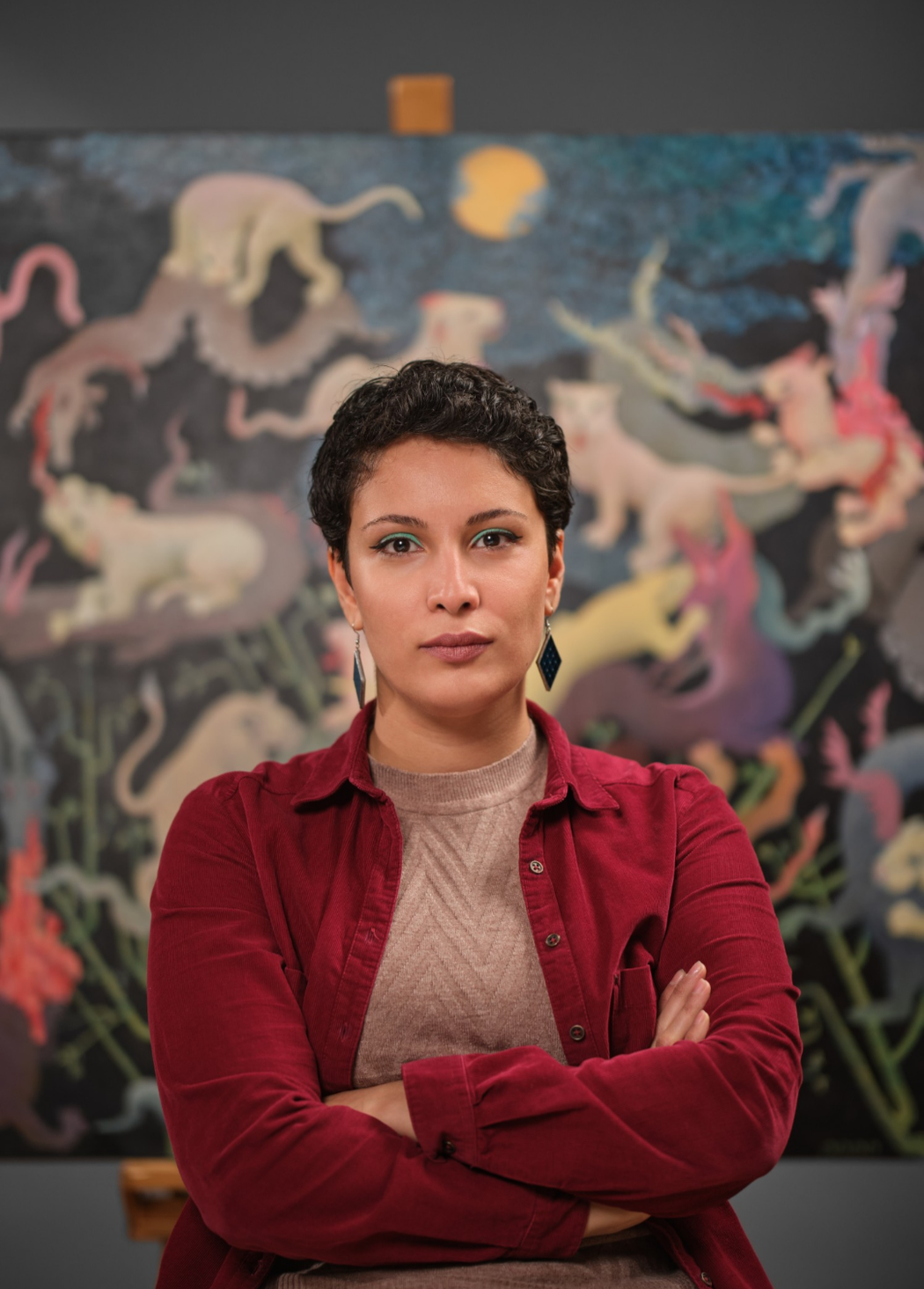
Your recent series Battleborn revolves around animal combat, especially the confrontation between lioness and dragon. What does this battle symbolize for you on a personal and cultural level?
My latest body of works, Battleborn series, have been focused on animal combat imagery, specially the battle between lion and dragon. The idea came from seeing a vast variety of animal combats in Iranian visual arts of any kind in every era, in museums, books and even on Qajari buildings all around Tehran. I have been dwelling on this concept for a few years now in my works; it is fair to say that they have become more and more personal gradually. I may use some kind of symbolism, but I do not believe the battle to be of good and evil, there is more to it, has different layers and reads.
This particular motif comes from ancient times; some of its earliest examples are engraved on the beautiful stoneware of Jiroft civilization in Iran. The battle between lions and other animals such as bulls, snakes, other felines, gazelles, and also mythical creatures like dragons, Qilin and Simorgh are depicted in many mediums and forms in nearly each and every era in Iran’s art history. This just fascinates me, showing how relatable and flexible the concept actually is.
I am trying to render my own interpretation of what interested me formally, I am asking myself: Is this ancient visual motif still capable of expression? There are a lot of battles going on in the world right now.
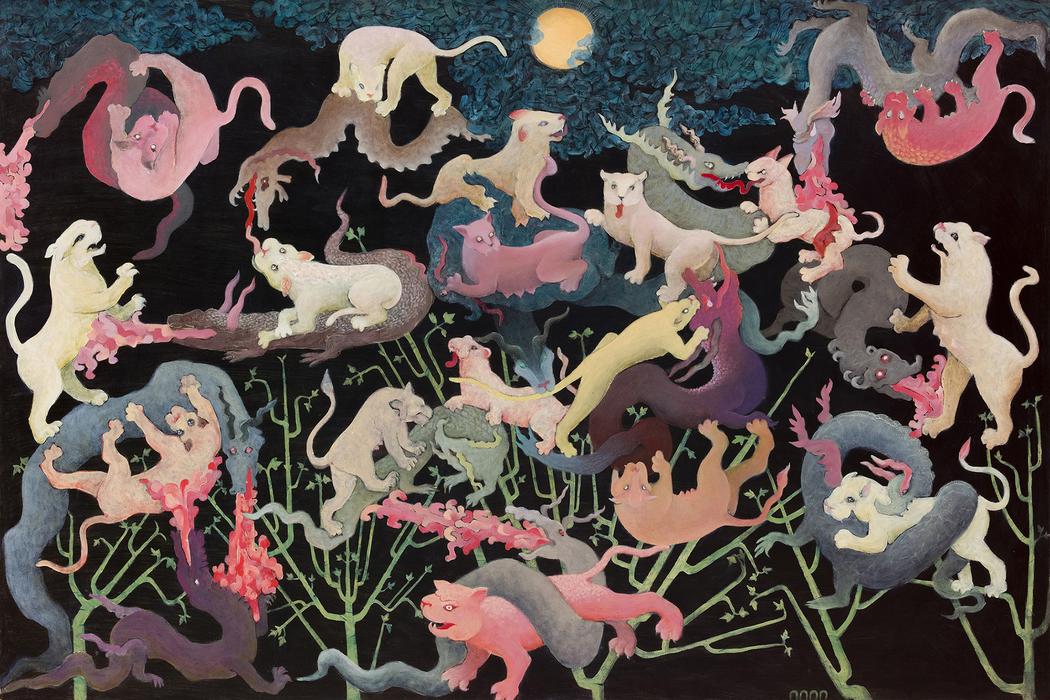 Anahita Darabbeigi | Battleborn | 2025
Many of your works depict lionesses rather than lions. How did the Woman, Life, Freedom movement influence this transformation in your imagery?
This visual allegory stuck with me for many reasons throughout the last couple of years; one being the Woman Life Freedom movement (2022) in Iran. At the time, I was pursuing a master of art program at University of Tehran. It hit me in the face: the violence I witnessed there, the harassments I experienced as a female student and above all, the oppression and killing of protesters all around the country. All this profoundly transformed and reshaped my visual world.
Little by little I got attached to this concept; lions turned into lionesses in my works since that movement, before which I was working on imaginary landscapes (Dusk and Dawn series) and later on Trees of Tehran, as my subject matter. The social uprising and our hope for change, resonated with my art history research and my everlasting search for a new visual language and structure.
In other words, the familiar patterns became a bridge between past and present, allowing traditional forms to comment on contemporary experiences, emotions, and political realities, while somehow maintaining their symbolic resonance.
 Anahita Darabbeigi | Khazar | 2025
Persian miniatures and carpets play an important role in your visual language. How do you transform these traditional structures and motifs into a contemporary painterly expression?
Throughout my overall art practice, I have always been experimenting with ways of depicting dreams, imaginary atmospheres and visions which led me to non-western visual perspectives and new image structures. As I was developing the combat with different materials and mediums, the visual structure became bolder with flat and bright colors and sometimes a multiple angel perspective found in Persian miniatures and carpets.
Persian carpets are the main key to understand my images; their visual language is something other than an image we are used to. Narrative, geometry and symbolic decorations along with their color palettes and bold outlines affected my vision entirely. I tried to use a local visual structure for a traditional Iranian motif, in a way that would no longer be considered traditional art. I transform the visual world of Persian carpets into a contemporary language by reimagining their motifs and structures within my paintings.
Your compositions often present multiple perspectives simultaneously. What role does this spatial complexity play in the narrative of conflict?
In Battleborn, each composition does not depict a single battle from multiple angles but rather layers many battles within the same visual space, much like the dense, intricate narratives found in Persian carpets or miniatures. There is no single perspective; instead, the viewer navigates a field of simultaneous actions, collisions, and encounters. This multiplicity mirrors the complexity of conflict itself, suggesting that struggle is never linear or singular, but a constellation of forces interacting at once, like the revolution itself.
Violence, struggle, and transformation appear as recurring themes. Do you see the battle as destructive, regenerative, or both?
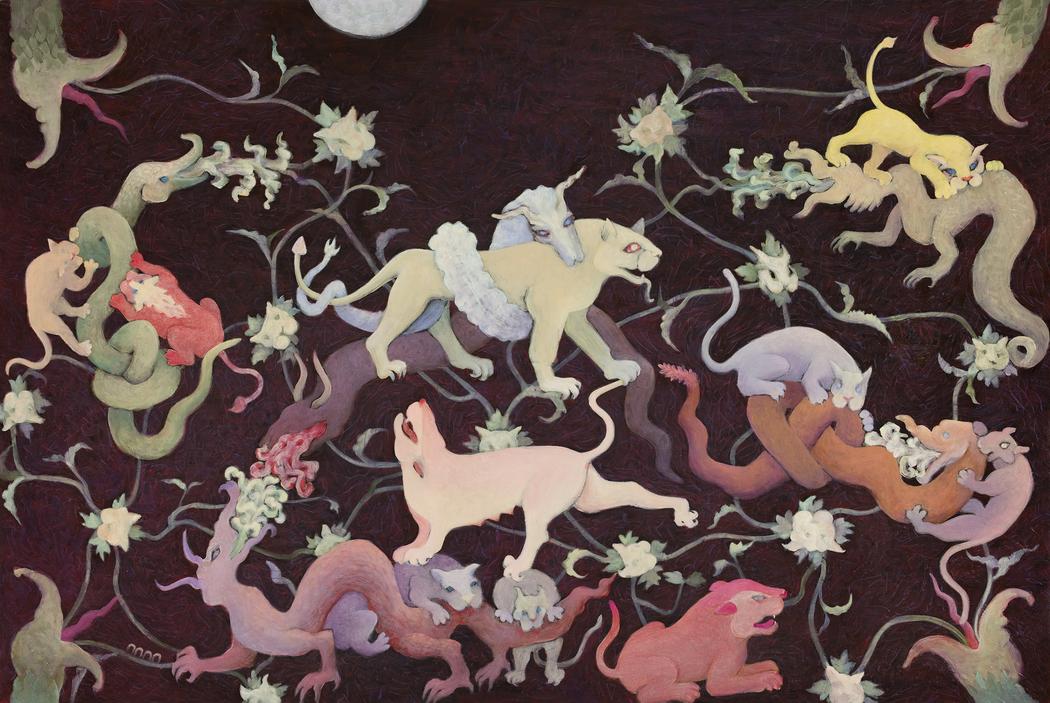
The title Battleborn reflects this duality: born to battle and born from battle, simultaneously. The imagery embodies both destruction and regeneration. The animal combats portray the raw force and violence of conflict, yet the repetition and patterns echo survival, adaptation, and transformation. I tried to create a space where destruction and renewal coexist, emphasizing that struggle is inseparable from growth, and creation cannot happen without endeavor.

You experimented with many media before settling on large oil paintings and paper-mâché sculptures. What did each material teach you about the subject of combat?
When this battle idea became serious for me, I started with trying every material and medium: embroidery, drawing, printmaking, ceramics, paper-mache, oil painting and artist books. I even experimented with reverse glass painting, a popular technique in Qajar era in Iran.
I started with drawing and then embroidery, because the oppressions followed by Jina Amini’s death and the protests have left me in shock for a while. I could not paint, so I decided to sew my drawings as a way of coping; something maybe every woman has used as a form of expression.
As the time went by and I could find myself again, I made lots of monoprints and some experimental sculptures. After about two years I ended up making larger oil paintings and more enhanced paper-mache sculptures. At first I was trying to get to know the forms of entangled animals, then I chose larger canvases to be able to engage more deeply with space and arrangements of figures in the composition. I believe in a way, I am still painting landscapes, with a more visibly invented imagery and a stronger contextual and contemporary approach related to the things I witnessed and experienced.
 Anahita Darabbeigi | Lion Dragon Combat no.1 | 2025
How does living and working in Tehran shape your artistic practice and the themes you explore?
Had I not been in Tehran at the dawn of that social movement, I would not be working on this series so passionately even now. Everything makes sense in light of what happened in Iran and the courage of the oppressed women and men.
Leave a Reply
You must be logged in to post a comment.