
Kjersti Ochsner
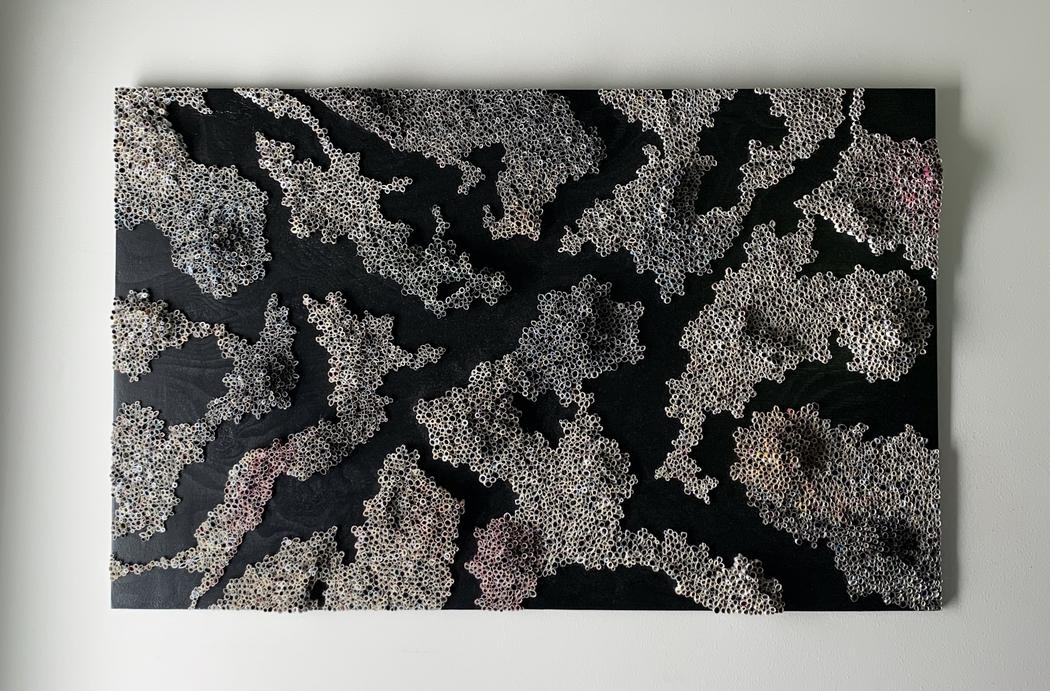 Kjersti Ochsner | Cluster | 2020
Your work is built from thousands of tightly rolled paper elements. At what point does repetition become meditative rather than purely labor-intensive for you?
At this point, the repetition feels more meditative than labor-intensive. I’ve rolled so many pieces over the years that the physical action doesn’t require much thought anymore. It becomes rhythmic and steady. While it’s still labor-intensive, the rhythm of the process creates a kind of quiet concentration.
You describe your process as intuitive and organic. How do you recognize when a piece is “finished”, if there is no predetermined composition?
Once the elements are adhered, they’re not easily removed. I guess that it’s this permanence that shapes the way I work. Each decision builds directly on the last, so there’s a level of commitment involved at every stage. Because of that, I’m constantly evaluating how the surface is developing as I go. I’m looking at balance, density, and the overall movement across the panel.
There isn’t a predetermined image I’m trying to reach, but there is a point where the surface itself eventually defines the endpoint.
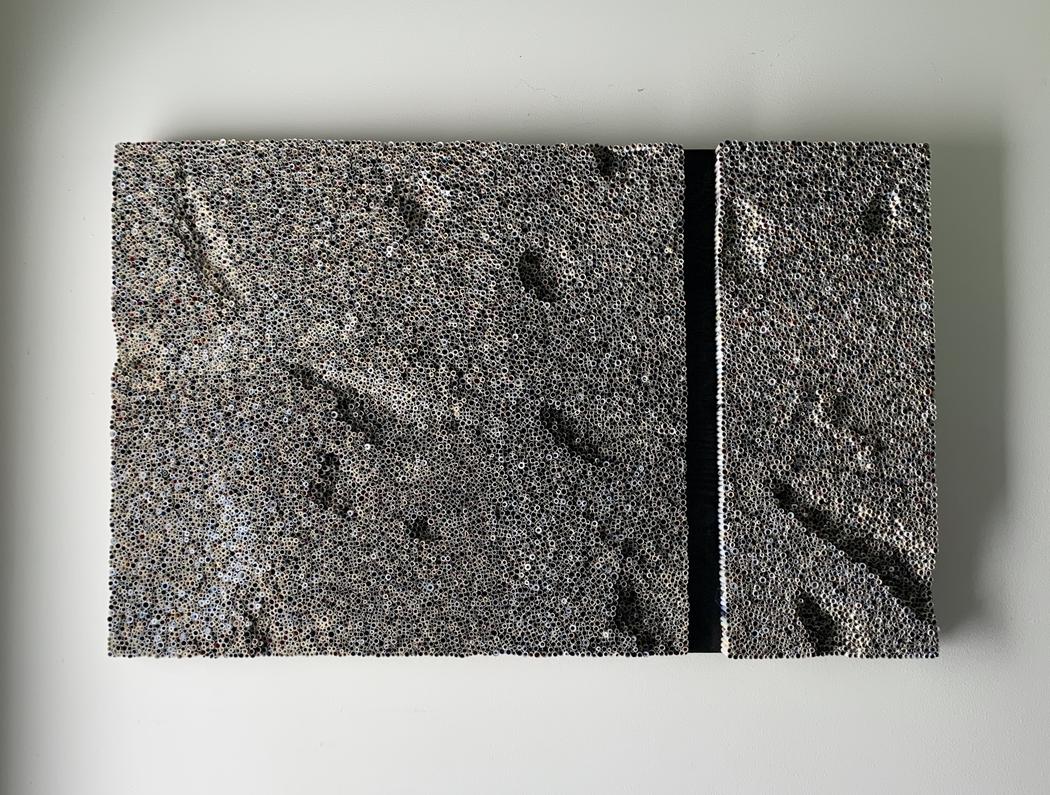 Kjersti Ochsner | Crevice | 2022
Recycled magazines and discarded paper carry traces of previous lives. Do you think about the original content of these materials while working, or do they become purely formal elements?
The original content isn’t something I actively think about during the process. Once the paper is cut and rolled, it becomes primarily about color, density, and structure. The paper loses its narrative function and operates formally within the composition.
I initially used recycled magazines simply because they were readily available. I began using this material in college while trying to complete a project without purchasing additional materials. I had a stack of magazines and catalogues on hand, so I decided to experiment with what I already had. Over time, I came to appreciate the practicality of that choice. These are materials that would typically be discarded, and there’s something satisfying about repurposing them and turning it into a work of art. The emphasis, though, remains on structure, rhythm, and surface rather than on the printed content itself.
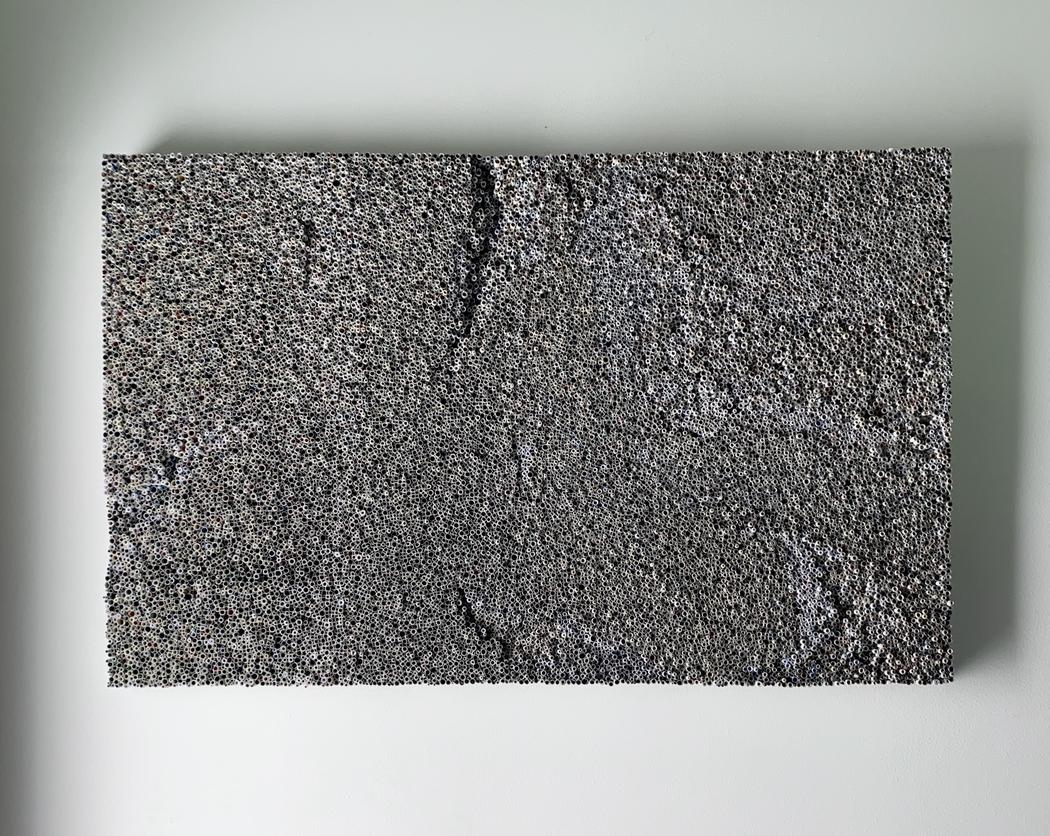 Kjersti Ochsner | Deja Vu | 2022
Light and shadow play a crucial role in how your works are perceived. How important is the viewer’s movement and distance in completing the work?
Light and movement are central to how the work is experienced. I cut the rolled elements to varying lengths, so as a viewer moves around the piece, the surface shifts. Changes in light, whether natural or artificial, alter the shadows and subtly shift the visibility of color.
Distance also plays an important role. Up close, the work reads as a dense field of individual forms. From farther away, the surface begins to soften and unify, and larger patterns become more apparent.
Many of your pieces suggest natural, architectural, or cellular structures without depicting them directly. Are these associations intentional or emergent?
The references are emergent. I don’t begin with specific imagery in mind. As the repetition builds, certain patterns may suggest natural or architectural forms, but those connections develop organically.
I think it’s natural for viewers to look for recognizable patterns within abstraction. I appreciate that different people see different things in the work. That openness is important to me. The pieces leave space for interpretation rather than directing it.
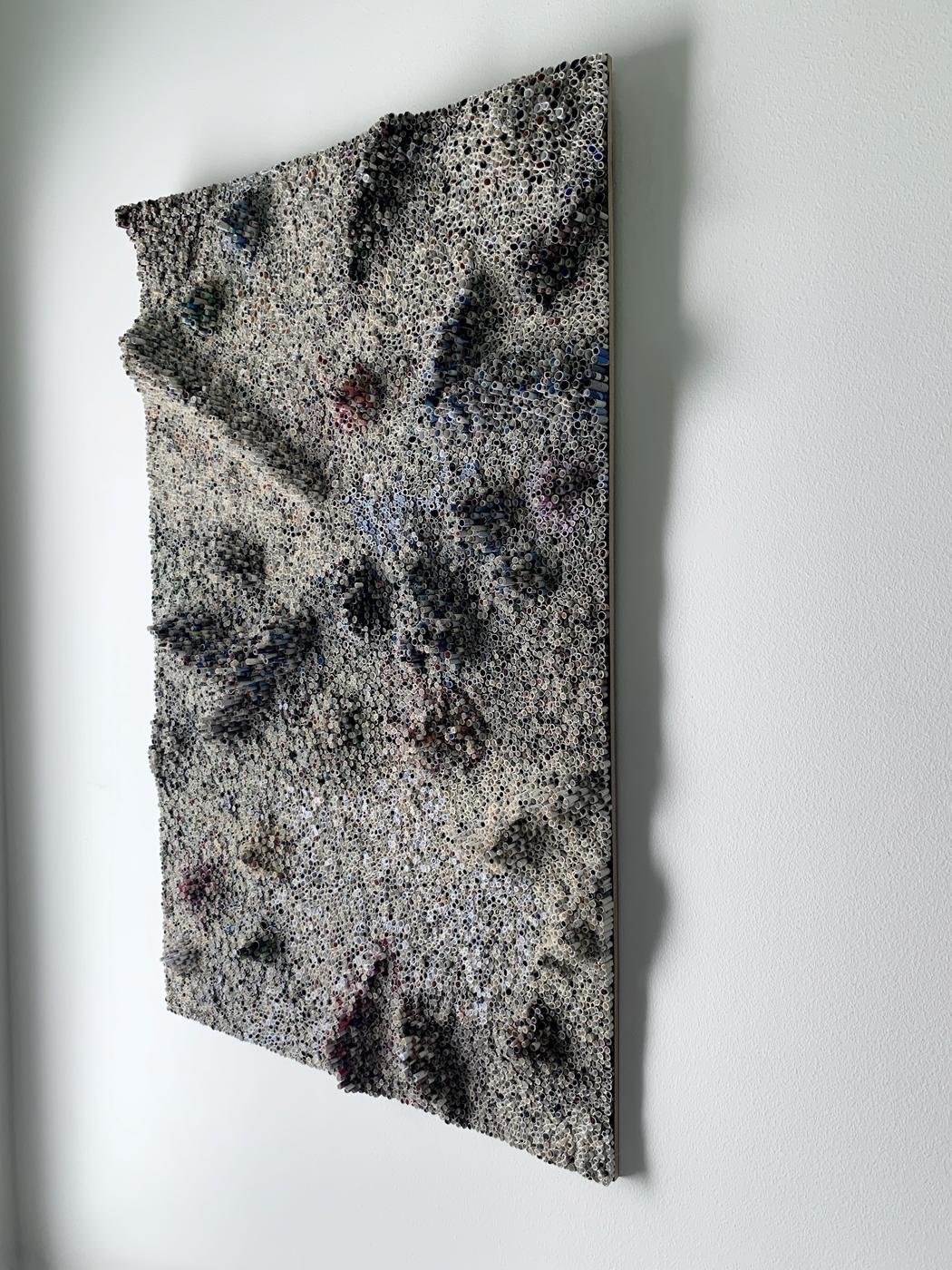 Kjersti Ochsner | Excavation | 2019
The surfaces of your works resist quick reading and demand slow looking. Do you see this as a response to contemporary visual overload?
I didn’t initially frame the work as a response to visual overload, but I do think it asks for a different kind of attention. Part of that has to do with the absence of a single focal point. There isn’t one area that directs the viewer’s eye immediately. Instead, the surface unfolds gradually.
Because the composition is distributed across the entire panel, the viewer has to move through it rather than absorb it all at once. That structure naturally slows the experience down.
What do you hope a viewer feels or notices after spending extended time with one of your pieces?
I don’t approach the work with a specific emotional outcome in mind. If someone spends extended time with a piece, I’d like them to notice how it changes, how light shifts across the surface, how color emerges at different angles, how the structure softens or intensifies with distance.
If the work creates a sense of focus or quiet, that’s meaningful to me. But I’m equally interested in viewers bringing their own interpretations to it. The pieces don’t prescribe a narrative, so whatever associations or responses arise belong to the viewer.
Interestingly, reactions vary. Some people find the work calming, while others find the density or repetition slightly unsettling. I think that range of response is part of what makes the experience active rather than passive.
Leave a Reply
You must be logged in to post a comment.