
Jefimija Stoicic
Your works seem to capture fragments of inner dialogue — urgent, emotional, sometimes chaotic. How do you decide which words or symbols become part of the final composition?
When I begin painting, I rely primarily on the emotions carried by the theme I am working with. I don’t think about words immediately; instead, I allow them to emerge naturally during the process. Painting can sometimes take months, and the words that appear often reflect momentary emotional states, which may even contradict one another, as they are not the same at the beginning of the process as they are at the end.
At times, this feels like a dialogue I am having with myself — questioning previous decisions and evoking memories of specific places and people. The words that appear in my paintings often function as characters; sometimes they are not sufficient on their own, but exist in relation to the image and the emotional space it creates.
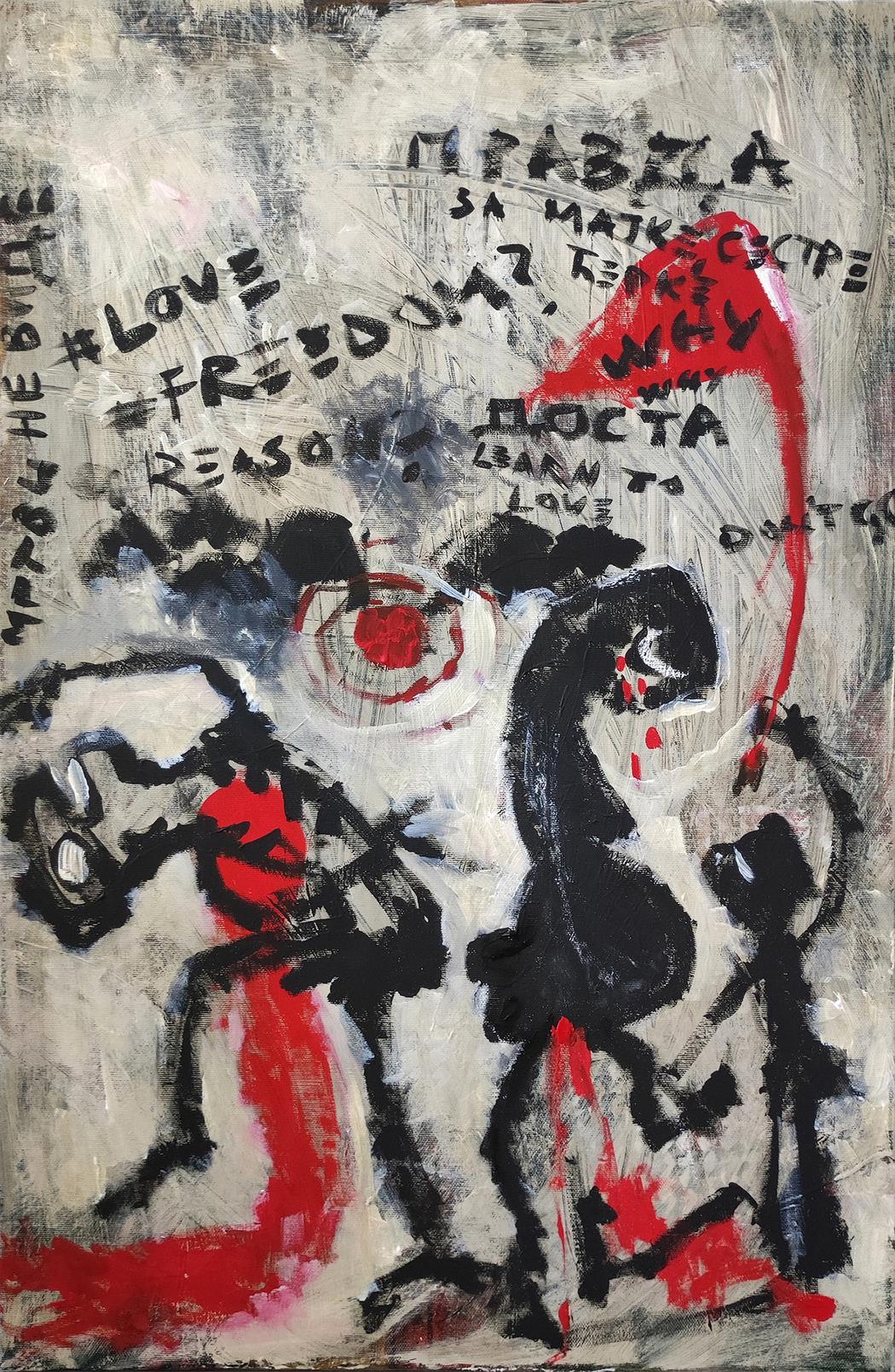 Jefimija Stoicic | Dead Don’t See | 2022
Many of your paintings combine text and figures in a raw, expressive manner. What comes first for you — the visual image or the written phrase?
Most often, it is the figures that come first. They are meant to express fundamental emotions — human suffering, anxiety, love, desire, fear, happiness, calm. The theme I explore is not always purely personal; sometimes it is focused on a specific “problem” that I want to address and, in a way, resolve through my work.
These figures become the protagonists of the story I want to tell — whether it is a personal issue, a desire, a fear, a dream, or a problem I observe within society and feel particularly sensitive toward. Ultimately, it always depends on the theme itself.
You often explore fragility and transformation. How do you translate such invisible psychological states into visual form?
For me, fragility and transformation are states that cannot be directly depicted, but only suggested. I don’t try to translate them into clear symbols; instead, I build them through the process itself — through changes that happen within the painting. The figures I create often appear unstable, unfinished, or caught in a state of transition, as these conditions feel closest to inner psychological processes.
Transformation in my work is rarely sudden; it is slow, sometimes barely noticeable, yet constant. Fragility appears in the tension between what is said and what remains unspoken. In that in-between space, I try to preserve emotion — not to explain it, but to give it a form that can be felt.
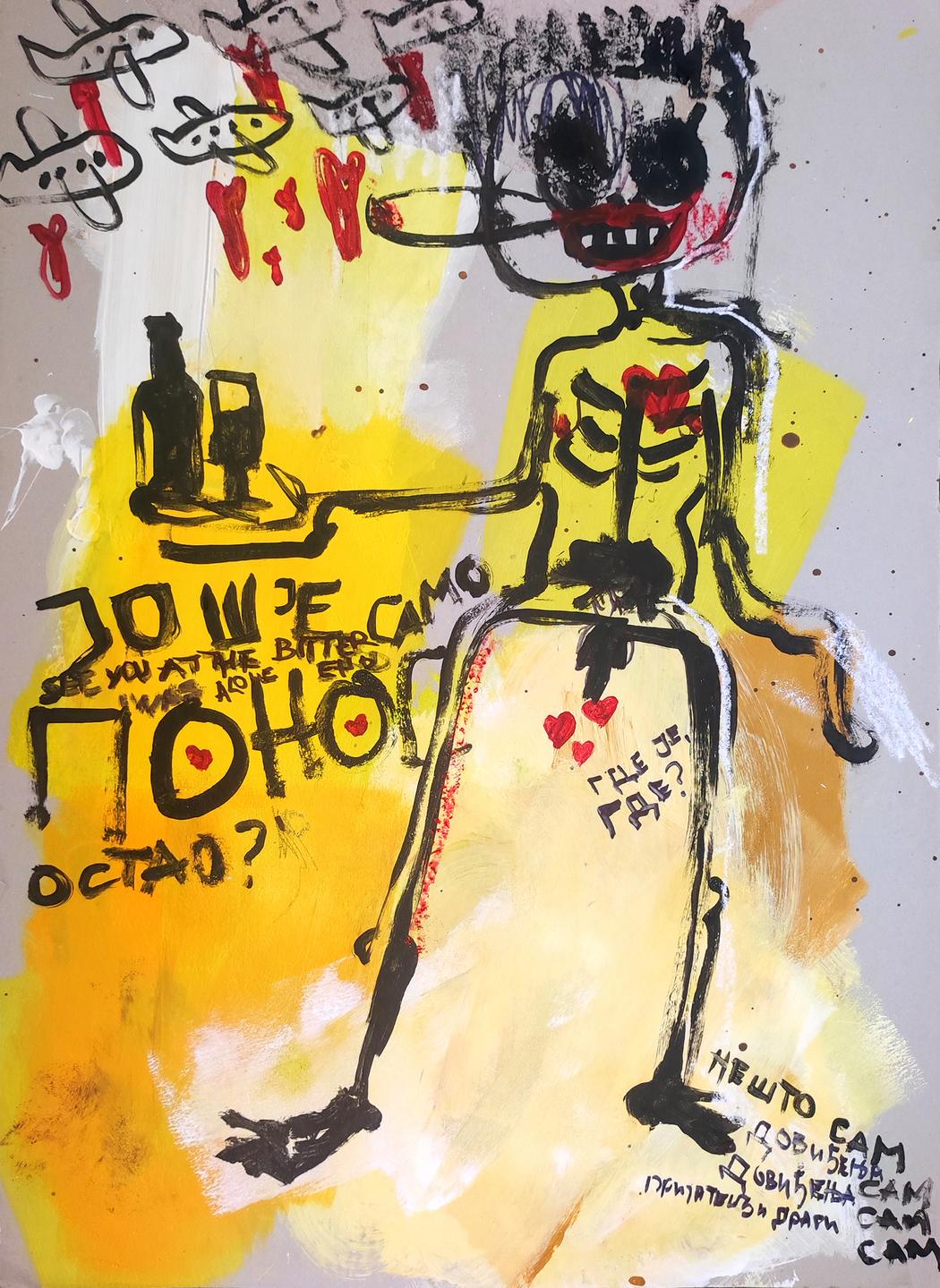 Jefimija Stoicic | Only Pride Remains | 2022
The color red appears frequently in your works. Does it carry a specific symbolic meaning for you?
Yes, red is a color I often use in my work. I perceive red as the color that can most clearly express the emotions carried by human beings across the entire color spectrum. And no — I don’t mean only the conventional symbolism of red as love or resistance.
For me, red represents something primal, something that cannot be easily altered. I am referring to the “codes” we are born with — something that lies deep within us and exists as long as we exist. Human beings are inherently changeable; our opinions and attitudes are shaped over time. Yet that inner spark, the basic structure of our existence, remains constant and influences all the aspects of life we try to change. At our core, we remain the same — the variables appear on higher levels of intellectual development. My “red” is precisely that.
Your art evokes both childlike simplicity and existential tension. How conscious is this balance between naivety and intensity?
As I mentioned earlier, we all carry certain fundamental “codes” that follow us throughout life. As children, we simplify complex emotions and allow ourselves to express them in the most basic way possible — and that is where the beauty lies. Adults tend to overcomplicate things that should, in essence, remain simple.
On the other hand, complexity enters through the themes I explore. When I paint, I try to break down the questions I am dealing with into their simplest elements and then recombine them in search of an answer. This process is very spontaneous and natural; while working, I don’t consciously think about selecting elements, but rather allow emotion to guide me.
 Jefimija Stoicic | Tata Taranta I Nista | 2022
What role does spontaneity play in your creative process? Are your gestures instinctive, or do you plan compositions carefully?
Although I consciously choose the themes I work with, spontaneity is a central thread that guides me. I genuinely enjoy the process of creation because I never know where it will lead — whether a piece will be finished in five minutes or over several months or even years.
That is why I often return to older works and continue to rework them. I simply feel that some pieces expect that from me. My artwork is a living matter — it continuously renews and transforms itself.
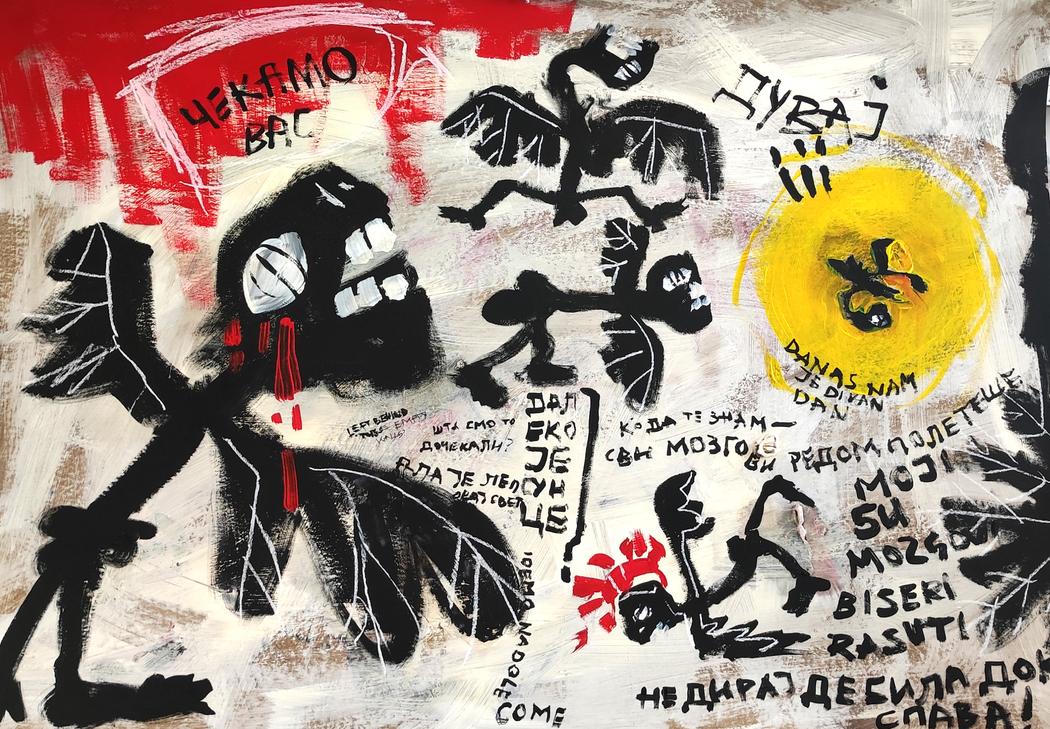 Jefimija Stoicic | We Were Waiting You | 2022
The texts in your paintings often mix languages — Serbian and English. Is this linguistic layering intentional, and how does it affect meaning?
This is a very interesting question. Sometimes, I must admit, I don’t think much about which language I use. At times, I experience my work as a kind of personal diary — an imaginary world where language is not essential.
On the other hand, it often happens that during the creative process I hear lyrics from a song I’m listening to and realize they perfectly describe the emotion I am expressing, so I incorporate them into the work. Essentially, the language I use to address myself or the viewer is not crucial to me.
An interesting moment occurs when the viewer, perhaps not understanding one or both languages, tries to interpret the message based solely on personal experience and perception. That is where the magic lies. It’s like passing by a graffiti you can’t read at all, yet still experience it very strongly on an emotional level. In that case, text becomes a new visual element, freed from a fixed meaning. That is why a single work of mine often allows for multiple interpretations.
Leave a Reply
You must be logged in to post a comment.