
María Sauzet
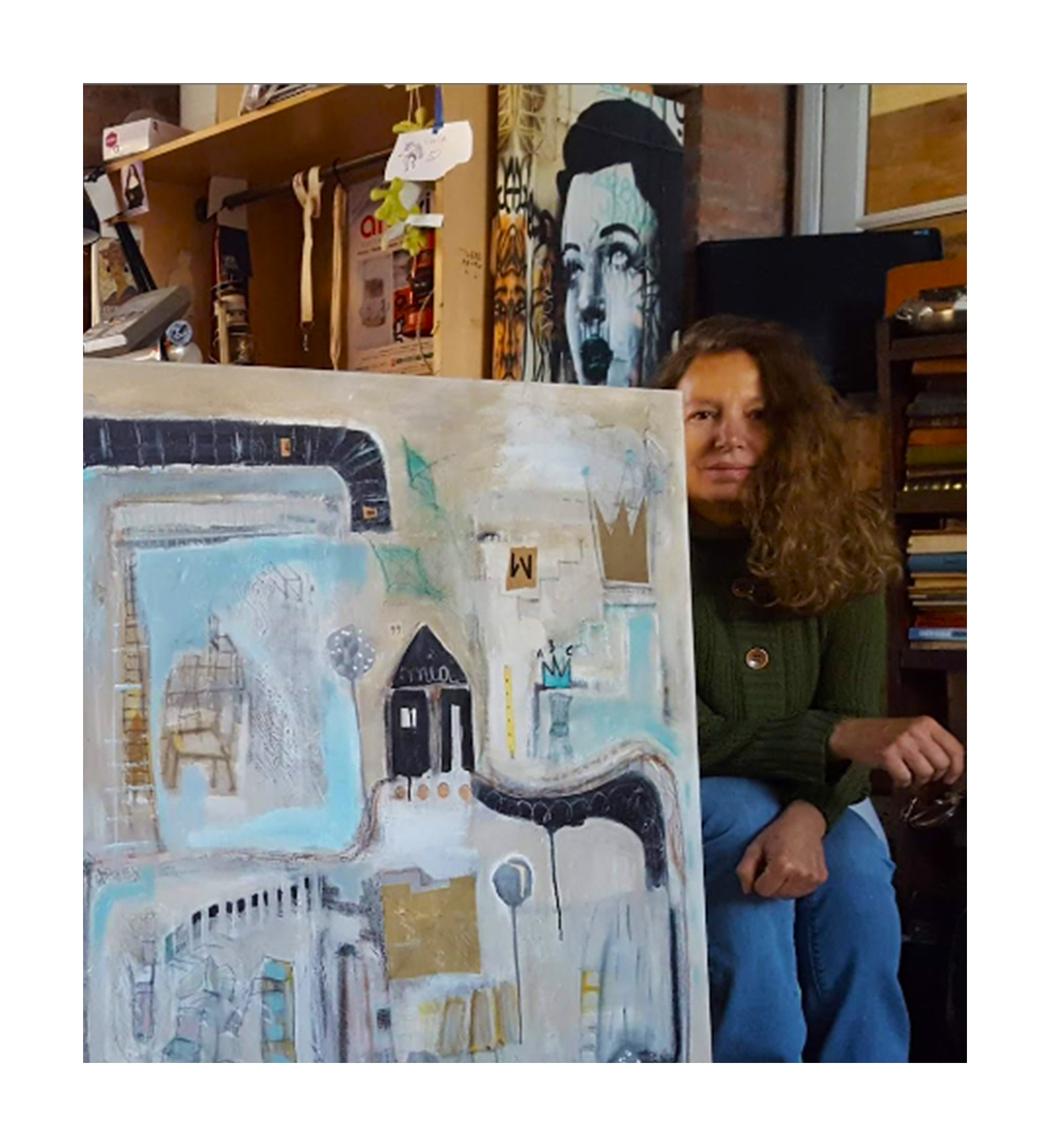
Your work often transforms interior spaces into surreal emotional landscapes. How do these imagined rooms connect to your own memories or lived experiences?
They are connected in a beautiful way, as it is absolutely magical to be able to capture in each piece—regardless of the technique—my emotions, feelings, or circumstances from the past, present, or even the future. Those invented landscapes, such as forests, gardens, or microuniverses, are precisely the imaginary places where I long to be or where I once imagined myself. In this sense, I can say that my works are both expressive and symbolic.
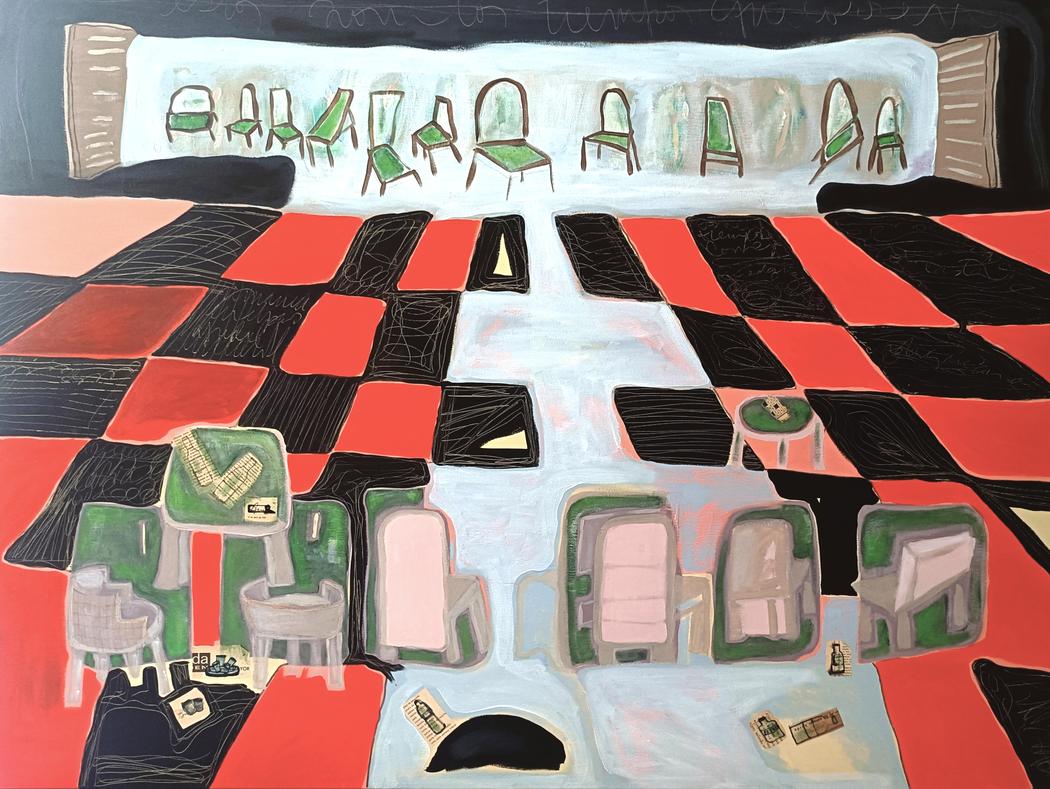 María Sauzet | Happy Hour
The perspective in your works often bends or shifts, creating a dreamlike disorientation. Is this intentional, and what does this distorted perspective represent for you?
The distortion in my work is entirely intentional. For me, it’s part of an expressive language: just as memories fade, are invented, or reinvented, I allow myself to reconstruct scenes in my own way. That freedom becomes a metaphor. I’m not interested in depicting reality as it is; my works are infused with symbolism.
This is also why I turn to collage. I’m fascinated by how this technique allows you—figuratively—to turn the world upside down. I find it compelling when the viewer notices that something is out of place, that the vanishing point doesn’t align the way it “should.” That slight dislocation opens up a different way of seeing.
In this sense, the surface—the canvas, the paper, the fabric—becomes both a playground and a metaphor for an internal state. What appears as distortion is, in truth, a way of revealing what cannot be expressed literally.
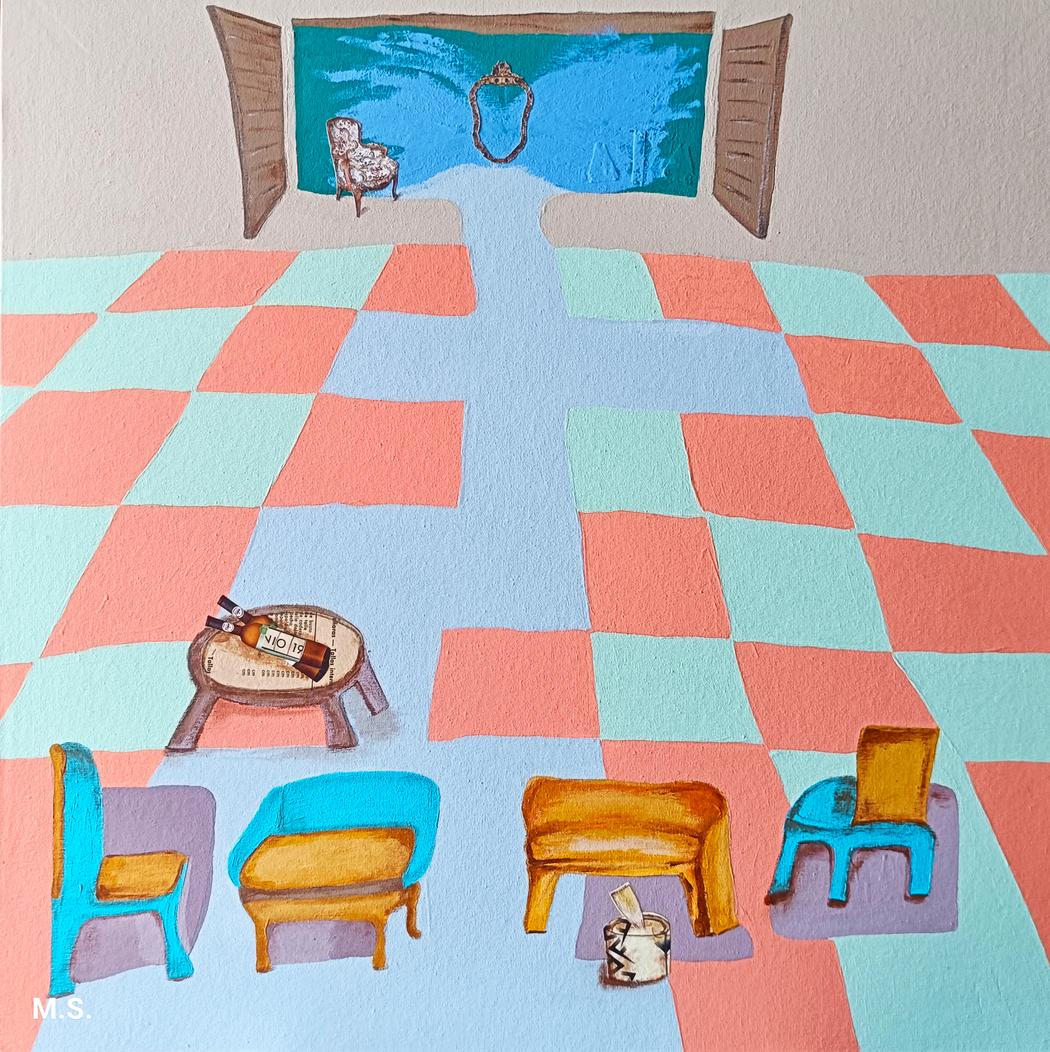 María Sauzet | HastíO
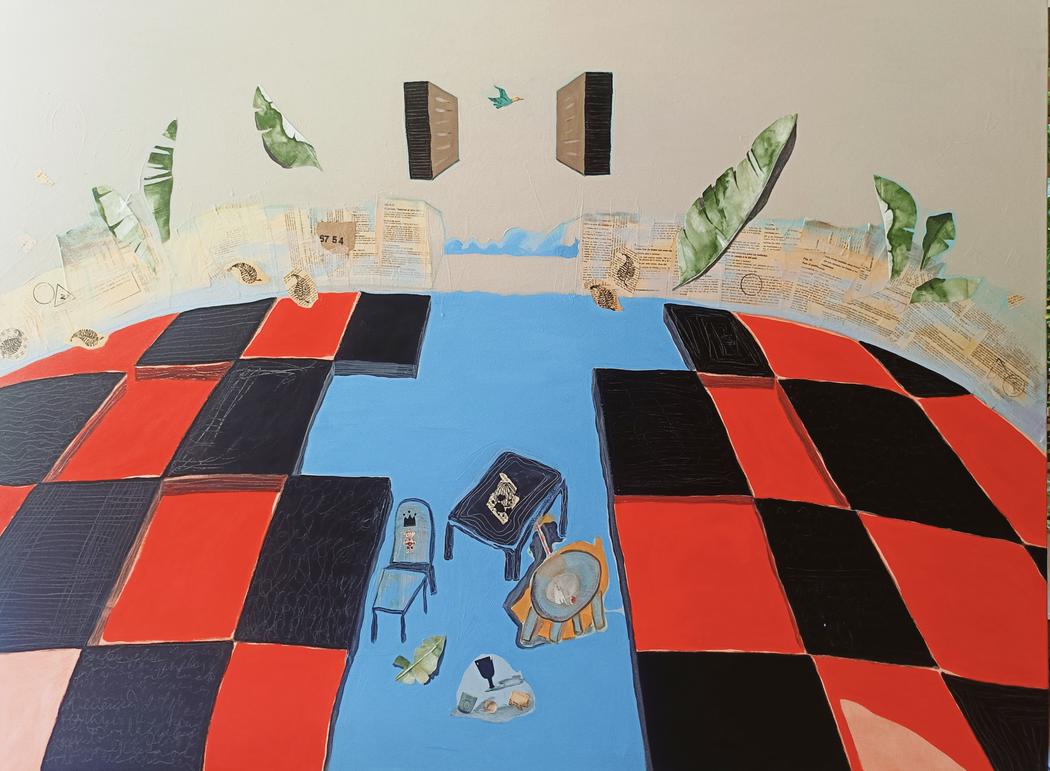
The checkered floor appears almost like a stage where objects “perform.” What draws you to this motif, and what does it symbolize in your visual language?
The checkered floor holds enormous meaning for me. I spent most of my childhood in my grandparents’ house, where the light filtered in through the tall windows, and the skylight let sunlight spill across each tile of the worn checkerboard floors. There were Hispanic art figures, beautiful illustrated books, and wooden furniture full of character. People talked about theater, and my aunt would recite the verses of Federico García Lorca. In those rooms, I read my children’s books while imagining every possible setting.
I perceive spaces as sanctuaries of memory; the floor is emotional, a trigger for other sensations. It’s a stage where I place objects not casually, but exactly where I feel they need to be.
Life unfolds on a stage, and the privilege of artists is that we can move the pieces at will and recreate moments from the past.
A large part of my work belongs to the series Vestiges of Childhood. Vestiges are the traces and memories that come back to us in mischievous ways. My practice is multidisciplinary, and these vestiges appear in collages, paintings, photographs, assemblages, and mixed media. The series has no end—I continue to work on my vestiges over time.
These most recent pieces clearly reflect a Mediterranean influence, the region where we lived after leaving Argentina.Every national and international experience has greatly enriched both my work and my life in this profession I’ve chosen—the profession of art. I’ve always been supported and accompanied by my family on almost all of these trips, which makes each experience doubly rewarding.
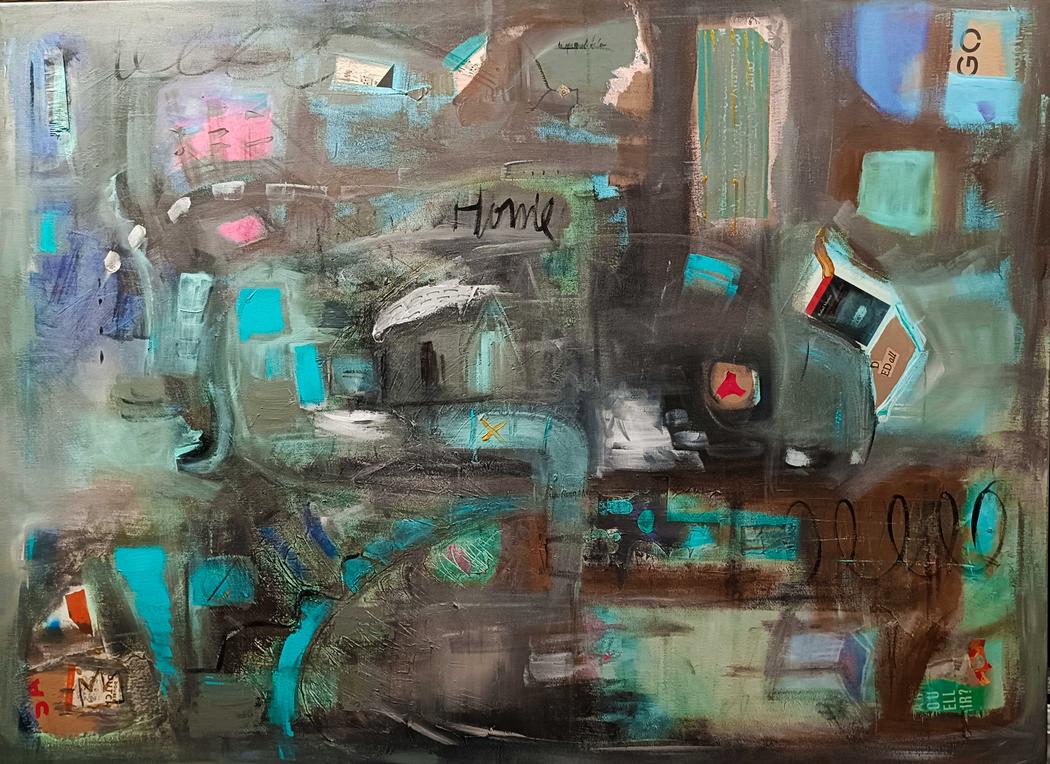 María Sauzet | Home
Your international background spans Argentina, Italy, and Spain. How has this multicultural experience shaped your artistic vision?
I’ve been fortunate to participate actively in several major art fairs. (Let me tell you that I’m always surrounded by my family and friends, who are wonderful fans). One of them—ART ON PAPER in New York City—surpassed all my expectations. As in other fairs, I met there with the gallerist and with other artists who were able to travel. During the days of the fair, you are immersed in a world where art is both breathed and lived. Your heart races not only when the audience engages with your work but also as you visit other booths and see the work of fellow artists. The experience is truly sublime.
At that particular fair in NYC, I sold a piece to a collector, Julia W. from Onatrio, Canada. Once she returned to her country, she sent me a photo of the piece beautifully framed and expressed how happy she was to have acquired it. That was incredibly gratifying.
I’ve also participated in other art fairs in the United States, including the one at the Miami Convention Center. A remarkable aspect of that experience was that the gallerist couldn’t travel, so the artists took part in installing the booth, welcoming visitors, and handling every detail—an experience made even more meaningful by the spirit of generosity and camaraderie among us. Traveling to the Palm Beach Art Fair and exhibiting my work there was also highly enriching.
I traveled to PARC in Lima, Peru, and I’ve participated in many art fairs in Argentina, my home country. One of the most important and rewarding was BA Photo, the leading photography fair in Buenos Aires. A magazine selected my installation—circular photographs of the sidewalks of Wynwood, covered in acrylic—as one of the most interesting projects of the fair, which was an immense joy.
Now living in Spain, I regularly take part in competitions where being selected among so many works already feels like a prize in itself. In 2022, I was awarded First Prize in a competition in the city of Cieza, Murcia, for a piece from the Encuentro series, also created with collage and acrylic. It was deeply fulfilling to travel there and meet the wonderful people who chose my work for the award.
I participate actively in open calls, and we travel whenever possible to the cities where the exhibitions are held.
I also contribute by donating works to charitable causes; I believe it’s important for artists to collaborate, because together we can truly make a difference.
It is also a wonderful experience to be blessed with awards. I received the First Prize from the San Isidro Visual Artists Association in 2004, and more recently I was also awarded the First Prize in Cieza, Murcia, in 2022. I have also received an honorable mention in photography from the University of Salvador.
When viewers explore your works, what emotional journey do you hope they experience—from the intimate interiors to the open horizons?
This is interesting because the question itself implies the dilemma of whether a work of art should—or even can—be explained, or whether each person should have their own emotional experience when standing in front of it. Personally, I don’t like to explain my work too much. Everything I pour into it is emotional and connected to the moment of creation, the circumstances, the environment, and my experiences—past, present, or future.
Many times, I write texts almost automatically, without thinking, and generally, I intend for them not to be fully understood.
Above all, I believe that to have a true emotional experience, one must be physically present in front of the work. Images do not come close to capturing what a piece is in body and soul. Its textures, palette, details, and spirit are diminished when seen only through a reproduction.
I am personally fascinated by how people interpret my exhibitions, because each viewer brings their own imprint and perceives the work through the lens of their own life experiences. The artwork functions as a trigger for personal narratives. I remember a piece from the Partituras series with particular affection, as it was part of my first solo exhibition. The image showed a staircase with blurred ballerina feet, combined with a colorful collage of a beautiful sheet music cover. One viewer gave me a full story: the ballerina is afraid to perform in public and flees down the theater stairs to avoid ever appearing on stage. It was amusing to hear, but not wrong at all—the work could perfectly convey that, or on the contrary, express her joy and urgency to reach the stage.
The truth is, when we present works in an exhibition or on social media, we are sharing our feelings and revealing our soul and heart.
 María Sauzet | La IntrospeccióN Me Da Una Felicidad Tranquila
You describe objects as “silent witnesses of memory.” Which objects in your compositions hold the strongest personal meaning for you?
It’s a beautiful and interesting question.
I have a particular fondness for old objects—those with history, with a soul—objects that once inhabited other homes and belonged to other people. I think I grew up in places where such objects were part of everyday life: a mannequin here, small altarpieces there, attics filled with accumulated things where discovering an object felt like finding a treasure.
I was also fortunate that my father instilled in me a love for photography. My first camera was a KODAK Brownie, and from a very young age I carried it everywhere, photographing the present without knowing that, in the future, it would help me reconstruct my past. Taking photographs, waiting for the roll to be developed—which could take a week—and then seeing the results, was, in a way, part of an artistic creation in itself.
Regarding objects, one of my works, which uses an old typography drawer as its base, holds small elements in its compartments. Each object can represent a memory, a stage of life, or a past emotion. The drawer functions as a personal archive of memory, preserving fragments of lived experiences. It is a miniature world.
I protect these worlds so carefully that I often don’t want to exhibit them; I can hardly bear the thought of parting with these works, as they are an intimate archive of memory and emotion. This is also true for my autobiographical collages. To avoid compromising the privacy of any child, I use my own photographs to create works about childhood, and then I resist letting these works leave me. We are the sum of our memories: of what we preserve, what we choose to show, and also of what it is difficult for us to reveal.
Leave a Reply
You must be logged in to post a comment.