
Anastasia Grigorash
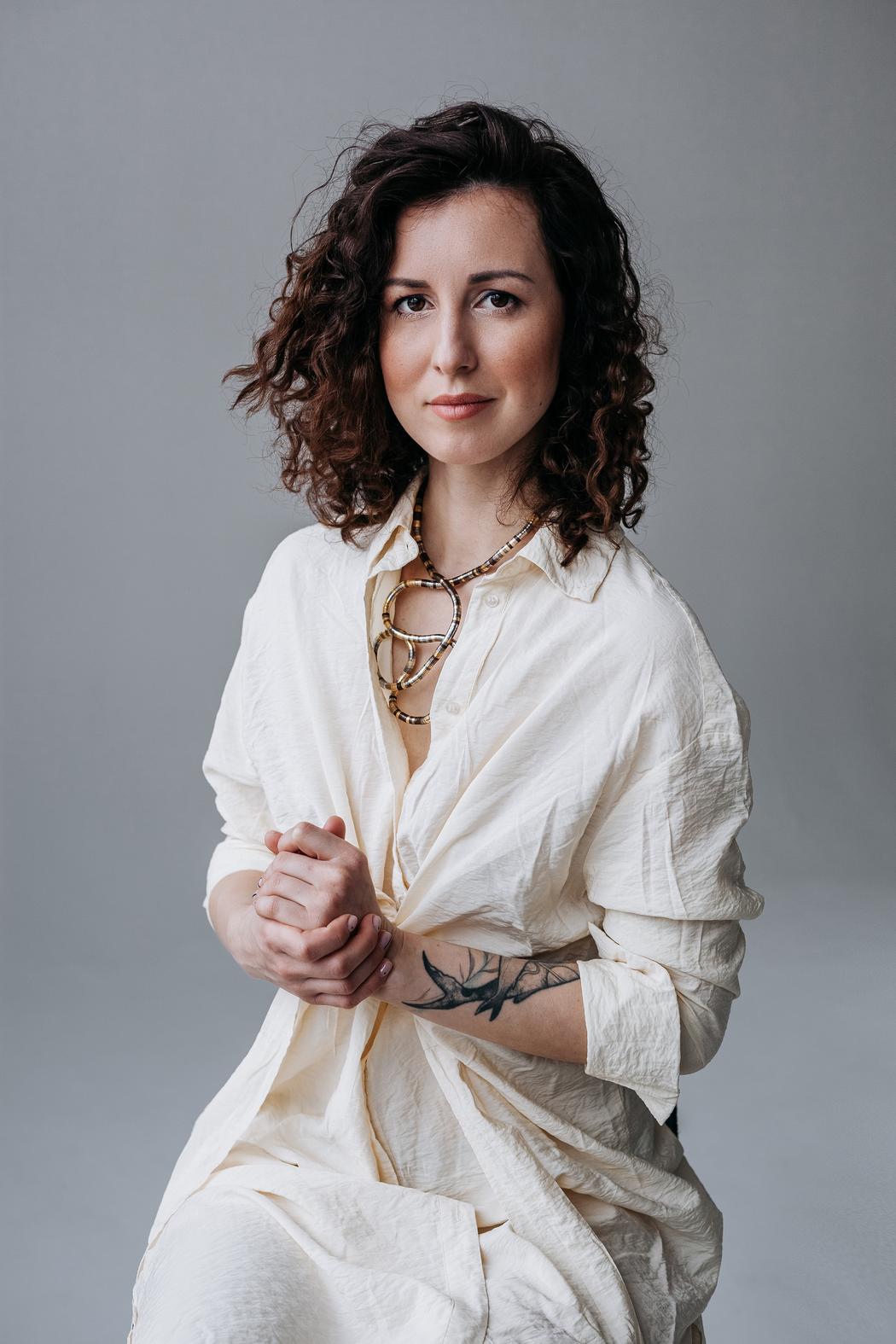
Your project Cabinet de merveilles references the historical tradition of curiosity cabinets. What drew you to this concept, and how does it resonate with contemporary society?
When I visit exhibitions or museums, my attention is inevitably drawn to sculptural works with a high level of detail. This love of examining intricate details is reflected in the aesthetic of the Collector’s Cabinet installation for the Cabinet des merveilles project.
The project began with the free sculpting of flowers. There was an inner desire for high detail, beauty, contemplation, and even possession. Through these sensitive impulses, I arrived at the theme of collecting and the cabinet of curiosities. I began studying photographs of famous European cabinets of curiosities from the 16th–17th centuries. Beyond the collected objects themselves – sometimes astonishing (such as a mermaid skeleton) – I was deeply captivated by the way these collections were presented: carved furniture, whimsical stands, and an abundance of delicate curves and details. All of this fascinated me. I wanted to observe and be amazed, and eventually felt the urge to create my own personal cabinet de merveilles.
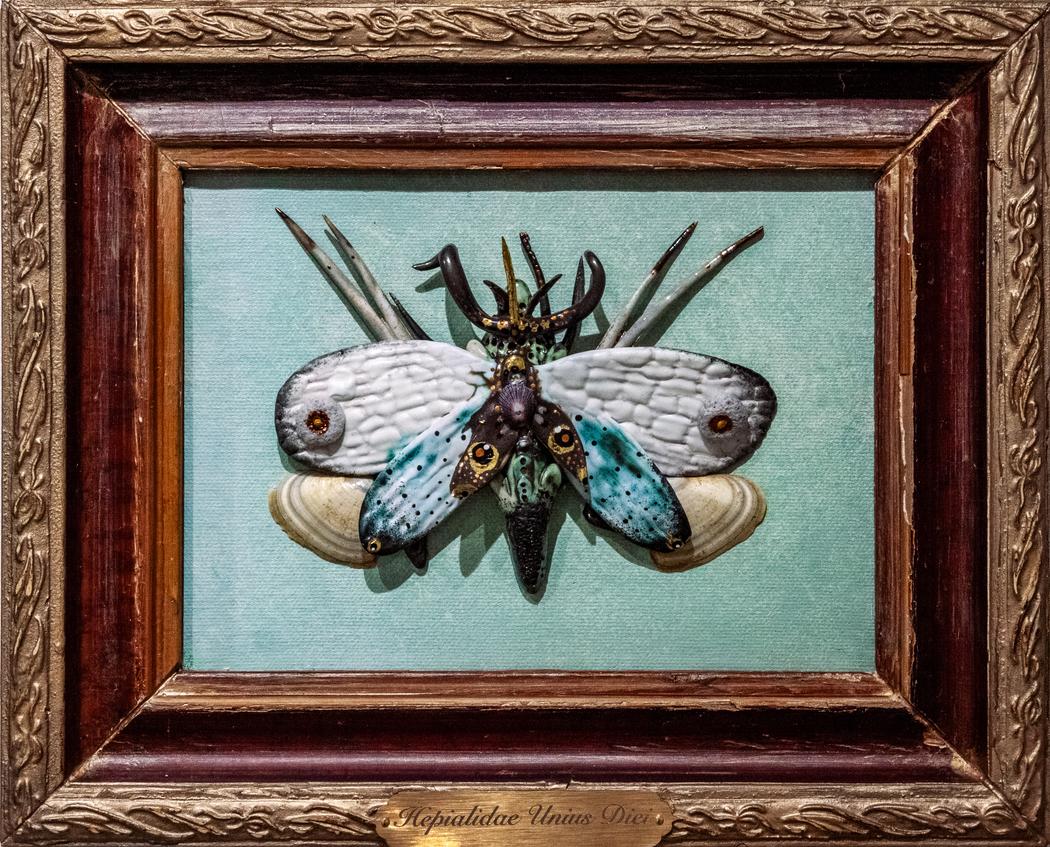
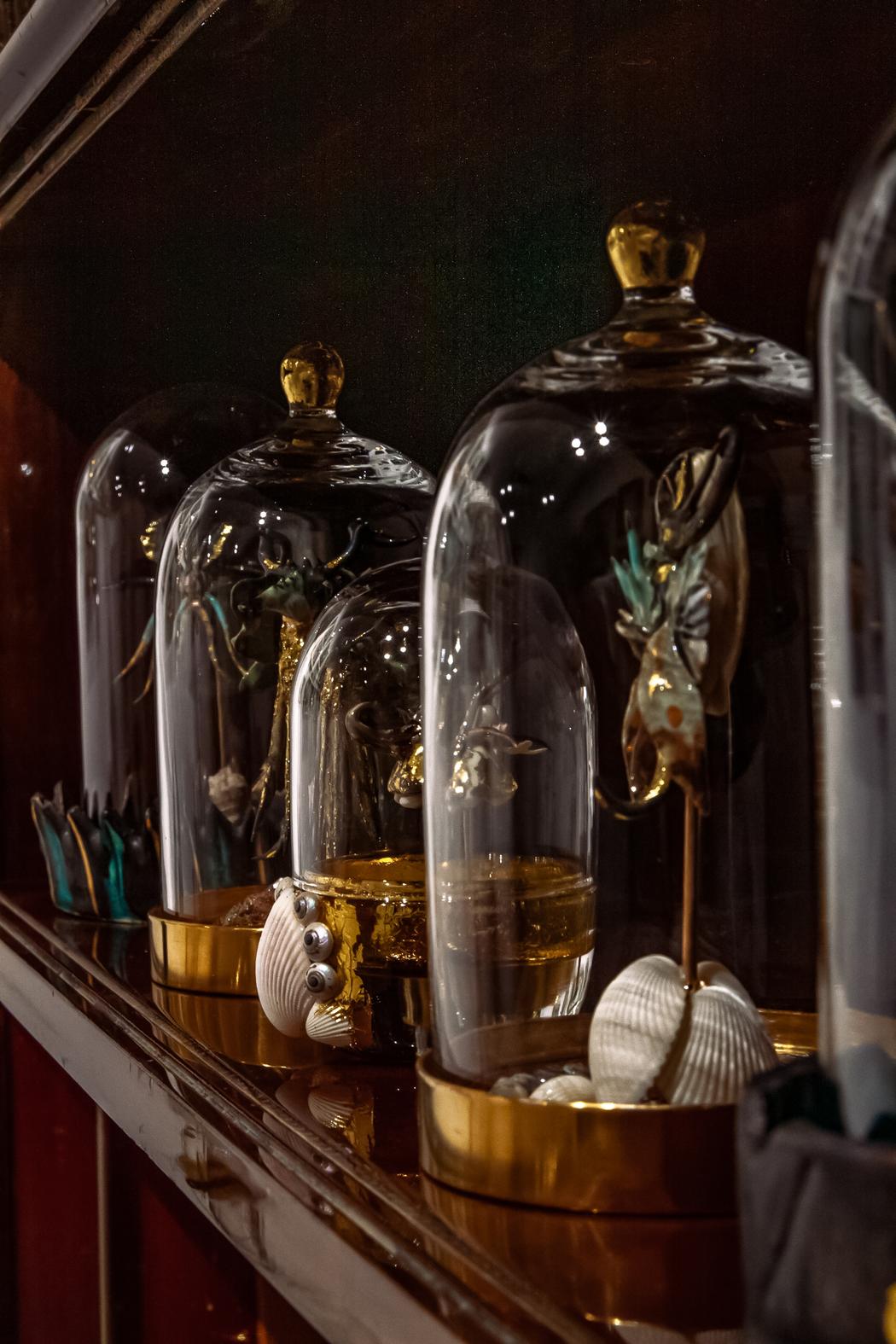
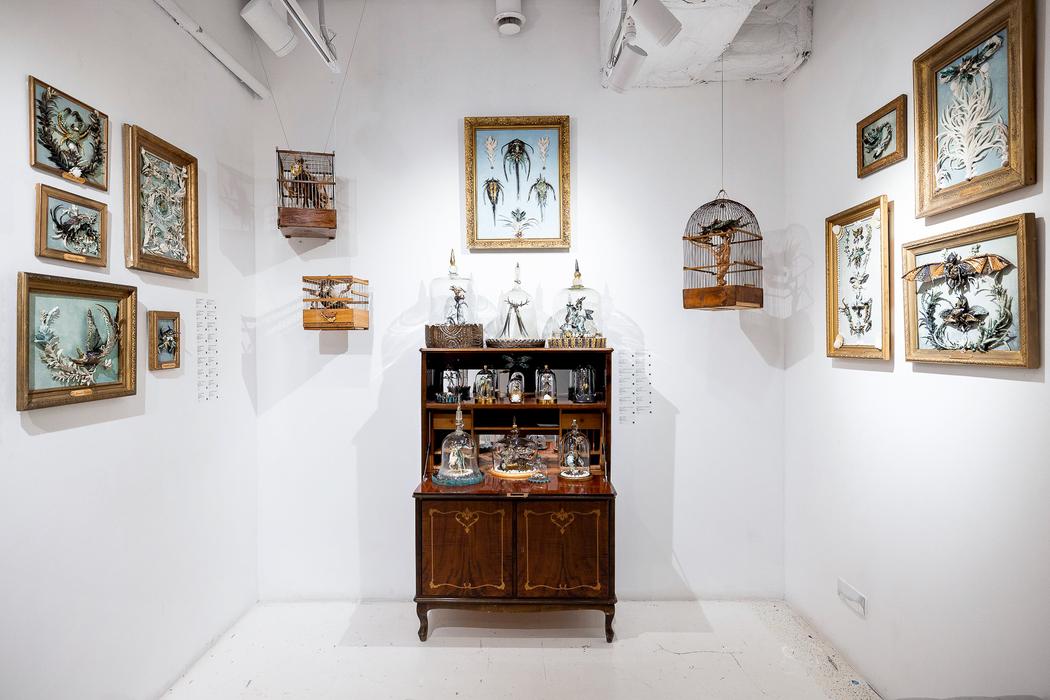
My project explores the deeper mechanisms of human behavior through the lens of collecting, viewing it as a complex psychological and philosophical model. The concept revolves around a fictional collector who hunts golden humanoid creatures. Although he has not yet managed to capture them, he has assembled a collection of various creatures from their world. The Collector’s Cabinet installation, styled as a cabinet of curiosities, symbolizes both the historical tradition of collecting and its spiritual role as a repository of knowledge and cultural values. Here, the collector is not only an owner of rare objects but also a researcher who documents his perspectives and values, striving to understand and preserve unique elements of reality. The installation includes 25 vintage frames with three-dimensional depictions of reptiles and insects, a cabinet filled with cloches, and cages with birds of paradise.
The second part of the project is a video artwork that presents the natural habitat of these creatures—the forest – as well as the being the collector is hunting. This creature turns out to be a human wearing a mask, belonging to a forest tribe. Will the collector be able to stop once he realizes he is hunting someone like himself – a human?
The concept of the project raises questions about the ethics of owning rare species and the boundaries of exploiting living beings for aesthetic pleasure. This issue is particularly relevant today, when, alongside climate change and the ecological crisis, the extinction of rare animal species continues to be driven by human exploitation and barbaric hunting.
You began your professional path as an engineer working with reinforced concrete structures. How has this technical background influenced your artistic thinking and the way you build ceramic installations?
My technical education taught me to think logically and spatially. Thus, when sculpting complex objects, I mentally construct a system of reinforcing ribs or think through deformation joints that can reduce changes in form during drying and firing. I experiment with creating interactive ceramic objects, and when creating installations, spatial thinking comes into play, helping me visualize and harmoniously integrate objects into the surrounding environment.
However, despite my developed logical thinking, in my creative work I adhere to a post-rational approach. First comes the image, then through reflection I ask myself where this visual impulse comes from, and eventually I arrive at developing the concept of the project. I believe that such an approach helps to better reveal artistic abilities and create more vivid and sincere works.
Ceramic sculpture plays a central role in your practice. What attracts you to this material as a primary medium for expressing complex philosophical ideas?
For me, ceramics are not only a material but also a metaphor for human nature: they require patience, attention, love, and constant work on oneself, and it is through this process that I learn to better understand myself.
By its nature, clay possesses a unique tactility – each work becomes a reflection of an emotional state. Therefore, I primarily work with hand-building techniques. Works created by hand help restore a sense of human closeness, vulnerability, and authenticity, which is becoming increasingly rare in the modern world.
Many of your works depict hybrid or imaginary creatures. What do these beings represent, and how do they reflect aspects of human identity or behavior?
My fictional creatures live in a world that reflects our own reality – a kind of escapism into a mirror realm. They symbolize the inner contradictions, dreams, fears, and desires within each of us. Through these characters, I explore the multifaceted nature of personality – both the light and the dark sides of human character. These creatures become conduits for understanding human behavior within society.
Your installations combine ceramics with found objects such as shells, branches, and other materials. How do these elements expand the narrative of your work?
I work in the style of magical realism – an artistic approach that combines realistic depictions of everyday life with the inclusion of fantastical, mystical, or absurd elements. In this way, real found objects make the installation more vivid and tangible, creating a sense of presence and enhancing the viewer’s immersion, blurring the boundary between the real and the imagined.
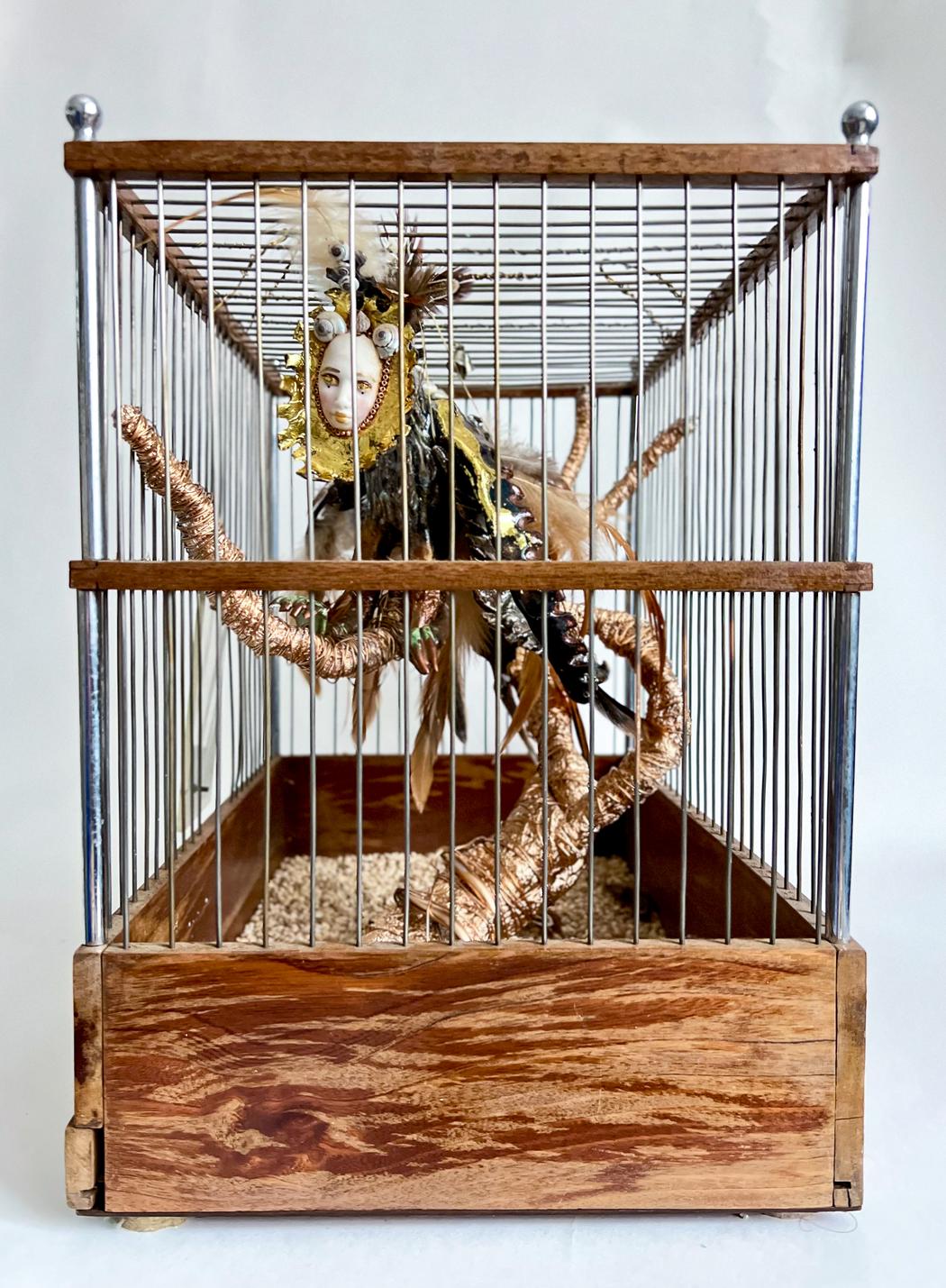
The theme of collecting runs throughout Cabinet de merveilles. Do you see collecting more as a poetic act of preservation or as a reflection of human obsession?
I find it difficult to give a definitive answer to this question. I perceive collecting more as a tool for exploring the dual nature of human beings, which lies in the coexistence of two opposing principles: instincts and needs versus reason and morality. The project presents a hyperbolized, artificially constructed situation that exposes this dualism to the extreme; however, in real life, we are unlikely to ever be able to imagine such a scenario.
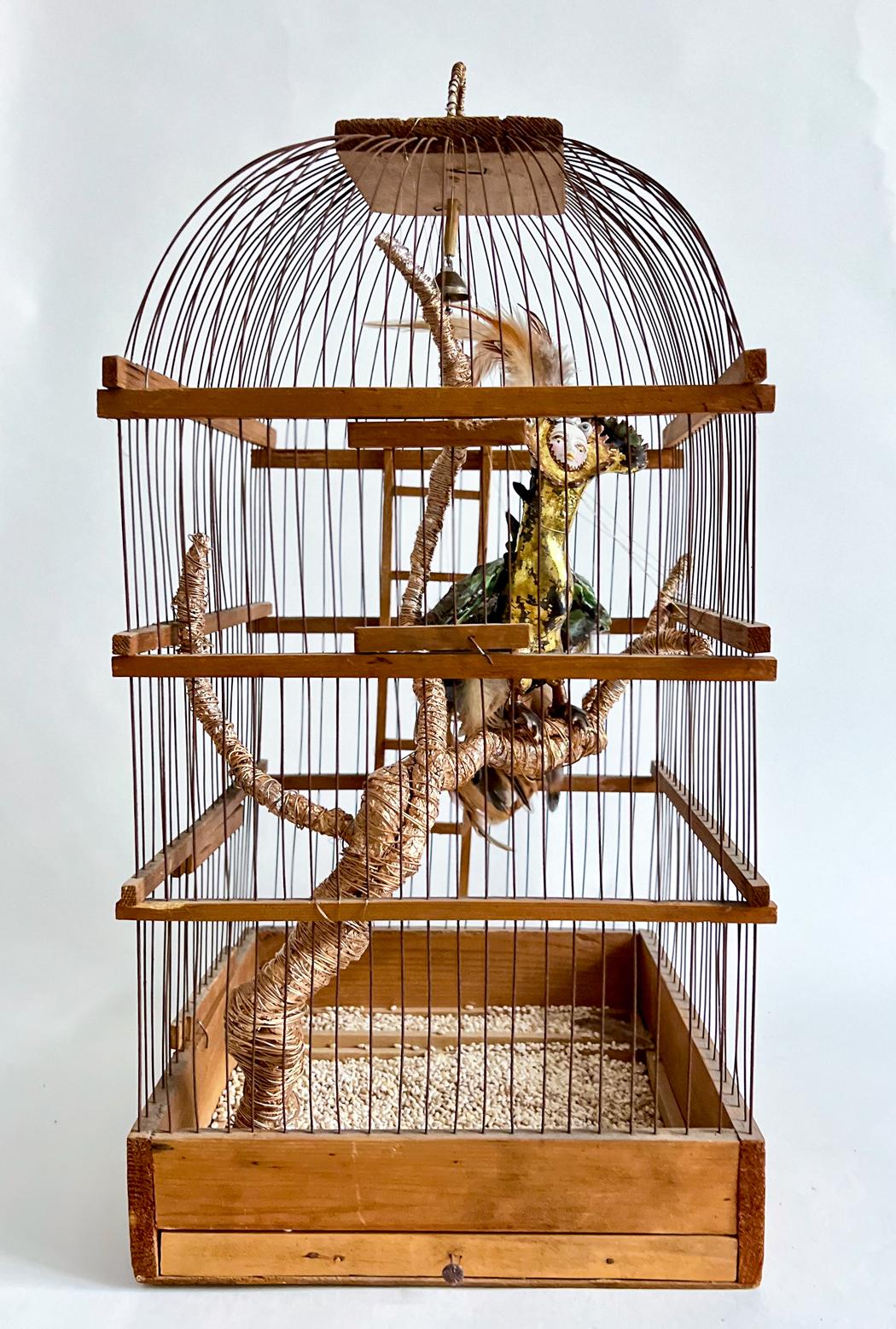
Many of your installations create an intimate and almost ritualistic atmosphere. What kind of emotional or psychological experience do you hope visitors will have?
In my projects, I strive to establish the closest possible connection with the viewer and to create a space of trust for experiencing my work. It is important to me that my art fills the viewer with deep personal reflections, encourages self-exploration and reflection on the surrounding world, and also focuses attention on the importance of preserving humanity in society.
Leave a Reply
You must be logged in to post a comment.