
Murielle Mobengo – Ellébore Guimon
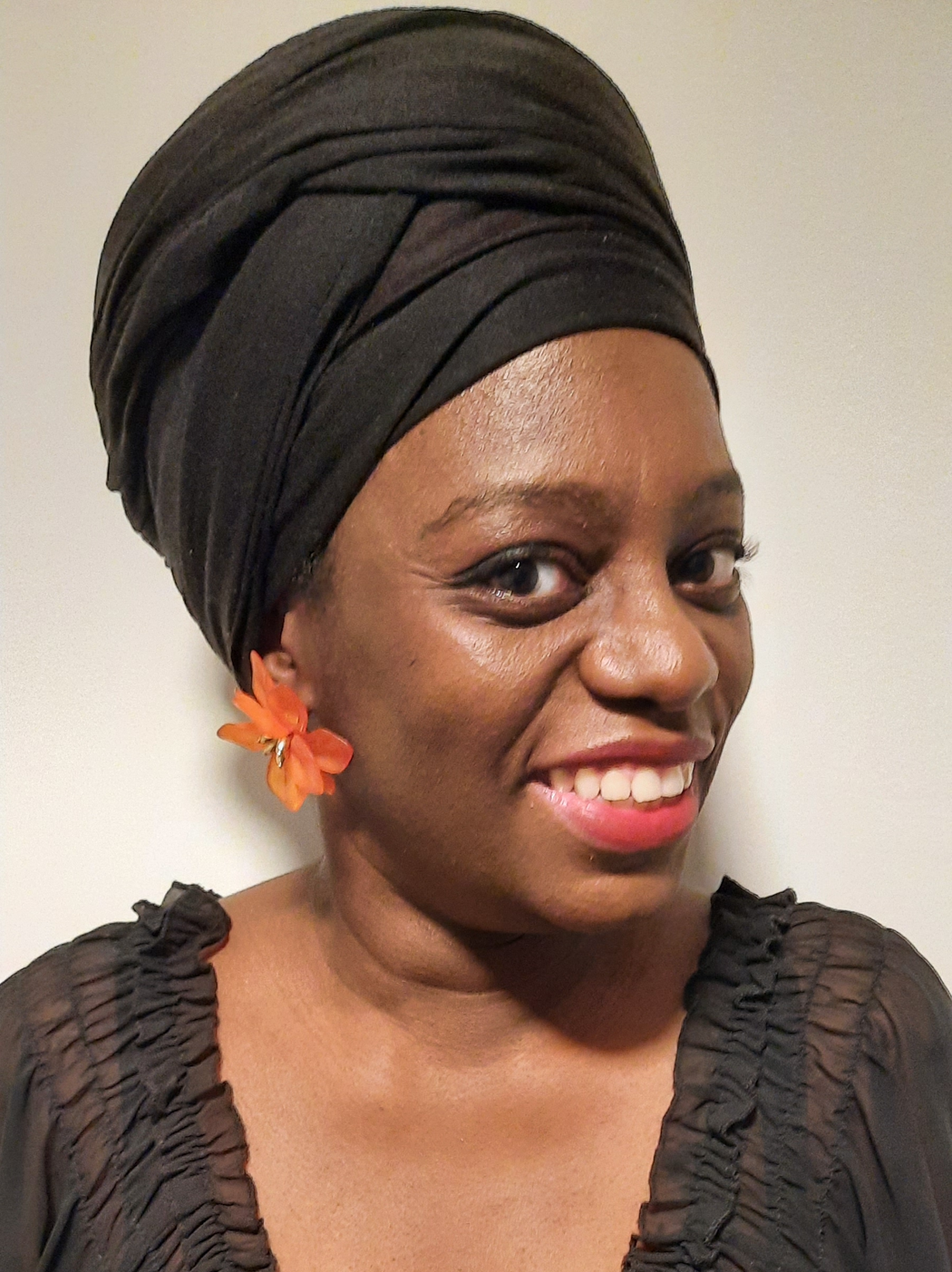
Your work blends Renaissance chiaroscuro with Eastern sacred iconography and Central African visual language. How did this synthesis emerge in your practice?
The language of light in painting was something I encountered early on. I’ve always been drawn to drama in art—the way black and white act like “metacolors,” from which all colors emerge or fade. There’s a power in seeing opposites—light and dark—reunited on a single surface, telling a story that’s both symbolic and aesthetic.
I remember standing in front of Veronese’s The Wedding at Cana at the Louvre. The sheer scale and the way the light filled the canvas left me in awe. It wasn’t chiaroscuro, but the luminosity and epic dimension of the scene stayed with me. Later, I discovered Caravaggio, and with him, the depth of clair-obscur, chiaroscuro. His pale figures emerging from darkness taught me how opposites can create a powerful, cinematic and emotional charge.
But it’s only recently that I began to explore how different skin tones interact with light. Using dark-skinned sitters in chiaroscuro adds complexity and mystery, and yet I love all skin tones. Each one brings its own beauty and challenge. Ultimately, I’m trying to capture what I call the “divine look”—an inner state that’s unique to the sitter but also universal.
As Eastern sacred iconography entered my practice through philosophical and inner inquiry, I found that these traditions aren’t separate. They naturally converge, and my connection to Central African visual language lives in my hand and eye as intuition and memory. Over time, Eastern, Western, and African aesthetics began to feel like a shared visual intelligence. What I’m doing isn’t a fusion so much as a recognition—a recollection of something that exists across cultures, but has been historically fragmented.
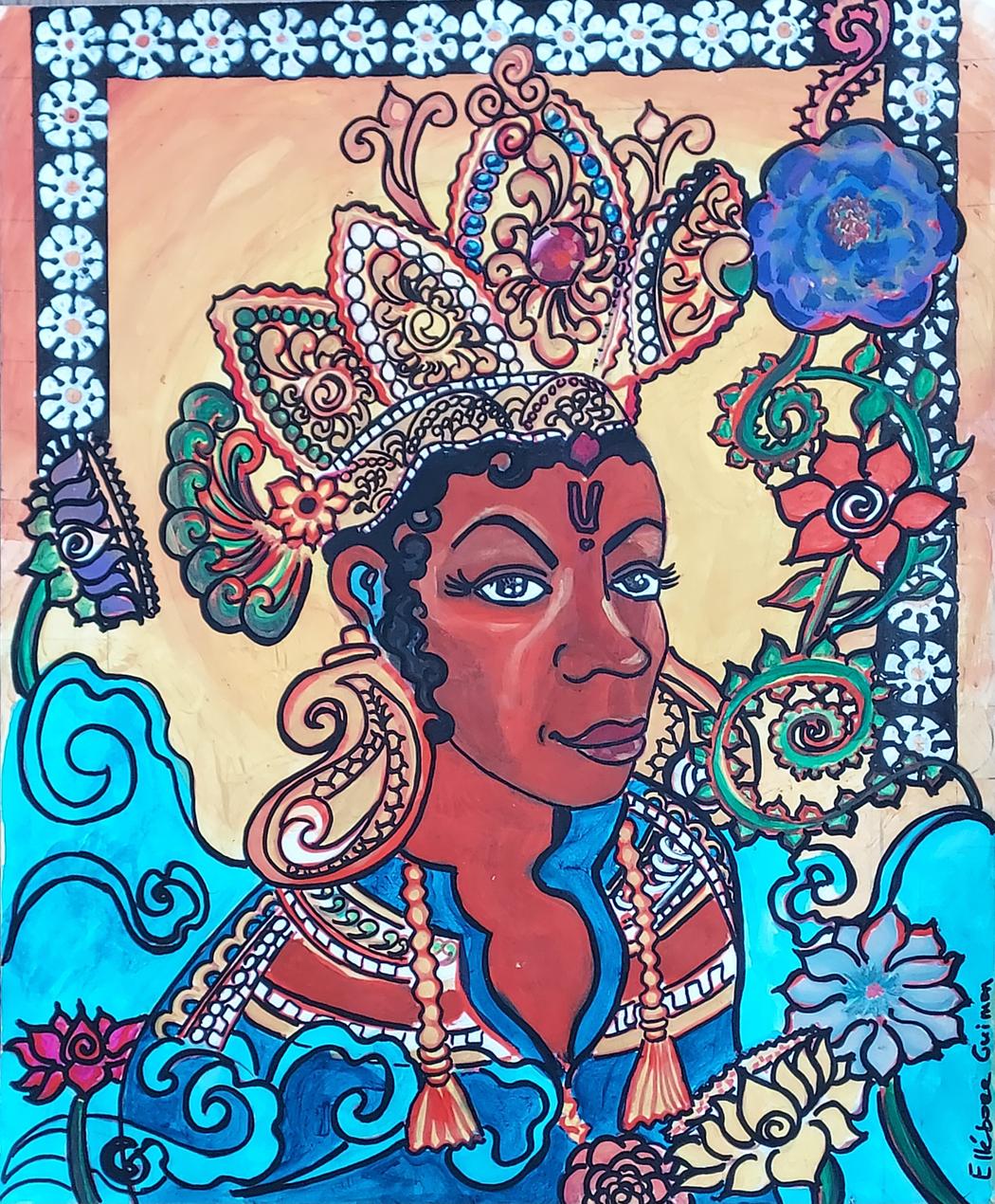 Murielle Mobengo – Ellébore Guimon | God In Jaisalmer Dress
You describe your paintings as “contemporary icons”. What does it mean to create an icon in today’s world?
Traditionally, an icon represents a human figure who has undergone an inner transformation so profound that they come to embody something beyond the individual—something worthy of contemplation or veneration.
To create a contemporary icon is to suggest that this possibility has not disappeared. It is not confined to the past, nor to a select few. There is, in every human being, a dimension that exceeds circumstance—a presence that is not entirely defined by biography, time, or form.
My work is concerned with making that dimension perceptible.
In a world saturated with images that are immediate and quickly consumed, the icon functions differently. It slows perception. It introduces stillness.
It is constructed with intention—through proportion, light, and symbolism, often expressed in the crown or in the chromatic structure—so that the viewer is not simply looking at a figure, but is gradually drawn into an inner state.
In our hypermodern world, where so much feels overstimulating or triggering, it can be hard to find that sense of stillness—but I believe it’s still possible, and that’s what I try to evoke.
How does your background in Theology and Philosophy influence your visual language and choice of symbols?
It gives a philosophical framework to my artistic practice—coherence, narrative, perceptive power, and discipline. In other words, it allows me to share ideas through forms. Let me explain.
Theological and philosophical traditions do deal with lofty subjects that seem abstract or disconnected from everyday life. But thinking itself is a constant process within us—silent, invisible, and so fast we hardly notice it. Theology and philosophy slow that process down. They’re liminal disciplines that let us reflect deeply on our lives, identity, and actions. Thinking about God, the soul, or consciousness consistently leads us to act on those reflections.
For an artist, that means seeking symbols that encapsulate these abstract thoughts. It’s like a treasure hunt—captivating, challenging, and deeply rewarding when something clicks. It becomes a kind of inner archaeology, but one that can be shared through art.
In my experience, when informed by philosophy and strong inner experiences, artistic creativity—whether in art or poetry—becomes a kind of sixth sense: the capacity to synthesize the visible and the invisible, action and thought, spirit and matter. In that process, the possibility of expressing and sharing Beauty emerges.
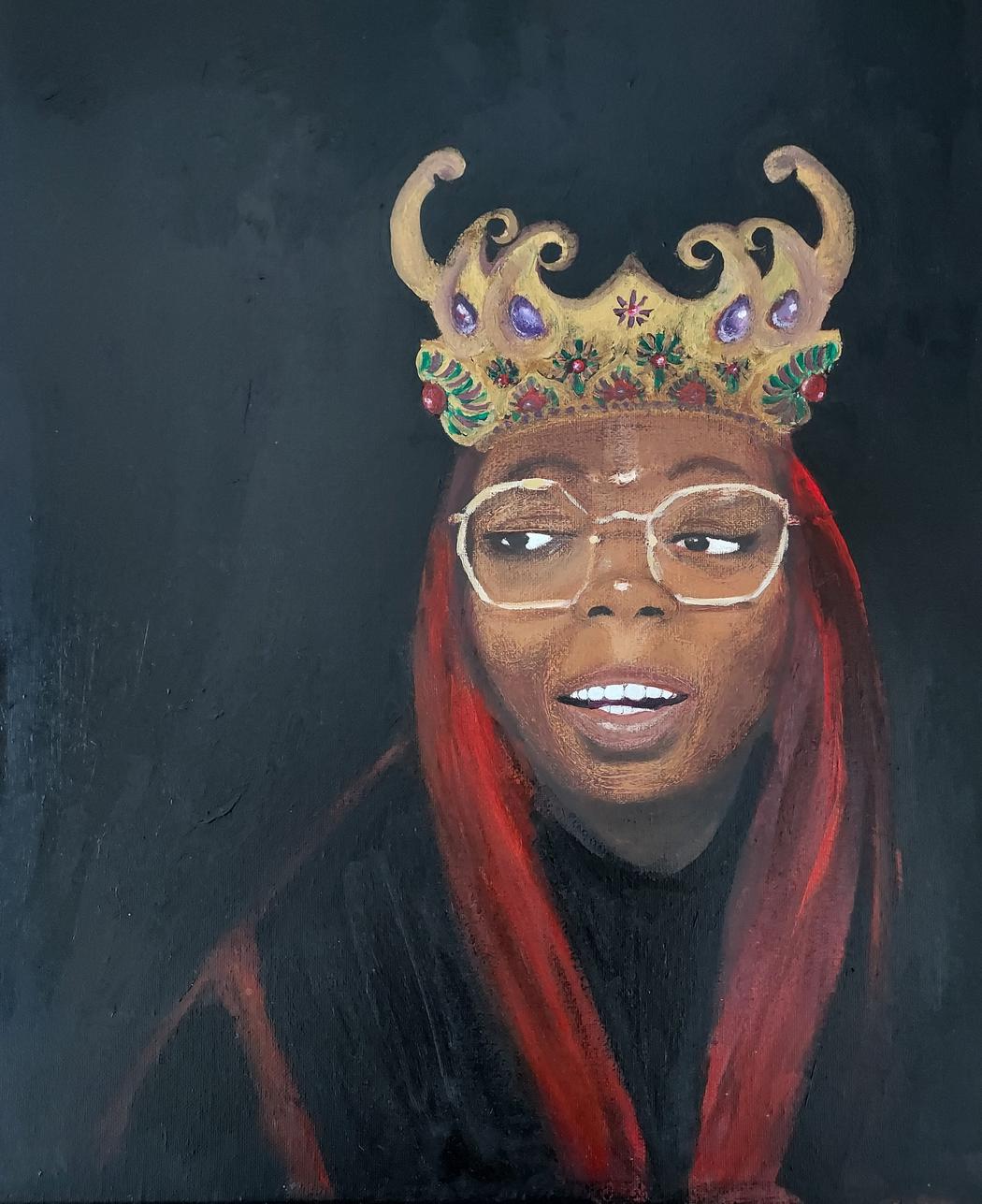 Murielle Mobengo – Ellébore Guimon | Divine Phalguni | 2023
Many of your portraits feel both intimate and transcendent. How do you approach capturing this “liminal state” between the individual and the divine?
I spend time with my subjects, talking with them (or to them), listening to them, and sometimes guiding the conversation toward more existential topics. I’ve noticed that the “liminal state”—what I call the divine look—often emerges from those genuine exchanges, where we connect on a deeper level.
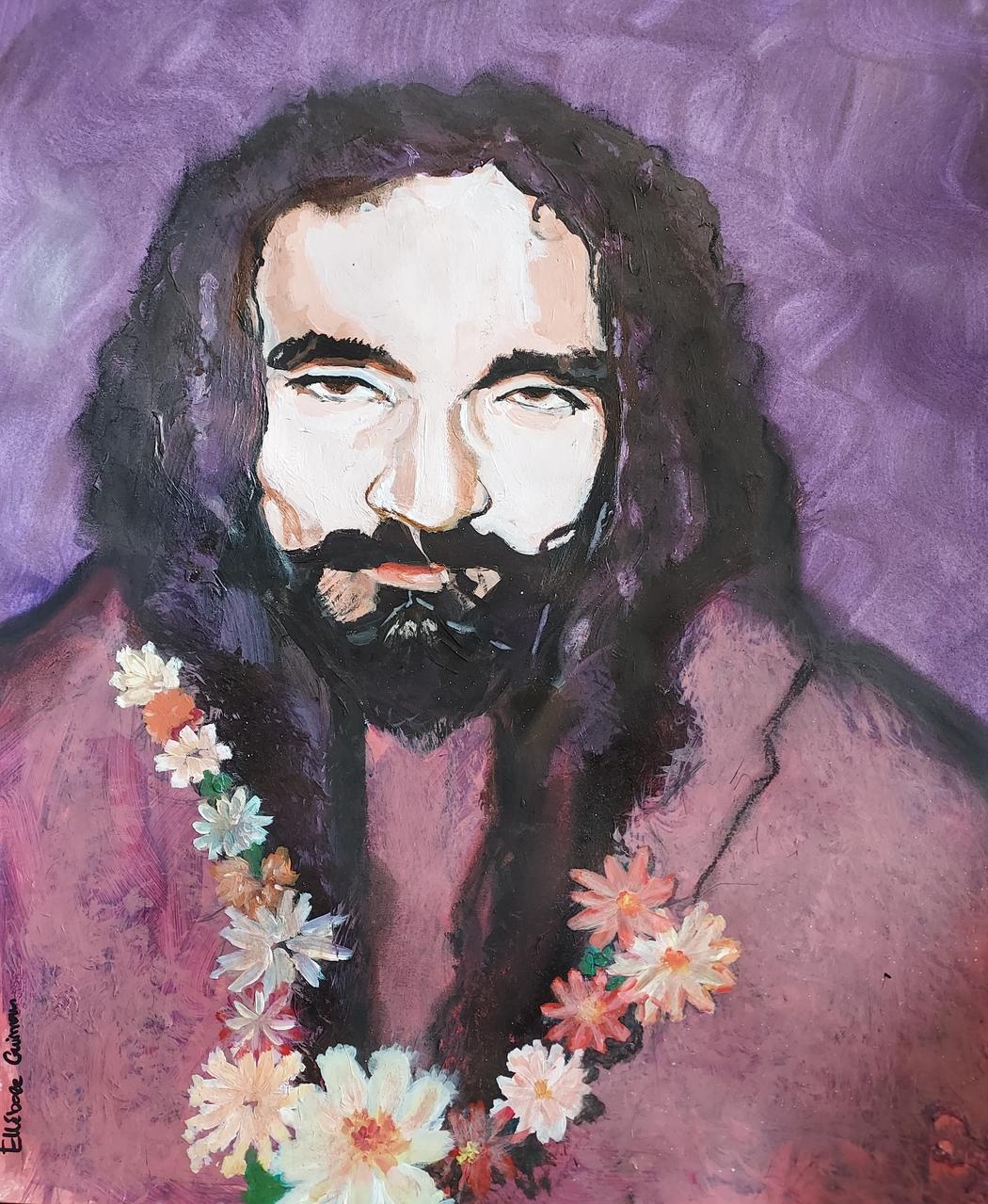 Murielle Mobengo – Ellébore Guimon | Brahmleen | 2026
As a self-taught artist, how did you develop your technical approach, especially in mastering light and shadow?
By observing and drawing constantly. Da Vinci’s Treatise on Painting insists that structure comes before painting, and observation and draftsmanship are essential. I find that to be true even 500 years later, although it’s not easy.
I study painters who mastered light, shadow, and color, and the real learning comes from repetition—drawing, correcting, pausing. I’m also exploring oil now, which brings new challenges.
I move between realistic and semi-realistic approaches. Semi-realistic work is closer to symbol, rawer, and more intuitive. That’s why I’m drawn to Kerala Mural painting, where light serves vibrant color. My painting Durga intérieure—later renamed Apotheosis, God in Jaisalmer Dress in its semi-realistic form—reflects this process, shifting from an Old Master’s technique to Kerala Mural style inspiration. I consider Kerala Mural painting a very noble art, and I’m grateful for the opportunity to learn it from authentic artists.
Among the European Old Masters, I admire Caravaggio most, and the Renaissance painters in general. I also love the Pre-Raphaelites—John Collier, William Holman Hunt—who balanced light, color, and shadow beautifully and portrayed the feminine with such power. And I have a very strong admiration for Gustave Moreau, Alfons Mucha, and Nicholas Roerich for his unique rendition of light.
Your works suggest a dialogue between cultures and traditions. How do you navigate cultural references while maintaining authenticity and respect?
Each tradition—European, Indian, African—has its own logic: proportions, symbolism, relationship to the sacred. I read and study these systems and reach out to contemporary artists who carry these traditions forward. It takes time, study, and humility. It also means recognizing that these traditions aren’t isolated—they often respond to similar questions, even if they express them differently. Authenticity and progress come from that depth of engagement, which can only happen in a peer culture. I also consider travel to be essential for my artistic perception.
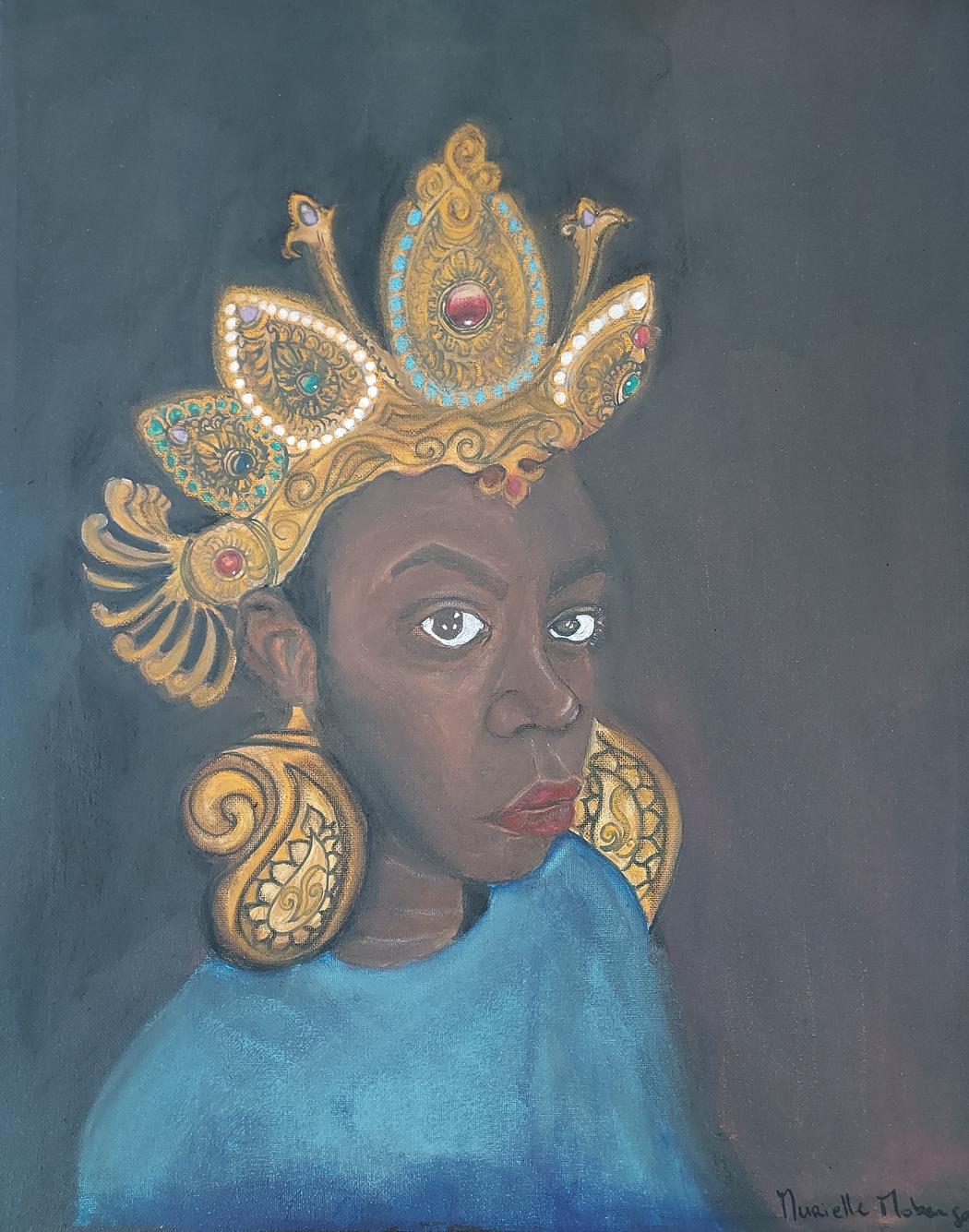 Murielle Mobengo – Ellébore Guimon | Inner Durga | 2024
What kind of inner experience or reflection do you hope viewers encounter when engaging with your work?
An opening. A gentle invitation to turn inward.
Leave a Reply
You must be logged in to post a comment.