
Eszter Bóra Paál
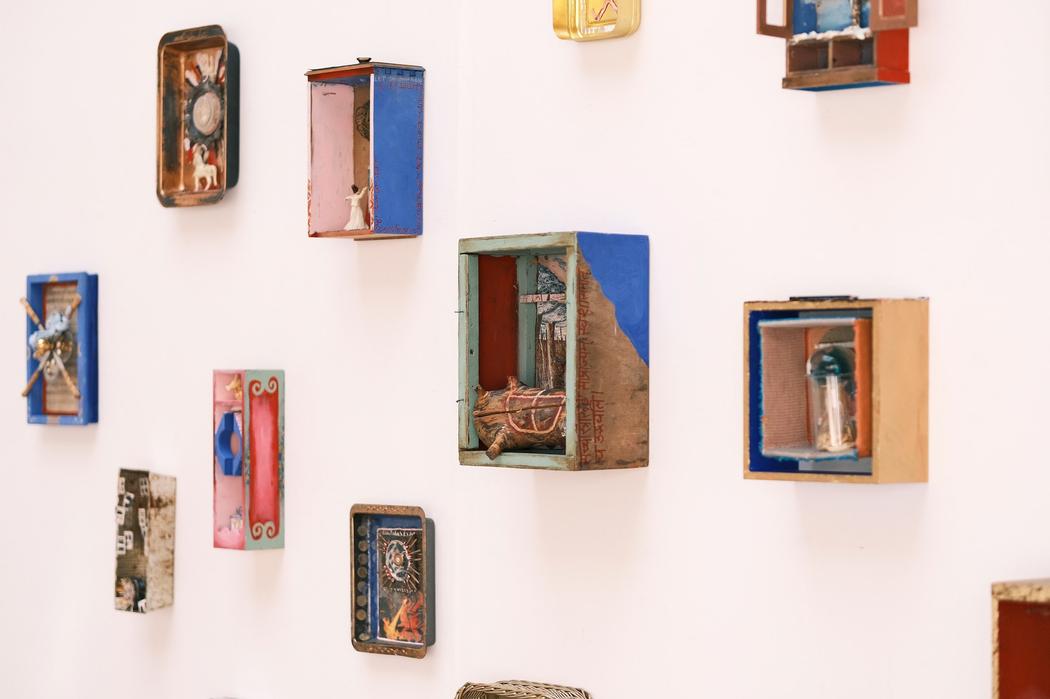 Eszter Bóra Paál | Topogó Universe | 2025
Your work frequently explores the idea of the microcosm. What first drew you to this concept, and how does it influence the way you construct your artworks? First, while observing our world, I noticed the pattern outlined by the concept of the microcosm.
Even as a child, I was attracted to everything where science, philosophy and art met just like a magnet. I loved, for example, astrophysics, I read books about it, however I was so small that I couldn’t understand most of it, but still it made every cell in my body tingle. I looked for recurring patterns, things that visually belonged together, like the branches and the roots of trees, the veins of leaves and the veins of rivers. Or the walnut kernel, which is like the human brain, or our skin, which resembles the dry soil of the desert if observed closely. Of course, I didn’t always have the words for this, and it wasn’t even conscious, I just constantly wanted to understand the world and the people in it. How we are the same and how we are different from nature. Who is this God that everyone talks about, and yet no one seems to know anything about? I don’t know when my metaphysical desire took shape, but it all happened organically and inevitably. I wrote my thesis on the influence of Hermetic philosophy and occult teachings on fine art. In my works, lines of force and composition are paramount. They always carry significance. Whether it’s the right side or the left side, where the triangles point, the position of the crosses all structure the artwork along the way of analogical thinking. I like to work in symmetry because for me it makes even the profane seem altar-like, and this state of balance calms me.
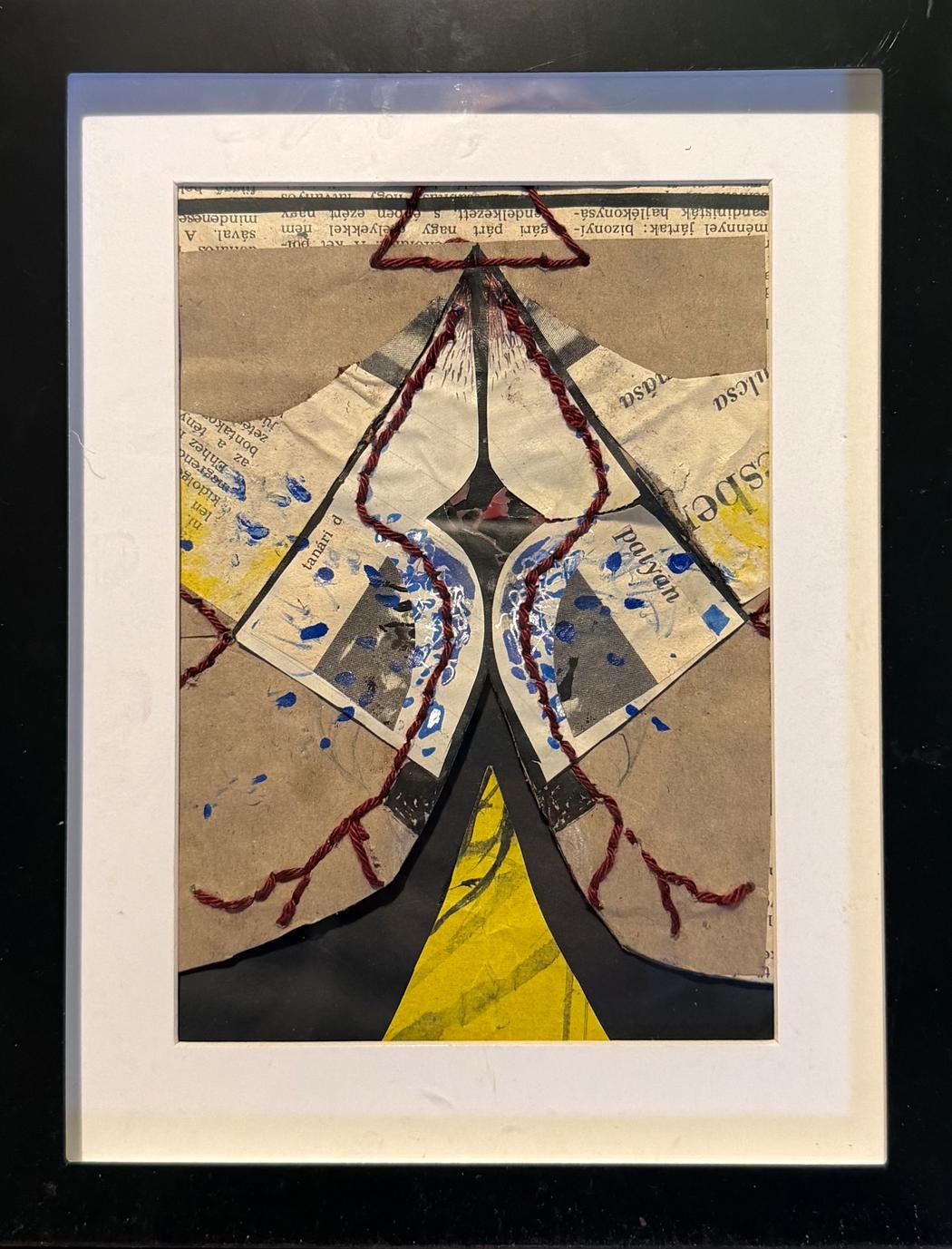 Eszter Bóra Paál | Lung of the Shell | 2025
Boxes appear as recurring elements in your practice, functioning almost like self-contained universes. What does the box symbolize for you, both visually and conceptually?
In the beginning, it was just the most obvious way to birth collages into space. Before I finished my first box piece, I went to the bulky waste collection event to throw out some old boxes. Here in Hungary, this is like Christmas, the street sides get filled up with unwanted items, and until they’re taken away the next day, crowds of young and not-so-young people go hunting for treasure. The first thing I picked up was a woody smelling drawer from an antique desk, and from then on I spent the whole evening looking for drawers. The intimacy of the drawer as a symbol became obvious to me. Peeking into someone’s secrets, memories, and soul through their objects. Since then, I begun to see the ‘box’ as a complete universe, it is like a drawer, or like a window, a true dimensional gateway. On the other hand, it’s also a beautiful embodiment of our unconscious and our thinking. I put what I don’t want to deal with in a drawer, pack it away, shove it deep into a box. It’s beautiful because it harbours secrets and thus dissolves them. I often paint on the back and the sides of my boxes only for the very curious to notice. It’s a kind of game. Box art for me is an abstract manifestation of the principle of “as above, so below”.
 Eszter Bóra Paál | Religion all of a sudden | 2025
Many of your works incorporate found objects with their own histories. How do you select these objects, and how do their previous lives influence the narrative of the piece?
They come across me and I put them away until their time comes. If I like a small piece of trash or a giant heavy piece of architectural debris, I’m sure to take it home, and many funny stories have been born from this. Often the texture of the given object touches me, or the place where I find it, and it has happened several times that something was almost too beautiful a symbol and got an entire project, other times it just played a supporting role in someone else’s finale. When something really touches me in the present because, for example, it is connected to the flow of my thoughts at the time, I immediately incorporate it into an artwork, but more often an object or piece of trash waits for several years before I use it. I have very small scraps and pieces of the city put away, each one neatly catalogued. Each part carries the whole, which is why all such objects are inseparable from their previous lives, their transgenerational experiences, if you like. For example, I once found someone’s complete personal archive in a soggy shopping cart. It contained beautiful sheet music, and love letters and pictures, and there it was, thrown out by the railroad tracks. It was a sad but amazing sight. I dried everything at home and used these pieces for the Lovers’ box of the Topogó Univerzum. The picture, which only shows the negative of the couple, is glued to the back, because I wanted to memorialize that person, and how others threw away their memory. Through three lives, the memento arrived at the happy conclusion of an immortal but impersonal presence. I am grateful that these opportunities found me.
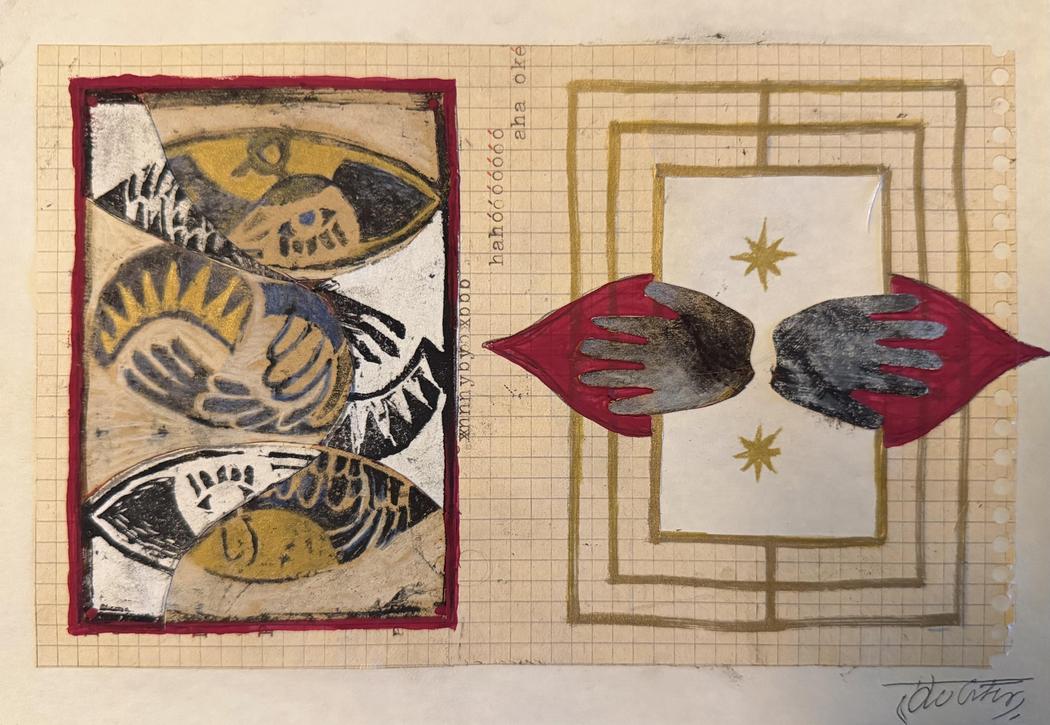 Eszter Bóra Paál | The Red Lion | 2025
Your practice combines printmaking techniques such as monoprint, linocut, and etching with collage and installation. How do these traditional methods shape the conceptual depth of your work?
This is the synthesis of the past and the future. It shows the relativity of time on a broader spectrum. On the other hand, most classical graphic techniques are very clear, strong and associative. Based on dualistic thinking, the existence of one pole is conditional on the existence of the opposite pole. And for example, from a linoleum sheet, by removing the negative of the image, you give life to the forms that were hidden within it. Collage is jazz, in the sense that each piece sings about its own story. The parts that make it up are individuals, but most of the time we still focus on unity. My installations are also collages, only on the canvas of space. But overall, I started experimenting with this pairing along the axis of past and future, personal and collective experiences.
In your artist statement you mention the influence of hermetic thought and archetypes. Which philosophical or symbolic traditions have had the strongest impact on your artistic language?
It is difficult to give a clear answer to this without synchronizing our concepts. By Hermetic philosophy I generally mean late Hermeticism, which was not only concerned with interpreting the teachings of Hermes Trismegistus, but also explored the cosmic and spiritual nature and regularities of man through the complex system of the entire collective intellectual heritage of humanity. In this way, late Hermeticism integrated all the major esoteric concepts of its time, such as Kabbalah, alchemy, magic or astrology. For me, therefore, the source of inspiration is not clearly graspable, since all of them influenced me at the same time and continue to influence me to this day. Usually, different traditions become guiding principles on a project-by-project basis. However, the world of Tarot cards is especially dear to my heart, I have already designed a deck and the symbol system of the Major Arcana has appeared in several of my projects, because it is the purest cross-section of spirituality, the collective unconscious and art. It is such a simple and pure concept. I often reach for Tarot because it is accessible to more people because the archetypal images allow us to easily connect with our unconscious selves. It is not a matter of faith, but of self-awareness and psychology, hence in many cases it is a better communication channel than other traditions.
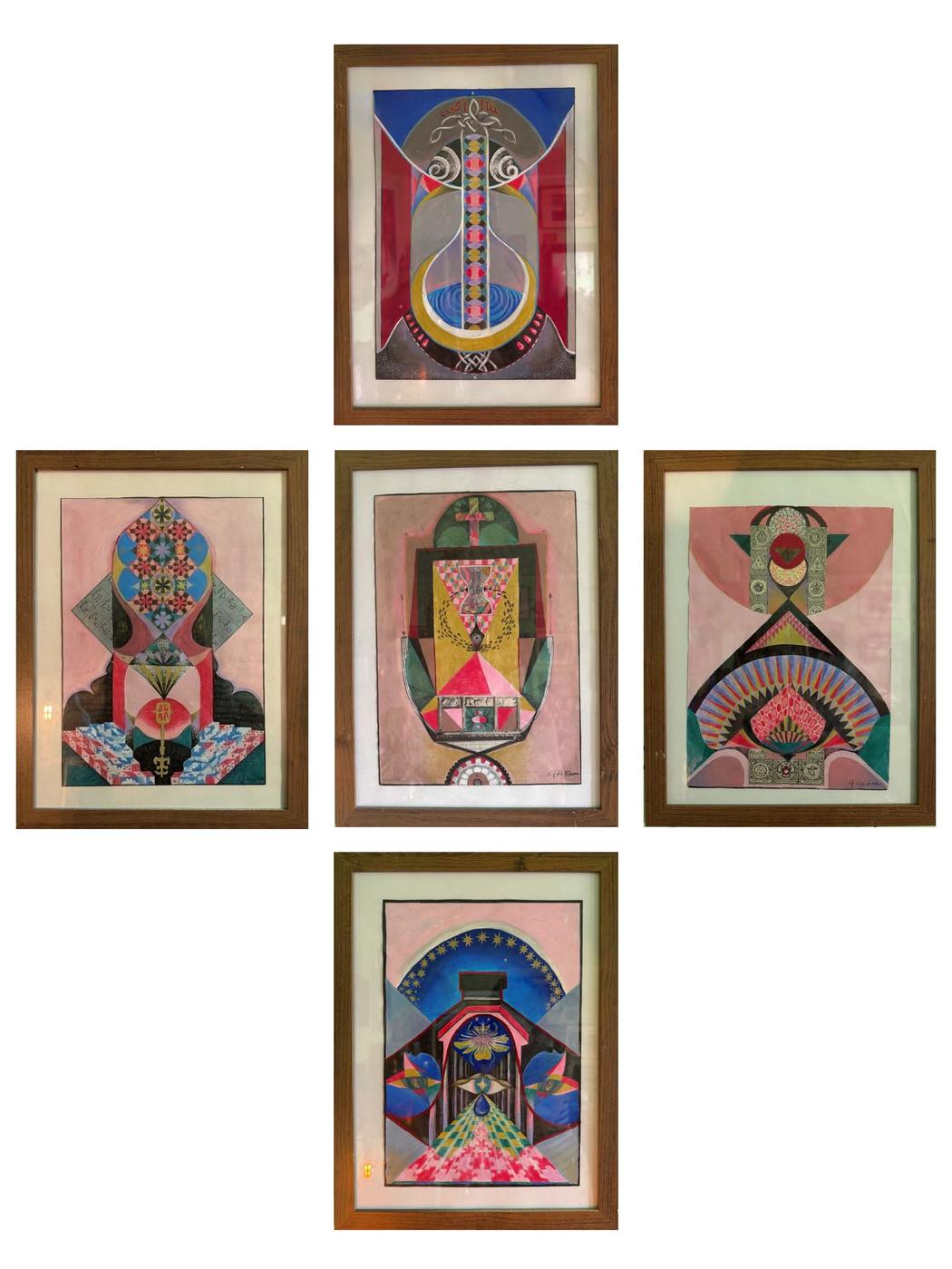
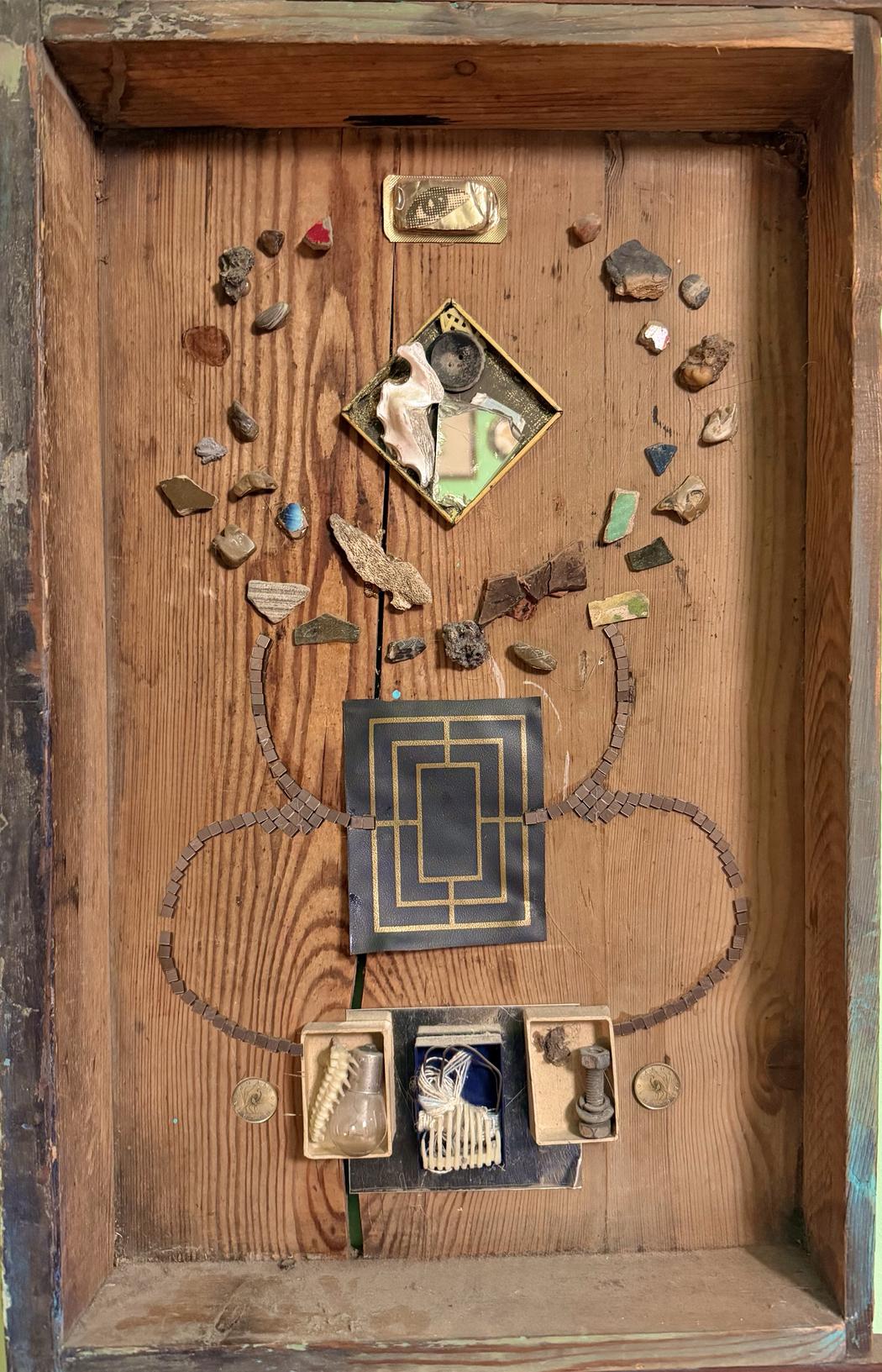 Eszter Bóra Paál | The golden ratio of the mind | 2024
Many of your pieces evoke the feeling of sacred or meditative spaces. Is spirituality an intentional component of your work, or does it emerge naturally through the process?
If I have a conceptual starting point, I often consciously weave in symbols and gestures that represent the intellectual connections that form an integral part of the narrative. On the other hand, when the medium inspires me, it is usually not my goal for my work to talk about a specific topic. I often meditate on a technique or material to tune in to it and let it start telling me a story. In such cases, incorporating spirituality into the work is not conscious, but my pure investigative curiosity that stems from my being usually leads me there. It would be very difficult for me to leave my own person out of the work, because the work itself is a microcosm of the artist. So it is no wonder that the object of my interest intrudes into my works, whether intentionally or unintentionally. I don’t know if I have ever made anything that did not at least include the polarity of the dual worldview.
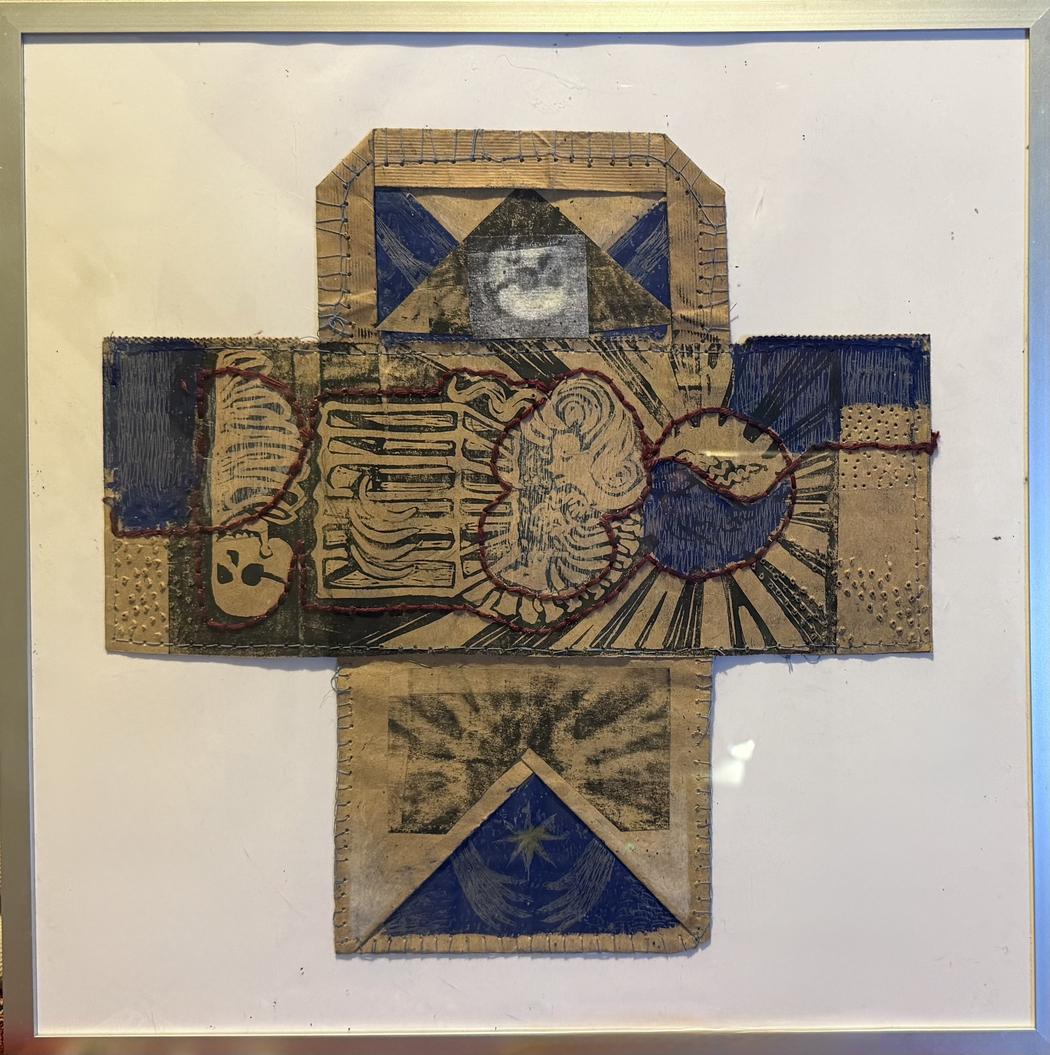 Eszter Bóra Paál | XXXX-XXXX-XXXX-1234 carcass | 2026
Your projects often take the form of series, where individual works function as parts of a larger structure. How do you approach building these interconnected bodies of work?
Like anything else in my creative practice. In the light of hermeticism, man is a microcosm of God. When I feel that a world cannot be expressed on its own, I start thinking in series. I consider the installation aspect of series important, in what order do they convey what message. How they can best communicate with each other. This is also the most difficult part, because I often imagine something, plan it, and by the time I am finished, the objects have changed in a lot of ways and the chemistry between them is no longer the same as when I dreamed up the concept. In such cases, they have to find a new home. My style is quite eclectic, and this caused me great ego struggles to accept or to change, whether something was a conscious choice or just a veiling of my uncertainty. Working in the form of series helped me with this, because through my creative process I learned to accept that everything has a meaning for me, the medium, the form, the colors, the definiteness or chaos of the guided lines. This is of course common in art, but it still caused me conflict that I couldn’t label my art. Then I realized that it wasn’t necessary, because things that belong together retain cohesion, and thus thinking in series blew away the fog of self-doubt in me, and I was able to be free in my work again.
Leave a Reply
You must be logged in to post a comment.