
Bronka Nowicka
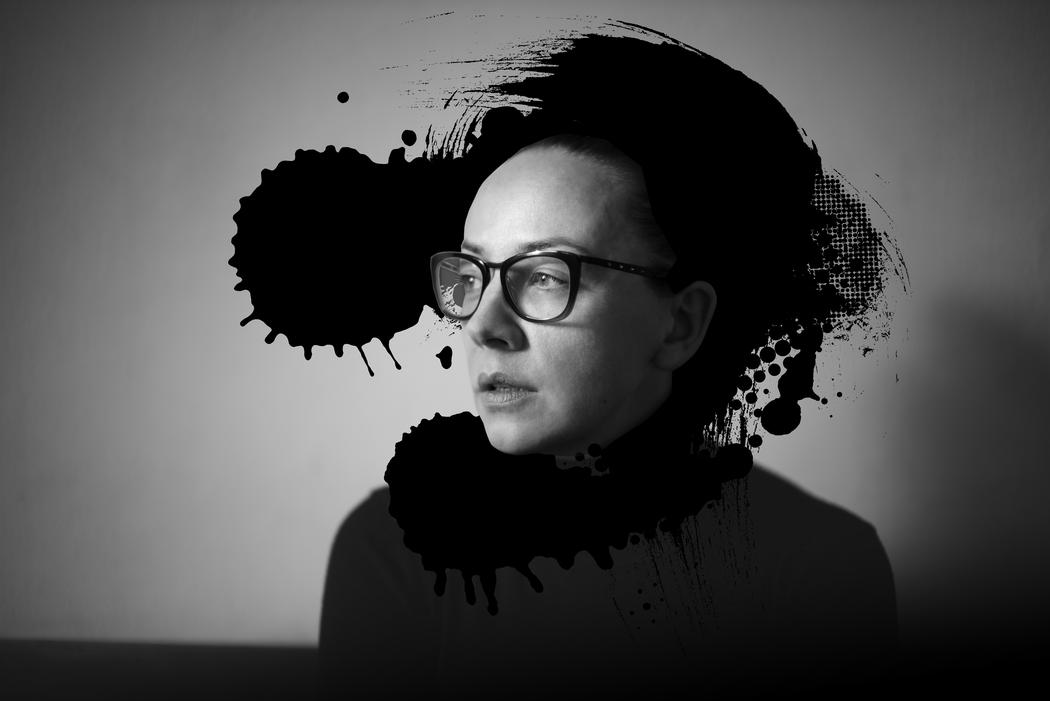
Your practice moves fluidly between literature, visual art, performance, and installation. How do you understand the relationship between word and image in your work?
I feel I am an interdisciplinary creator and I take responsibility for this classification, keeping in mind what the Latin word inter means. I undertake creative efforts between visual arts and literature. Borderlines – a difficult and fascinating terrain – are my conscious choice. In the past, when I called myself an interdisciplinary creator, I felt like an emigrant forced to earn a passport to a specific discipline. Today – when art and its accompanying didactics are open to hybridity – I can create and teach freely in the common area of disciplines that are dear to me. I am pleased to work as a lecturer at a place that is favourable for interdisciplinarity – the Department of Painting at the Art Faculty of Jan Długosz University in Częstochowa. This is a place where the potential of creative freedom uninhibited by rigid boundaries of domains and media is understood and appreciated. I can be in my element.
You asked about words and images. Combining them into image-words and word-images is organic to me. Scientists (eg. Benjamin Bergen) have described the connection between language and images. They have called it embodied simulation. When you read the following sentence written by me: a bear is crawling in the snow, how do you decode the meaning reduced to graphic signs? The visual centre in your brain activates – you just see a bear crawling in the snow. Other sensory centres also get mobilised to work: the centre responsible for hearing – perhaps snow scrunches in your mind; for smell – the ozonic, frosty fragrance of ice may be reaching you; for touch – you are feeling, as if by your own skin, the friction of the bear’s belly against the white surface. This is how embodied simulation works. Language is a system of encoded images (and sounds, movements, scents, gustatory sensations) that – when decoded by the mind – create a multisensory, state-of-the-art, and – simultaneously – the oldest and cheapest cinema that offers films of all genres – inner projections of images activated under the influence of words. When I introduce language into the area of visual art activity, I basically remain in the domain of imaging; a word is a kind of image.
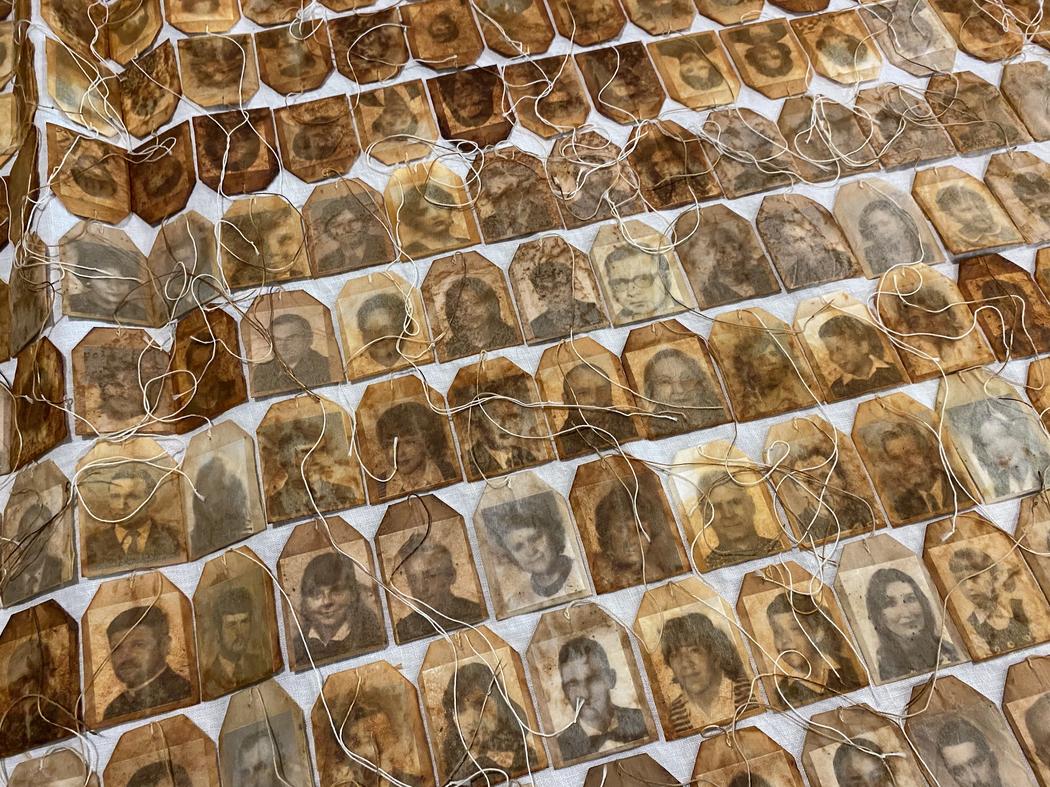
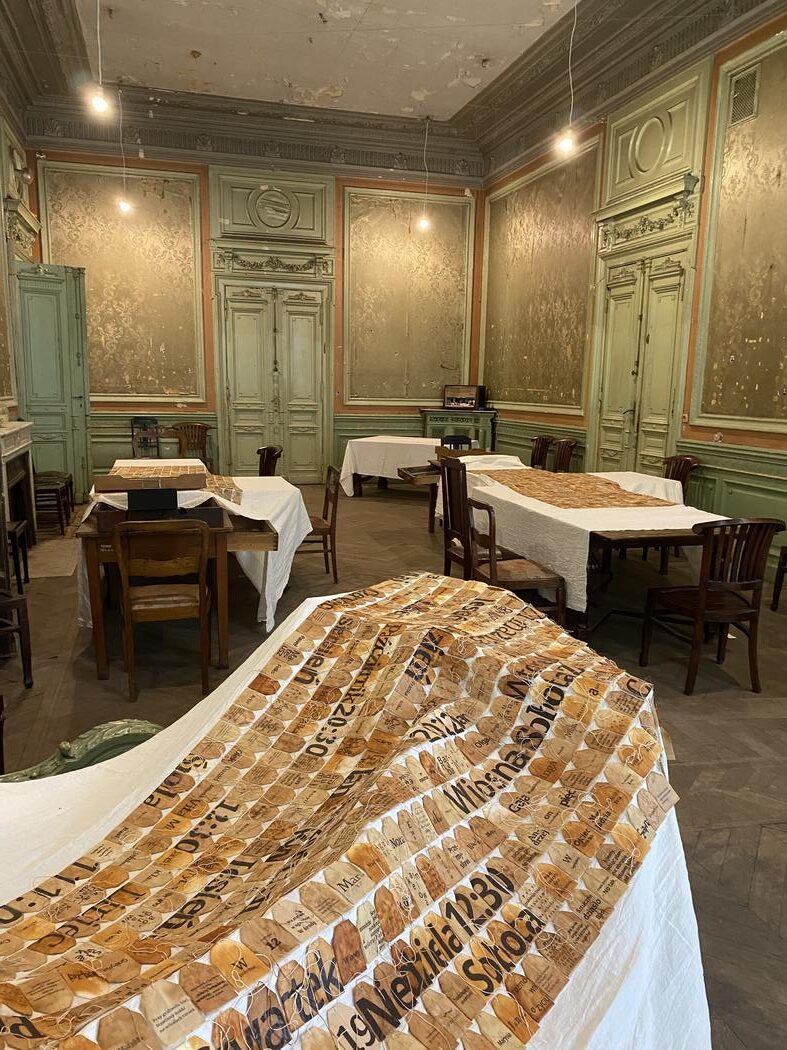
In LiTEAture – the title of the work is a wordplay between literature and tea – texts put on used teabags come from extensive documentation of tea-related conversations. They contain not only the names of fellow-tea-drinkers but also their personal insights, thoughts attempting to encompass the complexity of existence. Some have a poetic character: Things have roots, people see stems. / A soaking sugar cube, what a spectacle! / Mountains on Venus – eight-thousanders, they’re there as much as we’re here, can you imagine? Others recount everyday life with colloquial language: How can you drink bitter tea, my child? / My dog doesn’t know the taste of tea. / Mira died of COVID, she had it twice, and it was the second time. Imprints in the collage also contain details about the date, place and circumstances of the tea meeting: in the garden, in the kitchen, in the room, on the go, on Tuesday. The text on each teabag can be seen as closed and separate, but one can also seek semantic sequences forming between neighbouring bags. I composed numerous parts of the collage in such a way that neighbouring text would combine into associative wholes. The collage with word fragments complements the canvas-collages with photographic effigies of people with whom I have drunk tea. A peculiar archive comes into being: the portrait of a human being, their name, the time and place of drinking tea, a documented snippet of a conversation or a monologue.
In LiTEAture, you use used teabags as both material and metaphor. What does tea represent for you – memory, ritual, intimacy, time?
You brew it and all things – besides the tea itself – seem unimportant. Tea ensures docking in the here and now. It roots you in the present moment. I drink and suddenly I realise that I am sipping the taste from my fellow-tea-drinker, I am taking small sips (from) someone who is enjoying the infusion with me. In fact this is what it’s all about – about Others, Other People.
Some time ago I dried my first used teabag and I used its paper as a notebook: I wrote down the date of the meeting. It was the same instinct that makes you put flowers between book pages. The conversation over tea was good so I kept the bag as a souvenir. I liked the materiality of the drying bag, its colour, wrinkles, stains. I thought: perhaps I will create a document of meetings and events based on tea mummies? The preparation period ensued. I dried the teabags. I removed the leaves. Inside, I put photographs of people with whom I sipped the infusion. I love it: I cut the teabag open, I scoop out the dry used tea leaves, I clean the inside with a flat makeup brush, I put the photograph inside. Sometimes I slightly shorten the string attached to the sachet. During the preparations it smells of bergamot, caramel, hibiscus, lemon grass, fig opuntia. Since my hands have learnt the sequence of the movements by heart, I don’t have to focus on these activities. My hands are busy, my thoughts are free. I look at the faces shown in the photographs. It kick-starts chains of memories, just like the fragrance of teas. Scents affect the limbic system – responsible for emotions and memory. I look at photographs of my father, mother, aunts, grandmas, great-grandparents, friends. I reminisce. Sometimes thoughts cease. I lean over the table. A cone of black, greenish, rust-coloured or brown dried tea leaves forms on the table top. I am simply present.
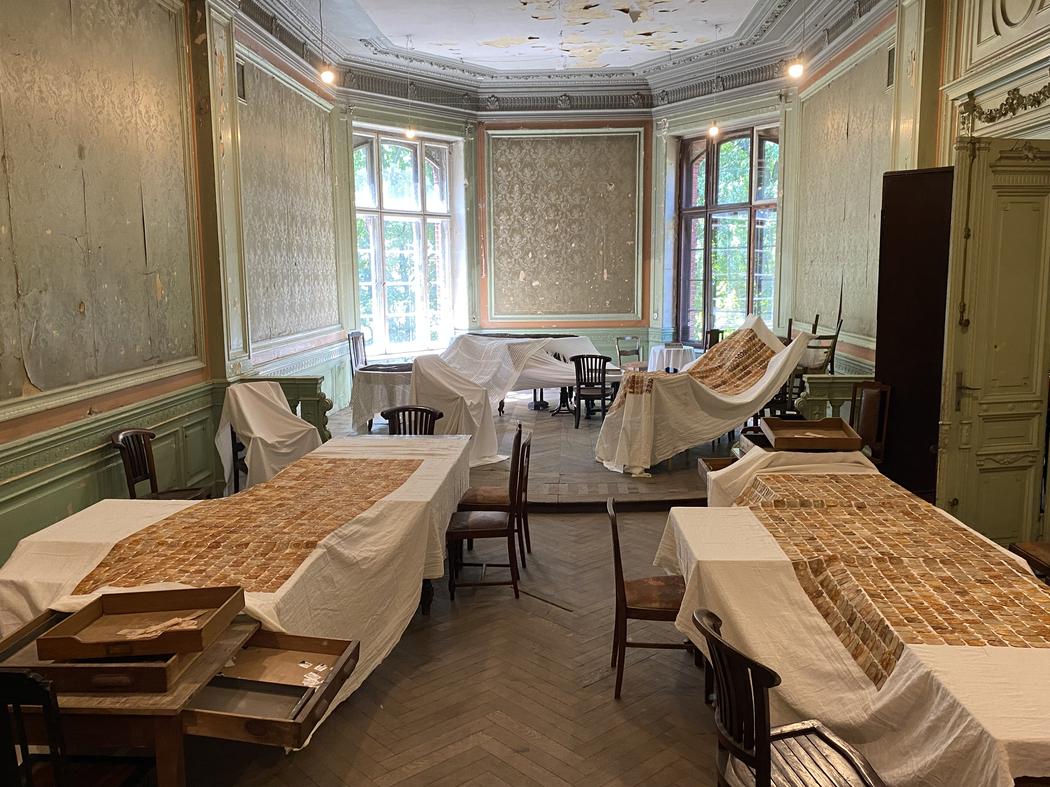 Bronka Nowicka | LiTEAture | 2025
The installation invites viewers to touch, smell, sit, and even alter the work. Why was it important for you to abandon the traditional “do not touch” rule of exhibition spaces?
I have presented the installation in run-down, historic interiors of the Artistic Book Museum in Łódź. The collages were laid out on old tables. I risked having the works destroyed by encouraging the guests to take a seat directly at them, on ancient chairs. During the vernissage, a traditional Japanese tea ceremony took place. The gathered people drank it at the tables, putting the bowls on collages-tablecloths. I didn’t fear the works would be damaged because my willingness to create an atmosphere of community was stronger than my anxiety over damaging the delicate materiality of the collages. I didn’t worry that some of the teas would spill over the work. In fact, it did happen. The liquid dried and turned into a rusty stain that naturally integrated with the rest of the composition. The stain pleased me. Thanks to such interferences the documentary character of my work strengthens. Each consecutive exposition leads to a change in the creation – it bears a human trait. The works also deteriorate on their own: teabags dry, wrinkle, fade or darken, in this way the work reflects memory where something withers or gains power like a stubborn reminiscence.
The possibility of touching the works physically is important to me also due to the availability of visual art for visually impaired people. I deal with the accessibility of art by organising workshops for people who are blind or partially sighted and by creating audio-descriptions of paintings. When I work as a curator or co-curator of exhibitions presenting other artists’ works, I encourage the creators to create works that can be touched, smelled, and even eaten because I believe that the possibility of having multisensory contact with art can deepen the way it’s experienced by eliminating the barrier of shame connected with the lack of intellectual readiness for the reception of the works. The possibility of touching an artistic creation has an encouraging effect on most contemporary viewers, it evokes in them a deeper interest in the work.
The painter and curator Artur Wawrzkiewicz and I have recently organised the exhibition Można dotknąć! (“You may touch!”), which presented the works by students of the abovementioned Art Faculty. There was a hyperrealistic work showing a double portrait of the student-artist’s parents. It was made from sand paper and was entitled Szorstcy (“The Abrasives”) which referred both to the psychological layer, the parents’ characters, and to the material itself. Viewers could look at the faces of Mr and Mrs Abrasive and simultaneously touch these faces, which grazed the finger pads in an unpleasant way. In the exposition there were also casts of the grandpa’s glasses made of colourful kissel that the author associated with her childhood. Visitors to the exhibition could also eat part of the glasses, which took them to the realm of the creator’s memories by means of their own taste buds. In the exhibition there was also a punchbag covered with canvas and filled with small bags full of paint. When people hit the punchbag, the small bags hidden under the canvas burst open, the paint spilled on the surface, and colourful stains appeared on the canvas. Aggression turned into a creative act, the impact transformed into the aesthetic power of a multicolour stain. I value such activities because not only do they affect multiple senses at the same time, but they also stimulate symbolic and metaphoric thinking that I consider the essence of art.
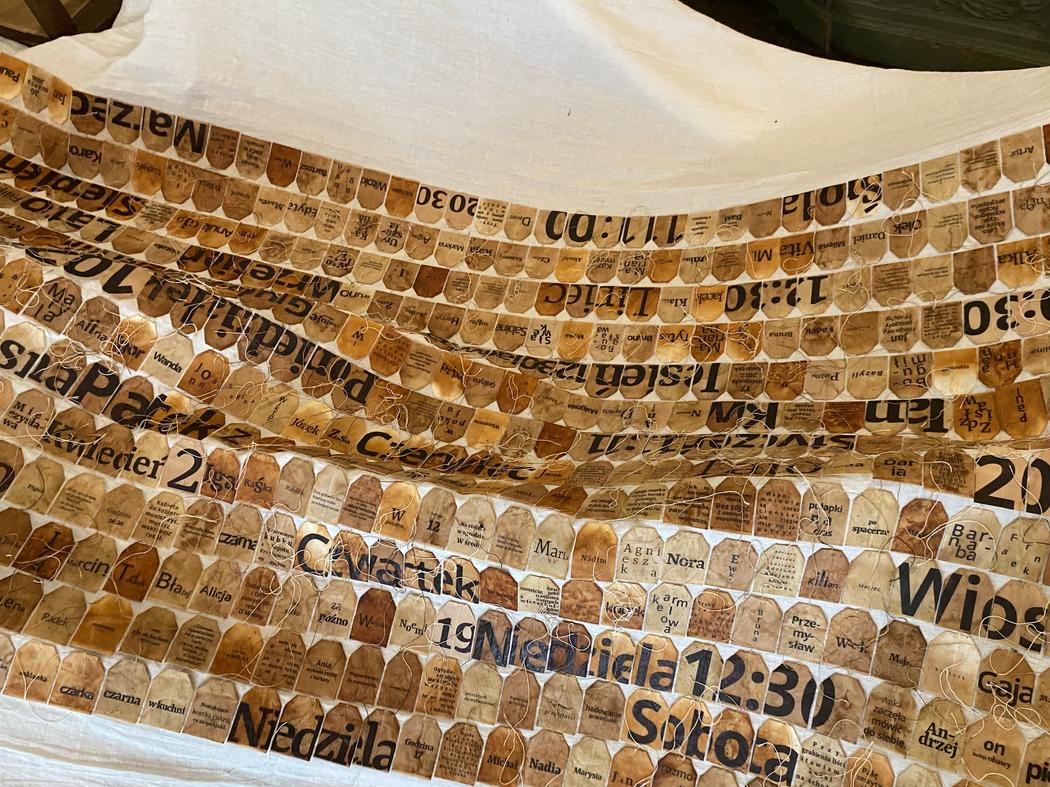 Bronka Nowicka | LiTEAture | 2025
Many of the faces in the installation appear faded, almost dissolving into the tea stains. Is this fragility intentional? How do you think about disappearance and preservation?
Portrait photographs show through the thin paper of the used teabags. Thanks to this effect the effigy obtains sienna and umber stains, characteristic of daguerrotype, sepia or heavily aged photographs. A post-tea-bag stuffed with a photo doesn’t only become a document of a real meeting, but instantly takes on the qualities of an old paper artefact: it’s wrinkled, close to wearing through here and there, yellowed, rusty. Combining a teabag dyed by tea on its own, and a black-and-white photograph (a full face portrait), gives an immediate effect that otherwise would need the passage of time or an archaic photographic process. When I began my work on the installation, what attracted me was precisely this face showing through the filter paper: not fully clear, although recognisable, somewhat aged, pushed through time by one gesture. The effect of this instant shift, dislocating from a point a few days ago to a point in the distant past determined that a seemingly absurd gesture performed at the kitchen counter (sliding a photo inside a teabag) transformed into an artistic project in which I repeated this original gesture several thousand times.
Someone’s face fades in a photo, yet it may remain sharp in memory. Or the other way round: something may fade in memory and preserve well as matter. Relations between disappearing and retaining / keeping / preserving generate dramatic and dramaturgic tension.
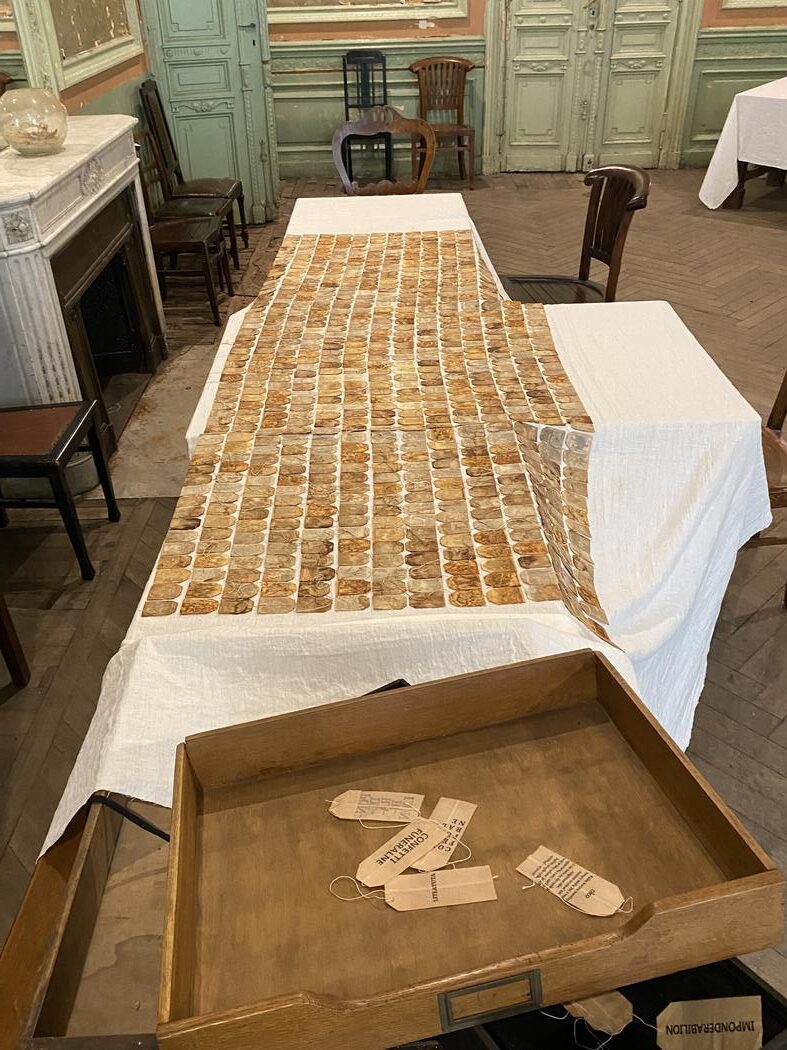 Bronka Nowicka | LiTEAture | 2025
You describe the work as “tea archaeology”. Could you elaborate on this idea of excavating memory?
One part of the installation is a performative object. The basic element of this object is a large piece of fabric with a printed text composed by me. The text is styled as a myth and concerns memory, which is compared to an archaeological excavation. The fabric with the text is covered by a thick layer of dried tea leaves. By means of brushes (an archaeologist’s tool) viewers of the installation retrieve pieces of the text from under the tea: words, sentences and longer fragments, as they are dug out and excavated, form meanings. Some viewers-archaeologists, including children who can’t follow the text yet, use the dried tea leaves to create their own drawings, similar to those from Nazca.
 Bronka Nowicka | LiTEAture | 2025
The installation accepts and even welcomes its own transformation through human traces. How do you relate to impermanence in art?
Impermanence is organic. In nature and in art. It’s an obvious process whose outcome is not an end but change.
 Bronka Nowicka | LiTEAture | 2025
If LiTEAture were a short story rather than an installation, what would its opening sentence be today?
Your question makes me smile because such a short story has already been written. This is the one that is excavated from under the dried tea. I wrote it under the influence of associations between memory and earth, and between earth and dried tea leaves that resemble black earth. The title of the story is Terra Memoria. Its opening sentences are the following: A long time ago every image of a thing existing in memory could be exchanged for the thing’s body because memories stored in the mind were similarly stored in the earth and achieved the concreteness of matter. What a human being remembered would immediately develop in the subsoil: within it accumulated layers of tangible manifestations of objects, phenomena, animals and people. All the living had their own fields in Memoria, which was a plain and bore nothing but embodiments of the past…
Leave a Reply
You must be logged in to post a comment.